
A Joyful Noise
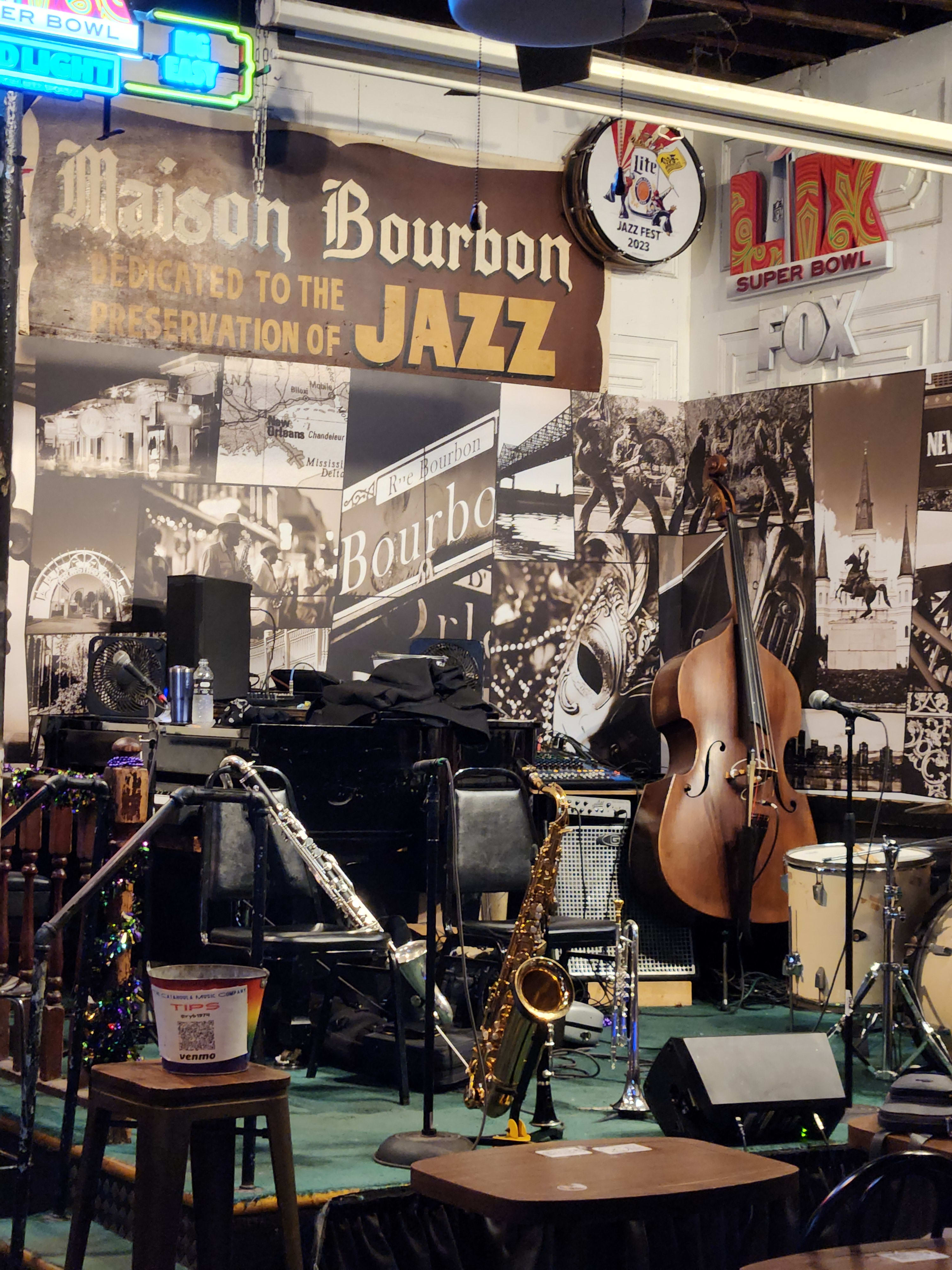
I was in New Orleans for a conference this week. I go to New Orleans any chance I get. I like the food. I like the vibe of the place. But I love the music.
I don’t claim to be hip or in-the-know. I don’t know the coolest places to go hear live music, or the names of the current artists redefining jazz for a new era, or anything like that. My tastes are utterly pedestrian. I like old-fashioned, Preservation Hall-style, Dixieland Jazz. I like a squeaking clarinet and a roaring trombone and a blaring trumpet and a jangling piano. And when I can hear that music played live, it’s a wondrous thing.
I’ve always liked live music, though I don’t really seek it out in my everyday life. When I was young, in Atlanta, untethered to any responsibility, I used to go listen to the Indigo Girls two or three times a week. I knew them, I knew their music, and I knew most of the people in the crowd. It was a whole social scene for me. But even on the nights when I happened to be at some bar alone, the music was enough for me.
And I’ve always liked going to the symphony, to hear orchestral music played live—ever since my parents took me to Tanglewood as a child, to lie on my back on a blanket, looking up at the starts and letting Tchaikovsky waft over me. When my kids were small, I tried to take them to a classical concert at least once a year, to give them a little bit of that experience.
My parents didn’t own many jazz records when I was growing up (yes, records. I am old). When I think about “their music,” it’s mostly classical that I think of, and Broadway soundtracks. If I knew any jazz, it was whatever Woody Allen was putting in his movies. Most of the time, it was just background noise, but two movies stood out to me: Manhattan and Hannah and Her Sisters.
The soundtracks to those movies made a difference because my friend, Stephanie, made a cassette tape for me of those soundtracks (again: old), and I took those tapes with me to Los Angeles when I went off to grad school. I listened to those tunes over and over, and I started seeking out more. I got to know some of the artists. I started connecting the dots between the Broadway soundtracks I had grown up with and the jazz interpretations done by vocal and instrumental artists over the years. I started developing a little more nuanced understanding of American musical history, pre-Beatles.
And then I went to New Orleans.
I was there for some work event, and it was my first time in the city. I wandered around the French Quarter, exploring on my own. The Jazz Festival was about a week away, and there were musicians on many street corners, playing solo or in small groups. I remember stopping to watch one quartet of ragged musicians playing their beaten-up, weathered, old instruments somewhere on Royal Street. I was transfixed, as I wrote about years later, in the voice of my character, Jordan, in the book, The Cat Came Back:
There was something about this new music I was hearing that matched a whole different feeling, a feeling I couldn’t name and didn’t understand. It wasn’t happiness, because the music wasn’t always happy. And anyway, “happiness”—I knew what that was, and it was a little enough thing. This wasn’t a little thing, or a surface thing. This was something that hit me in a deep-down place I couldn’t pinpoint. It made this fluttering feeling in my stomach, and it made my head feel lighter. There was something in the beat, something in the interplay of the instruments—something in the whole spirit of the music that just gave me a feeling of…joy, I guess you’d have to call it. I couldn’t identify it for a long time. I don’t know if I had ever really felt it before. Maybe when I was five, or something, playing in a sandbox or running around the backyard. But not since then. It wasn’t something I ever expected to feel. Grown-ups didn’t do joy.
But standing on that street corner, I felt…lifted, somehow—literally lifted up off my feet. There was joyfulness inside me somewhere, and this music was reaching down and tickling it and bringing it up to the surface. The music made me feel lighter than I had ever felt before. And as I walked down that street from band to band, the goofy smile on my face just grew bigger, and my feet grew lighter, and I was in heaven. I was more than in heaven. I felt like I was home in my own skin for the first time in years.
That’s still the feeling I get when I sit in a small club, listening to the old music played live and lively and new. I’m grateful for any chance I get to be in its presence.
The world is in chaos, and my job never feels secure, and my wife continues to battle illness, and my kid can’t find a job, and my other kid still needs two years of college tuition, and there are times—too many times—when I feel irrelevant and discarded, my work and my life having amounted to so much less than I thought they would, and it’s all just…a lot. Too much.
But as someone said on a social media post I saw yesterday: you can’t control the sea; you can only control the ship. And so, while my hand is on the wheel, I will steer it in the direction of joy when I can, because how often can you even see that on the map? Not often enough.
If you know what it looks like in your life, and where to find it on the map, unfurl your sails and head for it.
To quote myself again, from that same book:
After all the damage we’ve endured—or inflicted on other people—all the things we’ve stored up to be ashamed of and regret, maybe we don’t think we deserve anything like joy. And maybe we don’t. Maybe I don’t. But for some reason, it keeps offering itself up to me, again and again, waiting for me to take it. And it seems kind of rude, kind of stupid, not to pay attention.


Scenes from a Broken Hand

- Andrew Ordover's profile
- 44 followers

