Every museum sends a message
The only city I know better than my hometown of Buffalo, N.Y., is Washington, D.C. That has been a gift of my sister Claudia, who has lived in the Washington area for most of the last 50 years. She first worked there as a 21-year-old Marine, and at 16 I saved money to visit, dazzled by the city’s monuments and history. Later, I lived with Claudia while attending graduate school; she was, by then, an officer in the Army.
Please consider becoming a free or paid subscriber to Casey's Catch.
Just two years after my first trip to the city, the Smithsonian’s National Air and Space Museum opened, in 1976. It is one of the few museums I have visited regularly over 50 years. I have gone there alone, with my kids, with my daughter Anna’s eighth grade class and last week, when I went with Anna and her daughter, Ellie. The place was mobbed. The gift shop cashier mentioned that he had just waited on a couple from New Zealand. The people in line behind us were from Japan.
Despite the crowds, in the most important ways the visit was exhilarating. The museum has evolved. Planes still hang from the ceiling. But the exhibits are now so different from decades ago, when I first attended as a teenager with long, black hair, up to this past week, when, as a white-haired grandmother, I panted hard to keep up with Ellie.
Early on, the museum was a paean to human creativity and male testosterone with just one exception: Amelia Earhart, the world-famous, courageous pilot and feminist who was the second person to fly across the Atlantic nonstop. Otherwise, the contributions of women were scarcely represented. The same could be said of Black pilots. That changed in 1982, with the exhibit “Black Wings,” which showcased the barriers and struggles African Americans faced who wanted to fly.
That early exhibit was a step forward, but still separate. The achievements of Blacks were not showcased as part of the main museum. They were still Other. The same could be said of women. The treatment of the exhibits spoke volumes.
Every museum conveys what is, or is not, important to a society.Fast forward to this year. When the visitor enters the main hall, a banner with the image of Katherine Johnson hangs from the ceiling. She was the NASA mathematician showcased in the movie “Hidden Figures,” so flawless in her calculations that astronaut John Glenn wouldn’t fly unless she approved his flight trajectory. She and other female, Black “computers” – so called because they were experts in math – made space flight possible. There are also exhibits throughout the museum of women astronauts, astronomers, and aviators like Bessie Coleman, the first Black woman to get a pilot’s license. They are no longer separate.
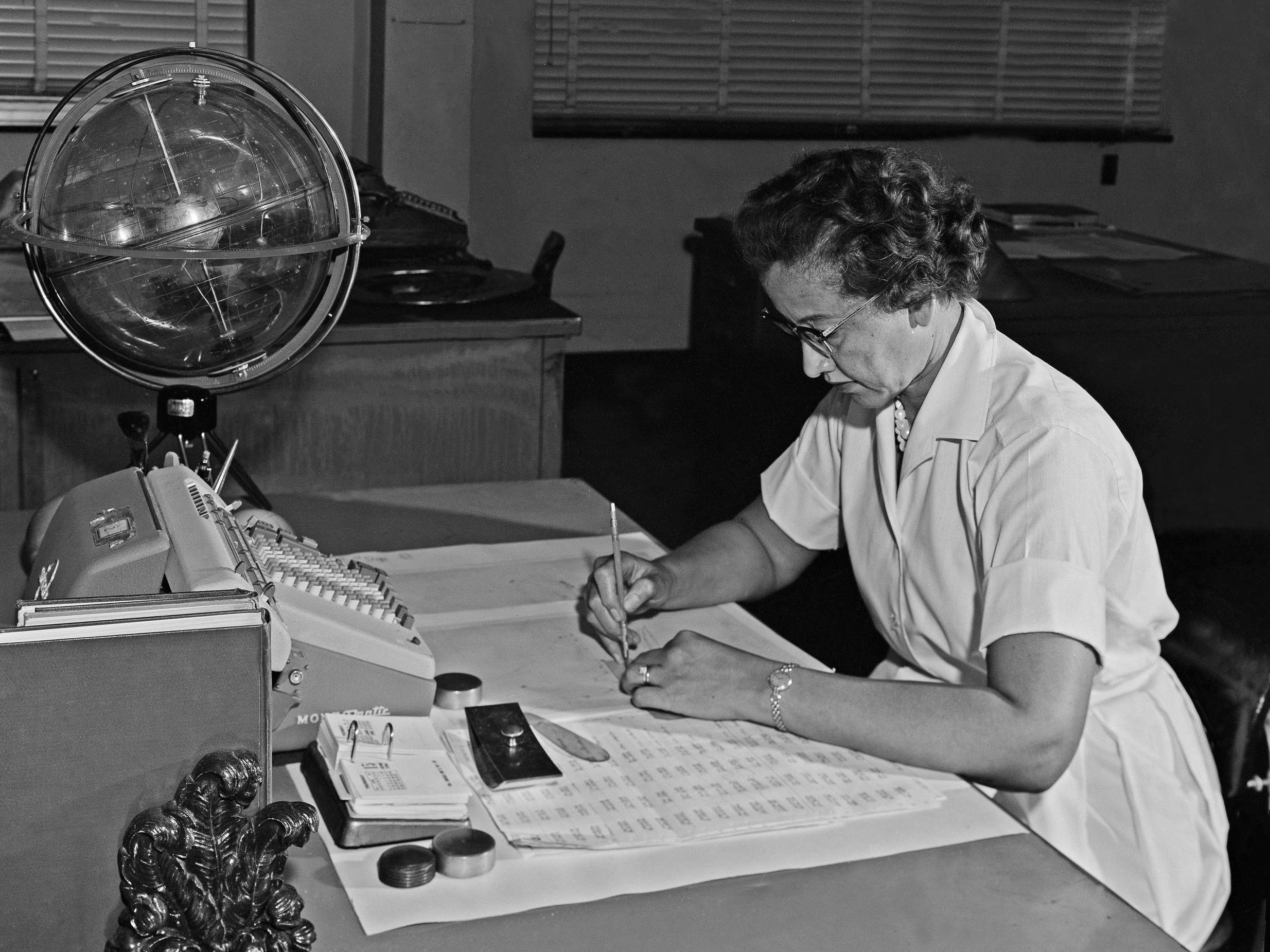 Katherine Johnson at her desk at NASA
Times have indeed changed. On April 1, while watching the countdown to the launch of Artemis II in its journey to the dark side of the moon, I noticed a woman, Emily Nelson, directing the final preparations of the flight from NASA headquarters. It matters, just as it matters that this museum now gives everyone a seat at the table.
Now the question haunts me: Will that last?
In the name of purging any and all efforts at DEI (diversity, equity and inclusion), the Trump administration has gleefully fired women and Blacks. Pete Hegseth, that superbly unqualified secretary of defense, has implemented such efforts in the military with enthusiasm, best described by Lucian Truscott, whose Substack I follow. Hegseth intervened less than three weeks ago to remove two Blacks and two female officers in a committee-approved promotions list to brigadier general. Hegseth apparently believes that if women or minorities hold high office, it is proof they did not merit promotion. Yet he is proof that this administration promotes incompetent white men based on their loyalty, race and gender. The qualified need not apply.
For example, last year Hegseth fired Chief of Naval Operations, Adm. Lisa Franchetti, the first woman to be named the Navy’s highest ranking officer. Before becoming CNO, she had led the U.S. Sixth Fleet in the Mediterranean Sea, headed U.S. Naval Operations Korea, commanded a naval destroyer, led a destroyer squadron and twice commanded aircraft carrier strike groups. But her ample qualifications didn’t matter.
The bigotry of the Trump Administration is bound to affect even cultural icons like the Smithsonian, and indeed, the Administration is acting like the politburo of the former Soviet Union. It has aimed its racist and sexist efforts squarely at the Smithsonian Museums to censor and alter exhibits, insisting that they “remove divisive narratives.” Happily, the Resistance has emerged in an army of volunteer citizen historians who are documenting any changes for the blessed day when this administration ends.
For now, my excited granddaughter and her completely exhausted grandmother absorbed the museum’s core message, the only acceptable one in a decent society: That for every child, the sky is the limit.