Editing
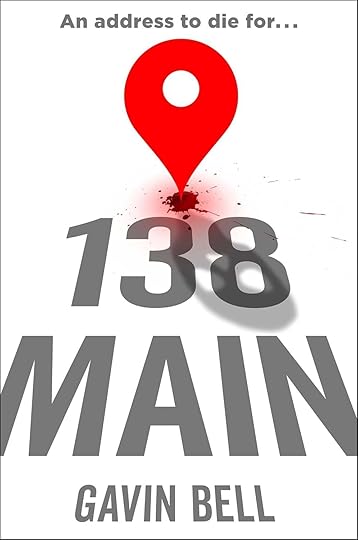
Obligatory plug for the new book up front: 138 Main is out now in the UK and published this Tuesday in the United States, and the reviews are the best of my career. The Daily Mail just said:
“[A] crackling serial killer thriller with a super smart twist … Bell’s new book bristles with fresh ideas and nuanced characters that leap off the page: it is definitely not to be missed.”
Get it in the UK here or the US here.
Okay, that’s out of the way. On to editing.
In my last regular installment, I covered my approach to writing a first draft. Basically: get your ass in the chair, get the words down. If you do that for a few months, congratulations: you might have the first draft of a book.
The good news is you have something to work with. The bad news: this is where the real work begins.
For me, it’s not really bad news at all, because I actually enjoy the editing process. It’s the phase when the book goes from a rough, unfinished state to something that’s more like the story I have in my head. I’ve done some editing jobs in between writing my own books, and even with my own stuff, I like to establish some distance. I tell myself I’m a hot-shot book doctor1 brought into rescue this wreck of a manuscript.
Writers are luckier than most, because we get so many chances to go back over our work and tweak it before we have to show it to anyone. I don’t envy musicians or athletes who have to produce their very best work in the moment, as opposed to when they happen to be in the zone.
Editing isn’t a chore, it’s a gift.
Once the hard work of getting the first draft over the finish line is out of the way I can go back through the manuscript and decide what things work, what things don’t work, which characters need to be developed more, which chapters need to be moved around and so on.
Thanks for reading The Basic 500! Subscribe for free to receive new posts and support my work.
I’m pretty sure most of the editing routine I’ve developed for myself comes from Stephen King’s excellent On Writing. Any aspiring authors reading this should do themselves a favour and buy a copy right now, because it’s the most useful and genuinely inspirational book I’ve read on doing this job.
As soon as I’ve finished the first draft of a book, I like to put it aside, ideally for a few weeks, to get some distance from the daily grind of the writing phase. Deadlines don’t always allow the luxury of a break, but it’s always helpful when I can fit one in.
Once it’s time to get started on the next phase, I print the book hard copy so I can sit down away from the computer and read through it. For some reason, the human brain tends to miss typos more often when reading from a screen. If it’s a physical document, there’s nothing to distract you. Once I have the hard copy of the manuscript (or ‘ms’, to use the publishing shorthand), I sit down with a notebook, a pencil and some highlighters and get to work.
I’m doing two things as I read through the first draft. Most importantly, I’m finding out how well it reads. Reading a book in one or two sittings is a completely different experience from writing it in small daily chunks of a thousand words or so. The read-through will give me a good idea of what works and what doesn’t and what the big things I’ll need to change are. As I’m reading, I’ll use my notebook to record ideas for new scenes or edits to existing ones.
That’s the big picture. The second thing I’m doing is looking for the smaller pieces of work that need done at the level of paragraphs and sentences and words: things like typos and awkward sentences and the places where I need to carry out some research before revisiting. I mark any mistakes with the pencil so I can fix them later, and add any extra detail that needs to be there in the margin.
I like to use real locations, buildings, street names and so on in my books wherever possible, so quite often in a first draft I’ll have something like:
Mitch stepped out onto xxx Street and headed east. The sun was beginning to set behind him, casting elongated shadows ahead.
(A lot of us use “xxx” to show where we need to come back and fill in a blank. It works for me because it’s hard to accidentally leave in on a read-through, and easy to search for. Unless you’re writing a book about adult movie theaters I suppose. In that case, Mitch might be on 42nd Street and the year is 1976.)
This is where the highlighters come in. I use them to flag up any piece of information I need to check for consistency. For example, I tend to use one colour for information about location or geographical description, one for descriptions of characters, one for equipment (weapons, cars, whatever), and one for any mention of time or dates. In the example above, I’d want to check which street Mitch was stepping onto, and if it makes sense for the sun to be setting behind him at that point in the story.
It saves a lot of pain later on if I can scan through the ms looking for any mentions of the time, as it ensures I can keep everything as consistent as possible. Highlighting attributes also stops a character from having blue eyes in one scene and green in another. This kind of thing is invisible to the reader if you get it right, but it’s always noticeable if you screw it up. The second draft is where I start forcing myself to pay attention to the fine detail.
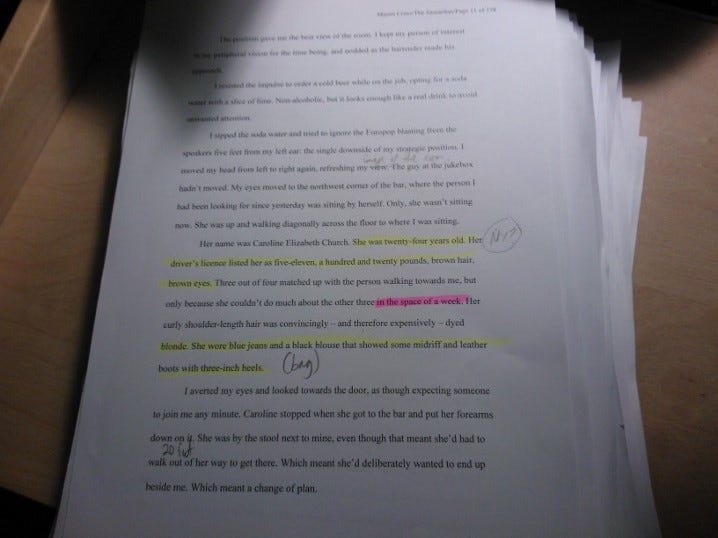
By the time I'm finished, the manuscript usually looks like a cross between a term paper with a lot of mistakes and some kind of day-glo Jackson Pollock painting. In the chapter on editing in On Writing, King recommends drawing a little squiggle on the top-right of any page where you've made an edit, so you can find the pages that need attention easily. The first draft of my work in progress is 384 pages, and if I'd bothered to do that, I'd have that edit symbol on roughly 383 of them (I'm pretty confident the cover page is okay).
Once that's done, I'm usually brimming with ideas of how to improve the book, and eager to get back in front of that Word file where I can start tidying things up and transforming it into something I'd be happy for people to read. For me, this is when the book really starts to come together. It’s the point where you start making it look like you knew what you were doing all along.
And that's why I actually love editing.
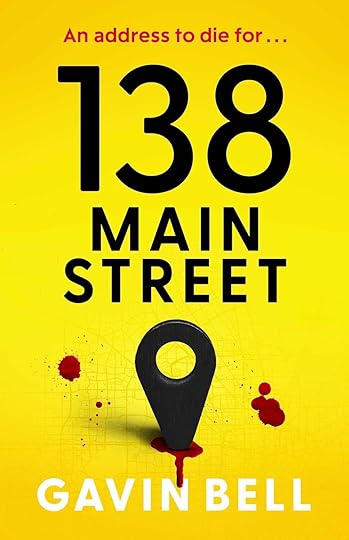
138 Main Street is out now in the UK, available from all good bookshops.
If you’re in the United States, you have a mere four days to wait until it’s published on June 2, and you can preorder now.
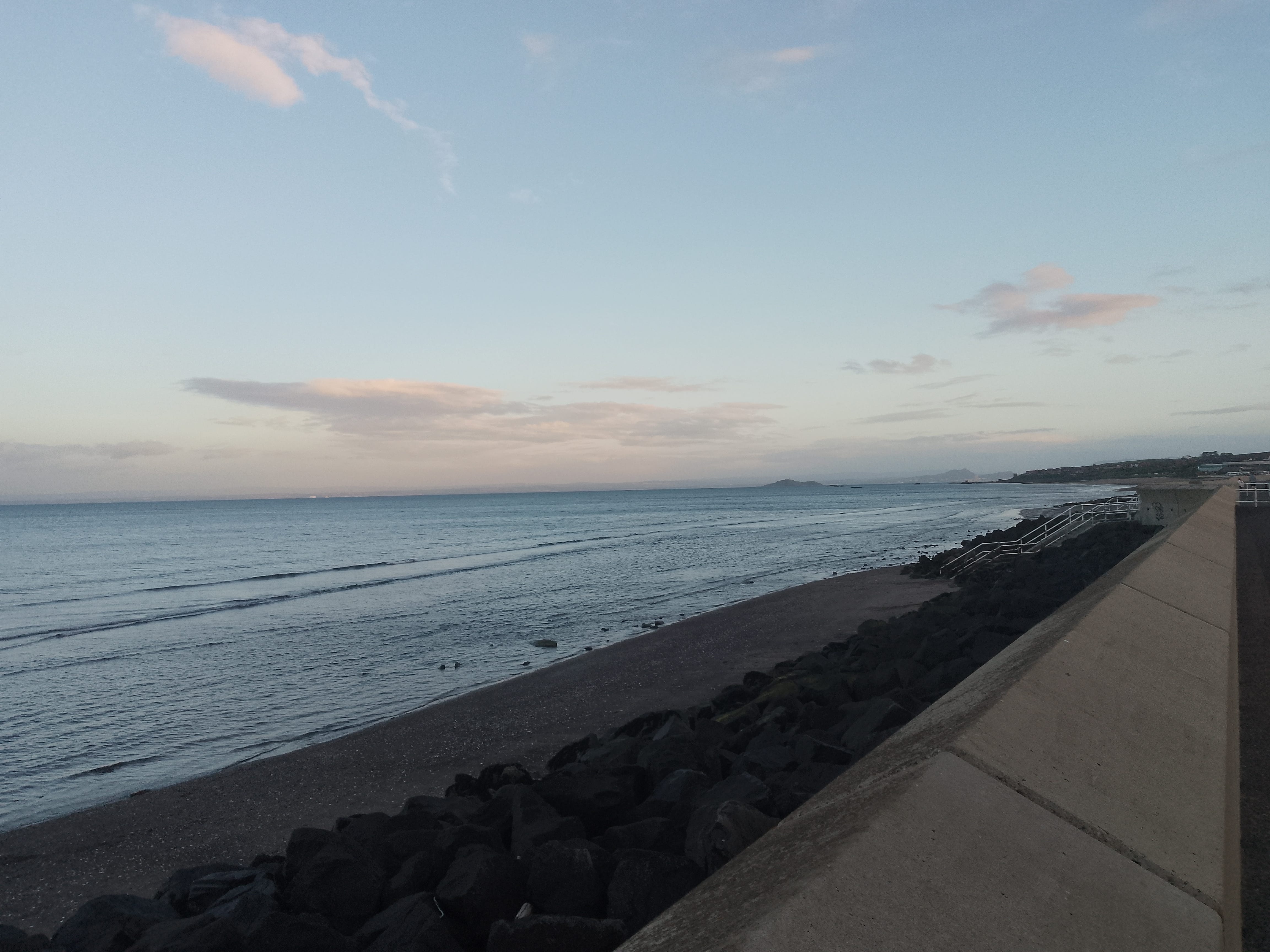 Walking pic of the week: Kirkcaldy beachfrontReading
I’m appearing at Capital Crime in London next month with Rebecca Hardy and C.B. Everett talking about ‘Your Summer of Suspense’. I already read and loved C.B.’s meta The Final Chapter and have just started Rebecca’s The Summer We Lied, which has already got its hooks into me.
WatchingCineworld is running a Spielberg season right now, so I’ve been revisiting copper bottomed classics like Jaws and Jurassic Park along with… um… less classic material like Hook. I saw Empire of the Sun for the first time the other night and found it to be an underrated gem in the master’s back catalogue. Incredible visuals, and it’s eminently satisfying to watch a huge crowd scene or bombing raid carried out by P51 Mustang fighters and know that none of it was done with CGI.
WritingI’m taking a break from book two to get some much-needed distance (see above), and mulling over a short story idea that might have the title ‘Saudade’.
ListeningI somehow forgot how great PJ Harvey’s Stories from the City, Stories from the Sea is, but that’s been getting heavy rotation this week.
See you in fourteen…
1In fact, I have occasionally been hired to edit an unfinished manuscript written by someone else, and it’s an interesting challenge. I’ll write about it in a future post.