2 Pentecost
June 7, 2026
+ This Thursday, I will celebrating my22nd anniversary of ordination to the Priesthood.
It’s been a fascinating 22 years sofar.
I have gone places I never thought Iwould go.
I’ve done things I never thought I’ddo.
I was joking yesterday at Joy Coffey’sinterment that I never thought in a million years that I would be digginggraves as a priest. . .
But that’s part of the journey, right?
In our Gospel reading for today, wealso have a similar realization.
In these stories, we find Jesus goingwhere religious people would say one should not go.
In the first story, he goes to a taxcollector’s booth.
Then he goes to a dinner table filledwith sinners.
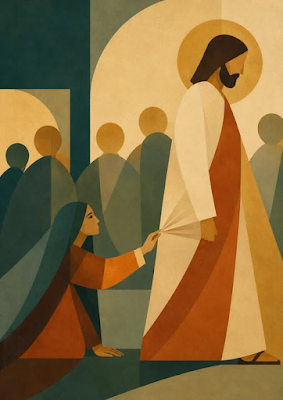
Then, he allows himself to be touchedby a woman whose illness has made her ritually unclean.
And then, perhaps most shockingly ofall, he takes a dead girl by the hand.
All of these would have been prohibitionsagain the Judaic law of his time and culture.
But, everywhere Jesus goes in thispassage, he crosses a boundary.
The tax collector is outside thatcircle.
The sinners are outside that circle.
The hemorrhaging woman is outside thatcircle.
The dead girl—by simply being dead—isoutside that circle.
And through it all, Jesus just keepswalking straight toward them, breaking down barriers as he goes.
That seems to be one of the definingcharacteristics of Jesus.
He is forever moving toward those whomeveryone else is moving away from.
Matthew the tax collector, maderitually unclean by the pagan coins he handles, is sitting at his tax booth.
We should remember that tax collectorsweren’t just disliked.
They were considered collaboratorswith the Romans.
They were viewed as corrupt, morallycompromised, and unclean.
Matthew, a Jew, has definitely made amess of his life.
But, Jesus doesn’t ask him for anysort of explanation.
He doesn’t demand some kind of evidenceof repentance.
What does he say to Matthew?
He simply says, “Follow me.”
And Matthew gets up and follows him.
There is something wonderfullyunsettling about that.
I mean, he just gets right up andfollows him without seemingly a second thought.
There’s no repentance.
There’s no, “I’m sorry for what I’vedone.”
There’s no dramatic turning away fromhis old life style.
There’s no cleansing—no washing awayof his uncleanliness.
He just gets up and goes.
And Jesus, for his part, doesn’t say, “get your crap in order and then you can follow me.”
He just says, “Follow me.”
Don’t worry about the rest of yourcrap.
Just leave it behind and follow me.
We often forget that.
We have sometimes behave as though beingChristian is some kind of reward for “beinggood” rather than medicine for our wounded souls.
We act as though holiness is anentrance requirement instead of the lifelong work of God’s grace.
But Jesus says something very differentthan that.
“Those who are well have no need of aphysician, but those who are sick,” he says.
The old saying is, “The Church is thehospital for our souls.”
The Church is not a museum.
It is not our job to preserve thesacred vessels of the church building.
Rather, the Church is a hospitalfilled with people in various stages of healing.
It is a place where wounded people goto seek healing.
T
hen, we hear about this woman who hasbeen bleeding for twelve years.Twelve years.
Just think about that.
Twelve years of disappointment.
Twelve years of fear.
Twelve years of hoping that maybetomorrow it will stop.
Twelve years of failed remedies.
Twelve years of absolute isolation.
Twelve years of being treated as aproblem rather than as a person.
And what does she do?
She just reaches out.
She doesn’t ask permission.
She doesn’t ask, “may I?’
She probably hadn’t even planned to doit.
An opportunity arose and she just didit, hoping probably that Jesus wouldn’t notice.
Just imagine for a moment all the emotionand hope and uncertainly in that one simple action.
And, in turn, what does Jesus do?
He turns.
He sees her.
That glance—that look—is truly themiracle before the miracle.
He actually sees her.
Sees her for who she really is.
He doesn’t see her illness.
Or her shame.
He sees her.
And he tells her, “Take heart.”
Be strong.
Hope has been renewed.
And fulfilled.
Then we find Jesus at the ruler’shouse where this girl has died.
Everyone there knows what’s going on.
They know death when they see it.
They know how the story ends.
Yet Jesus just comes in and takes herhand.
T
he same hand everyone else hasstopped holding because it’s now unclean.It’s the hand of a corpse.
And what happens?
Life returns.
A God who enters into places everyoneelse has abandoned.
Did you notice how this Gospel readingis full of hands?
Matthew rising from his tax booth—heis using the ritually unclean hands with which he handled the pagan coins torise up.
The woman touches his garment.
Jesus takes a dead girl’s hand.
There’s something so beautiful inthat!
That speaks to us.,
Because that’s what God does.
Again and again God reaches across thedistance.
The distance between uncleanliness and cleanliness.
The distance between health andsickness.
The distance between life and death.
The distance between ourselves andGod.
So, what do we get from this readingtoday?
Certainly, we hear those words,
“Take heart.”
Follow Jesus.
Those are our words too.
Take heart.
And follow Jesus.
Follow Jesus into those places politeChristians say we shouldn’t go.
Follow Jesus to places others fear totread.
And as we do so, let us use our hands.
And our feet
And whole selves.
Because Jesus is leading us into thoseplaces others tell us we shouldn’t go.
It is precisely those uncomfortableplaces he goes and expects us to follow.
He knows.
After all, the physician goes to thesick.
The shepherd goes to the lost.
The Giver of life goes to the dead.
And in doing so, we realize we havenothing to fear.
After all, whenever Jesus went tothose places, it was then that life began.
But even more than going there, maybewe should realize that we are already there.
After all, at times, we are the taxcollectors.
We are the wounded people reaching forthe hem of Jesus’ fringes.
We are the bleeding, broken peoplejust reaching out.
We are the ones who have heard his voicesaying to us, “Follow me.”
We are the ones hearing that voicesaying, “Take heart.”
We are the ones who hear that voicesay to us, “Arise.”
Arise.
Take heart.
Follow Jesus
And live.
In the end, those are truly the thingsthat matter.
Amen