6 Pentecost
July 5, 2026
Matthew 11:16–19, 25–30
+ Let’s faceit.
We’re allkind of weary right now.
We have allbeen through a lot
Certainly inour own personal lives.
Certainly asa country.
(Happy 250,by the way!)
Just ingeneral.
There is justa kind of weariness that comes from simply being alive.
It’s notalways physical exhaustion, either.
Sometimes—oftentimes—it’sa spiritual weariness.
Sometimesit’s just a weariness of trying to get it right.
Trying to bethe right kind of person.
Trying to saythe right thing.
Trying tobelieve the right things.
Trying tolive up to the expectations of other people.
Trying tolive up to our own expectations.
Andsometimes—if we are very honest—it is the weariness of trying to live up towhat we think God expects of us.
That, Ithink, is the kind of weariness Jesus is talking about today.
But first,Jesus says something rather strange.
He says thepeople of his generation are like children in the marketplace:
We played theflute for you, and you did not dance;
we wailed,and you did not mourn.
Of course!
Nothing isever quite right.
John theBaptist came fasting, living ascetically in the wilderness.
And peoplesaid what?
He has ademon.
Then Jesuscame.
Jesus atewith people.
He drankwine.
He sat attables with sinners and tax collectors and all the wrong people.
And what didthey say?
Look, he’s aglutton.
He’s a drunk.
John was toosevere.
Jesus was notsevere enough.
There’s nowinning.
I think weall get that.
We live in aworld in which everyone seems to have an opinion about how everyone else shouldlive their lives.
You’re toomuch of this.
You’re notenough of that.
You’re tooreligious.
You’re notreligious enough.
You’re tootraditional.
You’re tooliberal, too progressive.
Nothing isever quite right.
And if wespend our lives trying to satisfy every voice calling to us from themarketplace, guess what?
We’re gonnaget exhausted.
We’re gonnabe. . . weary.
And that iswhat Jesus is talking about.
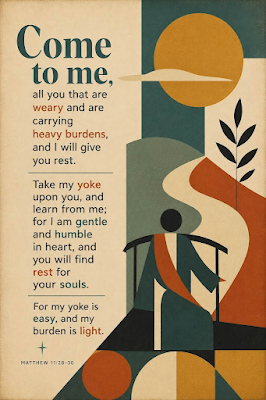
Come to me,he says. All you who are weary.
Notice whathe’s not saying.
He doesn’tsay, get your act together first.
Be morereligious first.
Figure it allout out first.
Stopdoubting.
No. He simplysays, Come.
Come to me,all you who are weary.
Come to me,all you who are tired of trying to prove yourselves.
Come to me,all you who have been carrying things you were never meant to carry.
And whathappens if we do?
“I will giveyou rest,” he says.
Jesus is notpromising that life will suddenly become easy.
The restJesus offers is something so much deeper.
It is therest that comes when we finally understand that we don’t have to earnthe love of God.
We don’t haveto work to get God to love us.
We don’t haveto get everything right.
We don’t haveto prove our own worth.
We don’t haveto carry around every judgment someone has made about us.
We don’t haveto keep punishing ourselves for just being who we are or what what we are.
But, weshould be clear.
We’re notpromised an easy life.
There will bethings we just have to carry in this life.
We don’t getto have no burdens.
There areburdens we are actually called to carry.
We are calledto carry one another.
We are calledto carry the needs of the poor.
We arecalled, sometimes, to carry a cross.
But the otherstuff?
God neverasked us to carry all those thing.
Like theburden of shame.
The burden ofperfection.
The burden ofpretending we’re something we’re not.
The burden oftrying to make everyone happy.
The burden ofbelieving that God is somehow perpetually disappointed in us.
Those aredangerous burdens, especially if you’re already weary.
Those burdenswill crush us.
What does Jesussay to us?
Put themdown.
He saysinstead, Take up my yoke.
Now, that’san interesting turn of images if you ask me.
Put down yourburdens.
But take upmy yoke.
B
ut there’ssomething very enlightening about that image.A burden issomething carried alone.
A yokehowever is something shared.
You’re yokedto something else.
Jesus doesn’tpromise us a life without difficulties.
He promisesus instead that we will never carry these burdens alone.
Take my yokeupon you, and learn from me, he says.
Walk with me.
Move with me.
Let me carrythis with you.
For I amgentle and humble in heart.
That may beone of the most beautiful things Jesus ever says about himself.
Because bysaying that he is telling us what the heart of God truly is.
The heart ofGod is gentle.
The heart ofGod is not cruel.
The heart ofGod is not waiting for us to fail.
The heart ofGod is not expecting us to be. . . perfect.
The heart ofGod is gentle.
Jesus says, Listento my voice.
I am gentle.
Come to me.
Perhaps todaywe need to ask ourselves:
What am Icarrying that God never asked me to carry?
Whose voiceam I listening to?
What am Istill trying to prove?
And to whom?
And whatwould happen if I simply came to God as I am?
Not as Ithink I should be.
Not assomeone else thinks I should be.
But as I reallyam.
Tired.
Weary
Imperfect.
Hopeful.
But still afraid.
Faithful.
But still doubting.
Human.
Come to me,Jesus says to us.
Not tomorrow.
Not when you’vefigured it all out.
Not when you’vebecome the person you think you should be.
Now.
Come to me.
And when youdo, bring your weariness.
Bring yourburden.
Bring thewhole complicated truth of who you are.
And when wedo, it is then that we will find our rest.
Amen.