7 Pentecost
July 12, 2026
Matthew 13:1-9,18-23
I am not a garden person.
I just have never been the kind of personwho likes to spend time in a garden, planting seeds and watching things grow.
I’ve tried.
I once tried to start an herb gardenyears and years ago.
But there came this point when I couldn’ttell the difference between hat was a weed and what was an herb.
So, I just let it go.
And you can guess how that ended.
So, all this talk today in our Gospelreading about sowers and seeds is kind of lost on me.
I will say this, though.
At first glance, the parable of thesower is one of those stories that sounds simple.
I kind of get it.
But then, we realize, that’s not theway Jesus does things.
Nothing is ever really simple.
And as we all know, Jesus refuses toexplain everything away.
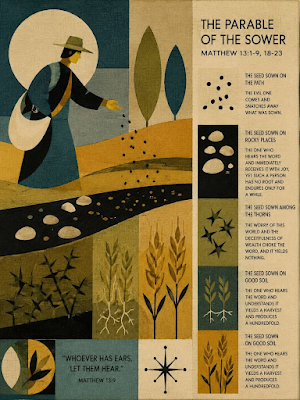
In this parable, he speaks of seedscattered everywhere.
Some fall on the path.
Some on rocky ground.
Some among thorns.
Some on good soil.
And then he simply says:
“Let anyone with ears listen.”
What a strange thing to say!
It leaves us wondering.
For us, no doubt we start askingourselves, What kind of soil am I?
But perhaps maybe that’s not the real firstquestion we should be asking.
Maybe the first thing we should do is noticehow extravagance the sower is.
Again, not an expert here, but. . .
I don’t think a careful farmer wouldscatter seed on a hard path or among rocks and thorns.
Even I know that!
It would be a waste.
It would be a waste of time.
And it would be a waste of money.
But you know who does sow like this?
God does.
Because, the kingdom of God is to beannounced everywhere.
Even on the hard path.
Even among rocks and thorns.
Grace—this wonderful un-asked for giftfrom God--the very seed of that Kindom of God, is scattered wherever.
Without calculation.
God’s grace is offered to everyone—to saintsand doubters, to the faithful and the indifferent, to those who are ready andto those who are not.
God, as I hope we all realize, isastonishingly generous.
And only after this talk of seeds andsowing does Jesus speak about the soil.
And that is where the parable quietlybecomes uncomfortable.
Because good soil doesn’t always justhappen.
Or rather, good soil can be made inplaces where we thought it couldn’t.
A hard path can be broken open.
Rocky ground can be cleared.
Thorns can be pulled.
Good soil is cultivated.
Following Jesus is not aboutpretending our hearts are already fertile.
It is about allowing God, oftenpainfully, to prepare us for what has always been freely given.
Certainly, most of us know exactly whatthorns feel like.
Anxiety.
Depression.
Endless distraction.
The desire to acquire just a littlemore.
The need to always be right.
The fear that there will never beenough.
Jesus tells us that these things chokethe seed before it can bear fruit.
Notice he doesn’t say that they destroythe seed.
They simply keep it from growing.
And perhaps that is the greater danger.
Maybe the greater danger is becomingso crowded with other concerns that we no longer have room for God’s grace totake hold in our lives and flourish.
But, we have to be clear before westart to despair over this parable.
This parable is actually full of hope.
The seed itself is alive.
Its power doesn’t come from us.
Our task isn’t to manufacture life.
Our task is simply to remain open tothe One who never stops sowing.
Every Sunday, the Word is scatteredagain.
Every Eucharist, grace is scatteredagain.
Every morning, God begins again in us.
The Sower has not given up on thefield.
Or on us.
And that’s the real message of this parable.
Amen.


No comments have been added yet.