8 Pentecost
July 19, 2026
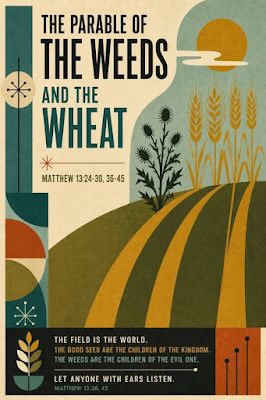
Matthew 13:24–30, 36–43
+ Last week I told a story in mysermon about how I once had an herb garden.
I was in my early 20s.
And, for some reason I don’t rememberanymore, I had this idea that I wanted to plant an herb garden at my parents’home.
I planned it out.
I did my research.
I bought all the seeds and was veryexcited about having these various herbs.
I dutifully planted them in a cornerof my parents’ property and would try hard to cultivate it.
But, as I said last week, the weedsstarted coming around the same time the herbs started growing.
And soon, I couldn’t tell which waswhich.
I could not for the life of me figureout what was an herb and what was a weed.
And, as you can guess, I simply wipedmy hands of it and walked away.
Months later, in this overgrown patch,I found it kind of amusing that some of those so-called “weeds” smelled amazingin the sun.
In fact, for years, my father wouldsay that little patch of ground had some of the best smelling “weeds” he eversmelled.
So, when I heard the story last weekin our Gospel reading about sowing seeds and especially the one this week, I amreminded of that forlorn little herb garden all those years ago.
For today, the story Jesus tells us is,like some many of his stories, bothcomforting and frustrating.
In it, we find a farmer who sows goodseed, but does so under the cover of darkness.
An enemy sows weeds among the wheat.
When the servants discover theproblem, they ask the obvious question: “Do you want us to pull the weeds?”
Their instinct is our instinct.
We want to fix things.
We want to make things right.
We want to sort people into neatcategories.
We want the righteous over here, thewicked over there.
We want the world cleaned up.
Nice and neat.
What does Jesus say to that?
He says, “No.”
Leave them both to grow together untilthe harvest.
That answer is almost unbearable.
We look at the violence in the world,the cruelty, the injustice, and we want God to act now.
We look at the failures of the Church,at our own failures, and we wonder—why is God so patient?
Perhaps the answer is this: becauseGod knows something we do not.
The servants cannot always tell thedifference between wheat and weeds.
Their zeal for purity may end updestroying what God intends to save.
We are not always reliable judges ofone another, or even of ourselves.
The person we have written off may yetbecome a saint.
The one who appears strong may bebarely hanging on.
A life that seems hopeless today may,by God’s grace, bear extraordinary fruit tomorrow.
God’s patience is not indifference.
It is mercy.
The reign of God is not built by ourability to identify the weeds.
It is built by God’s determinationnever to give up on the wheat, even when it is surrounded by everything thatthreatens to choke it.
There is another truth here as well.
The field is not simply “the world.”
It is also our own hearts.
Wheat and weeds grow together withineach of us.
Love and resentment.
Faith and fear.
Generosity and selfishness.
Confidence and insecurity.
We know what it is to be dividedpeople.
We ourselves are often so dividedwithin ourselves.
The good news is that Jesus doesn’tabandon the field because it is messy.
He continues to tend it.
He waters it with grace.
He feeds it with his own Body andBlood.
He waits patiently for what only timeand mercy can accomplish.
There will be a harvest.
Jesus doesn’t deny that.
As you’ve heard me say again andagain, evil does not have the last word.
Justice will come.
Every hidden thing will be broughtinto the light.
Into God’s Light.
But that day belongs to God, not tous.
Our calling, in the meantime, is notto become experts at pulling weeds.
It is not our job to figure out whatis wheat—or herbs---and what are weeds.
It is to become faithful wheat—to sinkour roots deeply into the love of God, to bear fruit for the sake of the world,and to trust that the Judge of all the earth knows what God is doing.
Sometimes, from that mess of weeds,comes a beautiful smell, and when it does, we know, all is not lost.
That kind of trust is difficult.
It asks us to surrender our need tocontrol, our desire to condemn, our impatience with God.
But it also frees us.
We no longer have to carry the burdenof sorting out the whole world.
We are simply called to follow Jesus,to love our neighbors, and to let God’s grace do its quiet work.
God’s reign often grows unnoticed.
So does holiness.
And in God’s own good time, not ours, thewheat will shine like the sun in the kingdom of God.
Amen.


No comments have been added yet.