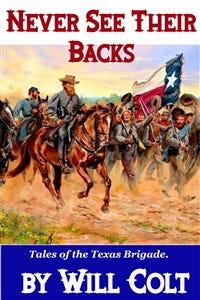
Never See Their Backs
The Mississippi sun penetrated through Daniel MacLean’s gray wool uniform. It was the summer of ‘63, and they were marching again, not into battle, but away from it. Barely eighteen but with the hard, lean strength a boy used to hard work on his father’s tobacco plantation, he had the watchful eyes of someone who knew horses better than men. He held his piece, but kicked a clod of dirt in frustration.
“Retreat again?” Sergeant Miller, a lanky Georgian with a permanent squint, spat a stream of tobacco juice that landed with a soft plop near Daniel’s worn boot. “Seems that’s General Johnston’s favorite tune. A slow, sad waltz away from the fight.”
Daniel ran a hand through his sweat-soaked brown hair. “It’s senseless, Miller. We got good men, good positions sometimes, and he just… pulls back. Like he’s scared to bloody his boots.” His voice, usually a low rumble, held a sharp edge of impatience. Back home on the plantation, whenever something needed doing, you didn’t wait around for somebody else; you did it. Retreatin’ Joe didn’t seem to hold to the same values.
Another soldier, a quieter fellow named Jenkins who looked perpetually lost, chimed in softly, “He’s a strategist, they say. Protecting his men.”
“Protecting us from what? Winning a battle?” Daniel grumbled. He’d heard tales, glorious, terrifying tales, of charges… like Jackson at Second Manassas, or Hood at Gaines’ Mill. Men throwing themselves into the teeth of the enemy, breaking lines, seizing ground. That was fighting. This constant parrying, followed by a slow withdrawal, felt like dying by inches, morale bleeding away drip by maddening drip. He was good with a rifle, deadly accurate from practicing on squirrels and deer back home, and strong enough to handle a bayonet, but his real skill, his love, was horses.
Thanks for reading! Subscribe for free to receive new posts and support my work.
Daniel, along with his older brother Noah, had ridden the plantation’s finest since he was tall enough to swing a leg over a saddle. He enjoyed the power and grace of them as he grew to think of them as an extension of himself. He longed for the chance to use his skill like Noah, who was riding with Mosby’s Raiders. He dreamed of galloping into the fray, sabre flashing, the thunder of hooves drowning out all fear. But under Johnston, there was little call for headlong charges or bold maneuvers. It was mostly marching, falling back, digging in, and waiting.
The talk among the men was the same everywhere – frustration. Whispers of General Bragg’s army up north, fighting in Tennessee, rumors of potential movements, reinforcements. Anything to escape this passive existence.
Then came the order that sent a ripple of excitement through the ranks, a crackle of anticipation like lightning before a storm. General Johnston, or perhaps it was a request filtered down from higher command, needed volunteers. Volunteers to be transferred north, potentially to General Braxton Bragg’s Army of Tennessee. More specifically, some would be assigned to shore up units that had seen hard fighting, including the legendary Texas Brigade, part of Major General John Bell Hood’s division.
Hood. The name itself was a jolt. John Bell Hood had resigned from the United States Army immediately after the Battle of Fort Sumter. Dissatisfied with the neutrality of his native Kentucky, he decided to serve his adopted state of Texas, joining the Confederate army as a cavalry captain, promoted to major and sent to command Brigadier General John B. Magruder’s cavalry in the lower Virginia Peninsula. The aggressive Kentuckian was known for his fierce countenance and a penchant for throwing his men forward like a battering ram. Hood’s Texans and Georgians had ripped holes in Yankee lines at Gaines’ Mill, charging through lead and fury. That was the kind of general Daniel wanted to follow. That was the kind of fighting he ached for.
He didn’t hesitate. Before the officer had finished reading the details, Daniel stepped forward. His heart hammered against his ribs, a mix of excitement and trepidation. Leaving behind the only company he’d known since enlisting was a wrench, but the promise of action, of serving under a man who understood Daniel’s own restless energy, was too strong to resist.
“What’s yer name, boy?” the officer asked, pen poised over a roster.
“Daniel MacLean, sir.”
“You ever rid a horse, boy?”
“Yessir. My brother Noah and I rode all the time before this started. He rides with Mosby.”
“Mosby, huh?”
“Yessir.”
“How old are you?”
“I’m goin’ on nineteen.”
He wrote something on the roster and then moved to the next in line.
They brought out a spirited horse and asked us to ride around obstacles and over barriers to see how well we stayed in their saddle during the test. Those who passed were processed quickly, given new orders, and told to pack light.
The journey to Hood’s camp was a blur of dusty roads, rattling trains, and hurried marches. Daniel was grouped with a handful of other volunteers, a mixed bag from various Virginia regiments. They spoke of home, of past battles, and of the reputation of the unit they were headed towards… Hood’s Texans. The stories were wild, sometimes exaggerated, but the core remained: they were fearless, tough as pine knots, and they charged like the devil himself was at their heels.
When they finally reached Hood’s camp, the atmosphere was very different. Tension and anticipation hung heavy in the air. The men were haggard, but with a hard glint in their eyes that spoke of recent, brutal fighting and victory. They were near Chickamauga Creek in Georgia, a place that sounded peaceful but felt heavy with the weight of an impending battle.
Daniel was assigned to a Texas regiment within Hood’s Brigade. The Texans were a rough-looking lot, clad in a variety of worn uniforms and civilian clothes, many with wide-brimmed hats pulled low. They eyed the new volunteers with a mixture of curiosity and assessment. Daniel, with his quiet competence and easy way with the horses tethered nearby, earned a few nods of grudging respect. He learned quickly that his reputation would be earned. They were laconic, tough, with a form of discipline that hadn’t been forged on the parade-ground, but on the battlefield, where you learned to trust and depend on the man fighting next to you.
Initially, he was assigned to the infantry section of the Texas Brigade, though he was often assigned to tend to the officers’ horses and worked with the horses in the artillery traces.
The days leading up to the main battle were a series of skirmishes, positioning, and waiting. The woods were dense, the undergrowth thick and tangled, making visibility poor and movement difficult. Daniel heard the distant rumble of artillery, the closer rattle of gunfire as probes and counter-probes felt out the enemy lines. He was finally where he wanted to be, on the cusp of a major engagement, under a commander known to attack rather than run away with his tail between his legs.
On the morning of September 20th, the air thrummed with an energy Daniel had only imagined. Orders came down, crisp and urgent. Hood’s Corps, positioned on the Confederate left-center, was to be the spearhead of a massive assault. Specifically, a mix-up in the Union lines had opened a gap, and Hood was to exploit it. It was a rare chance for a decisive blow.
Hood himself rode among his units, a figure of grave intensity. Daniel, dismounted, and moved into line with his adopted Texan comrades, feeling a surge of adrenaline. This was it. The charge he’d yearned for. The chance to be in the thick of it.
When the order came, his nerves were at their limit from waiting. A rolling wave of sound began to surge from the throats of those around him… the rebel yell, starting as a ripple and swelling into a deafening, high-pitched scream that seemed to carry all the frustration, all the courage, all the desperation of the Confederate army within it.
“Forward!” The officers’ commands were lost in the din, but the movement was clear. The line surged.
Daniel ran, rifle clutched tight, the bayonet fixed. The woods were a chaotic, terrifying obstacle course. Trees seemed to leap out at him, branches clawed at his face, and uniform surged through the tangled briers. The ground was uneven, littered with fallen leaves and hidden roots. And through it all came the sound; a roar unlike anything he had ever experienced.
Rifle fire erupted in front of them, a solid sheet of flame and lead. Men around Daniel staggered, cried out, fell. The air filled with the acrid, suffocating smell of black powder smoke, thick and gray, obscuring vision. It tasted like sulfur and death.
He saw a Texan to his left go down, his face a mask of shock. He saw the glint of sunlight on bayonets ahead, the blue uniforms of the enemy emerging from the smoke. There was no more thought, only instinct. Run, load, fire, reload. Push forward. The rebel yell was primal now, a sound ripped from the gut, sustaining the charge.
He fired his rifle at a blue shape in the smoke, saw it jerk. He lowered his weapon and charged forward alongside his comrades. A Union soldier loomed through the haze, wide-eyed. Daniel didn’t hesitate, lunging forward. The man parried with his own bayonet, but Daniel’s farm-honed strength was greater. He twisted, shoved, and felt the sickening give as his bayonet found flesh. He pulled it free, the world narrowing to the immediate, terrifying space around him.
They crashed into the Union line. It wasn’t a neat formation; it was a melee. Hand-to-hand fighting erupted in the smoky woods. Bayonets clashed, rifles became clubs, and men grappled with each other in the undergrowth. Screams, curses, the grunt of exertion, the chilling gurgle of dying men, all mixed in a horrifying symphony.
Daniel fought with a fury he never knew was within him. The frustration that had gnawed at him for months was channeled into furious energy. He parried a bayonet thrust, sidestepped a swinging rifle butt, and fired his revolver at point-blank range into a face distorted by fear. He saw bravery and terror in equal measure, on both sides. He saw men he’d only just met fight with desperate courage, saw others break and run.
They were breaking through. The Union line, caught by surprise and hit with such ferocity, was fragmenting. Blue figures were scattering through the trees, pursued by yelling, bloody Confederates. The charge wasn’t neat; it was a torrent, pouring through the gap, widening it.
Daniel stumbled over a body and caught himself. His uniform was ripped, his hands slick with sweat and the stickiness of blood. His lungs burned, and his ears rang from the continuous roar. He looked around, disoriented for a moment because of the chaos in every direction. Trees were splintered by artillery fire, the ground churned and stained. The reality of the “thick of things” was visceral, brutal, and far more terrifying than he had imagined in his daydreams. In place of his visions of glory was a primal urge to survive, something pure, desperate, and beastly.
He saw the colors of his regiment ahead and pushed himself forward. He rejoined the surging tide, reloading his rifle mechanically. The initial gap was exploited, but the fighting wasn’t over. Pockets of resistance remained, artillery still pounded, and the woods seemed alive with unseen dangers.
He had wanted action, wanted to charge headlong into battle. He had gotten his wish. In the heart of the whirlwind at Chickamauga, surrounded by the noise, the smoke, and the dying, he realized that wishing for battle was a world away from living through it. Despite the horror, a grim satisfaction settled within him. He was there. He was doing his part. He was fighting. He was in the thick of it, just like he wanted to be. Buried under layers of shock and exhaustion, the eagerness was still there, but tempered by the raw, unforgiving truth of the battlefield.
This story features Daniel MacLean from Lonestar Ranger. Available on Amazon.
Thanks for reading! Subscribe for free to receive new posts and support my work.