Will Colt's Blog
September 1, 2026
Smiley
I miss Smiley.
I miss Alice too.
I miss Smiley because he was free and uninhibited.
That’s why Alice gave him the nickname Smiley.
Alice was an older neighbor about the age of Smiley’s parents. She recognized a light in him that was liberating and refreshing to her. She saw how, for him, the world was uncomplicated and full of exciting new adventures every day; sometimes every hour.
Smiley was a kid with ADHD before ADD or ADHD existed. He couldn’t sit still. He had to be moving, in on the action or busy with something. When you made him sit still, he wiggled or jabbered.
Does anyone use the word jabber any more?
Smiley jabbered when he had to sit still.
“Be still,” Grandpa would say in a harsh tone. That was what he said to make Smiley stop jabbering and wiggling.
“Is there a switch to turn it off?” That’s what Glen would say whenever Smiley was jabbering. But Glen hardly ever said anything. Smiley began to wonder if that was the way grownups were supposed to act. He decided maybe he should try acting that way too.
Somehow, Smiley found a way to keep everybody happy by learning to “be still” when someone needed him to be still and “turn it off” when someone needed him to stop jabbering.
School was as close to a nightmare as a six-year-old could manage. However, Smiley wanted everybody to be happy, so he learned to sit still and be quiet. It was hard for him, and he wasn’t always good at it, but he loved to learn, which made things a little bit easier.
In elementary school, Smiley had a lot of friends and a few girlfriends. His first girlfriend was in the third grade. Her name was Rhonda. She had long hair the color of corn silks. They didn’t hold hands or kiss or anything like that. They sat together whenever the teacher didn’t separate them, played with each other during recess, and they wrote notes to each other continuously, each one declaring that they “liked” each other and were boyfriend and girlfriend. They gave each other the best and biggest valentines from their Valentine’s packets. Smiley gave her his school picture.
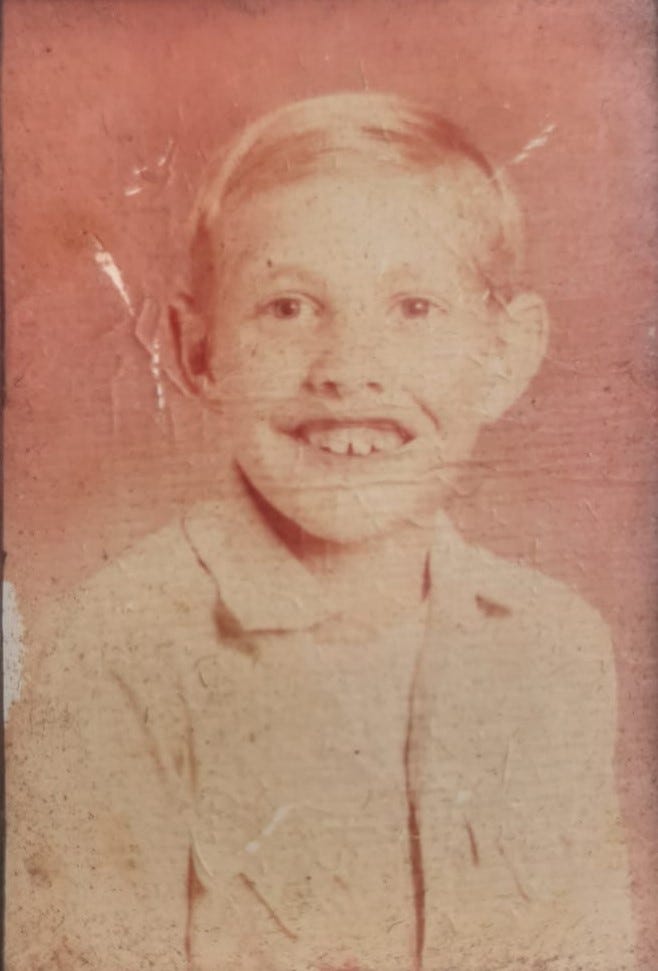
Rhonda didn’t come back to school in the fourth grade. Her family had moved away. Smiley moved on. His girlfriend in fourth grade was Dana. Dana was the pretty, popular girl that everybody wanted as their girlfriend. Smiley’s uninhibited energy and smile caught her eye. His relationship with Dana was not much different than the one he’d had with Rhonda.
Dana’s family didn’t move away that summer. Dana came back in the fifth grade, but she chose someone else to be her boyfriend in the fifth grade. Smiley accepted that as a part of life and sought adventure elsewhere, not with girls, but with other friends.
He and his friends, who were also raised on ranches, created a “gang” in the fifth grade. It was a known fact that gang members had no time for girls, especially their leader, “Hardluck Harry”, which was Smiley’s gang name. The gang never really did anything gang-like, just hung out together at recess and talked about gang stuff. They teased Yolanda a lot, calling her “big boobs”.
By sixth grade, the gang really didn’t exist anymore. Smiley found a new girlfriend. Her name was Robin. He crossed into a new level of intimacy with his girlfriend Robin. They got caught holding hands during a school movie in the auditorium. Smiley turned red as everyone teased him, but he continued being Smiley.
Junior high was when things started to change for Smiley. Things were changing for everybody. Old friends from elementary school vanished as interests began to shift. Smiley loved sports; some of his other friends didn’t. Smiley was wiry and athletic. He could do a standing backflip and he was so wiggly that he was hard to get ahold of on the wrestling mat.
Football and basketball became his favorite sports. He was good at football because he could let loose his aggressive energy and never got tired. His aggressive energy didn’t work very well when it came to playing basketball. He was good at defense and rebounding, but shooting… The word the other kids used for his shots in basketball was “brick”, because his shots would hit the backboard or the rim like a brick, then fall flat to the floor.
During the summer between junior high and high school, Smiley grew from five-foot-nine to six-foot-three. None of the control he had enjoyed over his smaller body remained. He became awkward and clumsy. That’s when Smiley began to feel self-conscious and withdraw a little bit.
That may have been the beginning of the end of Smiley. To overcompensate for his awkwardness, he began to discipline himself. It wasn’t an easy fit for the unihibited kid inside. It clipped the wings of his adventurous, free-loving soul. He still wanted to make everybody around him happy. That meant that he had to be the best that he could be, and he was up to the challenge. Determination had grown alongside his adventurous soul; a stubborn, never-say-die attitude that would never allow him to quit.
Smiley, a kid who could “barely walk and chew gum at the same time”, took on the high hurdles in track and field as a freshman in high school. He was slow and awkward. He switch-leg hurdled, which means that he switched the lead leg he used to go over each hurdle from one to the next. He lost almost every race he was entered in, but he stuck with it, determined to master something that everyone around him believed he could never master.
Besides football, the high hurdles became Smiley’s obsession. He awakened himself at night, having kicked off his covers because he was practicing the hurdles in his sleep. As a junior in high school, he was beginning to master hurdling but there were three hurdlers that he could not beat.
In the spring of his junior year, Dana was killed in a car accident.
While Smiley was changing physically and overcoming his awkwardness, he was still a freedom-loving kid who loved to jabber and enjoyed being around different kinds of people, even teachers, administrators, and other adults. He became someone adults could count on to do the right thing.
Smiley didn’t belong to any one group of friends. Technically, he was a “jock”, which is what they called athletes at that time, but he didn’t always hang out with the jocks. Since he was a ranch kid, he sometimes hung out with the “cowboys”, with whom he had the most in common. He had a few friends among the “stoners”; kids who tended to be less inhibited. He couldn’t really hang out with his stoner friends, because of “guilt by association”, which might get him kicked off the football or track team if anyone thought he was drinking or smoking pot. He sometimes hung out with the “egg heads”, but they had a much higher academic dedication than Smiley, who preferred to do just enough to get a B, and wasn’t overly concerned about being at the top of the class.
One day, during his senior year, Smiley came into the high school gym following a football game. He stopped at the water fountain near the bleachers. He was absently watching the J.V. girls’ volleyball match when he heard someone call out his name from the bleachers. He turned to see who was calling him. It was a girl about his age wearing the volleyball uniform of a rival school. Her hair was long and the color of corn silks. Rhonda instantly reminded him that he had been her boyfriend. They laughed and talked for a while, reliving something that had been long since forgotten. They had both changed, but they had their shared memory of something innocent and treasured.
Smiley mastered the high hurdles as a senior in high school, but an injury prevented him from accomplishing his highest goal: a state championship and a state record. A part of Smiley died when he failed to meet that goal. It was a pain that was never erased and perhaps caused him to drive himself harder.
Because it was what was expected, Smiley went to college. He finished his first year, but he was restless. The adventurous, freedom-loving boy still wanted to be let loose. He made plans to go to Argentina. Alice thought it was a great idea. He worked to get all of the necessary paperwork and arrangements ready for his new adventure in South America. A few weeks before he would have departed, he got scared, and he changed his mind.
Smiley went back to college. He boxed himself into the discipline of academic study. His discipline was harsh. His determination drove him. Smiley’s light began to fade.
After getting his degree, life hit Smiley the way life hits everyone who crosses over into adulthood: religion, responsibilities, jobs, duties, and expectations. Like he had done so many times, wanting to make everybody around him happy, he did what was expected, followed the rules, fit himself into the round hole designed for his misshaped peg.
His discipline and determination served him well, but Smiley’s light was barely a flicker. He was recognized as a leader in the church and in the community. People looked up to him. He was someone who could always be counted on to do the right thing. His self-discipline became harsher, his determination more intense, and his stress level multiplied to new levels as Smiley made sure the people around him were happy.
Something inside him broke.
He began to rebel against what was expected of him, replacing it with bitterness and self-seeking. The same harsh determination that drove him to become what he had become drove his rebellion as he withdrew from everyone around him, refusing to be burdened by their weighty expectations.
Smiley had a heart attack just before his 46th birthday.
Alice died in a car accident about that same time.
Remembering Alice, something deep inside Smiley recalled what he had been. Something began to stir inside him. He remembered wanting to go to South America at the age of nineteen. Less than two years after his heart attack, he moved to Colombia. A part of Smiley began to reawaken.
Smiley found Yolanda on social media once. He apologized to her. She didn’t even remember what Smiley had done, though she remembered the other boys.
Would his new adventure in Colombia revive the uninhibited, freedom-loving adventurer he had been?
It did for a time, but his life in Colombia was no different than the life he’d lived before. It was no escape from the life of disciplined determination that he’d carved out for himself. Smiley settled into the same driven and determined life and life style. The only thing that had changed was his location.
Smiley turned sixty-one this past summer. He rarely smiles now. He doesn’t jabber. He doesn’t wiggle. He works. He strives. He builds. He worries. He gets angry. He looks down on others. He speaks harshly to those around him. He acts the way grownups are supposed to act.
The other day, in a harsh tone, he told his grandson, Max, to “be still.”
Is Smiley dead and gone, like Alice and Dana?
I miss them sometimes.
I miss Smiley too.
The End


August 28, 2026
Lanzamiento en Latinoamérica: Necesito tu ayuda
Mi esposa, Sandra, me contó la historia de Gabriel García Márquez, quien necesitaba 80 dólares para publicar Cien años de soledad. Estaba atrasado con el alquiler. No tenía dinero. En ese entonces vivía en México y necesitaba un calefactor para mantener su casa caliente y poder escribir. Vendió el calefactor por el dinero justo para publicar su libro.
Yo no tengo un calefactor para vender. Sin embargo, tengo otra forma de recaudar los fondos que necesito para publicar mi libro en Latinoamérica.
Hasta ahora, he publicado mis novelas de Will Colt y Wm Howard principalmente en el mercado digital norteamericano. Sin embargo, existe una enorme brecha en mi distribución: los lectores de Argentina, Bolivia, Brasil, Colombia, Ecuador, México y España no han tenido fácil acceso a mi obra. Estos lectores suelen preferir el formato impreso al digital.
Como soy bilingüe y vivo en Colombia, me gustaría que mis amigos y vecinos tuvieran acceso a mi obra.
Mi objetivo:Para distribuir mi catálogo en siete países latinoamericanos, necesito activar un plan editorial de Libros Market. La tarifa de activación es de $199 (pago único).

Podría usar el crowdfunding para financiar este proyecto, pero es mucho más complicado y requiere más tiempo que simplemente pedirles su ayuda directamente. Jamás pediré limosna, así que les ofreceré algo a cambio de su apoyo.
Lo que ofrece el plan editorial de Libros Market:Publicación inicial de 4 libros (con capacidad para hasta 10 títulos a medida que crezca)
Distribución bajo demanda en Argentina, Bolivia, Brasil, Colombia, Ecuador, México y España
Imágenes profesionales de los libros para marketing
Previsualización de los libros para los lectores
Gestión de múltiples títulos y soporte especializado
Distribución facilitada a librerías y bibliotecas
Una vez activados, estos títulos estarán disponibles para los lectores de esos 7 países mediante impresión bajo demanda. Puedo añadir más títulos en los próximos años dentro del mismo plan editorial.
Esta es mi propuesta beneficiosa para todos:Cada compra contribuye a la cuota de $199. A continuación, les presento dos maneras de ayudarme económicamente. Cada uno tiene su propio enlace de compra debajo de la descripción.
PARA AMANTES DE LOS LIBROS - Dos Paquetes de ContribuciónCada compra me acerca a mi meta. Cada contribución cuenta.
Si no puedes realizar una compra, comparte esta información con tus familiares y amigos haciendo clic en este botón:
Paquete Ríos/Flecha — $10Lo que recibes:
2 títulos independientes en español (formatos digitales): Donde los Ríos al Oeste Corren y La Flecha y el Sol Poniente
Descarga inmediata al realizar la compra
Paquete Bilingüe — $20Contenido:
4 títulos digitales independientes (2 en inglés + 2 en español)
Inglés: Where Rivers Run West y The Arrow and the Setting Sun
Español: Donde los Ríos al Oeste Corren y La Flecha y el Sol Poniente
Descarga inmediata tras la compra
Agradezco tu apoyo.Incluso una sola compra me acerca a mi meta. Cada contribución cuenta.
Si no puedes comprar, por favor, comparte esto con tus familiares y amigos.
Gracias por leer mi trabajo y considerar apoyarme.
¡Gracias por leer! Suscríbete gratis para recibir nuevas publicaciones y apoyar mi trabajo.
August 27, 2026
Launching into Latin America: I Need Your Help
My wife, Sandra, told me the story of Gabriel García Márquez, who needed $80 to publish One Hundred Years of Solitude. He was behind on his rent. He had no money. He was living in Mexico at the time and needed a heater to keep his house warm so he could write. He sold the heater for just enough money to publish his book.
I don’t have a heater to sell. However, I do have another way of raising the funds I need to get my book published in Latin America.
Up until now, I’ve published my Will Colt and WM Howard novels in the primarily digital North American market. However, there is an enormous gap in my distribution: readers in Argentina, Bolivia, Brazil, Colombia, Ecuador, Mexico, and Spain haven’t had easy access to my work. These readers tend to prefer the print format over the digital format.
Since I am bilingual and live in Colombia, I’d like to give my friends and neighbors access to my work.
My GoalTo distribute my catalog across 7 Latin American countries, I need to activate a Libros Market editorial plan. The setup fee is $199 one-time.

I could use crowdfunding to help finance this move, but it is far more complicated and time-consuming than simply coming to you directly and requesting your assistance. I will never ask for a handout, so I’m going to give you something in return for your support.
What the Libros Market Editorial plan provides:Publication of 4 books initially (with capacity for up to 10 titles as I grow)
Print-on-demand distribution across Argentina, Bolivia, Brazil, Colombia, Ecuador, Mexico, and Spain
Professional book images for marketing
Book preview feature for readers
Multi-title management and dedicated support
Facilitated distribution to bookstores and libraries
Once activated, these titles will be available to readers in those 7 countries through print-on-demand distribution. I can add more titles over the coming years within the same editorial plan.
Here’s My Win-Win PropositionEvery purchase contributes to the $199 fee. Below are the seven ways you can help me financially. Each has its own purchase link below the description.
✍️ FOR FELLOW AUTHORS: Professional Review — $30 (4 Spots Only)Special Rate: I normally offer professional book reviews at the rate of $60 per manuscript. As part of this launch, I’m offering 4 spots at $30 each as a special rate.
What you receive:
Manuscript Review (up to 100,000 words)
Polished review blurb (300-350 words) for your marketing
To claim a spot:
Click the button below to reserve your review and provide me with your contact information
I’ll send you a private link
Once 4 spots are claimed, the offer closes permanently
Delivery: Within 2 weeks from manuscript receipt via Proton Drive (encrypted PDF)
FOR BOOKLOVERS - Six Contribution PackagesEven a $10 purchase moves me closer to my goal. Every contribution counts.
If you’re not able to make a purchase, please pass this along to family and friends by clicking this button:
Rivers/Arrow Package — $10What you receive:
2 English Standalone titles (digital formats): Where Rivers Run West and The Arrow and the Setting Sun
Immediate download upon purchase
Rios/Flecha Package — $10What you receive:
2 Spanish Standalone titles (digital formats): Donde los Ríos al Oeste Corren and La Flecha y el Sol Poniente
Immediate download upon purchase
Lawmen Package — $15What you receive:
4-Book Compilation (digital formats): First four books in the MacLean Brothers Classic Western Adventure Series (The Cavalier, Lonestar Ranger, Prescott, Big Sky Marshal)
Immediate download upon purchase
The Complete MacLean Brothers Series — $20What you receive:
All 5 published titles in the MacLean Brothers Classic Western Adventure Series (digital formats): The Cavalier, Lonestar Ranger, Prescott, Big Sky Marshal, Solomon’s Hand
Advanced Reader Copy of Sadie’s Stand (Book #6) — delivered November 1, 2026 via Proton Drive link
Bilingual Bundle — $20What you receive:
4 Standalone digital format titles total (2 English + 2 Spanish)
English: Where Rivers Run West and The Arrow and the Setting Sun
Spanish: Donde los Ríos al Oeste Corren and La Flecha y el Sol Poniente
Immediate download upon purchase
Supporter Package — $50What you receive:
The Complete MacLean Brothers Classic Western Adventure Series (5 books + ARC of Sadie’s Stand, Book #6) as well as both standalone titles (Rivers and Arrow) in digital formats
2 Print Books: Where Rivers Run West and The Arrow and the Setting Sun (English editions or their Spanish equivalents)
ARC copy of Will Colt’s third standalone, The Sons of Jonas Creek (January 2027)
Timelines You Can ExpectDigital titles come in pdf, epub and mobi formats that you can download immediately after purchase.
Print books (Supporter tier) will be shipped within two weeks after placing your order.
MacLean Brothers Series #6 ARC (Sadie’s Stand) will be available no later than November 1, 2026
The Sons of Jonas Creek standalone novel will be available no later than January 1, 2027
I appreciate your SupportEven a single purchase moves me closer to my goal. Every contribution counts.
If you’re not able to make a purchase, please pass this along to family and friends.
Thank you for reading my work and considering this support.
Will Colt Westerns: Stories where integrity survives in a harsh land.
Thanks for reading! Subscribe for free to receive new posts and support my work.
August 21, 2026
The Spirit of the Chase
Lieutenant Thomas Stirling, fresh-faced and barely twenty-two, adjusted the collar of his new, dust-filmed grey uniform. The year was 1861; the month of July. Manassas Junction hung thick with the humid weight of a Virginia summer and the acrid tang of gunpowder.
He’d graduated from West Point almost a year before the attack on Fort Sumter. He had been a model cadet, every stride, every drill, every strategy committed to memory. War, he’d been taught, was a science; a grand, intricate chess match played on a meticulously surveyed board. He’d envisioned precise movements, orchestrated maneuvers, the elegant unfolding of well-drilled columns overtaking the objective as planned.
Initially, he had been assigned to the Union’s Mounted Rifleman Regiment. However, as a son of Virginia, there was no questioning where his loyalties lay when his state seceded from the Union. In the Confederate Army, Lieutenant Stirling had been assigned to the cavalry regiment, under Colonel J.E.B. Stuart, whom he was just beginning to get to know.
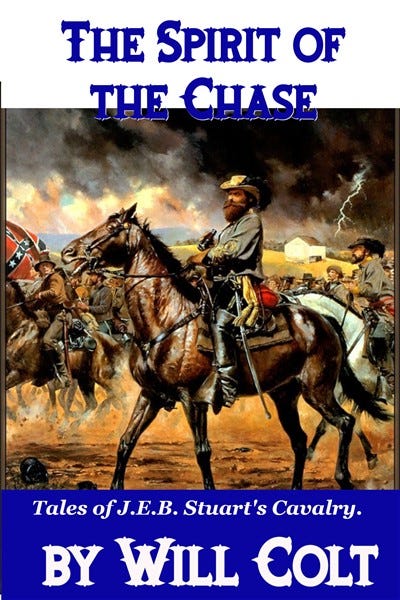
The sky, a brilliant, indifferent blue on that morning, had become smeared with soot and smoke, an apocalyptic canvas for the thunder of cannon fire that shook the very ground beneath the hooves of the horses. Both men and horses screamed in pain and terror, and the Rebel Yell, a chilling, primal sound he’d heard for the first time, tore through the air like a physical force. He felt a knot tighten in his stomach. He was not witnessing the war of textbooks, but a maelstrom.
He had heard tales of Stuart, of course. A dashing figure, a bold horseman, but also one known for his unconventional flair and his theatrical approach to command. Stirling, with his orderly mind and preference for strict military decorum, found such a reputation unsettling. He’d always imagined his commanding officers would be stern, by-the-book types, precise and predictable. And this Colonel Stuart was anything but.
Earlier that morning, before the real hell broke loose, Stirling had watched him. Jeb, as the men like to call him, with his flowing auburn beard, his broad-brimmed hat tilted just so, and the jaunty plume that seemed to defy the grimness of the situation. He’d been laughing with his staff, a booming, infectious sound, even as the first Federal skirmishers appeared on the horizon. He moved with an easy grace, radiating an arrogant confidence that bordered on recklessness. Stirling, perched stiffly on his mount, had found himself both fascinated and appalled. Where was the solemn gravitas befitting such a momentous occasion? Where was the rigid adherence to form? Stuart seemed to treat the coming battle like a grand hunting party.
And then, the hunt was on. When the order came, Stuart’s command, sharp and decisive, cut through the din: “Sabres! Prepare to charge! We ride with the Lord!”
Stirling took a deep breath, the metallic taste of fear and anticipation filling his mouth. His hand found the hilt of his sabre, drawing it with a practiced, if trembling, motion. The sun glinted off the polished steel. He remembered the drills, the diagrams of cavalry charges; wedge formations, lines of battle, precise angles of attack. He looked around. There was a formation, yes, but it felt looser, more organic than the rigid lines of West Point. It was a wave of men and horses, propelled by sheer, unadulterated will.
Then came the bugle call, piercing and shrill. “Charge!”
The ground erupted under the thundering hooves of two hundred horses. Stirling leaned forward in his saddle, his eyes fixed on the broad back of the trooper in front of him, then on Stuart, who seemed to be everywhere at once, a whirlwind of motion and energy, leading from the front. The Rebel Yell, now a collective roar from a thousand throats, drowned out the individual cries, becoming a terrifying, unified sound of defiance and aggression.
Dust billowed, thick and choking, a screen of golden brown that obscured everything beyond a few yards. Stirling’s ears rang with the cacophony, the shriek of sabres drawn, the whoosh of hot air, the frantic snorts of horses, the desperate screams of the enemy. He saw flashes of blue, brief, terrifying glimpses of faces contorted in fear, of bayonets glinting uselessly against the overwhelming tide of horsemen. He felt the jarring impact as his horse slammed into something, or someone, and then they were through, breaking the Federal line like a glass pane.
It wasn’t elegant. It wasn’t precise. It was brutal, efficient, and utterly devastating. The Yankee infantry, demoralized and exhausted, simply dissolved. They threw down their weapons, scattering like quail, their formations shattered beyond recovery. Stirling found himself swinging his sabre almost instinctively, parrying a desperate lunge, then riding past, unable to stop, carried by the momentum of the charge. The exhilaration was intoxicating, a wild, untamed surge of triumph that made his blood sing. Never in his life had he felt such a raw surge of power.
Within minutes, what had been a firm defensive position was no more than a churned field of bodies, discarded equipment, and the panicked shrieks of the routed. The Confederates, their charge spent, slowed, men reining in their horses amidst the wreckage.
Their orders had been clear, delivered with precise brevity. Their unit was to attack the enemy’s flank and proceed across the run to its left flank, further turning the enemy’s line. It was a classic manoeuvre, designed to roll up the opposing force, and Stirling, a by-the-book officer, appreciated its logic.
However, it appeared that Stuart was not going to proceed as ordered. He rode to the crest of a low ridge, studying the landscape. Stuart’s lips moved, muttering to his officers, bringing up his glass as he studied the terrain. Stirling, straining to hear over the din, caught fragments: “…rough ground… ravine… too slow…”
Then, Stuart paused, turning his head toward the heaviest part of the battle, his piercing blue eyes narrowed. Jackson’s brigade, further to his left, was engulfed in a continuous, deafening wall of sound, the crackle of thousands of rifles, the thud of cannonballs, the desperate shouts of men. That fight was turning into a brutal, grinding slugfest around the Hill upon which sat the Henry House.
Stuart’s voice, when he spoke, was low, almost a whisper, yet it cut through the din. “The right flank will be easier to obtain,” he mused, his gaze still fixed on the maelstrom surrounding Jackson, “and have a greater impact on the battle.”
Stirling felt a prickle of unease. “Sir,” he began, “our orders were…”
Stuart held up a hand. His eyes gleaming as he surveyed the ground between them and the heart of the inferno, specifically a patch of open field leading to a line of trees where Yankee forces, identifiable by their distinct, bright red kepis and baggy trousers, were clearly trying to outflank Jackson. The New York Zouave Regiment. Their reputation preceded them; fierce, well-trained, and utterly relentless.
With a sudden, sharp gesture, he pointed directly at the Zouaves, at the heaviest fire, at the very teeth of the Union advance. “There, gentlemen!” he roared, his voice suddenly powerful enough to cut through the cacophony. “We charge! Straight through them!”
Stirling’s stomach lurched. This was madness. A cavalry charge against entrenched infantry, especially the likes of the Zouaves, was suicide. It defied every principle of tactics. They were to flank, not plunge headlong into the fray. But there was no time for protest, no room for argument. The raw, primal energy of Stuart’s command swept through the men, overriding doubt with the instinct of obedience.
“Forward!” Stuart bellowed, drawing his saber and pointing its tip towards the scarlet-clad enemy.
The ground shuddered as hooves pounded the earth. Stirling, caught in the surge, spurred his mount forward. The initial shock of the order gave way to a cold, hard determination. He tightened his grip on his saber, its polished blade reflecting the midday sun. Their high-pitched, curdling shriek ripped from hundreds of throats around him as they descended on their quarry.
The Zouaves were a formidable sight. Their bright uniforms stood out starkly against the green fields, a defiant line of red. As Stuart’s cavalry thundered closer, they opened fire, a ragged volley that whistled past Stirling’s ears, kicking up dust and tearing through the ranks. Men screamed, horses stumbled and fell, their riders tumbling into the dirt, quickly trampled underfoot. The smell of black powder was overwhelming, stinging his eyes and burning his nostrils.
Stirling saw a man to his left slump in the saddle, a dark stain blossoming on his chest, before he pitched headlong to the ground. Yet, they pressed on. Stuart, a whirlwind of motion, rode at the very tip of the wedge, his saber flashing, his face a mask of fierce exhilaration.
Then they hit. The impact was like a physical blow, a collision of steel and flesh, horse and man. Sabers swung, cutting through air, then flesh. The Zouaves, disciplined as they were, were caught off guard by the sheer audacity and speed of the charge. They had been expecting a slow, methodical flank, not a direct, headlong assault into their very line. Their formation, tight and unyielding, began to buckle. Individual soldiers, too slow to reload, too stunned by the thundering hoofbeats, found themselves overwhelmed.
Stirling cut down a Union soldier who lunged at him with a bayonet; the impact jarring his arm to the shoulder. He was vaguely aware of the chaos around him, the screams, the clang of steel, the desperate, dying gasps. But the charge was successful. It had stopped the enemy’s movement cold, checking its advance upon Jackson. Though renowned for their courage, the Zouaves were thrown into disarray, their ranks panicking under the unexpected assault. Their bright red lines splintered, and they began to break and run, scattering across the field, discarding rifles, tearing off equipment in their frantic flight.
Stuart, seeing the tide turn, pulled up, his horse skidding to a halt. He surveyed the broken enemy line, a broad, triumphant grin splitting his face. Without a moment’s hesitation, he let out another roar, a sound of unadulterated zeal.
“Pursue! Pursue! Don’t let them rally!”
Stirling, his chest heaving, his arm aching, stared. “Sir, shouldn’t we regroup?” he asked, his voice strained. His instincts screamed caution. The charge had achieved its objective, buying crucial time for Jackson. A pursuit, especially with their depleted numbers, felt like overreach.
J.E.B. Stuart turned, his eyes alight with a wild, reckless fire. “The sooner we whip these whelps, the sooner this affair can come to an end,” he replied, his voice laced with unshakeable conviction, as if the entire war hinged on this very moment, this very chase. He spurred his horse forward again, leading the charge once more.
Stirling, with a sigh of grim resignation, followed. The pursuit was a blur of dust and adrenaline. They galloped across fields, through patches of woods, chasing down isolated groups of fleeing Yankees. But as they pressed on, Stirling’s initial objections solidified into undeniable observations.
“Our numbers are thinning, sir,” he called out, trying to make himself heard over the pounding of hooves. Some horses were limping, others simply couldn’t keep the pace. Men had been lost in the charge; more were exhausted, and some had been detailed to escort clusters of surrendering Yankee soldiers to the rear. Each prisoner reduced their effective fighting force.
Stuart waved a dismissive hand, not even turning his head. “They’re running with their tails between their legs and we ought to give chase,” he objected, his voice ringing with a fierce, almost fanatical optimism. “We could end this today!”
He genuinely believed it, Stirling realized. Stuart saw not just the rout of a single Union regiment, but the potential collapse of an entire army.
The reality of the pursuit was unforgiving. The open ground gave way to thicker scrub, then to tangled woods. The pursuing cavalry began to fragment into smaller, less effective groups. The horses, lathered with sweat and fatigue, began to falter. The momentum, once overwhelming, began to wane.
Even Stuart’s tireless horse began to show signs of strain. The shouts of pursuit grew hoarse, replaced by heavy breathing and the creak of leather. Stuart, ever aware, ever attuned to the flow of battle, registered the diminishing returns. He saw his men and horses flagging. He saw the distance widen between them and the main body of his force. They could no longer press their advantage.
With a final, frustrated sigh, Stuart pulled up on the reins, his horse skidding to a halt. He looked back at the straggling line of his remaining troopers, then at the distant, increasingly faint dust clouds of the fleeing enemy.
A slow grin spread across his face. It started small, then widened, until his entire countenance was alight with a boyish, unadulterated joy. He turned to Stirling, his eyes sparkling, like a child who had enjoyed a particularly thrilling game.
Seeing the grim, weary expression on Stirling’s face, etched with the dust and exhaustion of the chase, Stuart let out a long, booming peel of laughter. It was a sound full of mirth, entirely out of place amidst the distant rumble of the ongoing battle.
“Aaaaahhhh, what’s the matter, boy?” he chortled, clapping Stirling on the shoulder with a heavy hand. “Don’t have the stomach for a good chase?”
Stirling stared at him, his mind reeling. The audacity, the recklessness, the sheer, unadulterated enjoyment Stuart had taken in defying orders, in plunging into certain death, in the headlong pursuit, it was astonishing. What kind of man could ride so close to destruction, grin like a boy, and then laugh at the grim realities faced by his subordinates? What kind of leader was this J.E.B. Stuart, who threw out the rulebook and rode on instinct and a gambler’s grin?
As they turned their horses to rejoin the main body, the sounds of battle still echoing in the distance, Lieutenant Thomas Stirling was left to ponder over what sort of man he was riding with.
Thanks for reading! Subscribe for free to receive new posts and support my work.
August 19, 2026
Humanizing AI-Generated Content
AI blowback is one of the hottest topics on the web.
If you even suggest an opinion on it, you’re apt to start a war, especially when the discussion comes to written content. Even Substack has a button to check for AI generation.
Why are we so worried about AI?A few years ago, I was living fat and sassy (that means doing well for younger readers) writing content pieces for more than a dozen clients. Then, my client list slowly began to erode as AI content creation became more accessible. I lost ALL of my clients eventually. If anyone had a reason to be bitter and anti-AI, which I was for a time, it was me.
And then I awakened one morning and realized that AI was not going away. Rather than being angry and afraid (my fear was real, because it cost me most of my income), I decided to understand it.
Thanks for reading! Subscribe for free to receive new posts and support my work.
The wicked, as they will with all things, use AI to harm people. The AI-generated surveillance system being set up by governments is a direct affront to personal liberty, and is being used and can be used more in the future to deteriorate and eventually eliminate basic human privacy. Leo Hohmann addresses this issue about as thoroughly as anyone on the web. Follow his Substack to learn more about his understanding of this topic and views.
Where this is an issue to be VERY concerned about, we really don’t need to fear AI-generated content.
I can already hear the comments coming. Before you scramble to write whatever just triggered in your mind, stop for a moment and read the rest of what I have to say.
Let’s take a short walk through history.When I was in Junior High (I’m about to date myself), I had to write my research papers on a manual typewriter. Here’s a picture of one to help you understand the concept.
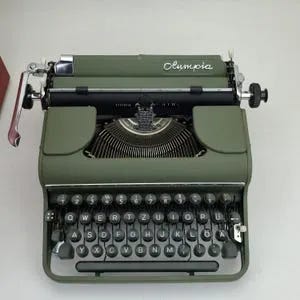
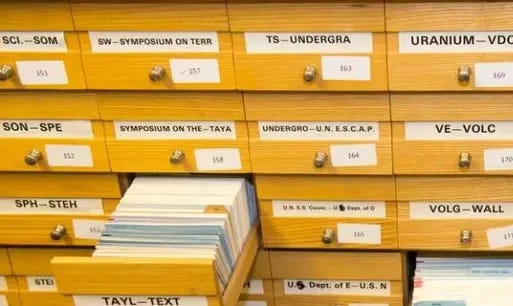
To write those papers, I had to go to the library, where I had to look in actual books, bound journals or current journals, and if I was lucky, microfilm or microfiche (google them; they were very helpful for research purposes).
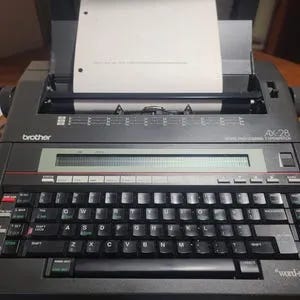
The research process didn’t change in high school, but in high school, I had access to an electric typewriter. Here’s a picture of one of those.

The electric typewriter required the same process as the manual typewriter, but you pushed a button to return to the next line… I’m not going to explain this. Essentially, it was still a pain in the arse to use.
I bought a digital version of the electric typewriter before going to college. This was a step toward word processing, since several lines appeared on a digital screen where you could edit them before printing to paper.
 Then came word processing.
 In a movie, this is where angels would sing as the heavens open. This new tool was a godsend to writers. If you ever wrote on a manual or electric typewriter, you understand; if not, then we might as well be discussing LPs and 8-track tapes.
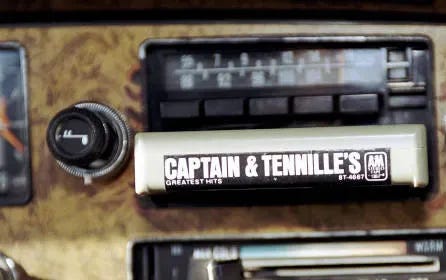
Life doing research papers in college changed instantly, and my digital typewriter was left forgotten. However, you still had to fix your spelling, typos, and grammatical errors manually.
Then came AI.No. I did not skip ahead. The first LLM (large language model) technology was used to scan your content and point out misspelled words and typos. There were also some basic grammar corrections, but that LLM technology came along a little bit later. Then came language translators, which are quite helpful as the world becomes more integrated. The voice-to-text technology and text-to-voice technology you’re using in your messaging apps are also AI-generated.
Should I mention that Google uses LLM technology? No. I’ll just let that one slide.
Here’s a note to the radical, anti-AI purists. YOU are no longer allowed to use your spellcheckers or grammar checkers, language translation, or messaging on your smartphone, because they are AI-driven LLM technology.
What is the truth about AI content generation?The opposing camps, the North vs. South, in the civil war of our time can be summed up as:
AI is taking over the world vs AI makes everything in life better.
Both viewpoints are wrong.In essence, this is the same argument as the gun control argument (that will bring another set of enraged arguments into my comments). Like guns, of their own accord, do not shoot people, neither is AI, of its own accord, taking over the world. Wicked men are using AI to do wicked things, just like wicked men use guns to shoot people.
On the other side of the argument, AI does not make everything in life better any more than guns make everything in life better. In the hands of good men, guns are a tool for helping maintain law and order. AI is essentially a modern tool, just like the tools I described above.
The problem is that people using AI tend to use it blindly, trusting it completely without supervision. Let me give you an analogy.
Let’s say you own a liquor store or a chain of liquor stores. Let’s say you hire an employee to work in your liquor store and you move to Tahiti. You keep track of bank deposits, but you never call in and never have anyone go by and check on your store. What would happen to your liquor store? Product would go missing, sales would drop, and your income would slowly deteriorate to nothing, right?
Why?
No supervision.AI needs supervision. AI needs to be fact-checked. AI sometimes makes spelling and grammatical errors. AI writes sentences that don’t make sense to any human. AI uses an em dash as its primary punctuation. AI sometimes forgets what it’s writing about, producing inconsistencies. There are other issues too, but these are the primary ones.
As a writer, I’ve made my peace with AI-generated content. I realize that AI haters who do not have the time or the talent to produce their own content will still need me to ghostwrite for them, and AI lovers will need me to fix the embarrassing content that AI generators produce for them.
Before I go, I want to pour fuel on the fire I’ve already started by posing a single question:
For years, authors, agents and publishers have used ghostwriters to produce fiction and non-fiction books upon which they place the author’s name. Now, when an author uses AI to do the exact same thing, everyone is suddenly angry and incensed that the book was not written by the person whose name it bears.
So, which one is more ethical?If agents, publishers, and the public are going to demand transparency with AI-generated content, then perhaps it is time that the authors, agents, publishers, and corporations who have been using ghostwriters to produce books and content reveal the identity of their ghostwriters.
Bottom line:AI is a tool.
Used for good rather than evil, it is very helpful for completing certain tasks. However, like the employee in your liquor store or whatever business you run, it requires supervision.
Humanizing AI-generated content is among the services I offer.
PM me for more information or Click Here.
BTW, AI helped me write this; I used it for spelling and grammar. Along with GIMP, I also used AI to generate the banner above (because I ain’t no graphic artist and can’t afford to hire one), and to resize it to fit properly within the text on the page, which uses AI for formatting and posting. Oh, and I used AI to help me find pictures of the various typewriters, the card catalogue, and the 8-track tape player, since I don’t have any of those items in my house and couldn’t take actual photos of them.
Thanks for reading! Subscribe for free to receive new posts and support my work.
August 14, 2026
Never See Their Backs
The Mississippi sun penetrated through Daniel MacLean’s gray wool uniform. It was the summer of ‘63, and they were marching again, not into battle, but away from it. Barely eighteen but with the hard, lean strength a boy used to hard work on his father’s tobacco plantation, he had the watchful eyes of someone who knew horses better than men. He held his piece, but kicked a clod of dirt in frustration.
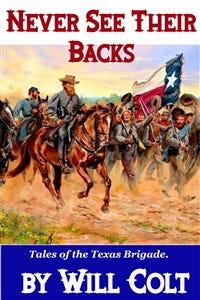
“Retreat again?” Sergeant Miller, a lanky Georgian with a permanent squint, spat a stream of tobacco juice that landed with a soft plop near Daniel’s worn boot. “Seems that’s General Johnston’s favorite tune. A slow, sad waltz away from the fight.”
Daniel ran a hand through his sweat-soaked brown hair. “It’s senseless, Miller. We got good men, good positions sometimes, and he just… pulls back. Like he’s scared to bloody his boots.” His voice, usually a low rumble, held a sharp edge of impatience. Back home on the plantation, whenever something needed doing, you didn’t wait around for somebody else; you did it. Retreatin’ Joe didn’t seem to hold to the same values.
Another soldier, a quieter fellow named Jenkins who looked perpetually lost, chimed in softly, “He’s a strategist, they say. Protecting his men.”
“Protecting us from what? Winning a battle?” Daniel grumbled. He’d heard tales, glorious, terrifying tales, of charges… like Jackson at Second Manassas, or Hood at Gaines’ Mill. Men throwing themselves into the teeth of the enemy, breaking lines, seizing ground. That was fighting. This constant parrying, followed by a slow withdrawal, felt like dying by inches, morale bleeding away drip by maddening drip. He was good with a rifle, deadly accurate from practicing on squirrels and deer back home, and strong enough to handle a bayonet, but his real skill, his love, was horses.
Thanks for reading! Subscribe for free to receive new posts and support my work.
Daniel, along with his older brother Noah, had ridden the plantation’s finest since he was tall enough to swing a leg over a saddle. He enjoyed the power and grace of them as he grew to think of them as an extension of himself. He longed for the chance to use his skill like Noah, who was riding with Mosby’s Raiders. He dreamed of galloping into the fray, sabre flashing, the thunder of hooves drowning out all fear. But under Johnston, there was little call for headlong charges or bold maneuvers. It was mostly marching, falling back, digging in, and waiting.
The talk among the men was the same everywhere – frustration. Whispers of General Bragg’s army up north, fighting in Tennessee, rumors of potential movements, reinforcements. Anything to escape this passive existence.
Then came the order that sent a ripple of excitement through the ranks, a crackle of anticipation like lightning before a storm. General Johnston, or perhaps it was a request filtered down from higher command, needed volunteers. Volunteers to be transferred north, potentially to General Braxton Bragg’s Army of Tennessee. More specifically, some would be assigned to shore up units that had seen hard fighting, including the legendary Texas Brigade, part of Major General John Bell Hood’s division.
Hood. The name itself was a jolt. John Bell Hood had resigned from the United States Army immediately after the Battle of Fort Sumter. Dissatisfied with the neutrality of his native Kentucky, he decided to serve his adopted state of Texas, joining the Confederate army as a cavalry captain, promoted to major and sent to command Brigadier General John B. Magruder’s cavalry in the lower Virginia Peninsula. The aggressive Kentuckian was known for his fierce countenance and a penchant for throwing his men forward like a battering ram. Hood’s Texans and Georgians had ripped holes in Yankee lines at Gaines’ Mill, charging through lead and fury. That was the kind of general Daniel wanted to follow. That was the kind of fighting he ached for.
He didn’t hesitate. Before the officer had finished reading the details, Daniel stepped forward. His heart hammered against his ribs, a mix of excitement and trepidation. Leaving behind the only company he’d known since enlisting was a wrench, but the promise of action, of serving under a man who understood Daniel’s own restless energy, was too strong to resist.
“What’s yer name, boy?” the officer asked, pen poised over a roster.
“Daniel MacLean, sir.”
“You ever rid a horse, boy?”
“Yessir. My brother Noah and I rode all the time before this started. He rides with Mosby.”
“Mosby, huh?”
“Yessir.”
“How old are you?”
“I’m goin’ on nineteen.”
He wrote something on the roster and then moved to the next in line.
They brought out a spirited horse and asked us to ride around obstacles and over barriers to see how well we stayed in their saddle during the test. Those who passed were processed quickly, given new orders, and told to pack light.
The journey to Hood’s camp was a blur of dusty roads, rattling trains, and hurried marches. Daniel was grouped with a handful of other volunteers, a mixed bag from various Virginia regiments. They spoke of home, of past battles, and of the reputation of the unit they were headed towards… Hood’s Texans. The stories were wild, sometimes exaggerated, but the core remained: they were fearless, tough as pine knots, and they charged like the devil himself was at their heels.
When they finally reached Hood’s camp, the atmosphere was very different. Tension and anticipation hung heavy in the air. The men were haggard, but with a hard glint in their eyes that spoke of recent, brutal fighting and victory. They were near Chickamauga Creek in Georgia, a place that sounded peaceful but felt heavy with the weight of an impending battle.
Daniel was assigned to a Texas regiment within Hood’s Brigade. The Texans were a rough-looking lot, clad in a variety of worn uniforms and civilian clothes, many with wide-brimmed hats pulled low. They eyed the new volunteers with a mixture of curiosity and assessment. Daniel, with his quiet competence and easy way with the horses tethered nearby, earned a few nods of grudging respect. He learned quickly that his reputation would be earned. They were laconic, tough, with a form of discipline that hadn’t been forged on the parade-ground, but on the battlefield, where you learned to trust and depend on the man fighting next to you.
Initially, he was assigned to the infantry section of the Texas Brigade, though he was often assigned to tend to the officers’ horses and worked with the horses in the artillery traces.
The days leading up to the main battle were a series of skirmishes, positioning, and waiting. The woods were dense, the undergrowth thick and tangled, making visibility poor and movement difficult. Daniel heard the distant rumble of artillery, the closer rattle of gunfire as probes and counter-probes felt out the enemy lines. He was finally where he wanted to be, on the cusp of a major engagement, under a commander known to attack rather than run away with his tail between his legs.
On the morning of September 20th, the air thrummed with an energy Daniel had only imagined. Orders came down, crisp and urgent. Hood’s Corps, positioned on the Confederate left-center, was to be the spearhead of a massive assault. Specifically, a mix-up in the Union lines had opened a gap, and Hood was to exploit it. It was a rare chance for a decisive blow.
Hood himself rode among his units, a figure of grave intensity. Daniel, dismounted, and moved into line with his adopted Texan comrades, feeling a surge of adrenaline. This was it. The charge he’d yearned for. The chance to be in the thick of it.
When the order came, his nerves were at their limit from waiting. A rolling wave of sound began to surge from the throats of those around him… the rebel yell, starting as a ripple and swelling into a deafening, high-pitched scream that seemed to carry all the frustration, all the courage, all the desperation of the Confederate army within it.
“Forward!” The officers’ commands were lost in the din, but the movement was clear. The line surged.
Daniel ran, rifle clutched tight, the bayonet fixed. The woods were a chaotic, terrifying obstacle course. Trees seemed to leap out at him, branches clawed at his face, and uniform surged through the tangled briers. The ground was uneven, littered with fallen leaves and hidden roots. And through it all came the sound; a roar unlike anything he had ever experienced.
Rifle fire erupted in front of them, a solid sheet of flame and lead. Men around Daniel staggered, cried out, fell. The air filled with the acrid, suffocating smell of black powder smoke, thick and gray, obscuring vision. It tasted like sulfur and death.
He saw a Texan to his left go down, his face a mask of shock. He saw the glint of sunlight on bayonets ahead, the blue uniforms of the enemy emerging from the smoke. There was no more thought, only instinct. Run, load, fire, reload. Push forward. The rebel yell was primal now, a sound ripped from the gut, sustaining the charge.
He fired his rifle at a blue shape in the smoke, saw it jerk. He lowered his weapon and charged forward alongside his comrades. A Union soldier loomed through the haze, wide-eyed. Daniel didn’t hesitate, lunging forward. The man parried with his own bayonet, but Daniel’s farm-honed strength was greater. He twisted, shoved, and felt the sickening give as his bayonet found flesh. He pulled it free, the world narrowing to the immediate, terrifying space around him.
They crashed into the Union line. It wasn’t a neat formation; it was a melee. Hand-to-hand fighting erupted in the smoky woods. Bayonets clashed, rifles became clubs, and men grappled with each other in the undergrowth. Screams, curses, the grunt of exertion, the chilling gurgle of dying men, all mixed in a horrifying symphony.
Daniel fought with a fury he never knew was within him. The frustration that had gnawed at him for months was channeled into furious energy. He parried a bayonet thrust, sidestepped a swinging rifle butt, and fired his revolver at point-blank range into a face distorted by fear. He saw bravery and terror in equal measure, on both sides. He saw men he’d only just met fight with desperate courage, saw others break and run.
They were breaking through. The Union line, caught by surprise and hit with such ferocity, was fragmenting. Blue figures were scattering through the trees, pursued by yelling, bloody Confederates. The charge wasn’t neat; it was a torrent, pouring through the gap, widening it.
Daniel stumbled over a body and caught himself. His uniform was ripped, his hands slick with sweat and the stickiness of blood. His lungs burned, and his ears rang from the continuous roar. He looked around, disoriented for a moment because of the chaos in every direction. Trees were splintered by artillery fire, the ground churned and stained. The reality of the “thick of things” was visceral, brutal, and far more terrifying than he had imagined in his daydreams. In place of his visions of glory was a primal urge to survive, something pure, desperate, and beastly.
He saw the colors of his regiment ahead and pushed himself forward. He rejoined the surging tide, reloading his rifle mechanically. The initial gap was exploited, but the fighting wasn’t over. Pockets of resistance remained, artillery still pounded, and the woods seemed alive with unseen dangers.
He had wanted action, wanted to charge headlong into battle. He had gotten his wish. In the heart of the whirlwind at Chickamauga, surrounded by the noise, the smoke, and the dying, he realized that wishing for battle was a world away from living through it. Despite the horror, a grim satisfaction settled within him. He was there. He was doing his part. He was fighting. He was in the thick of it, just like he wanted to be. Buried under layers of shock and exhaustion, the eagerness was still there, but tempered by the raw, unforgiving truth of the battlefield.
This story features Daniel MacLean from Lonestar Ranger. Available on Amazon.
Thanks for reading! Subscribe for free to receive new posts and support my work.
August 11, 2026
Who Was Otto Mears?
In my historical biographical novel, The Arrow and the Setting Sun, there is a real character who stood by Ouray and Chipeta, doing what he could to help with negotiations. That man was Otto Mears, a man who took the time to not only learn the mountains but also their inhabitants. A friend of Ouray from when he first arrived in Colorado, he is another of the amazing people who were a part of Colorado’s colorful history.
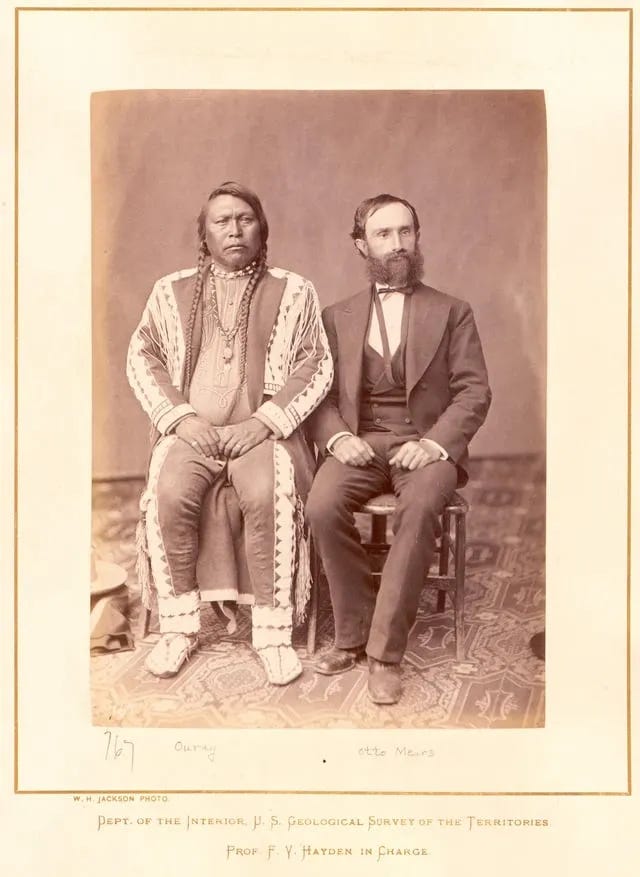 From Orphan to Empire Builder
Otto Mears’ journey began far from the majestic peaks of Colorado. He was born in Russia in 1840 to English parents, and orphaned at a young age, bouncing from relative to relative across Europe and England before landing in New York at the age of eleven. His early life was a masterclass in self-reliance, a precursor to the challenges he would face in later life. He worked odd jobs, taught himself English, and eventually found himself caught up in the defining conflict of his new home: the Civil War.
Thanks for reading! Subscribe for free to receive new posts and support my work.
He served with distinction in the Union Army, fighting in critical battles, like Vicksburg and Gettysburg. From the crucible of war, he emerged with incredible discipline, an understanding of logistics, and unwavering resolve. Restless and seeking new opportunities, Mears drifted westward, eventually landing in Colorado in 1865.
He tried his hand at various ventures, milling, merchandising, farming, and even operating a general store in Saguache, Colorado. At the crossroads of this early Colorado settlement, where he met Ouray and began to learn the Ute language, Mears saw the glaring bottleneck that prevented the region’s prosperity: a lack of adequate transportation. The scattered mining camps, rich with promise but choked by isolation, were waiting for someone to connect them to the wider world. Mears would step into that role.
The Lure of the LodeThe driving force behind Mears’ epic road-building endeavors was simple yet profound: gold and silver. In the late 19th century, the San Juan Mountains were exploding with veins of precious metals, rivaling those found anywhere in the world, transforming desolate valleys into boomtowns overnight. Rich ore bodies were discovered in places like Ouray, Silverton, Telluride, Rico, and Lake City, attracting thousands of hopeful prospectors and miners.
The rugged terrain protecting these riches also trapped them. Getting supplies into the mining camps was a nightmare; pack trains laden with food, tools, and machinery struggled over treacherous trails, often at exorbitant costs. A sack of flour, which might cost a few dollars in Denver, cost ten times that price in a remote San Juan camp. More critically, getting the extracted gold and silver ore out to smelters and markets was an even greater challenge. Miners were literally sitting on fortunes they couldn’t efficiently move.
As one contemporary observer noted, “The mountains give up their treasure reluctantly, and only to those who are willing to fight for it.” Mears understood the fight. Rather than focusing on the problem, he saw an immense opportunity. If he could provide reliable, albeit basic, transportation, he could unlock the region’s economic potential, facilitate settlement, and make a substantial profit for himself in the process. His motivation was a potent blend of public service and shrewd business acumen. He wasn’t just building roads; he was building the infrastructure for an entire economy, fueling the spirit of the American Frontier.
Battling the Behemoth: Six Major Challenges of the San JuansWithout a proper understanding of the sheer, unbridled hostility of the San Juan Mountains, one simply cannot truly appreciate Mears’ achievements. He was not merely dealing with difficult terrain; he was fighting an active antagonist, which constantly tested the limits of human endurance and ingenuity.
1. Altitude Sickness:Many of Mears’ first roads, and certainly his later railroad grades, traversed passes exceeding 10,000 feet, some pushing past 12,000 feet. Cochetopa Pass, Marshall Pass, and the notorious Red Mountain Pass presented challenges far beyond steep grades. The thin air at these altitudes made every swing of a pickaxe, every push of a wheelbarrow, an exhausting ordeal. Men accustomed to lower elevations quickly succumbed to headaches, nausea, and shortness of breath. Work slowed, and the toll on the laborers was immense.
2. Tyrannical Rock:The San Juans are famously rugged, characterized by sharp, erosion-resistant volcanic and metamorphic rock. Building a road in such terrain wasn’t anything like clearing a path through gravel and dirt; it was about blasting through solid granite, schist, and quartzite. Mears’ crews relied on black powder and nitroglycerin to carve narrow ledges into sheer rock walls. This was dangerous, painstaking work. Rockfalls were a constant threat, and the unstable nature of the blasted rock required ongoing maintenance.
3. Obstinate Ice:In winter, the mountains transformed into an Arctic wasteland, buried under dozens of feet of snow. Mears’ roads were often closed for months, and clearing them was a Herculean task involving snow shovels, sledges, and sheer brute force. Avalanches were a terrifying reality, sweeping away sections of road, bridges, and even entire work crews. Even in summer, shaded north-facing slopes and high cirques harbored perpetual snowfields. “Nature,” Mears is reported to have said, “has a way of reminding you who’s truly in charge up here.”
4. Unpredictable Weather:The San Juans presented an array of meteorological nightmares. Blizzards could descend with little warning, trapping travelers and work crews. Summer brought torrential downpours that turned roads into muddy quagmires and triggered flash floods in the narrow canyons, washing away bridges and sections of grade. The temperature swings, from scorching summer days to bitter winter nights, were extreme, contributing to frostbite and heatstroke among the exposed workers.
5. Logistical Nightmares:Every tool, every stick of dynamite, every pound of food had to be hauled in, usually by pack mule, over rudimentary trails that were barely passable. There were no supply depots, no convenient lumber mills, no machine shops. Everything was done by hand, using basic tools: picks, shovels, wheelbarrows, and primitive blasting equipment. Communication was slow and unreliable. A sudden shortage of powder or a broken wagon wheel could halt work for weeks.
6. Remote Desolation:The sheer remoteness added another significant layer to the challenges faced. Away from dawning settlements, Mears’ crews lived in temporary camps, exposed to the elements, isolated from comforts, and often far from any kind of medical help. The work was exhausting, dangerous, and monotonous, attracting a tough breed of men willing to endure hardship for a steady paycheck.
Ingenuity, Conviction, and the Toll GateHow did Mears overcome these monumental obstacles? He wasn’t a classically trained engineer, but he possessed an intuitive understanding of the land and an uncanny ability to find the most practical, if not always the most elegant, solutions.
Mears himself spent countless hours on horseback, traversing the very routes his roads would eventually take. He had an eye for grades, for potential rockfalls, and for the path of least resistance through the most daunting terrain. He understood the economics of his ventures intimately. Rather than waiting for government funding, which was scarce and slow, Mears pioneered the use of private toll roads. He secured special legislative charters from the Colorado Territorial Legislature, allowing him to build and maintain wagon roads through public land and charge a fee for their use.
The strategy allowed him to raise capital by issuing stock and borrowing money, knowing that the immense demand for transportation would generate consistent revenue. The tolls seemed steep to some, a few dollars for a wagon, a few cents for a pack animal, but they were a fraction of the cost otherwise incurred using slow, dangerous, and unreliable pack train services. As one contemporary newspaper put it, “Mr. Mears may charge, but he delivers value. You pay once for a safe passage where before you paid in time, broken wagons, and sometimes lives.”
Mears demanded hard work from his crews, but he also provided fair wages and relatively stable employment. He understood the psychology of his men, many of whom were frontier wanderers and immigrants seeking opportunity. He was known for his personal involvement, often riding the roadbeds, overseeing blasting operations, and ensuring supplies reached his workers. His vision inspired loyalty, and his pragmatic approach kept projects moving forward even in the face of setbacks.
He understood that time was money, especially in the volatile mining economy. He pushed his crews to work quickly, often blasting through mountainsides and building bridges over raging torrents with a sense of urgency. For him, efficiency was paramount.
His first major triumph was the construction of a wagon road over Poncha Pass in 1870, connecting the San Luis Valley to the Arkansas River settlements. This success led to more ambitious projects, including roads over Cochetopa Pass and Marshall Pass, vital arteries for the growing mining districts. He didn’t stop there. He constructed hundreds of miles of toll roads, most famously the network linking Ouray, Silverton, and Lake City in the very heart of the most rugged portions of the San Juans. These roads, though rough by modern standards, were lifelines, transforming days of dangerous scrambling into hours of relatively straightforward travel.
Mears’ Contribution to Settlement and Economic DevelopmentThe impact of Otto Mears’ roads on Colorado settlement and economic development cannot be overstated. He wasn’t just a road builder; he was a nation builder, laying the literal groundwork for civilization in a wild, untamed corner of the American Frontier.
His roads directly led to the establishment and rapid growth of numerous towns. Silverton, Ouray, Lake City, Creede, Durango, and Telluride, now iconic Colorado destinations, were all beneficiaries of Mears’ transportation network. These towns transformed from isolated mining camps into thriving communities with general stores, hotels, saloons, and other businesses, attracting not just miners, but merchants, doctors, teachers, and families. Along with supplies, the roads brought in people, allowing for diversification beyond pure mining. They made life on the American Frontier slightly less brutal, slightly more connected.
Beyond the immediate mining implications, Mears’ roads made the San Juans accessible to a wider demographic. Settlers looking for land, ranchers seeking pastures, and indeed, anyone with a dream of westward expansion found their journey made considerably easier and safer. His roads helped integrate these remote mountain regions into the broader fabric of Colorado, connecting them to the major population centers and railheads farther east. The isolation that had once defined the San Juans receded mile by arduous mile.
One of the most significant, often overlooked, contributions of Mears’ roads was their role as precursors to railroads. Many of his wagon road grades were so well-engineered and strategically placed that they later served as the initial surveys and sometimes the actual roadbeds for narrow-gauge railroads. Mears himself transitioned from being a road builder to a railroad magnate, constructing the legendary Denver & Rio Grande Railroad and others. These railroads further revolutionized transportation and dramatically increased the volume of ore and goods that could be moved. Today’s “Million Dollar Highway” between Ouray and Silverton, a modern marvel, largely follows the spirit and portions of the actual route of Mears’ original toll road.
When Colorado achieved statehood in 1876, Mears was a delegate to the constitutional convention, playing a role in shaping the laws of the new state. He was a political force, a respected businessman, and an undeniable legend of the West. His roads were literally the lifelines that pulled Colorado from a collection of isolated frontier outposts into a cohesive, prosperous state.
A Friend to the Native PeopleWhile one might assert that Otto Mears contributed to the progress that drove the Tabeguache from their land, Mears never saw Ouray and his people as an obstacle to progress. He believed that the Tabguache and settlers could live in harmony in Colorado. His experience with Ouray and his people gave him no reason to believe otherwise. He advocated on behalf of Ouray through various treaty negotiations.
A High Country LegacyOtto Mears passed away in 1931, but his legacy endures. He was, in many ways, the embodiment of the American Frontier spirit. His vision, fueled by the promise of gold and silver, transformed an impassable wilderness into a network of vital arteries. He took on the San Juans, not with brute force alone, but with a blend of ingenuity, business savvy, and sheer determination.
When you visit Colorado and drive its scenic mountain passes, marveling at the dizzying vistas and the sheer audacity of carving roads through such terrain, it’s worth pausing to remember Otto Mears. He was the Pathfinder, the man who tamed the untamable, whose pickaxes and dynamite echoed through the canyons, forging a path for civilization, commerce, and the enduring spirit of the West. His roads weren’t just routes; they were testaments to human ambition, courage, and the transformative power of a single, indomitable will.
Now, when you read about Otto Mears in The Arrow and the Setting Sun, you will know the kind of man who sat beside Ouray in Washington and advocated for the Tabeguache people.
Get your copy of The Arrow and the Setting Sun for only $2.99, August 12th and 13th 2026.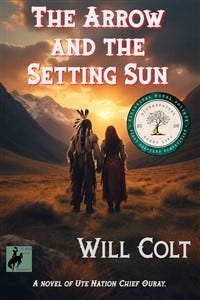
Thanks for reading! Subscribe for free to receive new posts and support my work.
August 6, 2026
Riding with the Grey Ghost
Riding with the Gray Ghost
Episode 1: A True Son of Virginia
The Maryland night behind enemy lines held a certain humid stillness, broken only by the rhythmic creak of saddle leather and the muffled thud of hooves on damp earth. We rode in the shadow of a low ridge, a dozen of Mosby’s Rangers, a grim and silent cavalry, our faces set, our eyes scanning the gloom. I, Noah MacLean, a Virginia cavalier, felt the familiar thrill and tension knotting in my gut, a peculiar blend of apprehension and an almost reckless exhilaration that only these daring raids could stir.
“Hold up,” Mosby’s voice, a low rasp, cut through the quiet. Ahead, through the skeletal branches of a winter-bare forest, a faint, flickering light pulsed. “There she is, boys. The iron snake.”
The target was a Yankee supply train, rumored to be laden with provisions for the Army of the Potomac, rumbling its way through a vulnerable stretch of track near a small crossroads settlement. Our mission: disrupt, destroy, and demoralize.
We waited in a thicket of pines, the resinous scent clinging to the brisk air as an advanced party of four moved through the darkness toward the target. As usual, Mosby’s plan was simple: a swift, brutal strike. Cut the wires, set the charges, hit the train hard, then scatter like quail into the vast, sheltering darkness. I checked the action on my Kerr revolver, the heavy revolver feeling perfectly balanced in my hand, and adjusted the wide brim of my hat. My buckskin mare snorted softly, sensing the impending action with a relish that equaled my own.
Thanks for reading! Subscribe for free to receive new posts and support my work.
“Remember, gentlemen,” Mosby murmured, his eyes glinting in the faint starlight, “hit hard and ride fast. And keep your powder dry.”
The signal was a single, piercing whistle. Then, all hell broke loose.
We burst from the tree line like a bolt of lightning. The air instantly filled with the roar of thundering hooves and the Rebel Yell, the staccato bark of our revolvers, and the answering crackle of Yankee picket fire, adding punctuation to the unfolding drama. The headlight of the train, a baleful eye, loomed through the smoke and confusion. I spurred my mount forward, charging towards the railway embankment, the world a maelstrom of sound and fury.
Dust and cordite were thick in my throat, explosions ripped through the night as charges planted by the advance party detonated, tearing up segments of track and sending shrapnel whistling; some of it quite near my own head. The behemoth of iron and steam screeched to a halt, its whistle letting out a dying wail. Yankee soldiers, caught flat-footed, poured out of the cars, their blue uniforms stark against the flashes of gunfire.
My revolver bucked in my hand, dropping a bewildered infantryman. I reloaded on the run, my senses sharpened to a razor’s edge amidst the chaos. It was pure, unadulterated pandemonium, a glorious, terrifying dance of destruction.
Then, through a sudden lull in the smoke, I saw her.
She was huddled by the side of a small wooden shack, no more than a few yards from the tracks. A young woman, no older than twenty, her modest dress torn, her dark hair disheveled, and her face streaked with dirt and terror. She was caught, truly caught, between two circles of hell. The hail of lead whistling through the air was like the blast of a dozen scatterguns all at once. A stray bullet splintered the wood next to her head, and she cried out, a small, raw sound that cut through the din of battle.
My gentleman’s instincts, honed since childhood in the tidewater manors of Virginia, seized me. This was no soldier, no combatant. This was a civilian, a woman in dire peril. The raid, the mission, faded in that moment. All that mattered was getting her to safety.
“Hold on, ma’am!” I called out, my voice barely audible above the din, and charged towards her.
She saw me coming, a Confederate devil on horseback, my face grim with purpose, my revolver still smoldering. Her eyes, wide and terrified, registered not a rescuer, but another threat, perhaps even worse. I holstered my pistol, hoping I would look less menacing, but as I reached her, she let out a strangled shriek and tried to scramble away, her small hands pushing weakly against my arm as I reached for her.
There was no time for an explanation. The train was burning, Yankee soldiers were regrouping, and our boys were starting to pull back. I moved with practiced swiftness, one arm wrapping around her waist. “Quiet, girl! I mean you no harm!” I commanded, my voice firm but not unkind.
She was surprisingly light as I scooped her up, a bundle of frantic nerves and fear, and swung her onto the saddle in front of me. Her struggles intensified, small fists beating against my chest, a desperate, guttural sob escaping her lips. I gripped her firmly, one hand on the reins, the other holding her secure. “Hush, I say! I ain’t gonna hurt you!”
My mount responded to the pressure of my knees, leaping forward, away from the immediate fray. We rode hard for a few frantic minutes, the sounds of the battle slowly receding behind us, replaced by the steady drumming of hooves and the ragged gasps of the woman in my arms. I veered off the main retreat path, heading for a small, overgrown copse I’d noted on our approach, a place of relative concealment.
When I drew rein beneath the gnarled branches of an old oak, the silence felt deafening. The moon, now higher, cast long, silvery shadows. The woman, still trembling, slowly eased her struggles. I dismounted first, then gently helped her down, careful not to touch her more than necessary. She stumbled, gazing at me with a mixture of terror and utter bewilderment.
“Are you going to…” Her voice was a fragile whisper, hoarse with fear. “What do you want with me?”
I removed my hat, my heart aching at the raw terror in her eyes. “Good heavens, no, ma’am,” I drawled, my voice as calm and reassuring as I could make it. “My name is Noah MacLean, a captain in the Confederate Army of Northern Virginia. I saw you in the midst of that… that hell, and I could not leave you to your fate in good conscience.”
She just stared, her chest heaving, tears silently tracking through the grime on her cheeks. “You… you took me… you were so fast…”
“There was no time for pleasantries, I fear,” I explained, gesturing vaguely towards the distant glow of the burning train. “I had to remove you from harm’s way.” I took a careful step back, giving her space. “Are you injured, ma’am? A cut, a bruise, perhaps?”
She shook her head slowly, still wary, but a flicker of understanding dawning in her eyes. “No… no, I don’t think so. Just… frightened.” She wrapped her arms around herself, shivering despite the mild night air. “I live… I live in that house, by the tracks. My pa works for the railroad. I was just fetching water…”
“A terrible place to be, miss, when Mosby’s men come calling,” I said softly, the faint wisp of a smile touching my lips. “May I inquire your name?”
“Sarah,” she whispered, her gaze still fixed on my face, searching. “Sarah Miller.”
“It is an honor to make your acquaintance, Miss Miller, though I regret the circumstances. Speaking of water.” I reached into my saddlebag, pulling out my canteen. “You look as if you could use a drink.”
She hesitated for a long moment, then slowly reached out, her fingers brushing mine as she took the canteen. She drank deeply, greedily, the water splashing down her chin. As she lowered it, some of the tension eased from her shoulders.
“Thank you,” she said, her voice a little stronger now. “I… I truly thought… I thought you were one of them. One of the raiders, come to…” She trailed off, unable to voice the thought.
“I am one of the raiders, Miss Miller,” I said gently, “but I am also a gentleman. And a gentleman does not allow a lady to perish in a hail of bullets, regardless of her politics or his.” I paused, then continued, “Are you well enough to make your way back? The fighting should be over, but Yankee patrols will be out searching, I assure you.”
Her eyes widened again. “I… I can’t go back there. My pa… what if he was…?”
“We struck the train, Miss Miller, not the houses,” I reassured her. “And the soldiers were our target. Your father, if he were not on the train, should be safe in his home. But it would be wise to wait until morning light to check.” I scanned our surroundings. “There’s a small, abandoned cabin about a half-mile north of here. It’s little more than a shack, but you could shelter there until dawn.”
Her gaze met mine, suddenly vulnerable. “Can you… take me there?”
My orders were clear: regroup with the others. But what was my honor worth if not to protect the innocent? “Of course, Miss Miller. It would be my pleasure.”
The walk to the cabin was quiet. Sarah walked a few paces behind me, still wary but no longer outright terrified. I kept my senses alert for any approaching patrols. The cabin was crude, long abandoned, but it offered shelter. I pushed open the creaking door.
“It’s not much, I’m afraid,” I said, stepping aside for her. “But it will keep the dew off you. I must rejoin my command.”
She turned, her face silhouetted against the faint moonlight. “You’re leaving, then?” There was a strange note in her voice, perhaps disappointment, perhaps just lingering fear.
“As much as I would like to keep you company, Miss Miller,” I replied, a pang of reluctance in my chest. “Duty calls and Mosby’s Ghosts do not linger.”
“You are a ghost, then?” she smiled as she asked the question. It was radiant, the sort that made a man want to put down roots right where he stood.
“Reckon I am, ma’am,” I responded, my lips parting with a broad grin.
“So, you will simply fade into the night, then?”
“I’m afraid it is the way of things in our spot in history.”
“I suppose it is.”
Feeling a pang of regret in my chest, I steeled myself against my emotions, swept my hat from my head in a flourish, and bowed. “May God keep you safe, Sarah Miller.”
“And you, Noah MacLean,” she said softly, her eyes holding mine for a beat longer than necessary. Then she slipped inside the cabin.
I mounted, turning my mare’s head back towards the general direction of our retreat. The image of Sarah, small and vulnerable, then resolute in her fear, clung to me. Her simple courage, her quiet beauty, had touched something within me, a part that war had long sought to harden.
The ride back to the rendezvous point was a solitary one. The moon sailed high, casting the Maryland countryside in ghostly silver. My comrades would be well ahead, leaving me to catch up. But I didn’t mind. My thoughts were consumed by Sarah. Her wide, frightened eyes, the way her hair framed her face, and the quiet dignity with which she accepted my help. She was a breath of fresh air in a world choked with smoke and powder, a poignant reminder of the life we were fighting for, a life of peaceful farms and quiet homes, not burning trains and desperate charges.
I found myself wondering if she was truly safe, if her father was unharmed, if she would ever think of the Confederate cavalier who had plucked her from the jaws of chaos. It was foolish, perhaps, in the midst of a war, to dwell on such a fleeting encounter. But her image had imprinted itself upon my mind, a fragile bloom in a field of thorns.
My reverie was abruptly shattered.
My mount, usually so steady, shied suddenly, her ears flicking forward. A low whinny, not hers, echoed from the dense line of trees to my left. Then, a voice, sharp and guttural, cut through the night.
“Halt! Who’s there?”
Yankees. A patrol. I could feel the cold dread creeping up my spine. Too close. I must have strayed too far to the west, lost in my thoughts of Sarah. My hand instinctively went to my revolver.
“Answer, or we fire!”
There were at least three of them, maybe more, their dark shapes emerging from the shadows, carbines already raised. I could see the glint of steel, the pale oval of a face. They’d spotted me before I’d spotted them.
“Virginia!” I roared, the old battle cry escaping my lips before I could think. It was a challenge, a declaration.
And then I dug my spurs into the flanks of my mount.
She surged forward with a burst of power, a loyal mount in battle, knowing instinctively what was required. Shots immediately rang out, tearing through the air around me. I leaned low in the saddle, making myself a smaller target, the wind whipping past my ears.
“Get him! He’s one of Mosby’s devils!” a voice shouted, closer now.
I twisted in the saddle, drawing my revolver and firing back, not aiming for a killing shot, but to disrupt, to sow confusion. One of the blue-clad figures stumbled, and another let out a curse. My aim, even at a gallop in the dark, was true.
They gave chase, their horses thundering behind me. The terrain was broken, a mix of open fields and scattered groves of trees, perfect for a mounted pursuit. I pushed my buckskin mare hard, demanding everything she had. She was fast, but their horses were fresh, and the odds were against me.
“Fan out!”
“Don’t let him get into the woods!”
I did not think about my pursuers; my eyes scanned the terrain ahead, looking for any advantage, any cover. A small, winding creek was there, its banks thick with reeds. Risky, but it was my best shot. I guided my mount towards it, forcing her to leap into the narrow, rocky stream, the splash echoing in the night. The Yankee riders hesitated for a moment, then plunged in after me.
I fired another shot, reloading smoothly as I rode, the process second nature. The metallic click of the cylinder in the darkness was a strangely comforting sound. One of the pursuing riders let out a cry of pain. Good. Fewer of them to worry about.
They were closing. I could hear the panting of their horses, the clatter of their gear. I risked a glance over my shoulder. Two men, determined, riding hard. Their carbines flashed again, bullets whining past my head like angry bees.
I had to lose them.
Ahead, a dense patch of forest rose, a dark, impenetrable wall. But I knew its secrets. I’d scouted this area before. There was a deer path, barely visible, that would lead me to higher ground, offering a vantage point and a chance to escape.
I spurred my mount again, driving her into the trees, ducking beneath low branches that scraped against my hat and shoulders. The Yankee riders, less familiar with the terrain, hesitated at the dense tree line. I heard their frustrated shouts, their horses snorting nervously.
“He went in there! Keep after him!”
I plunged deeper, trusting my mare’s instincts, her hooves finding purchase on the uneven ground. The path twisted and turned, ascending gradually. I could hear them crashing through the undergrowth behind me, their pursuit less organized now. My revolver was empty, and I had no more cartridges to load. I holstered it, drawing my saber instead. If it came to it, I would not be taken easily.
But it wouldn’t come to that. Slowly, steadily, the sounds of their pursuit faded. The climb grew steeper, then leveled out. I reached the crest of a hill, a dark silhouette against the waning moon. Below, I could hear nothing but the rush of the wind through the pines. They had given up.
I allowed the buckskin mare to slow to a walk, patting her neck, feeling the powerful muscles tremble beneath my hand. “Good girl, my beauty,” I murmured, “you saved us again.”
We rode on, leaving Maryland behind, finally crossing into the familiar territory of Virginia as dawn broke. The first rays of the sun painted the eastern sky in hues of rose and gold, the world awakening, new and clean. I was exhausted, bone-weary, but alive.
And even as the rising sun burned away the last vestiges of the night’s danger, the image of Sarah Miller was foremost in my thoughts. The daring raid, the thundering escape, they were the kind of adventures a cavalier lived for. But that brief, quiet moment with her was what truly resonated. It was a memory I would carry, a silent promise to the very ideals I fought for… a true son of Virginia.
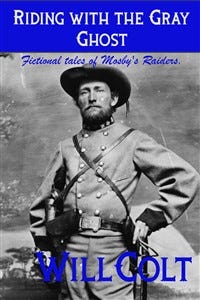 This story features Noah MacLean from The Cavalier:Available on Amazon.
Will Colt Westerns: Stories where integrity survives in a harsh land.
This story features Noah MacLean from The Cavalier:Available on Amazon.
Will Colt Westerns: Stories where integrity survives in a harsh land.
Thanks for reading! Subscribe for free to receive new posts and support my work.
Riding with the Gray Ghost
The bullet took my hat off before I heard the shot.
I’d been riding the western tree line at a canter when the crack split the air, and the wind of it passed close enough to raise the hair on my scalp. I turned my horse hard, driving him down into a dried creek bed. I lay flat against his neck while two more shots snapped through the branches above us. Union cavalry. Three of them, maybe four, breaking from the opposite tree line at a gallop.
I didn’t panic. My father, Malcolm MacLean, had taught me that fear was like the weather; real, unavoidable, and ultimately beside the point when there’s work to be done. I waited until I could hear the breathing of the lead horse, then wheeled my mount hard on its haunches and rode south through gaps in the timber that I knew and they didn’t. By the time they cleared the creek, I was already gone.
That little adventure is probably what got me reassigned.
Three days later, the general summoned me to his tent.
Thanks for reading! Subscribe for free to receive new posts and support my work.
I’d ridden with General J.E.B. Stuart long enough to know that when a man like him recommends you to another, it ain’t a compliment he throws around lightly. He wasn’t the kind of commander who tossed his men about carelessly, especially the ones he trusted most. So when he called me in on that gray morning, I listened the way my father had taught me, hands still, eyes quiet, mind open.
He wasn’t wearing that wide, theatrical smile he kept for the newspapers and admiring crowds. His slouch hat with its ostrich plume hung limp on a hook in the corner of the tent while he turned his words over in his mind before speaking.
“MacLean,” he said, a furrow on his brow. “I’m not in the habit of sending my best men to another unit, but in this case, I think you’re a perfect fit for something new. I’m sending you to ride with John Mosby. It’s an experiment, truth be told, a small, specialized outfit designed to operate behind enemy lines, cause chaos, disrupt supply chains. Irregular in every sense of the word.”
I held my peace. I’d heard the name. Most men in Virginia had. It had been murmured around campfires and at tavern tables. A partisan lawyer operating somewhere in Loudoun County, creating all kinds of havoc. That was about all anybody really knew.
“Sir,” I said. “I’ve heard of him.”
“Hearing and knowing are different ends of a horse.” Stuart leaned forward. “Mosby is one of the finest leaders I’ve come across in my experience in the army. What he does with thirty men makes most commanders weep with envy.” He paused, studying me. “He needs men who can ride, men who don’t panic, think fast in a tight spot, and who understand horses the way a Presbyterian preacher understands scripture. That’s you, Mac.”
High praise. I knew it. I felt it settle on my shoulders like something heavy and warm. But I also felt the weight of leaving the only command I’d come to trust, led by a man I’d known most of my life, a friend of my father’s since before I could recall.
“I ride for you, General,” I said.
“You ride for Virginia,” he corrected me. “He makes his own decisions about who rides with him, so you’ll have to prove yourself. I’ve no doubt you will.”
I met Mosby three days later at a farmhouse outside Middleburg, in the long gray throat of Loudoun County. Spring hadn’t yet arrived, so the countryside was iron-cold and still, bare trees standing like stripped fence posts along the frozen lanes. I’d ridden alone, as instructed, and tied my horse to a post outside a plain clapboard house where a thin curl of smoke rose from the chimney.
I don’t know exactly what I expected. Maybe Stuart’s theatrical dash, or the broad commanding presence of a man like Wade Hampton. What I found when I stepped inside was something else altogether, and it put me off-balance in ways I couldn’t quite put into words for a good while after.
He wasn’t a big man. That was the first thing I noticed. John Mosby was lean and compact, built like a thoroughbred, all economy and tension, nothing wasted. He sat at a rough table with a tin mug of coffee and a sheaf of papers. When he looked up at me, his eyes were something else. Pale, sharp, and still, the kind of eyes that didn’t so much look at you as take stock of you. I had the uneasy feeling that within five seconds after walking in, he’d already formed several complete and accurate opinions about me and was waiting, with patient amusement, to see if I’d bear them out.
“MacLean,” he growled.
“That’s right, sir,” I said.
“Stuart spoke highly of you.” Flat, matter-of-fact, neither admiring nor dismissive, like Stuart’s opinion was something to be weighed against what he could see with his own eyes. “He says you ride like a centaur and you don’t panic.”
“I try not to, sir,” I said.
He almost smiled at that. Almost. There was a flicker at the corner of his mouth that might’ve been humor, might’ve been something else. He gestured to the chair across from him, and I sat.
What followed was the strangest military briefing I’d ever sat through. Mosby didn’t talk the way other officers talked. He didn’t issue orders in the regular way, didn’t unfurl maps with grand sweeping gestures, didn’t say a word about glory, the Confederacy, or the righteousness of the cause. He spoke in straight, flat lines, like he was working out a sum. He asked me questions about horses, not about my nerve or my loyalties. They were specific, practical questions about how horses behaved in darkness, how they handled various types of terrain. I answered each one as straight as I could, and each answer got that same quiet, cataloguing stillness from him.
At one point, he stood and walked to the window, staring out at the frozen lane for a full minute without a word. I held my tongue. I’d figured out real quick that silence was one of Mosby’s native languages and that cutting into it was a poor idea. It was a language I spoke as well.
Then he turned and spoke without preamble. “We’re going to Fairfax Courthouse in a few days. There’s a Union general quartering there who won’t expect us. I intend to collect him.”
I looked at him. “Collect him?”
“Capture,” he said, though his tone made plain that collect was the more fitting word, like the general was some unusual specimen to be plucked from his habitat. “General Stoughton. Sleeping in the Gunnell house at Fairfax. His pickets are poorly placed, his men are comfortable and overconfident, and the ground between here and there is something I know considerably better than they do.” He sat back down, picked up his coffee, and looked at me, calm as a man discussing the weather. “We leave the night of the eighth of March. You’ll ride with us.”
“How many men?” I asked.
“Twenty-nine,” he said in a dry tone. “Including you.”
Twenty-nine men to ride into a fortified Union position and pull a general out of his bed. I thought of Stuart’s words: what he does with thirty men makes most commanders weep with envy.
“Yes, sir,” I said, feeling a lot less confident than my tone projected.
He studied me for a moment. There was a flicker at the corner of his mouth as plain as day, a real smile, like a kid about to get into mischief with a few of his friends.
The days between that meeting and the raid were educational. I rode with the Rangers through the Loudoun countryside, getting a feel for how Mosby moved and thought. Those I was riding with weren’t like any soldiers I’d known before. No formations, no drilling, no bugle calls or regimental ceremony. What they had was a deep, practiced familiarity with the land, every hollow, every ford, every farm track through the dark, and their mounts.
Mosby himself was a constant source of fascinated puzzlement to me. He seemed to run on a frequency slightly off from that of regular men. He could go silent for hours in the saddle and then, out of nowhere, deliver a perfectly formed and deadly-accurate observation about the Union army’s strategic failures. He read constantly, not military manuals, but history and law, which had been his trade before the war. He had a lawyer’s mind, and he put it to warfare with cold, clean precision.
He was also, I came to find, not vain in the way Stuart was vain. Stuart’s bravado was bound up tight in who he was, a performance as genuine as it was calculated. Mosby had none of that. He wore his scarlet-lined cape not for effect but because he always had and saw no reason to quit. When I brought up Stuart’s plumed hat one evening around a small fire, Mosby considered it a moment.
“Jeb performs,” he said simply. “He’s very good at it, and it serves a genuine military purpose. Fear and admiration are strategic resources.” A pause. “I’d rather be invisible.”
He wasn’t unkind. He was just precise. He gave every man in the outfit the same level of considered attention, asking the right questions, remembering the answers with unsettling accuracy. When young Billy Payne’s horse threw a shoe on a rough stretch of road, Mosby had already noted a farmstead three miles back where a spare mount was available, because he’d talked to the farmer’s wife four days prior and reckoned it worth keeping in mind.
That was Mosby all over. He held on to everything that mattered and let nothing slip away that might one day matter. His mind was an extraordinarily tidy place, and being in his orbit felt at times like standing inside a clock, complex, purposeful, running to a precision you could feel but couldn’t quite put your finger on.
The night of the eighth of March came in cold and pitch-dark. A steady rain had been falling all afternoon, and the ground was sodden and quiet, which suited us just fine. Noise carries on dry ground. On wet ground, we were ghosts before we’d even started.
I saddled my horse in the dark of a barn outside, listening to the low murmur of twenty-eight other men doing the same: no bravado, no loud talk, no false courage. The Rangers were quiet by nature, shaped by their commander’s way, and they moved through their preparations with a calm I’d grown up with and found steadying. Instead of being scared, I was focused, every sense sharp.
Mosby came out of the dark already mounted, his horse a dark shape against the deeper dark of the tree line. No distinguishing insignia, nothing to pick him out at any distance. He looked us over in the darkness, then turned his horse south-east. That was the whole of his pre-battle address. He just rode, and we followed.
Fairfax was roughly fifteen miles through darkness and wet country. Mosby led us at a steady, easy pace, navigating by some mix of instinct and a near-supernatural feel for the ground. We moved through a landscape that felt held in place, like the night itself was holding its breath.
I rode near the front, close enough to watch him plainly. He was something to see on horseback; easy in the saddle, his pale eyes moving steady and calm through the darkness, reading it the way a man reads a page he knows by heart. The way my mama used to read the Psalms. Once he raised a hand, and we all pulled up, sitting silent. He listened for maybe thirty seconds. Then he pointed slightly south, and we shifted our line without a word between us.
Whatever he’d heard or worked out, we never learned. He just knew, and we trusted the knowing.
We rode into Fairfax village well after midnight. Streets empty, houses dark, the Union encampment still and heavy with sleep. The rain had thinned to a cold mist, and our horses’ hooves were near-silent in the soft mud. My heartbeat picked up as we slipped through the gaps in the picket lines. Gaps Mosby had picked out beforehand with his usual methodical care.
He’d sent a scout to map out picket positions days earlier. Mosby had studied the map drawn for him in the dirt the way a surgeon studies a diagram, but he was a surgeon who knew the ground without a map; it just served as a means of planning his approach. “Union overconfidence,” he’d told us flatly, “was their biggest liability in Fairfax. They believe their lines are a wall. A wall with gaps isn’t a wall. It’s a suggestion.”
We moved through the suggestion with care, breaking into small groups on Mosby’s silent say-so, covering approaches to the Gunnell house, dealing with scattered sentinels with as little fuss as possible. I was among the group that rounded up a clutch of bewildered Union troopers sleeping in a stable on the north end of the village. They were so completely unprepared for us that they had initially mistaken us for a Union patrol. By the time they’d sorted out what was actually happening, they were already bound and gagged.
I tied off three horses and waved the captured men toward a colleague with a rifle, then moved to the rally point outside the Gunnell house. The whole thing had the feel of something run through a hundred times, even for me, who’d only ever run it in my head.
Mosby had gone inside.
I got the details after the fact, from men who’d been with him, and from Mosby’s own brief, comically flat account. He’d entered the house, found a servant, identified himself without so much as a pause, and gone upstairs to the bedchamber of Brigadier General Edwin Stoughton. Finding the general asleep, Mosby had lifted the man’s nightshirt and given him a firm swat across the hindquarters with a glove to wake him up.
When Stoughton awoke, furious and confused, he demanded to know what in the hell was going on. Mosby, with the calm of a man filing a legal brief, asked whether the general had ever heard of John Mosby.
Stoughton said yes.
“Well,” Mosby reportedly replied, “I am Mosby. Stuart’s cavalry is now in possession of the Court House, and you are my prisoner.”
I’ll admit that when I heard that, standing in the wet dark outside with a captured Union soldier’s horse at my side, something shifted in me. The wariness I’d been carrying since Middleburg, that careful reservation I’d held onto toward this strange, quiet, precise man who was nothing like the general I’d known most of my life, simply stopped mattering. It wasn’t that Mosby was unlike Stuart. It was that they were different tools serving a different purpose.
Stuart played the cavalry charge like a brass fanfare, loud, magnificent, unstoppable. Mosby played the night like a fiddle, precise, close, and devastating. Both made music. Both won battles.
Mosby came out of the house with Stoughton and two other captives in tow, moving with that same unhurried, matter-of-fact efficiency he brought to everything. He glanced over the assembled prisoners: Stoughton, two other officers, and nearly thirty enlisted men. The most valuable loot taken that night, however were the fifty horses we gathered up.
“Time to leave,” he announced, as though we were leaving a general store.
We rode north into the darkness and the mist, carrying no dead and no wounds worth mentioning. I rode at the rear for part of the journey, listening to the steady rhythm of hooves and the occasional low murmur of the men around me, turning over what I’d just been part of.
By the time the first gray light found us north of the Bull Run Mountains, I’d made up my mind about John Mosby, much sooner than I’d expected to.
He wasn’t what I’d come to think of as a commander. He was odd and quiet and kept a kind of cool, intellectual distance that sat uneasily alongside the warmer, more human bravado of Stuart’s command. He offered no theatre, no shared story of glory, no plumed assurance that God and Virginia were riding stirrup-to-stirrup with us.
What he offered instead was something that, in the cold gray light of a morning after the impossible, seemed worth a good deal more than any of that.
I pulled up alongside him as we crested a low ridge and the valley opened before us, pale and clean in the early light. He was looking at the horizon with those cataloguing eyes, already thinking ahead, already sizing up the next problem.
“General Stuart was right,” I said.
He glanced at me. “About what in particular?”
“About you, sir,” I said.
He sat with that a moment, still as ever, and then he gave me the full smile, not the flicker, but the real thing, brief and surprisingly warm.
“He was right about you, too, MacLean,” he returned. Then he turned back to face the horizon, and we rode on.
The stories of what happened at Fairfax Courthouse on that March night spread quickly enough: a Union general lifted from his own bed, a fortified position walked through without a shot fired, the twenty-nine men who pulled it off disappearing like smoke. A new name came along with the stories, arriving the way good names do, when nothing else is the right fit: the Gray Ghost.
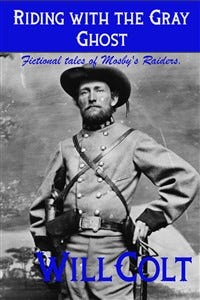 This story features Noah MacLean from The Cavalier: Available on Amazon.Will Colt Westerns: Stories where integrity survives in a harsh land.
Thanks for reading! Subscribe for free to receive new posts and support my work.
A New Kind of Ore
Spring 1883
Spring arrived in Lake City with a grudging reluctance to relinquish winter’s icy grip. But the sun, higher in the sky each day, began to assert its influence. The snow on the lower slopes receded, revealing patches of damp, dark earth, and the sound of rushing water became a constant symphony as meltwater swelled the Lake Fork and Henson Creek. Jap MacGregor, a man whose life revolved around the rhythms of the mountains, announced the inevitable: “Cinnamon Pass is opening, lads! We’ll be runnin’ stages through to Silverton by the start of April, weather holdin’.”
A buzz went through the MacGregor Stage Line office. The Sapinero run was steady, but the Silverton route over Cinnamon Pass was the true backbone of their operations, connecting Lake City and its surrounding mines to the silver camps of the western San Juans. It was a route famed for its beauty and its brutality, a seventy-mile stretch of unforgiving terrain that demanded the utmost from man and beast.
One morning, after another week of Sapinero runs, Jap called Rory into his office. “Fraser,” he began, his keen eyes appraising the young man. “You’ve taken to these roads like a badger to a burrow. You got a feel for the horses and a calm hand on the lines. And you’re not one to dither. I’m puttin’ you on the Silverton run in the mornin’.”
Rory’s pulse quickened. He nodded, accepting the challenge without a word. He knew what this meant. This wasn’t just about proving himself; it was about stepping into the real heart of the San Juans, a place where the mountains truly held sway.
Thanks for reading! Subscribe for free to receive new posts and support my work.
His first run over Cinnamon Pass was a revelation, far exceeding the challenges of Taylor Canyon or even the treacherous Cumberland Pass. The road started up the canyon, skirting Lake San Cristobal, a natural lake created by the Slumgullion Slide. It followed the Lake Fork River toward its headwaters, veering north at Cataract Gulch to Grizzly Gulch. Staying in the valley of the Lake Fork, it looped around Whitecross Mountain, turning south before beginning a slow, relentless climb above timberline, following a tributary toward Cinnamon Mountain, so called because its red-brown slopes were the earthy color of cinnamon. Snow was still patchy all along the route, but the spring thaw was only just getting started as the stage crossed over the pass.
Still early in the season, only two passengers rode in the sturdy Concord, which felt like a featherweight contraption against the sheer scale of the landscape, especially when compared to the ore wagons he’d driven in Leadville and Tin Cup. Rory sat high on the box, lines in his gloved hands, his eyes constantly scanning the path ahead. The six stout horses strained against their harnesses, their powerful haunches churning through mud and lingering snowdrifts. The view from the summit was captivating. He was surrounded by snow-capped giants like Red Cloud Peak to the southeast, Engineer Mountain to the northwest, with Wetterhorn, Matterhorn, and Umcompahgre Peaks standing guard to the north. It was a raw, untamed wilderness above a maze of river valleys that snaked their way toward the southwest, the most immediate being the Animas River valley.
The road was a constant series of hazards. In places, it narrowed to a single track, hugging a sheer cliff face with a thousand-foot drop into the canyon below. Other sections were a chaotic jumble of loose rock and gravel, requiring a delicate touch to prevent the coach from skidding. Sudden, unmarked ruts, carved by erosion and countless passing wagons, could snag a wheel and send the coach lurching violently.
Along with road hazards was the weather. The San Juans were capricious. A clear, crisp morning could dissolve into a blinding storm within an hour, or a sharp, sudden hailstorm that rattled against the coach roof like a thousand tiny hammers. Rory learned to read the clouds, the subtle shifts in wind, the tell-tale chill that preceded a change. He carried a heavy buffalo hide lap robe, wore a thick wool coat, and sturdy mittens, but even those were sometimes barely enough against the biting wind that funneled through the high passes in the spring.
Despite the constant tension, Rory felt an undeniable exhilaration. Hauling freight had been about brute force, about pushing through. Driving the stagecoach over Cinnamon Pass was a test of finesse, of timing, of a near-symbiotic relationship with his team. He drove at speeds that would have terrified less experienced men, the coach swaying and rumbling over the rough track. He barely felt the weight of the passengers in the coach behind him, but his mind was always cognizant of their lives entrusted to his steady hands. The responsibility, rather than being a burden, sharpened his focus, made him more acutely aware of every tremor and every shift in terrain.
He quickly learned the rhythm of Cinnamon Pass. The long, arduous climb out of Lake City, the brief, wind-whipped respite at the summit, and then the controlled, treacherous descent down into the Animas Valley to Silverton. He learned the rhythm of the swing stations, where fresh, eager teams were waiting, stomping their hooves in anticipation as the passengers stepped down for a brief rest. The horse changes were a blur of practiced efficiency, the new team hitched and ready to go in minutes, eager to maintain the tight schedule. Rory, quiet as ever, communicated with the stable hands and station masters with curt nods and efficient gestures, his competence speaking volumes.
He also learned the quirks of the road and the way the wind ripped through various gullies, threatening to unbalance the coach. He found himself relishing the speed, the feeling of the powerful horses pulling against the coach, the controlled chaos of it all. It was a dance between momentum and control, in constant negotiation with the unforgiving mountain. This was an entirely different kind of work than the slow, steady grind of freight hauling, and Rory found that he preferred it. The pulse of the stagecoach, the feeling of velocity, was a thrill that settled deep in his bones.
While his inherent quietness remained, the nature of stagecoach driving demanded a different level of interaction. Passengers, often nervous or simply curious, would call up to him from the coach window. “How much further to the summit, driver?” “Is this road always so… narrow?” “Any sign of snow?”
Rory would offer concise, reassuring answers, his voice calm and steady. Whenever he felt particularly gregarious, he’d point out landmarks, like the remnants of an old mining camp, a particularly stunning view of a distant peak, or explain the conditions of the road ahead. He carried an air of quiet authority, his competence evident in his lean, muscular frame and in the steady grip of his hands on the lines. Passengers, whether a grizzled prospector, a nervous merchant, or a well-dressed lady, quickly came to trust him.
One early afternoon, as the May sun began to warm the high country, Rory was preparing for the run from Silverton back to Lake City. A single passenger arrived for the journey, drawing a few admiring glances from the station hands. She was a woman of undeniable presence, perhaps in her thirties, draped in a coat of rich, dark velvet, her hat adorned with a bold feather that seemed to defy the conventions of mountain wear. Her face, framed by dark, carefully coiffed hair, was striking, marked by intelligent, lively eyes and a confident, almost mischievous smile. She moved with an easy grace, a whispered rustle of silk beneath her heavy coat.
Rory, as always, helped her with her bag and assisted her into the coach. He barely spared her a second glance, his mind already on the condition of the road and the temperament of his lead horses. He swung himself up to the box, and with a practiced flick of the lines and a sharp, “Yay!” to his team, the coach lurched forward.
The woman was his only passenger for the first leg of the journey, making the coach feel uncannily light. As they rattled along, she leaned out the window, her voice carrying clearly over the rumble of the wheels. “Driver, my compliments on your skillful hand. I’ve ridden these roads for years, and few have your touch.”
Rory grunted a quiet “Thank you, ma’am.”
“You’re new to the line, aren’t you?” she continued, her voice warm and melodious. “I don’t recall seeing a face as fresh as yours on this run.”
“Just started on Cinnamon Pass back in April,” Rory admitted, tightening his grip as they rounded a particularly sharp bend.
“Well, you handle it like an old hand, then,” she chuckled. “Where did you learn to manage a team like this?”
Rory gave her a clipped summary of his work with Silas Blackwood’s freight company, omitting the more dramatic details of his past. The woman listened intently, asking intelligent questions about the challenges of the road, the character of the horses. She seemed genuinely interested, and Rory, despite himself, found himself speaking more freely than usual, explaining the nuances of reading the terrain or anticipating a horse’s mood. He found her company pleasant, her conversation engaging. She was clearly a woman of the world, well-traveled, and sharp-witted. He assumed she was perhaps a successful businesswoman or the wife of a mine owner, traveling back to Lake City to spend the warmer months.
She attempted to continue her conversations with him at the various swing stations, but with little success, as Rory was extremely busy changing the team. When they finally descended into the familiar valley of Lake City, the buildings appearing as if conjured from the mountain mist, the woman leaned out once more. “Driver,” she called out to him. “May I have a moment of your time when we arrive at the station?”
“Sure, ma’am,” he responded, puzzled by the fact that she wanted to speak to him further.
The stagecoach rattled to a halt in front of the MacGregor Stage Line office. Rory, still slightly flustered but ever the professional, jumped down and went to assist Clementine, but he quickly discovered a line of men scrambling to help his passenger out of the coach. As she gracefully dismounted, the velvet of her coat swishing, she met his eyes, a glint of amusement dancing in her own, and once on the ground, she made a beeline for Rory.
“You’re a good man, Rory Fraser. And a fine driver,” she beamed, extending a lace-gloved hand. “I’d be much obliged if you’d consider calling on me sometime, off-duty, of course. For a proper conversation, perhaps a glass of something fine. My establishment is well-known, and I assure you, you’ll be treated with the utmost discretion and hospitality.”
Rory, caught off guard by the unexpected invitation, stammered, “Uh, ma’am… I appreciate the offer. Where might… where might I find you?”
She smiled, a slow, knowing curl of her lips that somehow managed to be both alluring and gently amused. “I reside in that large two-story house on Willow Creek Road, just a stone’s throw from the opera house. Everyone knows the place, just ask for Clementine.”
She deliberately spoke a little louder, ensuring her words carried to the bystanders, which included Jap MacGregor and a couple of other drivers who had just come out for a smoke.
“You won’t forget, now, will you, Rory? Clementine. And I’m the one,” she paused, her smile widening, her voice a playful purr, “who put the ’UUUUUMMMM in Umcompahgre.”
With a final, elegant nod, she swept away, leaving Rory standing beside the coach, his mouth slightly agape. Jap MacGregor, who had been leaning against the office doorframe, slowly straightened up, a grin spreading across his face. One of the other drivers, a grizzled old-timer named Gus, let out a low whistle.
“Well, well, well, Fraser,” Jap drawled, his eyes twinkling. “Looks like you’ve made quite the impression on Clementine. You know who that is, don’t you?”
Rory, his face slowly turning a deep crimson, shook his head. “Just a passenger I brought over from Silverton.”
Gus snorted, then burst into a fit of coughing and laughter. “A passenger, he says! That’s Clementine, boy! The Clementine! Runs the finest establishment this side of Denver! Willow Creek Road ain’t exactly for boarding house ladies, if you catch my drift!”
The implications hit Rory like a runaway freight wagon. Clementine. Willow Creek Road. The “finest establishment.” His mind, still steeped in the simpler, more straightforward world of an Indiana farm, reeled. He, Rory Fraser, had been invited, quite publicly, by the most celebrated madam in Lake City. The drivers around him were openly chuckling, their good-natured teasing a new, unfamiliar kind of embarrassment for him.
He felt a wave of heat wash over him, from the tips of his red hair down to his boots. His quiet, reserved nature, which had served him so well in the face of danger and hardship, offered no defense against social complexity. He had handled rampaging horses, faced down road agents, and navigated the most treacherous of mountain passes with a steady heart, but this… this was different. He was out of his depth.
As the laughter of the men echoed in the crisp mountain air, Rory Fraser, the boy from Indiana, felt a profound unease settle in his gut. Driving a stagecoach in Lake City, with its rough charm and intricate undercurrents, suddenly seemed a far more complicated place than any mountain pass. Raised in a simpler environment on the farm, where right and wrong were clear, and intentions were rarely veiled, he wasn’t sure if he was cut out for the intricate goings-on in a western mining town.
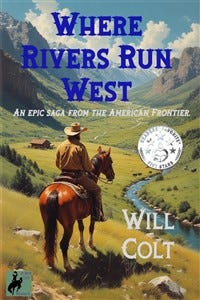 Where Rivers Run West: Available on Amazon.Will Colt Westerns: Stories where integrity survives in a harsh land.
Thanks for reading! Subscribe for free to receive new posts and support my work.