Smiley
I miss Smiley.
I miss Alice too.
I miss Smiley because he was free and uninhibited.
That’s why Alice gave him the nickname Smiley.
Alice was an older neighbor about the age of Smiley’s parents. She recognized a light in him that was liberating and refreshing to her. She saw how, for him, the world was uncomplicated and full of exciting new adventures every day; sometimes every hour.
Smiley was a kid with ADHD before ADD or ADHD existed. He couldn’t sit still. He had to be moving, in on the action or busy with something. When you made him sit still, he wiggled or jabbered.
Does anyone use the word jabber any more?
Smiley jabbered when he had to sit still.
“Be still,” Grandpa would say in a harsh tone. That was what he said to make Smiley stop jabbering and wiggling.
“Is there a switch to turn it off?” That’s what Glen would say whenever Smiley was jabbering. But Glen hardly ever said anything. Smiley began to wonder if that was the way grownups were supposed to act. He decided maybe he should try acting that way too.
Somehow, Smiley found a way to keep everybody happy by learning to “be still” when someone needed him to be still and “turn it off” when someone needed him to stop jabbering.
School was as close to a nightmare as a six-year-old could manage. However, Smiley wanted everybody to be happy, so he learned to sit still and be quiet. It was hard for him, and he wasn’t always good at it, but he loved to learn, which made things a little bit easier.
In elementary school, Smiley had a lot of friends and a few girlfriends. His first girlfriend was in the third grade. Her name was Rhonda. She had long hair the color of corn silks. They didn’t hold hands or kiss or anything like that. They sat together whenever the teacher didn’t separate them, played with each other during recess, and they wrote notes to each other continuously, each one declaring that they “liked” each other and were boyfriend and girlfriend. They gave each other the best and biggest valentines from their Valentine’s packets. Smiley gave her his school picture.
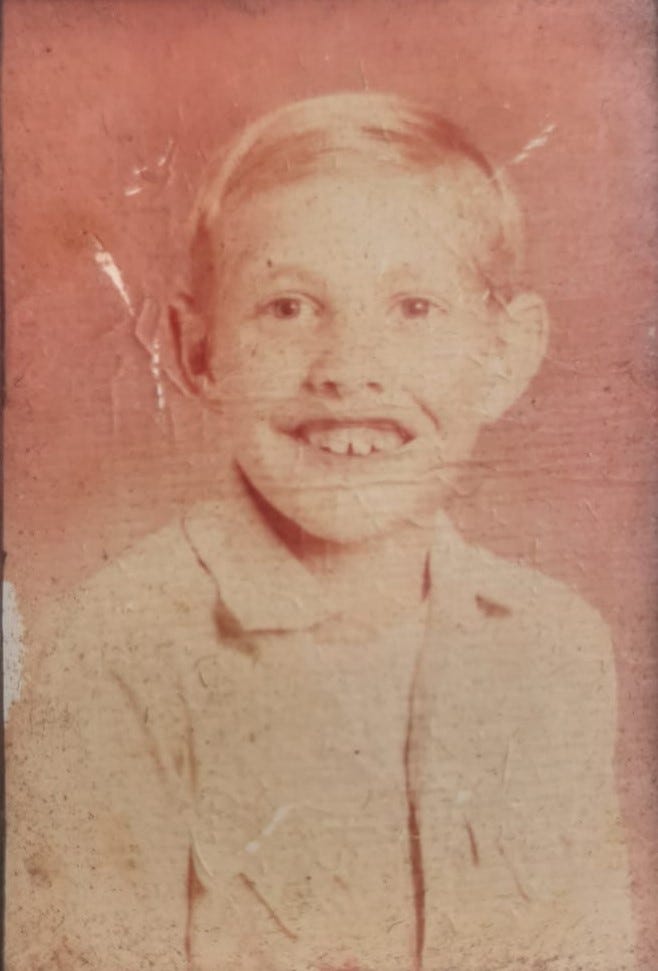
Rhonda didn’t come back to school in the fourth grade. Her family had moved away. Smiley moved on. His girlfriend in fourth grade was Dana. Dana was the pretty, popular girl that everybody wanted as their girlfriend. Smiley’s uninhibited energy and smile caught her eye. His relationship with Dana was not much different than the one he’d had with Rhonda.
Dana’s family didn’t move away that summer. Dana came back in the fifth grade, but she chose someone else to be her boyfriend in the fifth grade. Smiley accepted that as a part of life and sought adventure elsewhere, not with girls, but with other friends.
He and his friends, who were also raised on ranches, created a “gang” in the fifth grade. It was a known fact that gang members had no time for girls, especially their leader, “Hardluck Harry”, which was Smiley’s gang name. The gang never really did anything gang-like, just hung out together at recess and talked about gang stuff. They teased Yolanda a lot, calling her “big boobs”.
By sixth grade, the gang really didn’t exist anymore. Smiley found a new girlfriend. Her name was Robin. He crossed into a new level of intimacy with his girlfriend Robin. They got caught holding hands during a school movie in the auditorium. Smiley turned red as everyone teased him, but he continued being Smiley.
Junior high was when things started to change for Smiley. Things were changing for everybody. Old friends from elementary school vanished as interests began to shift. Smiley loved sports; some of his other friends didn’t. Smiley was wiry and athletic. He could do a standing backflip and he was so wiggly that he was hard to get ahold of on the wrestling mat.
Football and basketball became his favorite sports. He was good at football because he could let loose his aggressive energy and never got tired. His aggressive energy didn’t work very well when it came to playing basketball. He was good at defense and rebounding, but shooting… The word the other kids used for his shots in basketball was “brick”, because his shots would hit the backboard or the rim like a brick, then fall flat to the floor.
During the summer between junior high and high school, Smiley grew from five-foot-nine to six-foot-three. None of the control he had enjoyed over his smaller body remained. He became awkward and clumsy. That’s when Smiley began to feel self-conscious and withdraw a little bit.
That may have been the beginning of the end of Smiley. To overcompensate for his awkwardness, he began to discipline himself. It wasn’t an easy fit for the unihibited kid inside. It clipped the wings of his adventurous, free-loving soul. He still wanted to make everybody around him happy. That meant that he had to be the best that he could be, and he was up to the challenge. Determination had grown alongside his adventurous soul; a stubborn, never-say-die attitude that would never allow him to quit.
Smiley, a kid who could “barely walk and chew gum at the same time”, took on the high hurdles in track and field as a freshman in high school. He was slow and awkward. He switch-leg hurdled, which means that he switched the lead leg he used to go over each hurdle from one to the next. He lost almost every race he was entered in, but he stuck with it, determined to master something that everyone around him believed he could never master.
Besides football, the high hurdles became Smiley’s obsession. He awakened himself at night, having kicked off his covers because he was practicing the hurdles in his sleep. As a junior in high school, he was beginning to master hurdling but there were three hurdlers that he could not beat.
In the spring of his junior year, Dana was killed in a car accident.
While Smiley was changing physically and overcoming his awkwardness, he was still a freedom-loving kid who loved to jabber and enjoyed being around different kinds of people, even teachers, administrators, and other adults. He became someone adults could count on to do the right thing.
Smiley didn’t belong to any one group of friends. Technically, he was a “jock”, which is what they called athletes at that time, but he didn’t always hang out with the jocks. Since he was a ranch kid, he sometimes hung out with the “cowboys”, with whom he had the most in common. He had a few friends among the “stoners”; kids who tended to be less inhibited. He couldn’t really hang out with his stoner friends, because of “guilt by association”, which might get him kicked off the football or track team if anyone thought he was drinking or smoking pot. He sometimes hung out with the “egg heads”, but they had a much higher academic dedication than Smiley, who preferred to do just enough to get a B, and wasn’t overly concerned about being at the top of the class.
One day, during his senior year, Smiley came into the high school gym following a football game. He stopped at the water fountain near the bleachers. He was absently watching the J.V. girls’ volleyball match when he heard someone call out his name from the bleachers. He turned to see who was calling him. It was a girl about his age wearing the volleyball uniform of a rival school. Her hair was long and the color of corn silks. Rhonda instantly reminded him that he had been her boyfriend. They laughed and talked for a while, reliving something that had been long since forgotten. They had both changed, but they had their shared memory of something innocent and treasured.
Smiley mastered the high hurdles as a senior in high school, but an injury prevented him from accomplishing his highest goal: a state championship and a state record. A part of Smiley died when he failed to meet that goal. It was a pain that was never erased and perhaps caused him to drive himself harder.
Because it was what was expected, Smiley went to college. He finished his first year, but he was restless. The adventurous, freedom-loving boy still wanted to be let loose. He made plans to go to Argentina. Alice thought it was a great idea. He worked to get all of the necessary paperwork and arrangements ready for his new adventure in South America. A few weeks before he would have departed, he got scared, and he changed his mind.
Smiley went back to college. He boxed himself into the discipline of academic study. His discipline was harsh. His determination drove him. Smiley’s light began to fade.
After getting his degree, life hit Smiley the way life hits everyone who crosses over into adulthood: religion, responsibilities, jobs, duties, and expectations. Like he had done so many times, wanting to make everybody around him happy, he did what was expected, followed the rules, fit himself into the round hole designed for his misshaped peg.
His discipline and determination served him well, but Smiley’s light was barely a flicker. He was recognized as a leader in the church and in the community. People looked up to him. He was someone who could always be counted on to do the right thing. His self-discipline became harsher, his determination more intense, and his stress level multiplied to new levels as Smiley made sure the people around him were happy.
Something inside him broke.
He began to rebel against what was expected of him, replacing it with bitterness and self-seeking. The same harsh determination that drove him to become what he had become drove his rebellion as he withdrew from everyone around him, refusing to be burdened by their weighty expectations.
Smiley had a heart attack just before his 46th birthday.
Alice died in a car accident about that same time.
Remembering Alice, something deep inside Smiley recalled what he had been. Something began to stir inside him. He remembered wanting to go to South America at the age of nineteen. Less than two years after his heart attack, he moved to Colombia. A part of Smiley began to reawaken.
Smiley found Yolanda on social media once. He apologized to her. She didn’t even remember what Smiley had done, though she remembered the other boys.
Would his new adventure in Colombia revive the uninhibited, freedom-loving adventurer he had been?
It did for a time, but his life in Colombia was no different than the life he’d lived before. It was no escape from the life of disciplined determination that he’d carved out for himself. Smiley settled into the same driven and determined life and life style. The only thing that had changed was his location.
Smiley turned sixty-one this past summer. He rarely smiles now. He doesn’t jabber. He doesn’t wiggle. He works. He strives. He builds. He worries. He gets angry. He looks down on others. He speaks harshly to those around him. He acts the way grownups are supposed to act.
The other day, in a harsh tone, he told his grandson, Max, to “be still.”
Is Smiley dead and gone, like Alice and Dana?
I miss them sometimes.
I miss Smiley too.
The End