Let It Linger
I have no real excuse for taking so long to write again, here, except that my preferred way to write a Postcard from Mountain House is to let it linger. To give the text plenty of time to grow and change and be deleted and grow again and become something unexpected. To let it become something I didn’t ever intend it to be.
And while I have in fact started and deleted and re-started this post (or, more accurately, several posts like it) several times this summer, so far, it has taken me months to get it to a point of (debatable) completion. It’s been impossible to let it linger. I preach to the choir, but I do so with vigor: There is no plenty of time in summer with small children! There is — and I’m sure you know this — only a dearth of time: an exhausted half hour after their dangerously late bedtime; 45 minutes while Bluey plays loudly on the other side of the door; a mostly incoherent voice memo recorded while they nap in the backseat, which it is unlikely I will ever listen to again, and unlikelier still I will transcribe and transform into a Substack post.
Which suggests a valuable question about my whole Substack process:
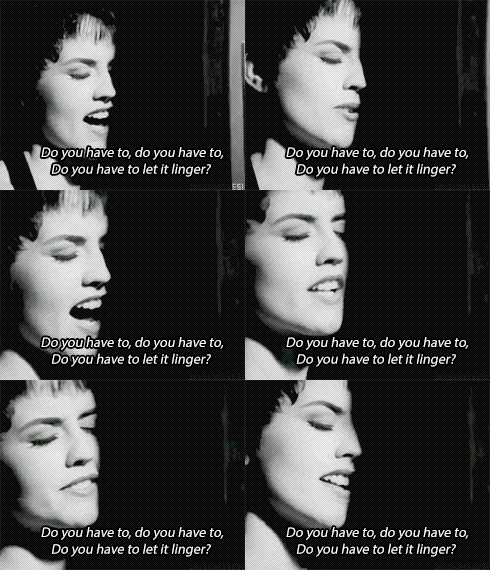 The Cranberries said it best.
Do I have to? Do I have to? Can I instead bang out a post of some (unverifiable) value in a single hard-won hour or two?
Spoiler alert (added retroactively): the answer, my friends, is, as it turns out, no. I tried very hard to write this post in less time than usual. I even front-loaded all the newsy-news, in an effort to treat the musings as an afterthought (see below). And, still, this thing, it took me just as long as it always does.
Postcards from Mountain House is always and will always be free! Please consider subscribing if you don’t already.
Anyway!
A Little Old (But Very Good) News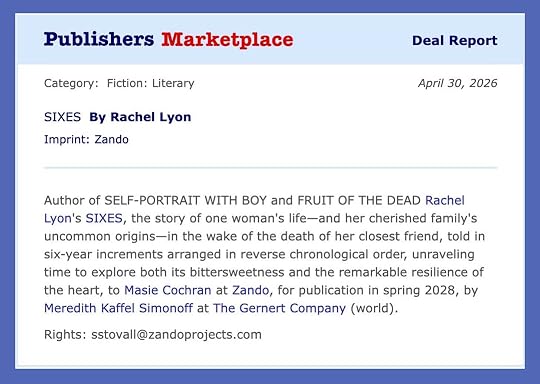
If you didn’t find out four to five months ago on Instagram (I’m sorry), I invite you to share in my delight now: my third novel will officially be published in 2028 by the very good people at Zando.
That I have had 2 books published before has only magnified my gratitude to my absolute hero of an agent, and increased my admiration of her incredible work in the desolate landscape of publishing rn (not to mention, yikes, The End Of Reading!).
Also I am very psyched to be working with the wonderful Masie Cochran.
Also!
Some Newer NewsFor the fifth summer in a row, thanks to a grant from the Ashfield Cultural Council, I’m teaching a free drop-in creative writing class on Monday evenings at Belding Memorial Library, the world’s best small-town library. It’s a judgment-free generative class, open to all writers of any degree of skill and experience. As of this abominably late notice, we have 2 classes left, so if you’re local, there’s still time to join in the fun.
Wednesdays this fall, 9/9-10/14, I’ll be joining this awesome lineup (Stephanie Feldman! Danielle Lazarin! Anca Szilágyi! Lena Valencia!) for a reasonably priced collaborative six-week online craft class over at . My session, Pacing, Exposition, and Scene (Getting To Your Best Ending), is on 10/7, but I’d highly recommend enrolling in the whole series. (You’ll get a discount if you do!) Sign up here.
Thursdays 10/22-11/12, I’ll be teaching a craft course on dialogue in fiction for One Story. The class isn’t listed yet, but you can stay tuned to their website and/or let me know if you’re interested, and I will notify you when it’s open for enrollment.
Saturday 1/16/27 (!) I’ll be teaching a daylong revision intensive, online and in-person, for Writers In Progress. It is sure to be a super productive day. Sign up at WIP’s website.
Please consider sharing this post with someone you know who might like to take a creative writing class.
A million years ago, in my freewheeling child-free days before the pandemic, I was lucky enough to be one of the writers who got to participate in Readings At Karma, a reading-and-conversation series hosted by Sarah Blakely-Cartwright — surely one of our most glamorous living writers!?!? — at the New York City gallery / art book press that represents her partner, the painter Nicholas Party. Sarah would invite an author to read a single and complete short story, and then discuss it with them with the gusto and charisma that only she could. Meanwhile Nicholas would illustrate each piece in gorgeous pastels. Happily, that series has been transformed into an absolutely beautiful book, which includes stories by the likes of Kaitlyn Greenidge, Hermione Hoby, Lisa Locascio, and Tony Tulathimutte. You can pre-order it at Karma’s website.
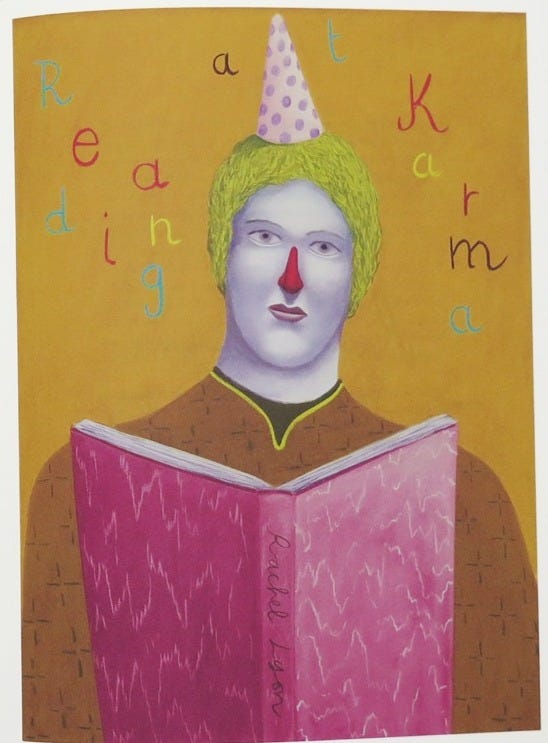 Nicholas’s illustration for my story became the book’s title image. Look, there’s my name on the spine of this grave clown’s book!
 I remember the experience of reading my ‘short’ story at the packed gallery that summer day in 2018. The story is actually rather long, and I became very self-conscious partway through, worried that I was losing the audience’s attention. I was nervous, too, as I always am when I read in front of people. My hands were trembling as I held and turned the printed-out pages. I remember my relief at finally getting to the end of it, and the complicated, self-conscious pride of reaching an ending that did seem — at last, and blessedly — to land.
It was an ambitious project for me at the time. I was still finding my voice, just beginning to test the limits and possibilities of the short story as a form. The goal was formal: a braided narrative. In one thread, a young woman works several jobs, writes prolifically but with mixed success, and attempts vainly to publish her own strange short stories. In another, her boyfriend, who is failing out of clown school, faces an existential crisis that she is too busy with her work, both creative and remunerative, to notice or care much about. In the third thread, the protagonist’s mother puts her in charge of her father, a painter, who has developed dementia and is beginning to forget her.
I published the story initially in 2014, under the title “Portrait Of The Artist’s Daughter With Clown Car.” It was my first and only piece to win a contest — $200, if I remember correctly — in a literary journal which was arcane even then and now no longer exists. It was edited, renamed “The Best Light Fades,” and republished in another small literary journal in 2019. (You can read that version of it here, if you’re curious.) So in fact its republication as “Clown Ambulance” in the Karma collection will be its third incarnation, having been revised and retitled yet again.
In 2014 I was two years out of grad school, and two years away from finishing a reasonably coherent draft of my first novel. With the advantage of the twelve years since, I can see now that this story, which has lived (is living!) these various lives, presages my debut pretty heavily, and not just because both, embarrassingly, include(d) the word “Portrait” in their titles. Both narratives follow emerging woman artists who are struggling to make a living in New York City, and are too obsessed with their own work to be able to connect authentically with those they love. Both narratives involve a father who is losing his sight, literally or metaphorically, to the grief of his daughter. In both, the mother figure exists only off-page.
I will not psychoanalyze myself here. I do wonder if it might be useful, though, to point out a few things about the story’s fate, and the fate of its writer since. My initial work on the story now called “Clown Ambulance” allowed me to begin to handle, in prose, some of the ideas I wanted to tackle in Self-Portrait With Boy, on a smaller canvas (as it were). That work gave me some insight into the themes that troubled me most generatively, and enabled me to handle them with a degree of humor and playfulness which I find, in the capacious form of the novel, more difficult to achieve. Later, having retold the story — in another way, at greater length, and featuring different, more considered characters — I was able to move on and tell what I thought then was a completely different kind of story: Fruit of the Dead.
Two years after the publication of Fruit, when I look back at both my published books I feel they, too, share certain themes. They are both, for instance, about alienation in some way — alienation from the parent, alienation from the lover, alienation from the self — and escape: into art, into fantasy. Alienation, of course, is a lack of connection. Is dearth, not plenty. And, because of that, it is, I think, in some ways easier to write. It is avoidance, which beginning writers tend to write a lot of anyway; it is the absence of conflict, which, ditto. It is even the absence of scene, of writing itself. It is the replacement of complex conflict with — what? In the case of my second novel’s protagonist, often with fantasy. In the case of the protagonist of my first book, with art-making, ambition, and self-consciousness.
From where I sit now, my third book — which is currently (but may not always be!) called Sixes — feels like a completely different kind of story from either of its siblings. It is not about a singular person and her tragic misunderstanding of what intimacy can/should be. It is — consciously and frighteningly — about the complexities of connection. It’s about a friendship and a family, and the many complicated connections therein. I will not psychoanalyze myself. I will say that, in some ways, it is a happier and more well-adjusted book. I will say that it is an ambitious project for me, at this time.