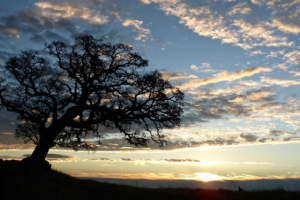
Mighty Oaks
My neck of the woods in California is home to one of the richest, most botanically diverse tree populations in North America. More than 50 native species thrive here in Monterey County, climbing past 75 when counting naturalized newcomers like eucalyptus and acacia. The secret lies in our dramatic topography: a dynamic collision of salt-laced coastal fog belts, lush riparian valleys, and the rugged, sun-bleached spine of the Santa Lucia Range.
The local canopy breaks down into three primary groups. Conifers claim the Pacific’s rocky points, maritime ridges and damp canyons—think Monterey pine, Monterey cypress, and soaring coast redwood. Hardwoods and oaks claim the canyons and foothills, while over twenty broadleaf and riparian species line the river beds. My own patch of ground along a river is sheltered by representatives from all three: Monterey pine, coast live oak, California sycamore, Fremont cottonwood, white alder, and Pacific willow. Together, they create a layered sanctuary offering food, shelter, and high-wire canopy routes for wildlife ranging from acorn woodpeckers to tree-climbing gray foxes.
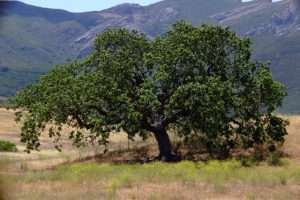
Yet among this vibrant arboreal community, the oaks reign supreme. While ninety oak species grow across the U.S., California claims twenty native varieties—and Monterey County boasts at least eight distinct kinds. Our undisputed signature tree is the coast live oak, recognizable by its convex, spine-tipped leaves and acorns cupped in velvety, yellow-fuzzed caps. Sharing the landscape are valley, Shreve, blue, California black, canyon live, interior live, and hardy scrub oaks clinging to chaparral slopes.
For the region’s indigenous peoples—the Rumsen Ohlone, Esselen, and Salinan—oaks were not merely shade; they were life. Acorns offered an abundant, calorie-dense staple rich in complex carbohydrates, healthy fats, and protein.
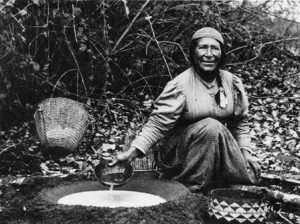
Harvest began in earnest during the autumn drop, with people gathering the fallen nuts in large woven burden baskets. Green acorns were cured in the sun to thwart mold and render outer shells brittle. Once dried, they were cached safe from damp ground and foraging rodents inside large, elevated granaries woven from willow branches. When ready for use, families cracked the shells on small stone anvils, then pulverized the golden nutmeat into fine flour using heavy stone pestles against bedrock mortars—many of which still indent our local sandstone outcroppings today.
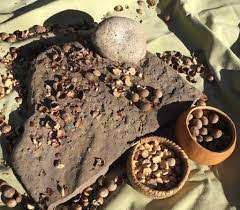
Raw acorn meal is fiercely bitter and mildly toxic due to heavy concentrations of tannic acid. To make it palatable, the flour was layered into shallow, sand-lined basins or tightly woven sift baskets, repeatedly filtering hot water through the grounds until the water-soluble tannins rinsed away, leaving behind a mild, nutty meal.
The leached flour was then mixed with water inside watertight coiled baskets. By placing glowing river stones straight from the fire into the liquid, the slurry was brought to an instant, bubbling boil to create a hearty porridge or dough for dense, skillet-baked flatbreads.
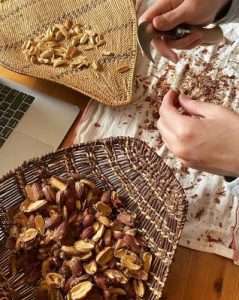
The oak’s gifts didn’t end at the table. The dense, hard wood made durable digging sticks and hunting tools, while broad sheets of bark insulated domed, thatched dwellings against coastal squalls. Even the astringent tannins found purpose: concentrated concoctions boiled from bark and oak galls served as antiseptics to cleanse wounds, ease inflammation, and soothe the burn of poison oak. Tea brewed from inner bark layers settled stomach ailments and calmed sore throats.
Standing beneath a sprawling live oak today, it’s easy to see why this tree remains our definitive icon. It isn’t just a survivor of fire, drought, and marine wind—it’s the generous cornerstone of California’s wild natural history.