Dwight Holing's Blog
September 23, 2026
Fire on the Mountain
No word travels faster in my neck of the woods than “Fire!” On August 8, a whisper of smoke rising from a forested coastal ridge ten miles as the condor flies from me turned into a shout for help. Within minutes, a spectacular and rugged patch of Big Sur became a war zone as lightning-free sparks ignited first one then two monstrous blazes across the Los Padres National Forest. Feeding on parched chaparral and timber along vertical canyon walls, the flames have chewed through more than 55,000 acres as of this writing, threatening coastal settlements, forcing evacuations, and shuttering cliff-clinging Highway 1.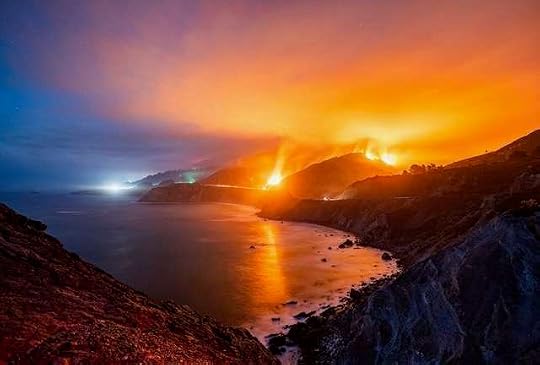
Against near-impossible topography, an army assembled to battle the blazes. More than 3,200 heroic firefighters answered the call—volunteer crews from Big Sur Fire, CAL FIRE strike teams, federal wildland agencies, and elite Interagency Hotshot crews mobilized from across the West. Supported by an armada of 227 fire engines, 55 bulldozers, heavy air tankers, and 28 helicopters, these courageous responders mounted an aggressive, around-the-clock defense. Tactical drones patrolled through darkness with infrared sensors and dropped aerial ignition spheres, penetrating the thick marine layer that routinely grounded manned aircraft.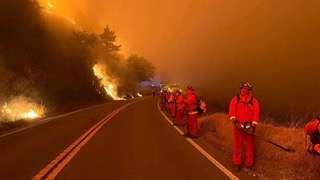
Miraculously, despite the sheer violence of the firestorms and terrain so steep that Hotshot crews were forced to rappel down sheer cliffs, structural defenses have held fast and, thankfully, injuries to firefighters have been minimal.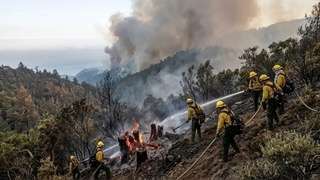
One of the campaign’s most heart-stopping moments came high above the coastline at the Ventana Wildlife Society sanctuary. With flames closing in and access roads severed, two endangered California condors were trapped inside a pre-release flight pen. In a daring operation, CAL FIRE escorted a senior biologist through active firelines to manually throw open the pen doors. Both birds launched into the smoky thermals, banking toward clear coastal skies to rejoin the wild flock.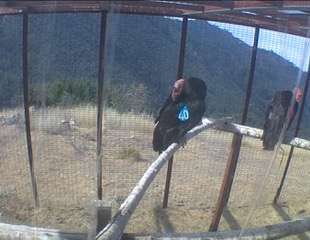
Today, the Plaskett Fire is 97% contained and the Timber Fire largely restricted to the most remote corner of the backcountry. But for Big Sur, victory is precarious. The notoriously dry and steep mountainsides have been stripped of their protective covering and now face an incoming “Godzilla” El Niño winter. The risk of high-speed debris flows, culvert blowouts, and catastrophic Highway 1 washouts looms large. The flames may be beaten back, but the mountains’ true test of endurance has only begun.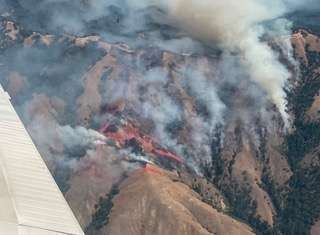
We once called this bad luck: one season of drought, one season of deluge. Now we know better. From Big Sur’s ridges to fire zones across the globe, the pattern is impossible to unsee. Our changing climate has shifted into overdrive. The science isn’t waiting on solutions—the proven tools exist today. The only question left is whether we will finally summon the will to use them.


September 8, 2026
Meet Author Dwight Holing
Huge thanks to award-winning author Jennifer Morita for being a fantastic interviewer—she didn’t pull any punches with her questions and dug deep into the details. And a warm thank-you to everyone who tuned in live and participated in the Q&A!
Catch the full replay here: https://youtu.be/W2ATfiyAL_o
August 26, 2026
Mighty Oaks
My neck of the woods in California is home to one of the richest, most botanically diverse tree populations in North America. More than 50 native species thrive here in Monterey County, climbing past 75 when counting naturalized newcomers like eucalyptus and acacia. The secret lies in our dramatic topography: a dynamic collision of salt-laced coastal fog belts, lush riparian valleys, and the rugged, sun-bleached spine of the Santa Lucia Range.
The local canopy breaks down into three primary groups. Conifers claim the Pacific’s rocky points, maritime ridges and damp canyons—think Monterey pine, Monterey cypress, and soaring coast redwood. Hardwoods and oaks claim the canyons and foothills, while over twenty broadleaf and riparian species line the river beds. My own patch of ground along a river is sheltered by representatives from all three: Monterey pine, coast live oak, California sycamore, Fremont cottonwood, white alder, and Pacific willow. Together, they create a layered sanctuary offering food, shelter, and high-wire canopy routes for wildlife ranging from acorn woodpeckers to tree-climbing gray foxes.
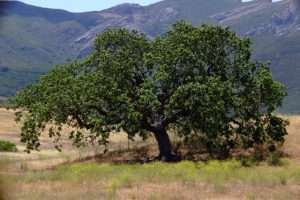
Yet among this vibrant arboreal community, the oaks reign supreme. While ninety oak species grow across the U.S., California claims twenty native varieties—and Monterey County boasts at least eight distinct kinds. Our undisputed signature tree is the coast live oak, recognizable by its convex, spine-tipped leaves and acorns cupped in velvety, yellow-fuzzed caps. Sharing the landscape are valley, Shreve, blue, California black, canyon live, interior live, and hardy scrub oaks clinging to chaparral slopes.
For the region’s indigenous peoples—the Rumsen Ohlone, Esselen, and Salinan—oaks were not merely shade; they were life. Acorns offered an abundant, calorie-dense staple rich in complex carbohydrates, healthy fats, and protein.
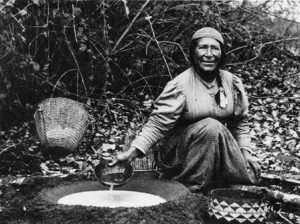
Harvest began in earnest during the autumn drop, with people gathering the fallen nuts in large woven burden baskets. Green acorns were cured in the sun to thwart mold and render outer shells brittle. Once dried, they were cached safe from damp ground and foraging rodents inside large, elevated granaries woven from willow branches. When ready for use, families cracked the shells on small stone anvils, then pulverized the golden nutmeat into fine flour using heavy stone pestles against bedrock mortars—many of which still indent our local sandstone outcroppings today.
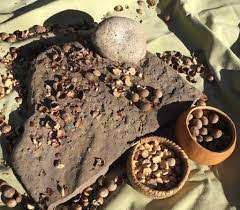
Raw acorn meal is fiercely bitter and mildly toxic due to heavy concentrations of tannic acid. To make it palatable, the flour was layered into shallow, sand-lined basins or tightly woven sift baskets, repeatedly filtering hot water through the grounds until the water-soluble tannins rinsed away, leaving behind a mild, nutty meal.
The leached flour was then mixed with water inside watertight coiled baskets. By placing glowing river stones straight from the fire into the liquid, the slurry was brought to an instant, bubbling boil to create a hearty porridge or dough for dense, skillet-baked flatbreads.

The oak’s gifts didn’t end at the table. The dense, hard wood made durable digging sticks and hunting tools, while broad sheets of bark insulated domed, thatched dwellings against coastal squalls. Even the astringent tannins found purpose: concentrated concoctions boiled from bark and oak galls served as antiseptics to cleanse wounds, ease inflammation, and soothe the burn of poison oak. Tea brewed from inner bark layers settled stomach ailments and calmed sore throats.
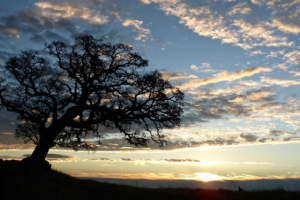
Standing beneath a sprawling live oak today, it’s easy to see why this tree remains our definitive icon. It isn’t just a survivor of fire, drought, and marine wind—it’s the generous cornerstone of California’s wild natural history.
July 21, 2026
Mendocino Meandering
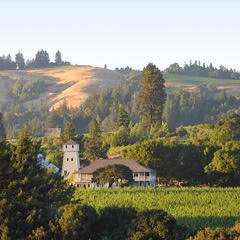
My wife, Annie, and I recently drove through five California coastal counties north of our own to explore Mendocino. It wasn’t our first visit there, but every trip yields something new worth sharing. The first stop was in the gorgeous Anderson Valley, whose cool climate nurtures vineyards famous for world-class Pinot Noirs and Alsatian whites. In the one-blink town of Boonville, we grabbed a Horn of Zeese—a cup of coffee in Boontling, the hyper-local dialect spoken there (where a walk is a pike and a party is a tidrick).
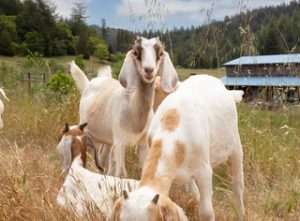
From there, we cut north to Comptche to visit Otter Valley Farm, where our friends use regenerative, organic practices to raise goats, sheep, and cattle along with fruits and vegetables. It’s a beautiful, off-the-grid Eden. Just east lies Montgomery Woods State Natural Reserve, home to magnificent old-growth redwood groves—including a Methuselah once officially measured as the world’s tallest tree at over 367 feet.
We continued west along a winding two-lane road through the Big River watershed. The sun was shining and the sky was a cobalt blue when we hit the coast. Jogging south on California State Route 1, we reached the Albion River. Crossing required driving over the wide river on a 15-story wooden timber truss bridge—the last remaining structure of its kind on the entire highway. We felt it shake beneath our wheels, a condition denizens say means the bridge is still “breathing.”
A nearby cottage clinging to a bluff—offering a nonstop view of the restless Pacific—became our basecamp. That night, we dined at the Ledford House, a local favorite. By the time we returned, the temperature had dropped and a blanket of fog had settled in, so we lit a fire and fell asleep to the soft hiss of flames and the thrum of distant surf.
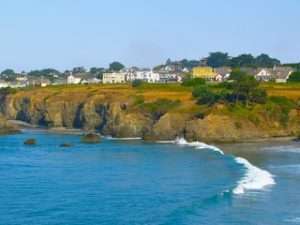
Waking to a glorious sunrise, we headed north to the town of Mendocino. Its Cape Cod-style architecture has long made it a double for New England in movies and TV shows, most notably Murder, She Wrote and The Russians Are Coming, the Russians Are Coming. After a stroll through galleries featuring local painters, sculptors, and weavers, we grabbed coffees to go and continued north to Fort Bragg, a historic lumber and fishing town where blue-collar grit meets coastal beauty.
That beauty is on full display at the Mendocino Coast Botanical Gardens. A friend who volunteers as a docent gave us a behind-the-scenes tour; she and her husband are longtime residents and regaled us with stories about the county’s long history, culture, and natural resources. The gardens are a blooming jewel and one of the few in the country that front the ocean. Towering rhododendrons flank the entrance, while a glade ablaze with 150 varieties of dahlias forms the heart of the property. Some flowerheads were the size of dinner plates; others mimicked sea anemones. A dizzying palette of cacti, fruit orchards, and diverse flora shared the grounds with rich wildlife. More than 180 bird species have been spotted here, including pileated woodpeckers, red-breasted nuthatches, and ospreys. At the garden’s outdoor café, coveys of adult quail herding their chicks skittered across our feet while a choir of songbirds serenaded us from the branches above.
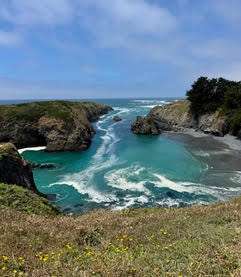
We ended the day hiking the ruggedly picturesque Mendocino Headlands, which are bookended by forested hills and the ebbing tide. As if it weren’t magical enough, my phone pinged with a message: the ninth book in my Nick Drake series, The Thunder Head, had just been named a finalist for Best Western at the upcoming Killer Nashville International Writers’ Conference next month.

On our last night at the cottage, the usual fog cleared to reveal a brilliant night sky. Stars, constellations, and astral bodies reflected perfectly across the water, a mirror image that made us feel doubly lucky to be there.
June 26, 2026
Tons of Whales!
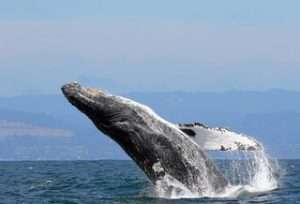
The secret to this marine explosion lies beneath the surface. A massive submarine canyon cuts right through the center of the bay, plunging deeper than the Grand Canyon. Combined with powerful summer upwellings that push nutrient-rich water to the top, it creates an absolute buffet for marine life. It isn’t just whales joining the feast, either. The water is practically roiling with massive bait balls, drawn in by thousands of California sea lions and sweeping pods of Risso’s and Pacific white-sided dolphins. It’s an incredible, breathtaking spectacle—and a reminder of just how wild and unpredictable nature can be.
August 23, 2025
The Broken Blood Wins Silver Falchion
“Wow!” It may not sound very writerly, but it was the first word that popped out when I stepped to the mike at the 2025 Killer Nashville Awards Ceremony to give my heartfelt thanks for winning the Silver Falchion for Best Western.
The thrill ride continued when I exited stage left and Sara Paretsky (author of the V.I. Warshawski novels and many others) leapt from her seat to grab my arm and say thanks for calling attention to the pressures Indigenous people and US Fish and Wildlife Service workers are facing today. Moments later, she took to the stage and gave a passionate, provocative, and poetic keynote speech about the real threats to our First Amendment rights, including free speech.
To all my readers, a loud shout out for making last night possible.
July 9, 2025
Dwight Holing: The Broken Blood
Crime and Wine with Pamela Fagan Hutchins – April 4, 2024 – “Dwight Holing: The Broken Blood”
Watch: https://www.youtube.com/watch?v=bUJ-g...
Listen: https://soundcloud.com/authorsontheai...
Dwight Holing: The Thunder Head
In Conversation with Terry Shepherd – June 3, 2025 – “Dwight Holing: The Thunder Head” –
Listen: https://soundcloud.com/user-547434833...
Meet Dwight Holing
Bold Journey Magazine – June 12, 2025 – “Meet Dwight Holing” –https://boldjourney.com/meet-dwight-h...
Dwight Holing Named Finalist for Best Western”
“Dwight Holing Named Finalist for Best Western” – https://www.killernashville.com/2025-silver-falchion-award-finalists