The Burning Bush
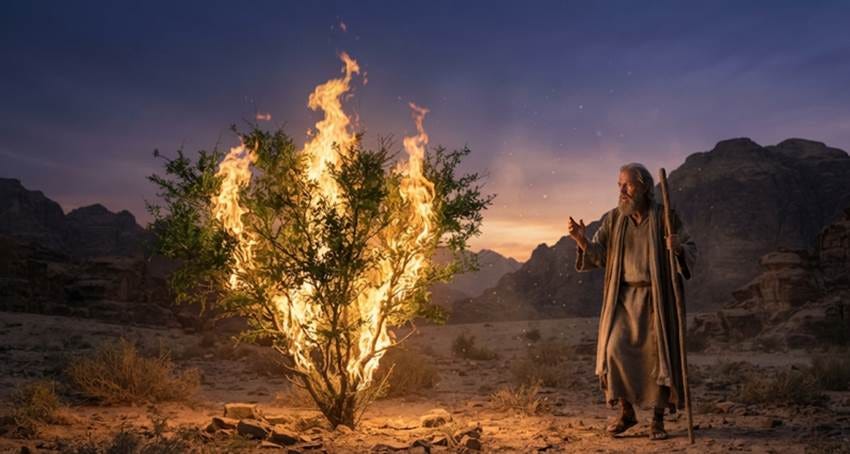
The narrative of the Burning Bush, described in the book of Exodus, is one of the most iconic events in biblical traditions. In the account, Moses encounters a shrub in the desert that burns in intense flames, but inexplicably, does not consume itself, leaving its leaves and branches unreduced to ashes.
When we move away from a purely literal reading and cross-reference the text with botany, chemistry, and optical physics, scientists and researchers find fascinating explanations for what may have inspired the myth.
1. What the Sacred Text Says
In the biblical narrative, the fire in the bush has no conventional earthly origin; it is the manifestation of divine presence (the angel of the Lord appearing in a flame of fire out of the midst of a bush). The great miraculous emphasis lies precisely in the perennial nature of matter: the fire burns, but the plant remains intact, capturing Moses’s attention and inaugurating the moment of his calling.
2. The Botanical Hypothesis: The Gas Plant and Volatile Oils
The most famous explanation in the field of biology and ethnobotany falls upon a real plant species found in the Sinai region and the Middle East: Dictamnus albus (commonly known as the “gas plant” or “burning bush”) or native shrubs of the rue family.
The Production of Highly Flammable Oils: These plants secrete large quantities of volatile, flammable essential oils across their entire surface (leaves, stems, and flowers).
The Extreme Heat Phenomenon: During intense desert heat, these gases form an invisible, flammable cloud around the plant. If a spark or spontaneous heat wave hits this atmosphere of vapor, the plant becomes enveloped in rapid flames.
Why Doesn’t It Consume Itself? Since the fire consumes only the gas vapors surrounding the shrub rather than the cellulose and woody tissues of the plant itself, the bush appears to burn furiously while remaining green and intact right after the gas burns off.
3. The Optical Hypothesis and Atmospheric Phenomena
Other theorists and historians suggest the phenomenon might have been an optical illusion intensified by desert conditions:
Refraction of Sunlight: Under certain conditions of suspended dust in the atmosphere, the sunset of the Sinai desert casts intense incandescent reflections upon silvery or waxy foliage (such as candelabra grass or certain acacias), creating continuous mock-flames without destroying the vegetation.
Conclusion: The Natural Phenomenon Elevated to Myth
Much like the parting of waters or pillars of smoke, the Burning Bush illustrates how rare yet physically and botanically explicable events such as the auto-combustion of plant volatile oils were interpreted by ancient populations as direct manifestations of the sacred, transforming the science of nature into the language of miracles.
In the physics that rules the universe of my philosophical fiction series, The Anthropologist and the End of the World, opposing views of science and religion do not belong to supernatural mysticism, nor are they mere physical delusions.
Note: Original ideas by the author. AI used purely as a support tool for research and editing.
Are you ready to explore the space where science and faith collide? Join our investigation by subscribing to the newsletter.