When the Nile Bled
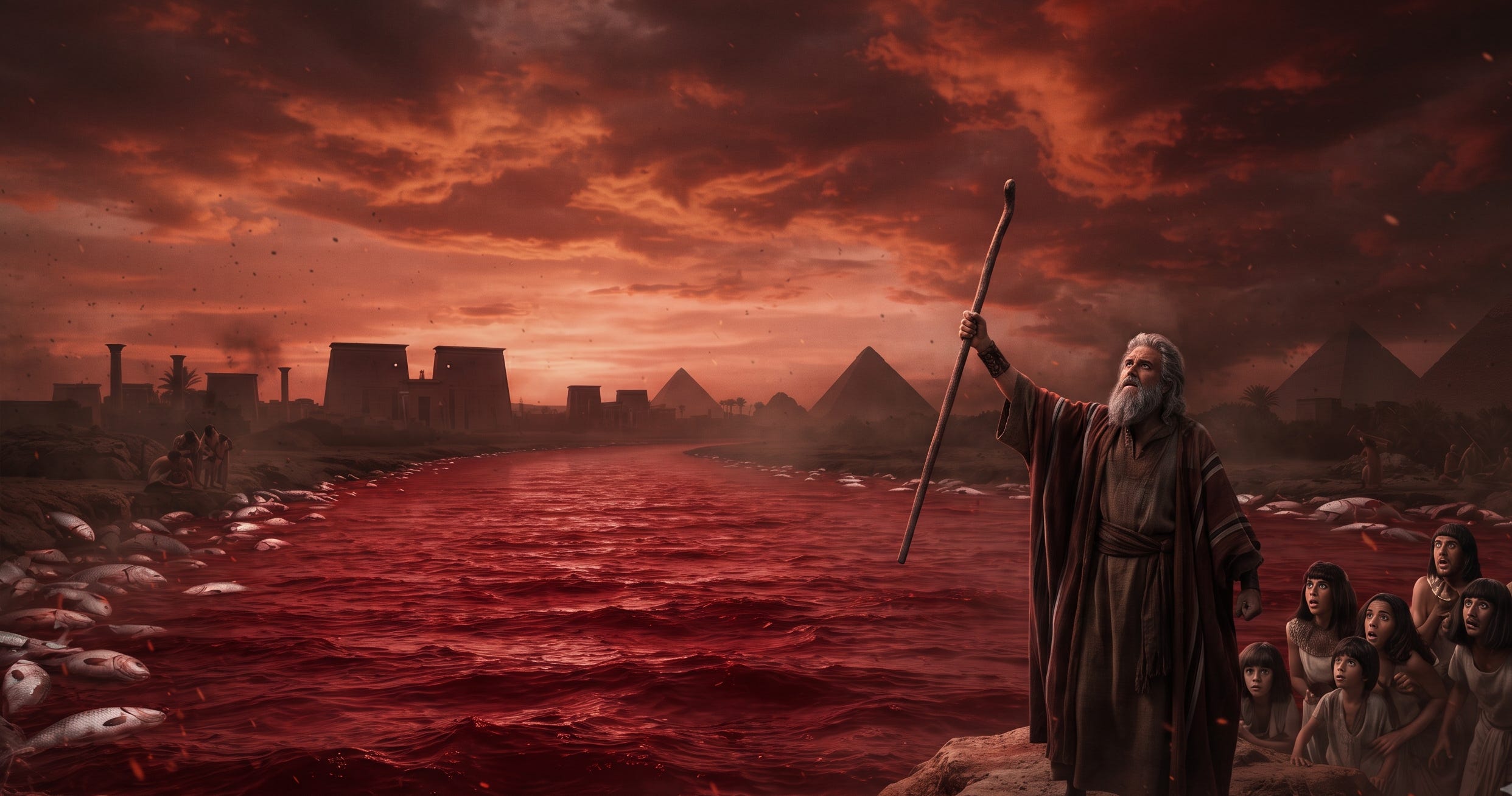
The story of the ten plagues of Egypt is one of the most impactful narratives of antiquity. Among them all, the very first the moment when the mighty Nile River turns to blood carries the symbolic weight of challenging the very source of life of Egyptian civilization.
But how could a sacred, perennial river suddenly manifest such characteristics? Let us examine the biblical account, the perspective of reputable historians, and how contemporary science rigorously explains the facts.
1. The Biblical Account (Exodus 7:17-21)
According to the sacred text of the Hebrew Canon, the divine command was given to Moses through Aaron:
“Thus says the Lord: By this you shall know that I am the Lord: behold, with the staff that is in my hand I will strike the water that is in the river, and it shall turn into blood. And the fish that are in the river shall die, and the river shall stink, and the Egyptians will loathe to drink water from the river.” (Exodus 7:17-18)
The text goes on to detail that the transformation was total: not only the main Nile, but all reservoirs, canals, and even containers of wood and stone throughout the land of Egypt reflected the plague. The fish perished, the water became rancid and undrinkable, forcing the population to dig wells along the banks in search of potable water.
2. The View of Historians and Specialists
Researchers and historians of religion and the Ancient Near East analyze the text of Exodus through the lens of textual records and the collective memories of ancient peoples.
Dr. Robert Miller (historian and biblical texts specialist) points out that the narrative reflects the literary genre of eras when drastic ecological crises were invariably personified as the wrath or favor of sovereign deities. For the Egyptians, the Nile was the god Hapi; corrupting the river meant defeating the theology of Pharaoh himself.
Dr. Siro Trevisanato (author of The Lessons of the Plagues: The Geochemical, Ecological, and Epidemiological Basis of the Story of the Exodus) argues that the accounts did not emerge from a vacuum, but preserve an exaggerated and mythologized chronicle of a real environmental catastrophe that occurred in the Nile Delta region, a true ecological domino effect that devastated the country’s infrastructure in antiquity.
3. The Scientific Explanation: The Ecological Domino Effect
When we cross theology with ecology, limnology, and atmospheric sciences, the “miracle” of the Nile turning to blood gains a fascinating and interconnected natural explanation:
The Red Dye (Algae and Sediments): Biologists and ecologists suggest the phenomenon could have been caused by a massive proliferation of toxic microalgae known as Oscillatoria rubescens (or “Burgundy blood”), a type of cyanobacterium that, when blooming in high concentrations (red tide), paints the water an intense red and releases severe toxins. Alternatively, anomalous torrential rains in the Ethiopian highlands could have carried tons of iron-rich red clay into the lower Nile, abruptly tinting it.
The Death of Fish: With the toxic proliferation of algae or heavy saturation of silt and sediments, dissolved oxygen levels in the water plummet drastically. Suffocated, fish die en masse and float to the shores.
The Chain Reaction (The Subsequent Plagues): The massive death of fish and water pollution forced amphibians like frogs to abandon their natural habitat in the Nile in desperation (the second plague), triggering the entire logical sequence of biological imbalance—from the proliferation of vector insects to livestock contamination.
Conclusion
The episode of the Nile transformed into blood perfectly illustrates the bridge between ancient human perception and the relentless mechanics of nature. What chroniclers of the past translated as an act of direct magical intervention, modern science reveals as a violent ecological crisis reminding us that, through the lenses of the ancient observer, the greatest forces of Earth always looked like gods in fury.
In the physics that rules the universe of my philosophical fiction series, The Anthropologist and the End of the World, opposing views of science and religion do not belong to supernatural mysticism, nor are they mere physical delusions.
Note: Original ideas by the author. AI used purely as a support tool for research and editing.
Are you ready to explore the space where science and faith collide? Join our investigation by subscribing to the newsletter.