On (Not) Practicing
I’ve been upfront about the fact that I actively study for Jeopardy! and other quiz competitions. At no point have I pretended that I could have just wandered onstage unprepared and answered questions on everything from marine biology to world history to recent horror films through osmosing knowledge randomly or something along those lines.
And yet:
Thanks for reading Know It All with Victoria Groce! Subscribe for free to receive new posts and support my work.
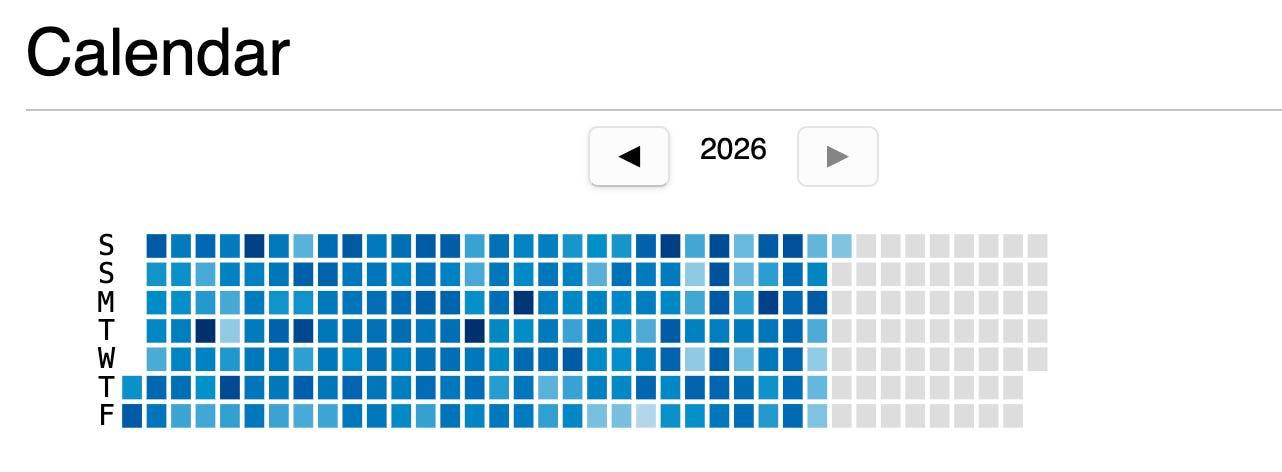
These are my practice stats in Anki, the app I use for trivia studying (and that I used back when I was a post-baccalaureate student taking biology classes a decade out of undergrad). Blue represents days I practiced. Light blue represents a relatively light day; deep saturated navy means hours of work. That light gray? That means I didn’t study at all. It’s been over eight weeks since I formally studied. That final blue day was July 18, the day the finals of Season 4 of Jeopardy! Masters taped.
Truth be told, I miss it! But for months leading up to Masters I sensed I was overworking and heading for burnout. In addition to Jeopardy! preparation I was researching and writing Know It All, and both of those endeavors hovered around normal full-time hours for about a year. It wasn’t sustainable and I knew it, but I kept myself going with the lure of a “sweater sabbatical”: absolutely no studying until I knit two full sweaters.
(The original plan had me finishing up my entire backlog of the New York Review of Books as well but I’ve abandoned that goal; I’ve made up some ground, but I get through maybe 1.5 issues before the new issue arrives in my mailbox. It’s good to have unreasonable aspirations, right?)
As a process nerd I’m dying to see what effects the “sweater sabbatical” will have on my brain because this is, in certain ways and as best as I can tell, uncharted territory in learning research.
Most of the research about what happens when people take breaks from training for things pertain to athletes. In general, when people take extended breaks from physical training, they decondition (lose some strength and power) but are able to return to their pre-sabbatical level of performance quickly—more quickly than they were able to originally build their muscle mass. This is one of two phenomena that are referred to as muscle memory (the other one, in case you were curious, is the way that our bodies can do certain well-rehearsed tasks expertly even if it’s been awhile since we did them). A case study by a physiologist/triathlete indicates that cardiovascular health and fitness might work similarly for runners and endurance athletes.
We have little or no information about the effect of similar extended breaks in adults who do what you might call mental training. There’s been a fair amount of research on what is often termed the “summer slide”—the fact that children returning to school after summer vacations tend to lose ground in reading and math skills compared to where they were at the end of the previous school year. School closures during the early days of the COVID-19 pandemic provided a similar “natural experiment” and also indicated that time away from formal education can erode skills.
It’s unclear to me how much this can be generalized to adults, however. We can certainly expect to forget some things when we haven’t reinforced them for awhile. This is a fundamental tenet of memory research known as the “forgetting curve”: a predictable erosion of a certain percentage of what we’ve learned over time. I suspect, though, that there are some fundamental differences between kids in school and adult learners.
I’ve taken a couple extended breaks from studying over the decades I’ve been doing learning projects. My experience is generally that the things I was learning most recently before the break will be shaky or forgotten when I go back to them, which makes sense: part of the reason I study the way I do is to move information into long-term memory, which means the things I know the most securely are, in many cases, the things I learned furthest back in time.
Regardless: I view learning holistically, and in that sense I am absolutely certain a long break is a smart idea. Even if I forget all sorts of things, I can already tell that a couple months replacing Anki with knitting has turned down the stress. Which is what I’d hoped for going in!
Thanks for reading Know It All with Victoria Groce! Subscribe for free to receive new posts and support my work.