Control the Controllables
“He accused me of not respecting him,” said a woman who was sure she’d be fired.
“She wants me to introduce her to high-net-worth people who don’t even know we exist,” said a fundraising professional.
“My SVP is pressuring me to give one of my team members a bad review so they can get rid of him,” said a regional director.
Each one of these scenarios can lead to sleepless nights—tossing and turning with anxiety, anger, resistance, righteousness, and vulnerability. At 3:00 a.m., you may question your values, integrity, and moral obligations as you struggle to find solutions to problems that are not clear-cut. What, exactly, is being asked of you? How can you stick to your ethics and follow your instincts so you feel good about the decisions you make and the actions you take?
What Top Performers Know“Control the controllables.” This is what performance coach Greg Harden, who counseled Tom Brady, Michael Phelps, and generations of University of Michigan athletes, tells elite competitors. He built a book around it: Stay Sane in an Insane World: How to Control the Controllables and Thrive.
It’s applicable to any professional.

Let’s take the issue of your senior leader demanding your respect. You understand that respect is earned; it can’t be demanded. What you can control: the quality of your work, and your respect for the organization’s goals and how you achieve them. The rest is noise. You’re not at the organization to ease your boss’s anxieties. You’re there to make the organization successful.
Now take the issue of unrealistic expectations—raising money from billionaires who aren’t interested in your nonprofit. This request comes from a combination of ego, wannabe leadership, and a lack of understanding of the fundraising process. What you can control: developing a plan built on relationships, and cultivating those relationships for maximum giving.
How about targeting one of your team members for a performance improvement plan or an involuntary exit? This might be a personal vendetta; you don’t know. But if someone above your boss later asks you to justify the review, you can’t point your finger at your boss after you obliged him. You can’t control the politics or how the team member will react. You can control a neutral, factual performance review.
Simple, Not EasyAs soon as you realize you can’t control what other people think of you, you see how simple—and essential—it is to control your own actions. When you acknowledge that you can’t control what other people think of themselves, you no longer take on their burdens. The clarity is refreshing and energizing.
Put It into Practice: AffirmationsHere are some affirmations to try:
I can control the quality of my work. I cannot control my boss’s personal opinion of me.I can control my goal-setting and my plans to achieve solid goals. I cannot control unseen pressures leading to unrealistic expectations.I can control the creation of a backup plan and exit strategy for an unreliable employee. I cannot control a team member’s absenteeism.I can control my public-facing reactions to ludicrous accusations. I cannot control a leader’s narcissism.

If you’re experiencing a lot of static and noise around your role, and the path forward appears murky, step back and create a Control the Controllables Sheet. Here’s an example:
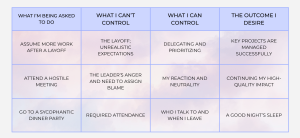
Here’s the bonus: as the holiday season approaches, you can apply this same practice. Do you really want to go to the annual bottomless brunch that starts at 11:00 a.m. the day after Thanksgiving? You can control your morning. You can’t control what they’ll think or say about you—even if you attend.
The post Control the Controllables appeared first on Robin Merle.