Lafcadio Hearn and the Beauty of Words
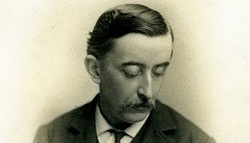 Patrick Lafcadio Hearn / Koizumi Yakumo Below are excerpts from a letter by writer Lafcadio Hearn to his editor. Hearn was born in Greece to a Greek mother and an Irish father. He was raised in Ireland, and lived for twenty years in the U.S. before visiting Japan on a journalistic assignment. He never left. He worked for newspapers, taught school, married a Japanese woman, Koizumi Setsu, and had a son. He took the name Koizumi Yakumo when he became a Japanese Citizen. He remains famous for his books on Japanese life and his retellings of Japanese folktales and ghost stories.
His love of language and his unique perceptions are so eloquently expressed in this letter that I want to share it with everyone who loves words.
The letter is reprinted in full at Letters of Note.
June 5, 1893
Dear Chamberlain,--
...Recognizing the ugliness of words, however, you must also recognize their physiognomical beauty. I see you and the Editor of the "Atlantic" are at one, however, in condemning my use of Japanese words.... For me words have colour, form, character; they have faces, ports, manners, gesticulations; they have moods, humours, eccentricities;—they have tints, tones, personalities. That they are unintelligible makes no difference at all. Whether you are able to speak to a stranger or not, you can't help being impressed by his appearance sometimes—by his dress—by his air—by his exotic look. He is also unintelligible, but not a whit less interesting. Nay! he is interesting BECAUSE he is unintelligible. I won't cite other writers who have felt the same way about African, Chinese, Arabian, Hebrew, Tartar, Indian, and Basque words—I mean novelists and sketch writers.
To such it has been justly observed: "The readers do not feel as you do about words. They can't be supposed to know that you think the letter A is blush-crimson, and the letter E pale sky-blue. They can't be supposed to know that you think KH wears a beard and a turban; that initial X is a mature Greek with wrinkles;—or that '—no—' has an innocent, lovable, and childlike aspect." All this is true from the critic's standpoint.
But from ours, the standpoint of—
The dreamer of dreams
To whom what is and what seems
Is often one and the same—To us the idea is thus:
"Because people cannot see the colour of words, the tints of words, the secret ghostly motions of words:
"Because they cannot hear the whispering of words, the rustling of the procession of letters, the dream-flutes and dream-drums which are thinly and weirdly played by words:
"Because they cannot perceive the pouting of words, the frowning and fuming of words, the weeping, the raging and racketing and rioting of words:
"Because they are insensible to the phosphorescing of words, the fragrance of words, the noisomeness of words, the tenderness or hardness, the dryness or juiciness of words—the interchange of values in the gold, the silver, the brass and the copper of words:
"Is that any reason why we should not try to make them hear, to make them see, to make them feel? Surely one who has never heard Wagner, cannot appreciate Wagner without study! Why should the people not be forcibly introduced to foreign words, as they were introduced to tea and coffee and tobacco?"
...
All this is heresy. But a bad reason, you will grant, is better than—etc.
Faithfully,
Lafcadio Hearn
Read the whole letter and hundreds more from hundreds of letter-writers at Shaun Usher's wonderful Letters of Note.


No comments have been added yet.