
March
I really love this section and it’s mostly because of Alexa. I’ve talked a bit about her before in the character reference part, but I would like to devote more time to her here.
To me, she is one of the most important characters because she keeps that myth-making element that I wanted to achieve with this story intact. Alexa’s entire agenda is myth-making: she thinks that Bernard, Thomas, and Jasmine will change the world. I originally wanted her to be a joke to initially poke fun at her whole New Age rhetoric, but her character ended up developing in ways that I didn’t anticipate. She, along with her husband, embody the performance of their own identity. I had mentioned this in the previous post about identity, and I think that Coetzee quotation applies to Alexa and her husband specifically. With Alexa and Marc, there are two seemingly opposite spectrums of thought – the capitalist business model and the New Age flake – and they are combined together to make (what I think, at least) to be a good couple. Because they don’t take themselves too seriously in their interests, they are able to have a family together. As much as Alexa loves her tarot cards, her astrology, and making the people around her into mythic figures, she knows that this is for fun. It is a game and it’s a performance.
It is so easy, especially when you get on the Wiccan and pagan sites, to believe your own bullshit. I talk a lot about religion in this book as a whole and I wanted to point out that while you could be critical about religion, that doesn’t mean that you have to give up the rituals and practices that make you feel better. It is a very private discourse, which is why when it is dragged into the public sphere (such as the lack of separate between church and state), it becomes something unyielding. Waging wars and causing violence in the name of religion is deeply problematic and definitely one f the negative sides of any type of idea. But there is a good side, one that you can approach with the awareness that just because it’s not completely “real” doesn’t mean it won’t be beneficial to you and your life. This can be said for any type of idea and any type of book or story. The bible is a book of stories – as Bill Maher has called it, The Big Book of Jewish Fairy Tales, and does not have to be an insult. Stories are the ways in which we define ourselves, they give us worlds we can explore, they are soothing, and they make us think. As the late Christopher Hitchens has said in his book God Is Not Great, it is in literature that we find better examples of morals and ways of living life. Just don’t get too hung up on one book and one way of thinking.
Tarot cards don’t tell the future. Astrology is not an absolute. But then again, nothing in life is an absolute and nothing is static. Everything changes. The tarot cards themselves are artistic as much as they are something for spiritual practice (it’s one of the reasons why I have the Strength card as the painting for this entire section). Carl Jung, who Alex mentions, posits that the major acana is representative of the ways in which people evolve and go through growth. This can be physical as well as emotion, where The Fool card (beginning at zero) can be a newborn child knowing nothing or a person just beginning life and not knowing anything about something in particular. Death can be representative of the physical changes that come with puberty, or it can mean a spirituality death of one way of life and the starting of another. The point is, these narratives are vague and can be applied to many scenarios and the cards themselves can be viewed out of order. But they contain symbols that resonate within human consciousness and that are all pervasive in the entire array of stories that we have. One of the reasons why the bible is something that I mention in this story, in spite of its many negative attributes, is that it contains these symbols and different versions of these stories that we still have around us. As suffocating as this can be, it can also be really fantastic. Even if there are language barriers, there is some comfort in knowing that we can still speak with someone using the same symbols. All creation myths are about the same thing, whether or not it’s god and Adam and Eve, or another cast of characters. All these characters are the same person, and all the stories are reaching toward the same final goal. As much as we want to be distinct from one another and differentiate ourselves, there is a lot to be said for being able to touch on human experience. I suppose, in the most ideal of worlds, I want this story and these characters to have that universal quality. They already do in my own mind. Alexa’s character in the story was needed because of this fact. To a certain degree, she is the myth maker keeping track of all these people around her that she sees as important and different manifestations of saints, gods, or iconic characters. She adores Thomas and Bernard because their story is so familiar. It has the basic shape and structure – but the inside, the personal stories of each person, that is different and unique and something that needs to be marked down.
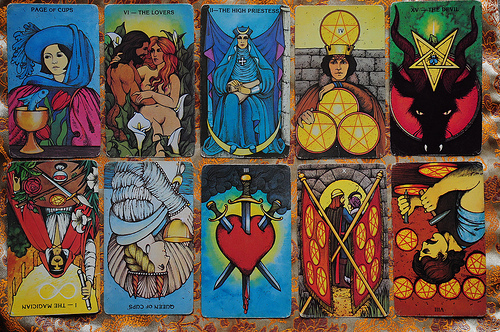
I don’t want to get too up in the air and convoluted with this stuff. I love tarot cards and even have some of the deck tattooed on me. I also like these stories and I try to read as much iconic ones as I can find. But there is something else about religion, spirituality, or whatever you want to call it that I think is completely necessary. The constant argument that comes up with religion debates is the loss of autonomy and determinism. Certainly Bernard speaks about these things in the texts and they are good things to consider. I hate the structure of a lot of religious thinking because it makes people settle for what they have or to try and prevent them room getting something better. Think of the phrase “the meek shall inherit the earth” or the idea of turning the other cheek. If taken too far, these good ideas (in some circumstances) become the ways in which people stay in really bad situations and they give away their freedom. Our right to feel passion and anger and to experience the good – and bad – with life is something that we need to acknowledge. This is the downside.
But when you enter into some atheist debates, they tend to miss the point as well. Reason and science are posited as the ways in which to obtain enlightenment and freedom instead. These are very good things; I don’t think reason or science is bad, but again, taken in the extreme they can become bad. Anything taken to the extreme can become bad. You can’t always reason with something. Some situations just don’t permit it. I always tend to use this analogy: you don’t argue or try to reason with a tsunami. You get up and you move on. Denying that we are a part of nature or are still, even with our of all accomplishments, very very small, is not the right way to go. A tsunami can come and wipe you out and our very bodies will break down one day and eventually die. We can’t reason our way out of this and at this time, there is not enough science to even prevent death, as much as we like to think we can.
So then what do you do? This is where I think stories and that myth-making that is all pervasive in every culture, in every language steps in. We tell ourselves stories in order to know who we are, and also in order to understand terrible situations that no longer make any sense. Think of the last time something happened that was beyond your control, what did you do? I know me – I listened to music, or read a book, or maybe I even went to tarot cards. People go to religion or art in order to get themselves out of bad situations. I still think we should try to use as much reason and autonomy as we possible can, but acknowledging that we do not have all the answers is so crucial. These cards or stars or psychics certainly don’t have all the answers either, but they are items that you can bring together that share your confusion. We will all die one day and this is probably the hardest fact to take. Stories make this a lot easier to deal with, and so long as you are aware of it as fiction, then stories and art and anything else that makes death easier should be welcomed.

I got into tarot cards when I was in my second year of university, but due to limited time and the stigma around any type of spiritual practice where I was, I didn’t really get into them until I graduated. While I was working a full time job, I returned to them and began to read a lot of books on the topics, but I also found Flora Peterson’s youtube channel.
I wouldn’t consider myself any type of spiritual or religious affiliations and I tend to approach things very similarly to Alexa. I acknowledge my own performance of this and take humour in all the ways I can embody the stereotype. I don’t take myself when I engage into these practices too seriously. But they are fun, and when I do feel like entertaining that side of myself, I go to Flora’s channel and I am reminded of what I like by it. This video in particular I like because she’s stressing the same things that Bernard stresses – passion in your life. Her medium is her own pagan pathway, and not through art, but it is the same message: be happy with your life.
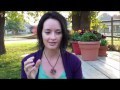
The business that she has started from her youtube channel is very similar to what I envision Alexa has done with her practice, too. To a certain degree, Flora even looks a bit like how I imagine Alexa! You should really check out her channel if you want to know more about these things. She does talk about some very pagan specific ideas (esbats and sabbats, talking with goddesses), but she also has some practical videos about allowing yourself to change, how to embody good energy, and the importance of journal writing. She also has some killer recipes, and since Alexa becomes pretty well-known for her banana bread recipe as the story continues, I shall finish off this somewhat haphazard post with it. :)
Chocolate Chip Banana Bread
2-3 large bananas
1/4 applesauce
1/4 oil
1/2 sugar
2 tablespoons molasses
2 cups whole wheat flour
3/4 teaspoon baking soda
2 teaspoons ground cinnamon
1 teaspoon vanilla
1/4 teaspoon ground nutmeg
1/2 teaspoon salt
1/2 cup chocolate chips
Preheat oven to 350 and lightly grease your baking pan.
1. In a large bowl, mix together the dry ingredients, except the chocolate chips.
2. Add the wet ingredients. Fold in chocolate chips when right consistency.
3. Add to your baking tin and cook for 45-50 minutes, checking periodically near the end. If you stick in a fork and it cups off clean, then you’re good.
4. Remove and let cool. Enjoy!



Evelyn Deshane's Blog

- Evelyn Deshane's profile
- 46 followers

