
Ode To Magritte
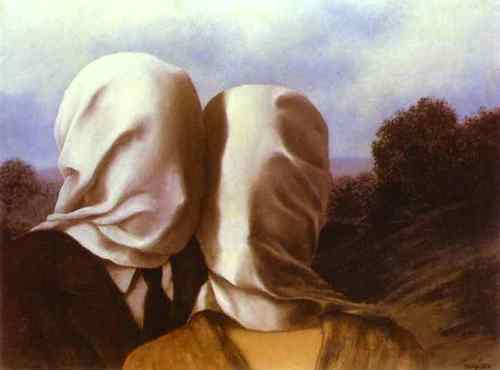
After I finished writing the story, I went through all the art I had on my computer and began to select items for the cover pieces for each section. I only had one by Magritte then – the one pictured above, The Lovers. I would come to know this man’s art more over the next few months and wish that I had been able to include more by him in the actual piece itself. I think he is utterly wonderful, his life fascinates me, and his art, not only does it wake up those who are sleeping through their life (he preferred this idea over the surrealist notion of painting dreams), but it reminds me so much of this story it physically hurts.
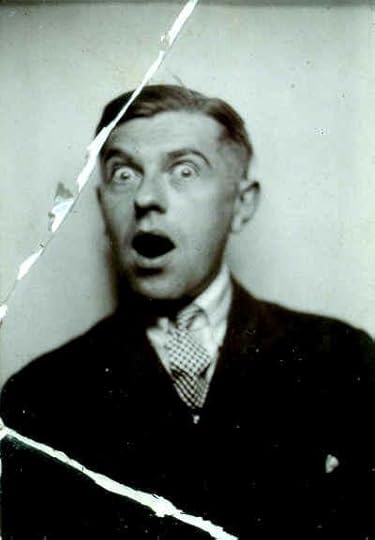
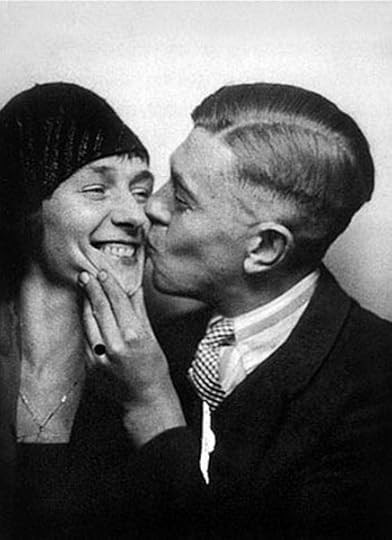
I don’t even know where to begin with this man! The above photos are of him and his wife, who used to model for most of his paintings. The two of them used to act out small movies for their friends and even did a video rendition of The Lovers. His fascination with cloth over people’s faces and bodies probably came from witnessing his mother’s body, after drowning herself in a lake, being found. It was a few days later and the night clothing that she left in was pulled up over her face, obscuring her. Although Magritte hated Freud and any type of “deep” meaning to his paintings, especially from his personal life, so he had always rejected that notion.
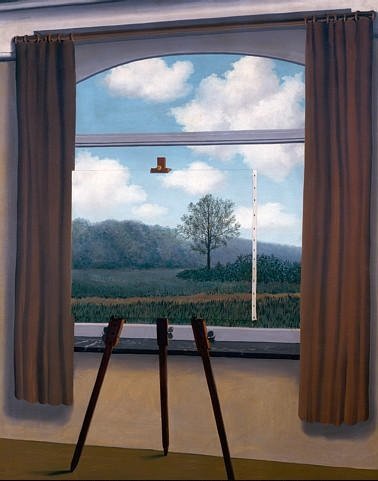
He was one of the innovators of modern art, and his piece The Human Condition, was picked by smarthistory as one of the three pieces of the 20th century.
His paintings about words captured a lot of people’s attention and The Treachery of Images, aside from The Lovers, was my other encounter with him. It was during one of my first graduate lectures and the prof made a remark about the pipe painting, saying it was a fantastic example of representation, and I felt as if I was the only one in the room who did not know about it. So, I went home and googled it, and then vowed to use it in my own TA class when we had to talk about representation. Of course, I talk about it in January as well, only Bernard misplaces its painter to Duchamp.
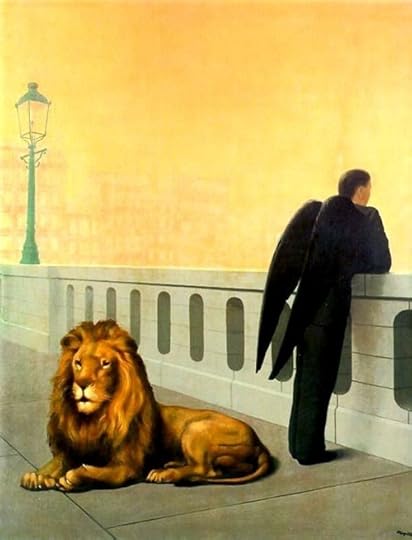
I wish I could have found this next painting when I was searching for something in the March section. This is called Homesickness (though some titles differ as Nostalgia since we are dealing with translation). This was painted one of the few times he was away from his wife Georgette, while he was in Paris and she was in Belgium.
I could probably go on and on about his life, about surrealism, and art history, but that is missing the point of this entry. But what is the point? I sometimes wonder if I have one, especially since this is the last entry I’m going to make for this website for a while, and even more since you are probably reading this after finishing the story and possibly hate me for how I’ve ended it. First off, I don’t want you to be mad. I tried to think of many ways I could end the book without having it end the way it did, with his death. But like I’ve said in this entry about archives, he will never really die. He can’t die; he is a fictional character, first of all, and you only need to flip to another section of the book to have him be alive again. The same thing applies to memories of people, I’d like to think. They as a body have died and are no longer present, but they never really die because you think of them, and you have these memories where everything feels fine, if only for a little while.
There are many quotations about just this feeling. The aliens from Slaugterhouse Five (a hugely influential book on this story especially since I was teaching it at the time), view death in this manner as well. Vonnegut writes,
The most important thing I learned on Tralfamadore was that when a person dies he only appears to die. He is still very much alive in the past, so it is very silly for people to cry at his funeral. All moments, past, present and future, always have existed, always will exist.
There is another saying about death where it really happens twice: the physical death, and then the last time someone utters the person’s name. With the archive that Thomas has set up, in addition to the art pieces at the final show, and what he is going to tell his daughter, the second death will not happen for a long, long time. If it happens at all.
This is what I mean, yet again, by tout ce qui n’est past donné est perdu. All that is not given is lost. This is what Bernard learned in Paris. If you stay by yourself and you don’t let anyone in on your life then your physical death is your final death. He knew that staying there any longer would be his death, so he came back. You always come back from your dream; you have to in order to live your life and then stay alive long after your death. Some could view this idea as immortality, but that seems to have an infinite metaphysical quality to it that I don’t think really exists in this realm. Eventually, the second death, where the name stops being uttered, will happen and the mortality will ensue. Not to mention the finality of the physical death itself. This idea of immortality does not affect the dead; it is there to comfort the living. All we have is what we know now. In the book, I’ve also discussed those eight minutes your mind still stays alive after your body is gone. Those can be the longest or the shortest eight minutes ever; the content of that, I think, has a lot to do with what you have done in this life. Bernard came back to fill those eight minutes with something good.
The aftermath of death is still huge, though, even if you are only mourning a fictitious character. I know that for weeks after writing and completing this, I was fucking devastated. I thought I had ruined something that once used to be good, but no matter how much I tried to envision another ending, I just couldn’t. Maybe it’s because I don’t want to write this series anymore, though a book of short stories is tempting to cover all the lose endings, or to detail Bernard and Vivian’s life in art school, or more about his life in Paris. There is always more there. But no matter how hard I tried to revision this book as you have just read it, I couldn’t. My part in this is done now.
But that does not mean it is all done. It does not mean that he is done, either, because, weeks later, when I found Magritte again and began to get books on him, I was moved to tears. Even I couldn’t quite let go of Bernard.
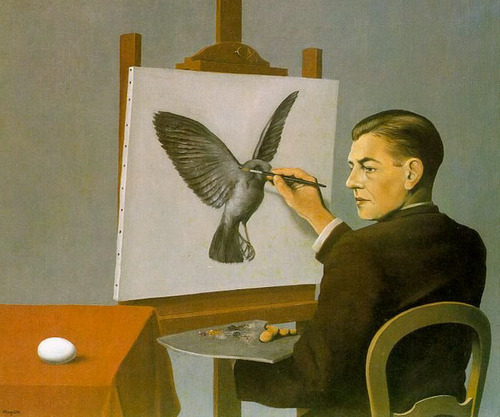
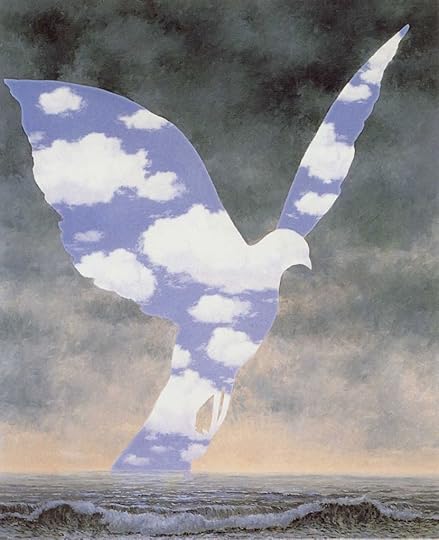
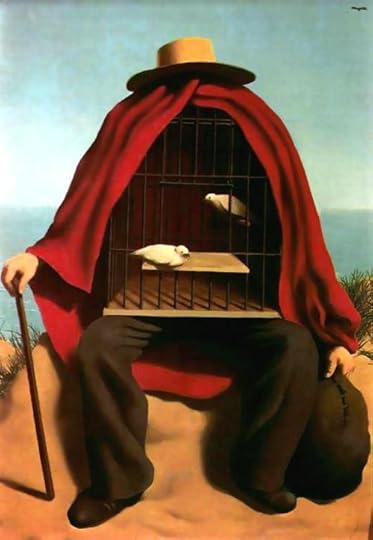
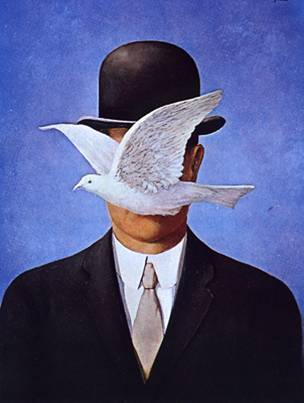
Magritte painted doves, too. Each image I see reminds me of this story. Though I know that I can no longer write this character anymore, at least right now, that does not mean I have to give up on him. This is what I mean when I say he doesn’t die. No one dies. Because we see paintings like this, think of a time period, a moment, or anything really that triggers something far more profound. Reality melts away for awhile and things are okay. I don’t even mean for this story; we do this for everything we see in this world. We see something beautiful and it may remind us of our mother, our significant other, something a teacher once said to us. We see a painting and it reminds us of another painting. We see a movie and it reminds us of going with our friends and goofing off before hand. All of these images, events, and people are connected. Looking at something the right way can produce astounding results where time stops, reverts, and bends.
So yes, the story is over now. But no story is ever really over, and nothing is purely linear anyway. Sometimes it feels as if everything is happening all at one for me. When Thomas talks about being in a fugue, he is describing that feeling where everything just happens all at once and you don’t know what to do. It’s freeing and terrifying and it’s beautiful. In music, fugue is when several notes are played at the same time. All of these stories – they all happened at the same time just like that. But they can be undone, redone, and you can go back and forth as much as you like. Or you can walk away for the time being. Anything is possible – not just with this narrative or any narrative, but with your own life, too. Look at how many stories are happening around you, all at once, and watch how your perception changes as you try to focalize yourself behind others. Everything is connected, everything is happening at once, and if you can change your perception you can change your life.
The story is over for now. I need to take a very long break because this has been a part of me for so long and it physically hurts to let it go. I need to read a bunch of books and just go out and do things because I honestly have nothing to say anymore, at least right now. I have ideas for big books, but nothing is happening yet. Until then I hope you, dear reader, are okay. Thank you very much for sticking with me. It has meant the world.
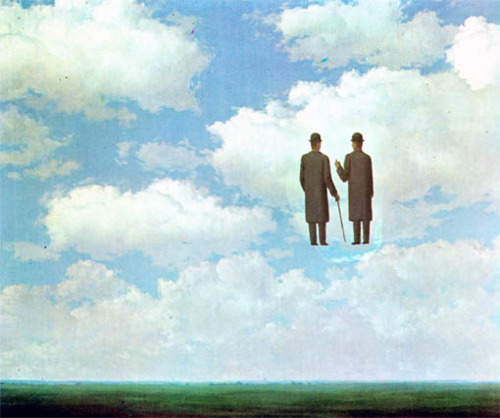
This Magritte painting is called “Infinite Gratitude.” It’s all I feel right now, so I will leave you with that. Thank you very, very much.



Evelyn Deshane's Blog

- Evelyn Deshane's profile
- 46 followers

