The Great Gatsby by F. Scott Fitzgerald
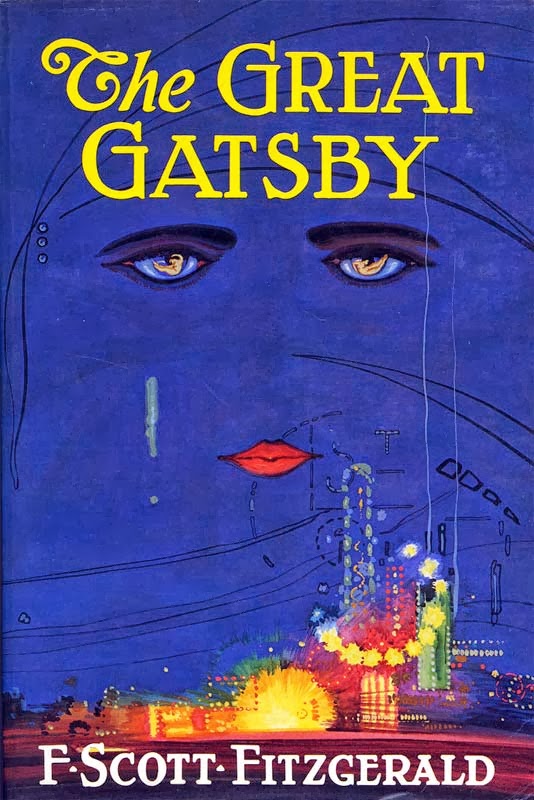 The Great Gatsby by F. Scott Fitzgerald
My rating: 4 of 5 stars
The Great Gatsby is a fairly simple story, old sport, about people who've gotten married and then want to have sex with anyone other than the person they're married to. Throw in a playboy who isn't married but who wants to have sex with someone who is, and there you just about have it. Two other characters, who aren't married (narrator Nick Carraway and golfer Jordan Baker), aren't having sex with anyone married, but also aren't having sex with each other. Perhaps they wanted to stand out from the swinging 1920s crowd?
Once the scene is set the driving force to the whole jig is Mr Gatsby himself, a self-created man on a complex mission to recapture his pre-war sweetheart by any means necessary. Like any good soldier story, the further he goes behind enemy lines the more dangerous his mission becomes. Daisy Buchanan, his WMD of choice, is an unobtainable target who soon becomes teasingly obtainable. Husband Tom, however, gets wind of this and has no intention of letting the playboy blow his mansion house down, despite being a little bit of a pig himself by snuffling in the trough of the local mechanic's wife, Myrtle. Pigs at War could well have been an alternate title, but I can see why they stuck with Gatsby.
TGG is a short novel containing a fair amount of dialogue and so the pages zip by. But this story doesn't need to be any longer; Fitzgerald gets it all done and does it well. Although we see the world through the eyes of Nick Carraway, his own thoughts don't intrude often on the description of what is essentially playing out before him. Nick even skims his own details, such as the slim relationship he has with golf pro Jordan Baker. This makes for a quick read about quick-minded folk mainly interested in...quickies.
Great writers are outlived by their art; why has this endured? Partly, I think, because Fitzgerald captured the spirit of the age he was living in, one in which people were so busy keeping up a front that they had no back. The characters in the book, except Gatsby, lack any great depth because of the time they lived in, when appearances were everything. What's at the front is not just what you get, but all that you get. The bohemian lifestyle is enjoyed, everyone drinks and has affairs (there's little else to do), and Carraway's career plans falter as he becomes sucked into his neighbour's quest for love. At heart this is a love story, of course, which is as relevant today as it was back then; it's up to the reader as to how much it resonates.
Gatsby is written with style (He knew that when he kissed this girl, and forever wed his unutterable visions to her perishable breath, his mind would never romp again like the mind of God.), a neat ear for dialogue ("He's an Oggsford man") and a concise handling of pent-up emotions ("She had told him that she loved him, and Tom Buchanan saw."); the scene where Tom and Gatsby confront each other over Daisy's future being a great example. Gatsby becomes more of its time the more it ages, so it will live on and on, like Pete Seeger.
As Nick Carraway observes these people he realises how fallible and unhappy they are. (He isn't married himself so he has no one to cheat on, but no doubt if he was then he would.) In the end he realises Gatsby, a romantic, is actually the most human of a disagreeable bunch. Tom wants everything as he likes it, as does Daisy, Myrtle and perhaps Jordan too. Carraway is so busy being on the receiving end he forgets to want everything his own way too, which is just as well, as the have-nots come out of this better than the haves.
Whenever Gatsby is mentioned the term 'The American Dream' often follows, but to me the strongest theme in the book is about life itself. It's about how empty the lives of the characters are without love or happiness to fulfill them. By the end Nick, our reliable man on the spot, rejects his own efforts at pursuing 'The Dream'. Gatsby himself is not the sort who plays by the rules, his is not a tale of how 'The Dream' is supposed to work, although he is successful at what he does. Sitting on the sand looking out over the Sound, Nick knows this is no longer what he is searching for.
The tragedy of Gatsby is that the author went to his grave not knowing its success. Although he sold enough copies (25k) to make most self-pubbers weep, he never suspected it would go on to shift the 25 million it eventually has. Although, perhaps his death by natural causes (heart attack) made him luckier than some of his contemporaries (Hemingway committed suicide).
Written with style, a quick, easy read; in other words, old sport, a book published in 1925 which is tailor-made for the readers of 2013.


No comments have been added yet.