A wicked Company
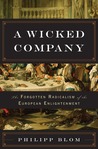 A Wicked Company: The Forgotten Radicalism of the European Enlightenment by Philipp Blom
My rating: 4 of 5 stars
Books about the Baron d’Holbach are a rarity. Why this should be the case is the subject of Philipp Blom’s book. Blom believes that Holbach has been unjustly neglected and relegated to the footnotes of history because his materialism and atheism are rejected today.
A Wicked Company is an attempt to portray Holbach and the circle that gathered around him. The title comes from a remark by the actor David Garrick who was a frequent visitor to Holbach’s house. Blom sets out the problem at the beginning of the book.
“Holbach was not only host to some of the most brilliant minds of the century but also an important philosophical writer in his own right, author of the first uncompromisingly atheist books published since antiquity. His work is ignored … His own philosophy – so fresh, so humane, so liberating – does not even appear in many histories of philosophy. His message was too disquieting, too anarchic, too dangerous to be released into the world at large.”
In attempting to trace the development of materialist ideas in the eighteenth century Blom is performing a useful service to the reading public. Materialism is supported by more scientific evidence than ever but it is widely disparaged and regarded as a dangerous doctrine. His well written and accessible book will bring Holbach’s circle to life for many readers.
Holbach was born Paul Heinrich Dietrich, in the town of Edesheim in the Rhenish Palatinate in 1723, the son of a wine-grower. He was adopted by a wealthy uncle who had bought his title of baron from the imperial court of Vienna. His uncle provided him with his name and the best education money could buy. Holbach enrolled at the University of Leiden in 1744 where he became a friend of John Wilkes, who went on to become a notorious English radical. The two remained friends until Holbach’s death in 1789. Holbach married and settled in Paris, holding his salons from 1750 to the late 1770s. Apart from a brief stay in England and a tour of the South of France after his first wife died, this was where he remained, except for the summers, which he spent at Château Grandval at Sucy en Brie, now in the south eastern suburbs of Paris. Many of Diderot’s letters were written from this summer retreat.
Diderot got to know Holbach after he was released from prison for writing his Letter on the Blind. Rousseau, who frequently visited Diderot while he was in prison, may already have known Holbach. Diderot was about to bring out the first volume of the Encyclopédie when he was arrested. Its publication in 1751 made the previously obscure writer widely known. The second volume in 1752 contains a number of articles by Holbach, he would eventually write more than 300, and the title page pays tribute to an unnamed person who is almost certainly Holbach.
“We particularly are indebted to one person,” the editors wrote, “whose mother tongue is German, and who is very well versed in the matters of mineralogy, metallurgy and physics; he has given us a prodigious amount of articles on different subjects, of which already a considerable number is included in this volume.”
The Encyclopédie was originally planned as a translation of Chambers’s Cyclopaedia, but in Diderot’s hands it evolved into a far more ambitious work which would be lavishly illustrated and would aim to do nothing less than systematise all available knowledge. Even the form of the book would be revolutionary since its entries were arranged alphabetically giving no precedence to subjects such as theology, church history or social ranks. The Encyclopédie was in itself a testament to the principle of equality.
The Dictionnaire of Pierre Bayle provided a model for Diderot’s project and a method of defeating the censors by seeming to present simple, straightforward, strictly factual information while allowing the readers to draw their own conclusions from the material that was presented to them. Bayle’s Dictionnaire was the main conduit through which the ideas of modern materialists like Spinoza and Hobbes and ancient materialists such as Epicurus reached the reading public of eighteenth century France.
Diderot would spend most of his working life editing the Encyclopédie and it would become, as Blum writes, “a battering ram, shaking the foundations of the age.” By 1765 it would run to 17 volumes containing 20 million words and 1,900 illustrations. In 1759 the government revoked its license, but the book continued to be produced illegally. Some 4,000 complete sets were sold despite the fact that it cost the equivalent of a year’s wages for a master craftsman.
Blom connects the Encyclopédie to the discussions that went on at Holbach’s house. “At its very best,” writes Blom, “it afforded the reader a seat at Holbach’s table, allowing him to listen to the flow of argument and the sheer exhilaration of ideas out of the mouths of some of the greatest intellects of the age.” The house became a magnet for foreign visitors, but they were often startled by the range of subjects that could be discussed there and the openness with which ideas that would normally be forbidden were openly expressed.
While the encyclopedists remained a diverse group, not all of them attended Holbach’s salons and nor were they all atheists or materialists, the influence of Holbach and the protection his house offered was certainly important in maintaining the Encyclopédie’s production. His salon had a distinct collective identity and Holbach’s guests often spoke of themselves as a group. Diderot referred to Holbach’s house as the boulangerie partly in reference to the pseudonym that Holbach adopted – Boulanger – and partly, no doubt because of the work that went on there. The word conjured up the image of a busy workshop, Blom writes, “constantly mixing and kneading, and pulling dangerous books out of the oven as if they were so many hot baguettes.”
Behind the respectable façade that Holbach himself maintained, Blom writes, he “funded and ran a clandestine publishing operation from his own house, a center of intellectual resistance.” His house served as “a meeting place as well as an unofficial translation agency and publishing house of subversive ideas.”
Those subversive ideas were central to the Enlightenment and Blom shows that Holbach and the group that gathered around him played a critical role in this movement. “Nowhere was the Enlightenment battle cry ‘Sapere aude!’ [dare to know] taken more seriously and acted upon more decisively than by Diderot and Holbach, and their friends, who published, translated, wrote, and transcribed a library of intellectually audacious books while at the same time pushing forward the Encyclopédie, the most distinguished and most significant encyclopedia project in history.”
Blom is conscious that the influence of postmodernism and the various forms of poststructuralism have played a part in devaluing the Enlightenment and Holbach’s role in it. “In an academic world in the thrall of postmodern and poststructuralist literary theory,” he writes, “there was no room for the works of a plainspoken philosopher whose greatest goal had been to make himself absolutely clear.”
This is an important point, but, in his eagerness to defend Holbach, Blom makes a hefty concession to the very intellectual tendencies he is trying to resist. He distinguishes between a moderate deist Enlightenment and a radical Enlightenment. This is very much in line with the work of Professor Jonathan Israel, who has done much to revive interest in the materialist and atheistic currents of thought in the Enlightenment. Blom argues that the moderate deist Enlightenment had a tendency to “dehumanize” and to create “a world dominated by the inexorable progress of the clock and the needs of machines and factories, stock markets and corporations – the nightmare factory world of Charlie Chaplin’s Modern Times.” But he wants to rescue the radical Enlightenment of Diderot and Holbach from that charge.
Rousseau was a deist who rejected materialism and atheism. For Blom this puts him squarely in the moderate Enlightenment camp. What is more he was the favourite philosopher of Maximilien Robespierre and this, for Blom, ties him to the revolutionary terror and to all forms of totalitarianism in the twentieth century. “Rousseau,” Blom writes, “was a direct inspiration not only for Robespierre but also for Lenin and Pol Pot.”
Blom is not alone in this estimation of Rousseau. Portraying Rousseau as a totalitarian has a long history. The philosopher Bertrand Russell went so far as to proclaim “Hitler is a consequence of Rousseau.” The identification of Rousseau with tyranny can be traced back to Hippolyte Taine in the later nineteenth century when France rejected its revolutionary past. It became more prevalent in liberal circles following the Russian Revolution when Rousseau was seen as an inspiration for Bolshevism. Karl Popper includes Rousseau among the enemies of the open society and in the post-war period both Hannah Arendt and Herbert Marcuse were to expand on this theme. Arendt maintained that Rousseau’s concept of the general will allowed the plurality of views that exist within society to be collapsed into one will - that of a dictator. Jacob Talmon identified Rousseau’s concept of the general will; as “the driving force of totalitarian democracy” [J.L. Talmon, The Origins of Totalitarian Democracy, New York: Norton, 1970, p. 6] of which Marxism was one variant and fascism another. The general will, Talmon maintained, was a “blank cheque to act on behalf of the people, without reference to the people’s actual will” [Talmon, 1970, p. 48].
The view that Rousseau was the originator of totalitarianism is entirely unhistorical. His ideas have to be set in the context of his writings as a whole and of the times in which he lived. In the context of ancien regime Europe Rousseau’s concept of the general will had an entirely revolutionary significance. The absolute monarchies of early modern Europe were legitimised by the Church but the general will was a secular concept that ran entirely counter to official politics. Rousseau systematically dismantled the theological framework that had been built up over centuries to maintain the power of kings and the sanctity of property.
Rousseau was not, like Diderot and Holbach, an atheist or materialist, but that did not save him from condemnation. His books were burned and banned because he was the philosopher of social equality in an epoch of gross inequality. That alone would qualify him as a revolutionary thinker. He opened his Social Contract with the words “Man is born free; and everywhere he is in chains.” As Ernst Cassirer observed “a truly revolutionary impetus emanated from him” because he sought no compromise with the existing society [Ernst Cassirer, The Question of Jean-Jacques Rousseau, Bloomington: Indiana University Press, 1963, p. 69]. The tragedy of Rousseau, and ultimately of the French Revolution, was that the most advanced thinkers which the Enlightenment produced could not, by sheer force of intellect, discover a means of ensuring equality among the citizens of the First Republic.
View all my reviews


No comments have been added yet.