"Blue As Hell's Brimstone!"
I can't spend the 150th anniversary of Appomattox without posting something. This time it concerns a historical figure who plays a minor but colorful role in my novel Lucifer's Drum, Henry Kyd Douglas. Douglas served as a trusted aide to Stonewall Jackson and later to Jubal Early. At Appomattox, where he was a brigade commander, his troops fired the last shots and were last to surrender.
Douglas hailed from Shepherdstown, Virginia (later West Virginia), though his family's home Ferry Hill stood across the Potomac, on the Maryland side. Enlisting as a Confederate private at the war's outbreak, the 22-year-old fledgling lawyer rose rapidly through the ranks and by mid-1862 was on Jackson's staff, participating in the Valley Campaign, Cedar Mountain, Second Manassas and Antietam. He filled the extra role of guide at Antietam, given his first-hand knowledge of the area. At Gettysburg he was captured and sent to the officers' prison camp at Johnson's Island, Ohio, but was freed by exchange in March, 1864. Lucifer's Drum depicts him as smart, daring and high-spirited, almost a surrogate son to his superior Jubal Early, whose mid-summer thrust down the Shenandoah brought them to the doorstep of Washington, D.C.
Many of the incidents and conversations in the novel are of course imaginary, informed by history but no more than that. One particular moment, however, is taken directly from the historical record. As Early gives orders for the Confederate host to withdraw from Washington's outskirts, following the Union counterattack, he stops to boast that they have "scared Abe Lincoln like hell." To which Douglas, then a major, responds, "Yes, General, but this afternoon when that Yankee line moved out against us, I think some other people were scared blue as hell's brimstone!" Reacting to his young aide's brash modesty, Early reportedly declared, "That's true, but it won't appear in history!" Early was no prophet.
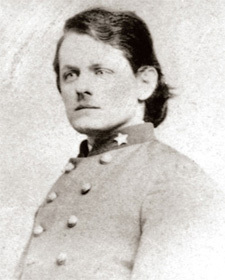
Henry Kyd Douglas, last to surrender
at Appomattox. (Courtesy: Library
of Congress)
Novels are by definition works of invention—but for historical ones, true events and true moments provide a mother lode of drama. Lucifer's Drum uses plenty of them: the solemn parade of Rebel troops past Stonewall Jackson's grave; the 4th of July picnic for the free black community of Washington, on the grounds of the President's House; Lincoln under fire on the parapet at Fort Stevens. Often, when you have researched these incidents, you are left feeling that only real life could have scripted them. Fiction pales.
Douglas saw action in nearly every Eastern campaign and survived six woundings. Varina Davis, wife of Confederate President Jefferson Davis, called Douglas, "with one exception, the handsomest man I ever met." After the war, he published his memoir I Rode With Stonewall, often cited as one of the most engaging and best-written of its kind, though not necessarily the most reliable. (You wouldn't think Douglas would have had to embellish, but it's a good bet that he did. Well, he definitely wasn't alone in that.)
Never marrying, he ended up a respected attorney in Hagerstown, Maryland, the very Unionist town that his Confederate brethren had shaken down for a "levy" during Early's Raid. Maybe its citizenry were more forgiving because of the mistake the Rebel cavalry had made on that occasion, misunderstanding Early's demand for $200,000 and snagging only $20,000 instead. History is plenty tragic, but once in a while it's funny.
Douglas hailed from Shepherdstown, Virginia (later West Virginia), though his family's home Ferry Hill stood across the Potomac, on the Maryland side. Enlisting as a Confederate private at the war's outbreak, the 22-year-old fledgling lawyer rose rapidly through the ranks and by mid-1862 was on Jackson's staff, participating in the Valley Campaign, Cedar Mountain, Second Manassas and Antietam. He filled the extra role of guide at Antietam, given his first-hand knowledge of the area. At Gettysburg he was captured and sent to the officers' prison camp at Johnson's Island, Ohio, but was freed by exchange in March, 1864. Lucifer's Drum depicts him as smart, daring and high-spirited, almost a surrogate son to his superior Jubal Early, whose mid-summer thrust down the Shenandoah brought them to the doorstep of Washington, D.C.
Many of the incidents and conversations in the novel are of course imaginary, informed by history but no more than that. One particular moment, however, is taken directly from the historical record. As Early gives orders for the Confederate host to withdraw from Washington's outskirts, following the Union counterattack, he stops to boast that they have "scared Abe Lincoln like hell." To which Douglas, then a major, responds, "Yes, General, but this afternoon when that Yankee line moved out against us, I think some other people were scared blue as hell's brimstone!" Reacting to his young aide's brash modesty, Early reportedly declared, "That's true, but it won't appear in history!" Early was no prophet.
Henry Kyd Douglas, last to surrender
at Appomattox. (Courtesy: Library
of Congress)
Novels are by definition works of invention—but for historical ones, true events and true moments provide a mother lode of drama. Lucifer's Drum uses plenty of them: the solemn parade of Rebel troops past Stonewall Jackson's grave; the 4th of July picnic for the free black community of Washington, on the grounds of the President's House; Lincoln under fire on the parapet at Fort Stevens. Often, when you have researched these incidents, you are left feeling that only real life could have scripted them. Fiction pales.
Douglas saw action in nearly every Eastern campaign and survived six woundings. Varina Davis, wife of Confederate President Jefferson Davis, called Douglas, "with one exception, the handsomest man I ever met." After the war, he published his memoir I Rode With Stonewall, often cited as one of the most engaging and best-written of its kind, though not necessarily the most reliable. (You wouldn't think Douglas would have had to embellish, but it's a good bet that he did. Well, he definitely wasn't alone in that.)
Never marrying, he ended up a respected attorney in Hagerstown, Maryland, the very Unionist town that his Confederate brethren had shaken down for a "levy" during Early's Raid. Maybe its citizenry were more forgiving because of the mistake the Rebel cavalry had made on that occasion, misunderstanding Early's demand for $200,000 and snagging only $20,000 instead. History is plenty tragic, but once in a while it's funny.


No comments have been added yet.