
Discover new books on Goodreads
Meet your next favorite book
Listopia > Best Gothic Books of All Time
Making its debut in the late 18th century, Gothic fiction was a branch of the larger Romantic movement that sought to stimulate strong emotions in the reader—fear and apprehension in this case. Gothic fiction places heavy emphasis on atmosphere, using setting and diction to build suspense and a sense of unease in the reader. Common subject matter includes the supernatural, family curses, mystery, and madness.
When adding books to the list, please make sure "gothic" is listed on the book's main genre page.
When adding books to the list, please make sure "gothic" is listed on the book's main genre page.


2299 likes · Like
Lists are re-scored approximately every 5 minutes.








Comments Showing 1-44 of 44 (44 new)
date newest »
newest »
 There are a few problems with this list. One is that some of the texts aren't novels, they're short stories, such as "The Yellow Wallpaper", or collections of short stories, such as M.R. James. Then we get to Poe's poetry, which is even further away from a novel! Others are indeed novels, but they're not gothic novels, they're novels which include parodies of gothic, namely "Northanger Abbey" and "Lady Oracle". I'd suggest pruning the list of anything which is very definitely not a novel, to begin with. Novellas such as "Carmilla" are probably OK, but anything ten pages long is nowhere near a novel.
 The list is titled "Best Gothic Books of All Time" - this makes our life easy as any type of fiction can be included, no matter whether novella, short story, short story collection or novel. Why should we limit ourselves to novels unnecessarily? I do agree that Northanger Abbey, for example, is a parody of the genre. However, as a parody it still contains all the elements necessary to be classed as a "gothic novel". It therefore should not be excluded from the list.
 Elettaria has a case, in that collections of short stories may have diverse subject matter and not all be Gothic in nature; and poetry is rarely "Gothic," since that's mainly a type of fiction. Both points would apply to Poe's collected fiction and poetry; but I still voted for that selection, because it includes so many masterpieces of Gothic literature, such as "The Fall of the House of Usher." I'm inclined to side with Christine's more inclusive approach.
That said, I don't think that "Gothic" is the most accurate description of The Island of Dr. Moreau. Wells was a writer of the Romantic school (in his own time, his novels were called "scientific romances"), and he certainly evoked fear and dread in that novel. IMO, though, it doesn't have a traditionally Gothic setting or subject matter. But maybe I'm just nit-picking! :-)
 What about Beloved? Am I completely off base? Why is Beloved considered a gothic novel. Also, doesn't gothic refer to a specific time period? There is some fairly modern literature on this list...
Coconut Library, I haven't read Beloved, so I'll let somebody else comment on that. But as to your question about the time period, the answer, at least as far as the publishing industry and book trade is concerned (I'm a librarian, so I have to keep up with that milieu), is "no." The Gothic school of fiction originated in the late 1700s; but literature written later --even books being written today-- are still called "Gothic" if they have the same characteristics.
Werner wrote: "Coconut Library, I haven't read Beloved, so I'll let somebody else comment on that. But as to your question about the time period, the answer, at least as far as the publishing industry and book t..."
What about Beloved? Am I completely off base? Why is Beloved considered a gothic novel. Also, doesn't gothic refer to a specific time period? There is some fairly modern literature on this list...
Coconut Library, I haven't read Beloved, so I'll let somebody else comment on that. But as to your question about the time period, the answer, at least as far as the publishing industry and book trade is concerned (I'm a librarian, so I have to keep up with that milieu), is "no." The Gothic school of fiction originated in the late 1700s; but literature written later --even books being written today-- are still called "Gothic" if they have the same characteristics.
Werner wrote: "Coconut Library, I haven't read Beloved, so I'll let somebody else comment on that. But as to your question about the time period, the answer, at least as far as the publishing industry and book t..."Thanks... good to know.
 I demand more Shirley Jackson. She is right up there with Poe himself. The Sundial please.
Actually, Seth, it isn't only the person who created this list (whoever he/she is) who can add books to it --you, and the rest of us, can too. So, you can consider yourself duly authorized to see that Ms. Jackson gets the representation here that she deserves. (I haven't read The Sundial myself, but I sure voted for The Haunting of Hill House!)
I demand more Shirley Jackson. She is right up there with Poe himself. The Sundial please.
Actually, Seth, it isn't only the person who created this list (whoever he/she is) who can add books to it --you, and the rest of us, can too. So, you can consider yourself duly authorized to see that Ms. Jackson gets the representation here that she deserves. (I haven't read The Sundial myself, but I sure voted for The Haunting of Hill House!)
 I think the best darkest and most Gothic tale was Bram Stoker's Dracula. Vlad was truly evil in every sense and even love wasn't strong enough to smother the demon inside him.
 Cool list, this provides me with lots of ideas for new books to read!
One thing... As much as I love Germinal - I wouldn't consider it Gothic in any way. If I'd want to put a label on it, I would rather say it's realist, naturalist or socialist.
 Hi guys, bit of a loose end now. I am trying desperately to think of some ideas for an extended essay on Gothic Novels. I was thinking along the lines of gender differences for authors or within the novels themselves. Any of you lovely people fancy giving me any more ideas? Get in contact with me however you like! Much appreciated!
 'Beloved' does not belong on this list.
 Beloved often gets read in relation to the Gothic by lit scholars, and does feature a lot of tropes usually found in Gothic lit (like ghosts). Clarissa, on the other hand, is not Gothic at all. I would love to hear why the five people who voted for it feel that it belongs on this list.
 I think that the graphic novel of "The Legend of Sleepy Hollow" should be replaced with the actual book, "The Legend of Sleepy Hollow" by Washington Irving... I suspect a lot of people voted for this thinking it was the original book (I know I almost did)
Done, Leslie! Thanks for catching that mistake.
I think that the graphic novel of "The Legend of Sleepy Hollow" should be replaced with the actual book, "The Legend of Sleepy Hollow" by Washington Irving... I suspect a lot of people voted for this thinking it was the original book (I know I almost did)
Done, Leslie! Thanks for catching that mistake.
 Lem's Solaris isn't a Gothic book, why is it in this list?
 I think you should also include Patrick McGrath's "Grotesque" and "Dr.Haggard's Disease".
Anitha, you can add those yourself! Just click on the "add books" link near the top, and then use the search function to bring up the titles you want to add.
I think you should also include Patrick McGrath's "Grotesque" and "Dr.Haggard's Disease".
Anitha, you can add those yourself! Just click on the "add books" link near the top, and then use the search function to bring up the titles you want to add.Noel, I haven't read Solaris (so, of course, I'm not the person who added it here!). But I have read a friend's review of it, and I'd have to say that while it's not traditionally Gothic, the plot and premise DO make use of some basic Gothic tropes. The lonely, isolated research station with its handful of humans functions as a sort of haunted house, and the protagonist sees hallucinations (or are they hallucinations?) of a dead love interest while he grapples with an ominous-seeming mystery. I could see how whoever put it on this list could reasonably argue that it's appropriate.
 Pleas add The Turn of the Screw by Henry James.
I hope someday my novel Mara, Book One of The Roses of the Moon will make this list!
Also The Bloody Chamber and Magic Toy Shop by Angela Carter also ed as Blood by Tanith Lee and her Secret Books of Paradys. Must be on here! :)
Alyne, The Turn of the Screw is already on this list (it's number 41). You can add the ones by Carter and Lee yourself. And best wishes for success with Mara!
 great list....much appreciated! great way to find books in the genre i'm interested in....found some great creepy horrors on this list also.
 Nice list but I'm pretty sure Lovecraft and his fellow Weird authors are fairly far removed from the Gothic definition. Granted Otranto has the mysterious limb of the Galactus-sized Giant in the hall so perhaps I'm wrong in this belief.
 Does "gothic" refer to writing from a certain era or about a certain era or is it only the stylistic elements described above? Can a story that takes place in the present time be considered gothic?? thanks!
Rhiannon wrote: "Aren't some of these more... historical horror than gothic?"
Does "gothic" refer to writing from a certain era or about a certain era or is it only the stylistic elements described above? Can a story that takes place in the present time be considered gothic?? thanks!
Rhiannon wrote: "Aren't some of these more... historical horror than gothic?"I'd like to know too.
As I understand it, the term Gothic refers to a particular literary style/subgenre. So yes, a book that exhibits those kinds of characteristics is Gothic, regardless of when it's written.
 MomToKippy wrote: "Does "gothic" refer to writing from a certain era or about a certain era or is it only the stylistic elements described above? Can a story that takes place in the present time be considered gothic..."
It's mostly about the elements no matter when or where the story takes place. There is also Gothic Horror as sub genre.
 I voted for Bram Stoker's Dracula because I believe it holds the top spot of gothic masterpieces. The first book that actually made me feel multiple emotions on every single page it hung onto every word. I still can't stop talking about how much I loved this book. Dracula is the book I be seen reading on my death bed.
Gothic isn't gothic without a castle, monastery, convent, some living architecture with its own secrets. Haunting of Hill House is the best example.
I voted for Bram Stoker's Dracula because I believe it holds the top spot of gothic masterpieces. The first book that actually made me feel multiple emotions on every single page it hung onto every word. I still can't stop talking about how much I loved this book. Dracula is the book I be seen reading on my death bed.
Gothic isn't gothic without a castle, monastery, convent, some living architecture with its own secrets. Haunting of Hill House is the best example.http://flickeringlamps.com/2015/04/03...
Go here to see Walpole's house.
 The Shadow of the Wind, which I've read, is not listed as Gothic genre on it's Goodreads listing page, and I don't see it as belonging, it's more of a creepy mystery.
Inheritance by Tom Savage. I don't know if it completely fits the genre, but it's as close as I have found in recent books. Excellent book, anyway, regardless, but to me it was gothic.
The Shadow of the Wind, which I've read, is not listed as Gothic genre on it's Goodreads listing page, and I don't see it as belonging, it's more of a creepy mystery.
Inheritance by Tom Savage. I don't know if it completely fits the genre, but it's as close as I have found in recent books. Excellent book, anyway, regardless, but to me it was gothic.
 Gothic fiction, which is largely known by the subgenre of Gothic horror, is a genre or mode of literature and film that combines fiction and horror, death, and at times romance or happiness. Its origin is attributed to English author Horace Walpole, with his 1764 novel The Castle of Otranto, subtitled (in its second edition) "A Gothic Story". Wikipedia
The rockabilly werewolf from Mars wrote: "I'm not quite sure why The Catcher In The Rye is on this. It has been a while since I read it, but I don't recall anything especially gothic about it."
Gothic fiction, which is largely known by the subgenre of Gothic horror, is a genre or mode of literature and film that combines fiction and horror, death, and at times romance or happiness. Its origin is attributed to English author Horace Walpole, with his 1764 novel The Castle of Otranto, subtitled (in its second edition) "A Gothic Story". Wikipedia
The rockabilly werewolf from Mars wrote: "I'm not quite sure why The Catcher In The Rye is on this. It has been a while since I read it, but I don't recall anything especially gothic about it."My guess is that putting it on this list was somebody's idea of a joke. I'm a Goodreads librarian, so I can delete it, if you'll tell me what number it is on the list. (That'll save me some time hunting for it!)
The rockabilly werewolf from Mars wrote: "I'm not quite sure why The Catcher In The Rye is on this. It has been a while since I read it, but I don't recall anything especially gothic about it."Since this comment was posted, I've discovered that there are LOTS of books on this list that don't have anything especially Gothic about them, not just this one! In the last two days, I've probably deleted at least two dozen improperly added books, and expect to delete a lot more.
"Gothic" might be a hard term for many modern readers to define, but the list description gives you a convenient rule to follow: add only books that list "Gothic" as a genre on the book's main Goodreads page. Not every book set in the historical past, or every book that involves a murder mystery, or even every book with a supernatural premise, is automatically "Gothic!" (And just because an author wrote one Gothic novel doesn't necessarily make everything else that he/she ever wrote automatically "Gothic," either.)
The Catcher in the Rye has been found and deleted!
 Werner, I appreciate the work you've done on cleaning up the list. It needed it. But it appears that a lot of books that most fans of the genre would consider 'gothic' are no longer there. The most apparent example being Dracula, which was at one time in the forefront on this list. If the main consideration for a book's inclusion is it having the genre listing of Gothic on its book page, is there a way to make such a thing happen? I have considered this list a valuable resource for finding good reads for some time. And will consider it so still. Just not quite so highly as I once did. Thanks for listening (er, reading... :)
Jon wrote: "If the main consideration for a book's inclusion is it having the genre listing of Gothic on its book page, is there a way to make such a thing happen?"
Werner, I appreciate the work you've done on cleaning up the list. It needed it. But it appears that a lot of books that most fans of the genre would consider 'gothic' are no longer there. The most apparent example being Dracula, which was at one time in the forefront on this list. If the main consideration for a book's inclusion is it having the genre listing of Gothic on its book page, is there a way to make such a thing happen? I have considered this list a valuable resource for finding good reads for some time. And will consider it so still. Just not quite so highly as I once did. Thanks for listening (er, reading... :)
Jon wrote: "If the main consideration for a book's inclusion is it having the genre listing of Gothic on its book page, is there a way to make such a thing happen?"Jon, good question! There is; but one person can't do it alone. When you join Goodreads, the program automatically sets your bookshelves up with three basic shelves (read, currently reading, and to read). But many people go on to create customized shelves of their own, sometimes by genre (including "Gothic"). Some very simple, generic shelf names, like Gothic, are used by a LOT of people, even though they don't coordinate with each other.
On the book records, where a list of "Genres" is supplied, the Goodreads program apparently lists every customized shelf name (like "Gothic," "Fiction," "Horror," etc.) that a certain number of people have all shelved the book as. (I don't know how large that number has to be.) The more people who have a "Gothic" shelf (I don't myself) and list a particular book on it, the more likely it is that Goodreads will list "Gothic" as one of the book's genres.
"Gothic" can be a relatively subjective term, not as cut-and-dried and easy to define as such even for people who know literature; and many other people are relatively clueless about what it is (as some of their list additions demonstrate!) I don't know the list creator, Rachel; but I'm guessing she set up that criteria as a way of bringing in an objective yardstick, and replacing idiosyncratic individual judgement with the collective perspective of many readers (in the hope that the latter would be more likely to be accurate).
All of that said, I can see Gothic elements in Dracula, though I personally usually associate "Gothic" with something set strictly in or around one particular sinister building. If you want to re-add it, I won't delete it again, even if it's not on the requisite number of people's "Gothic" shelves. :-)
Hope this helps!
Just by way of update, Dracula is on the list as #158. It doesn't look like a recent re-addition, so I'm guessing it wasn't deleted after all.
 I found a lot of M. R. James on this list that I have yet to read and I'm excited because James is my favorite Gothic author. I also found a lot of books I read as a young lady and completely forgot, so I was able to update my Read list. Keep highlighting the Gothic genre, it's so underrated.

Related News
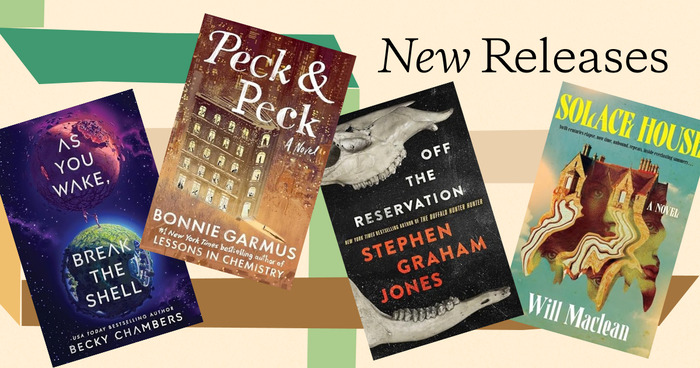
Need another excuse to treat yourself to a new book this week? We've got you covered with the buzziest new releases of the day, according to early...
Anyone can add books to this list.
But, if we're talking "Greatest Gothic Novel of ALL TIME" one would be a fool to limit oneself only to authors who have published in the last 10 - 25 years. To be truly considered for the crown of "Greatest of All Time," a book must stand toe-to-toe with those known to have stood the test of time: Shelley's Frankenstein; Dracula; some of Edgar Allen Poe's works, to name only a few.