
Find & Share Quotes with Friends
Harlem Renaissance Quotes
Quotes tagged as "harlem-renaissance"
Showing 1-13 of 13

“The best of humanity's recorded history is a creative balance between horrors endured and victories achieved, and so it was during the Harlem Renaissance.”
― Journey through the Power of the Rainbow: Quotations from a Life Made Out of Poetry
― Journey through the Power of the Rainbow: Quotations from a Life Made Out of Poetry

“History, too, has a penchant for giving birth
to itself over and over again, and those whom it
appoints agents of change and progress
do not always accept their destinies willingly.”
― Splendid Literarium: A Treasury of Stories, Aphorisms, Poems, and Essays
to itself over and over again, and those whom it
appoints agents of change and progress
do not always accept their destinies willingly.”
― Splendid Literarium: A Treasury of Stories, Aphorisms, Poems, and Essays

“The leaders and followers of the Harlem Renaissance were every bit as intent on using Black culture to help make the United States a more functional democracy as they were on employing Black culture to 'vindicate' Black people.”
― Encyclopedia of the Harlem Renaissance
― Encyclopedia of the Harlem Renaissance

“We are drawn to the Renaissance because of the hope for black uplift and interracial empathy that it embodied and because there is a certain element of romanticism associated with the era’s creativity, its seemingly larger than life heroes and heroines, and its most brilliantly lit terrain, Harlem, USA.”
― Encyclopedia of the Harlem Renaissance
― Encyclopedia of the Harlem Renaissance
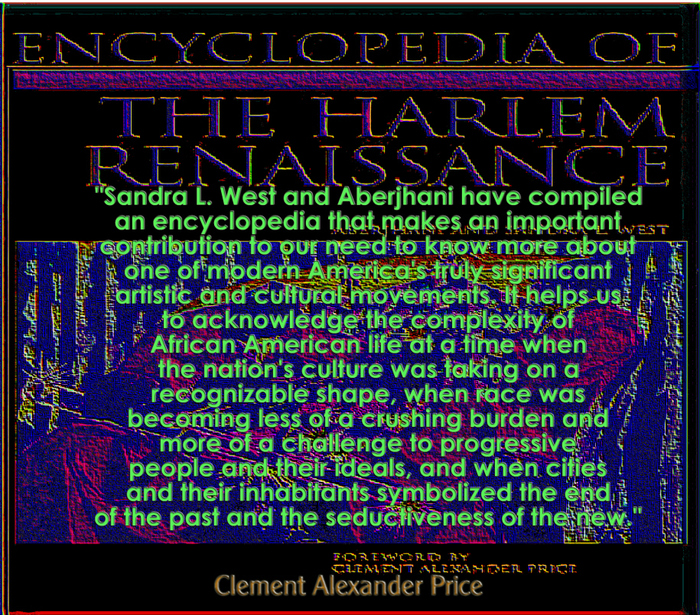
“Sandra L. West and Aberjhani have compiled an encyclopedia that makes an important contribution to our need to know more about one of modern America’s truly significant artistic and cultural movements. It helps us to acknowledge the complexity of African American life at a time when the nation’s culture was taking on a recognizable shape, when race was becoming less of a crushing burden and more of a challenge to progressive people and their ideals, and when cities and their inhabitants symbolized the end of the past and the seductiveness of the new.”
― Encyclopedia of the Harlem Renaissance
― Encyclopedia of the Harlem Renaissance
“Notwithstanding the memories of slavery, and in the face poverty, ignorance, terrorism, and subjugation still deeply woven into their lives, the embittered past of blacks was taken onto a much higher plane of intellectual and artistic consideration during the Renaissance.”
― Encyclopedia of the Harlem Renaissance
― Encyclopedia of the Harlem Renaissance
“It [the Harlem Renaissance] was a time of black individualism, a time marked by a vast array of characters whose uniqueness challenged the traditional inability of white Americans to differentiate between blacks.”
― Encyclopedia of the Harlem Renaissance
― Encyclopedia of the Harlem Renaissance
“The city of Paris, France, became a place of refuge for biracial Americans during slavery and at the time of the Harlem Renaissance for black musicians, fine artists, writers and others seeking opportunities to practice their craft free from American racism.”
― Encyclopedia of the Harlem Renaissance
― Encyclopedia of the Harlem Renaissance

“Whether we consider hip-hop as an evolved manifestation of the Harlem Renaissance or something completely new under the sun, it clearly has moved beyond the stage of just entertaining lives to that of informing and empowering lives.”
― Journey through the Power of the Rainbow: Quotations from a Life Made Out of Poetry
― Journey through the Power of the Rainbow: Quotations from a Life Made Out of Poetry

“Once, when they used to set their mouths in what they thought was the Boston Crimp, and ask me about the differences between the ordinary Negro and “the better-thinking Negro”, I used to show my irritation by saying I did not know who the better-thinking Negro was. I knew who the think-they-are-better Negroes were, but who were the better thinkers was another matter.”
― Dust Tracks on a Road
― Dust Tracks on a Road
“About the time I was 17 and graduated from high school, I went to Harlem, and that was a most beautiful place where, fortunately for me, I came into, or rather, ran into, the hands of some wonderful people, people who formed an important part of the so-called Black Renaissance. They were people like Langston Hughes, Wally Thurmond, Bud Fisher, all really wonderful writers. I lived in the YMCA where you could rent a room for $2 a week and they put all the regular inhabitants up on the 11th floor. Among them were people like Charlie Drew, who became the developer of blood plasma, distinguished physicians, physics people, and biologists.”
― Why I Left America and Other Essays
― Why I Left America and Other Essays
“I was right there in the middle of all of this action. I didn’t have to think up gags…The cartoons drew themselves…I was more surprised than anyone when Brother Bootsie became a Harlem household celebrity, not only among the colored proletariat be among the literati as well.”
― Why I Left America and Other Essays
― Why I Left America and Other Essays
“To really dig Brother Bootsie, his trials and tribulations, you’d have to see Harlem from the sidewalk. Everyone in Harlem had trials and tribulations because everyone was colored. Or almost everyone…But being colored, even in an enlightened northern burg like New York, could be a drag.”
― Why I Left America and Other Essays
― Why I Left America and Other Essays
All Quotes
|
My Quotes
|
Add A Quote
Browse By Tag
- Love Quotes 102.5k
- Life Quotes 81k
- Inspirational Quotes 77.5k
- Humor Quotes 45.5k
- Philosophy Quotes 32k
- Inspirational Quotes Quotes 29k
- God Quotes 27k
- Wisdom Quotes 25.5k
- Romance Quotes 25k
- Truth Quotes 25k
- Poetry Quotes 24.5k
- Life Lessons Quotes 23k
- Quotes Quotes 21.5k
- Death Quotes 21k
- Happiness Quotes 19k
- Hope Quotes 19k
- Faith Quotes 18.5k
- Inspiration Quotes 18k
- Relationships Quotes 16k
- Spirituality Quotes 16k
- Motivational Quotes 16k
- Religion Quotes 15.5k
- Life Quotes Quotes 15.5k
- Writing Quotes 15k
- Love Quotes Quotes 15k
- Success Quotes 14.5k
- Motivation Quotes 14k
- Time Quotes 13k
- Science Quotes 12.5k
- Motivational Quotes Quotes 12k