
Find & Share Quotes with Friends
Typography Quotes
Quotes tagged as "typography"
Showing 1-30 of 33

“Typography is the craft of endowing human language with a durable visual form.”
― The Elements of Typographic Style
― The Elements of Typographic Style


“Figures are the most shocking things in the world. The prettiest little squiggles of black looked at in the right light and yet consider the blow they can give you upon the heart.”
― The History of Mr. Polly
― The History of Mr. Polly

“Every page should explode, either because of its staggering absurdity, the enthusiasm of its principles, or its typography.”
― Manifesti del dadaismo
― Manifesti del dadaismo
“You can say, "I love you," in Helvetica. And you can say it with Helvetica Extra Light if you want to be really fancy. Or you can say it with the Extra Bold if it's really intensive and passionate, you know, and it might work.”
―
―

“Exposition is a mode of thought, a method of learning, and a means of expression. Almost all of the characteristics we associate with mature discourse were amplified by typography, which has the strongest possible bias toward exposition: a sophisticated ability to think conceptually, deductively and sequentially; a high valuation of reason and order; an abhorrence of contradiction; a large capacity for detachment and objectivity; and a tolerance for delayed response.”
― Amusing Ourselves to Death: Public Discourse in the Age of Show Business
― Amusing Ourselves to Death: Public Discourse in the Age of Show Business
“A man who would letterspace lower case would steal sheep, Frederic Goudy liked to say. If this wisdom needs updating, it is chiefly to add that a woman who would letterspace lower case would steal sheep as well .”
―
―
“The line-by-line, sequential, continuous form of the printed page slowly began to lose its resonance as a metaphor of how knowledge was to be acquired and how the world was to be understood. "Knowing" the facts took on a new meaning, for it did not imply that one understood implications, background, or connections. Telegraphic discourse permitted no time for historical perspectives and gave no priority to the qualitative. To the telegraph, intelligence meant knowing of lots of things, not knowing about them.”
― Amusing Ourselves to Death: Public Discourse in the Age of Show Business
― Amusing Ourselves to Death: Public Discourse in the Age of Show Business

“Readers usually ignore the typographic interface, gliding comfortably along literacy’s habitual groove. Sometimes, however, the interface should be allowed to fail. By making itself evident, typography can illuminate the construction and identity of a page, screen, place, or product.”
― Thinking with Type: A Critical Guide for Designers, Writers, Editors, and Students
― Thinking with Type: A Critical Guide for Designers, Writers, Editors, and Students
“We may say then that the contribution of the telegraph to public discourse was to dignify irrelevance and amplify impotence. But this was not all: Telegraphy also made public discourse essentially incoherent. It brought into being a world of broken time and broken attention, to use Lewis Mumford's phrase. The principle strength of the telegraph was its capacity to move information, not collect it, explain it or analyze it. In this respect, telegraphy was the exact opposite of typography.”
― Amusing Ourselves to Death: Public Discourse in the Age of Show Business
― Amusing Ourselves to Death: Public Discourse in the Age of Show Business
“Designers provide ways into—and out of—the flood of words by breaking up text into pieces and offering shortcuts and alternate routes through masses of information. (...) Although many books define the purpose of typography as enhancing the readability of the written word, one of design’s most humane functions is, in actuality, to help readers avoid reading.”
― Thinking with Type: A Critical Guide for Designers, Writers, Editors, and Students
― Thinking with Type: A Critical Guide for Designers, Writers, Editors, and Students
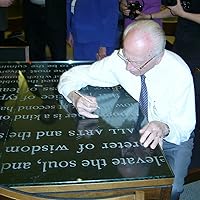
“Typography is two-dimensional architecture, based on experience and imagination, and guided by rules and readability.”
―
―

“I am a lifelong lover of form–content interplay, and this book is no exception. As with several of my previous books, I have had the chance to typeset it down to the finest level of detail, and my quest for visual elegance on each page has had countless repercussions on how I phrase my ideas. To some this may sound like the tail wagging the dog, but I think that attention to form improves anyone’s writing. I hope that reading this book not only is stimulating intellectually but also is a pleasant visual experience.”
―
―
“Typography is the use of type to advocate, communicate, celebrate, edu- cate, elaborate, illuminate, and disseminate. Along the way, the words and pages become art.”
― The Complete Manual of Typography: A Guide to Setting Perfect Type
― The Complete Manual of Typography: A Guide to Setting Perfect Type
“Typography must often draw attention to itself before it will be read. Yet in order to be read, it must relinquish the attention it has drawn.”
― The Elements of Typographic Style
― The Elements of Typographic Style
“IS GOD THE NEGATIVE SPACE IN THE UNIVERSE?
THE DESIGN OF THE UNIVERSE USED A LOT OF NEGATIVE SPACE”
―
THE DESIGN OF THE UNIVERSE USED A LOT OF NEGATIVE SPACE”
―

“One of my colleagues is convinced that having a wide range of types to choose from is a complete waste of time. He swears by two typefaces: Gill (1928) and Frutiger (1975), which he uses for road signs (among other things). (...) [U]ntil 1975, the year in which Adrian Frutiger's eponymous typeface came onto the market, my colleague could only have made half of his selection. It seems to me that this proves the case for continuing to design new typefaces.”
― While You're Reading
― While You're Reading
“Una y otra vez, los lectores se han condicionado mutuamente.”
― ¿Qué ocurre mientras lees?: Tipografía y legibilidad
― ¿Qué ocurre mientras lees?: Tipografía y legibilidad

“A page of a book is like a human face. Look at a page by Hemingway and compare it with Sterne and Marcel Proust. They are different typographical beings. But force upon them those ragged edges, and the influence of the author’s style on the physical aspect of the page, their typographical physiognomy will disappear. No, unjustified setting is a sort of gleichschaltung [enforced conformity] through diversity, a very phoney diversity. Produced methodically by chance. For the comfort of the keyboard, and not for the comfort of the eye.”
―
―

“For a new fount to be successful it has to be so good that only very few recognize its novelty.”
―
―
“Logograms pose a more difficult question. An increasing number of persons and institutions, from archy and mehitabel to PostScript and TrueType, come to the typographer in search of special treatment.In earlier days it was kings and deities whose agents demanded that their names be written in a larger size or set in a specially ornate typeface; not it is business firms and mass-market products demanding an extra helping of capitals, or a proprietary face, and poets pleading, by contrast, to be left entirely in the vernacular lower case. But type is visible speech, in which gods and men, saints and sinners, poets and business executives are treated fundamentally alike . Typographers, in keeping with the virtue of their trade, honor the stewardship of texts and implicitly oppose private ownership of words.”
― The Elements of Typographic Style
― The Elements of Typographic Style

“However, [Edmund G. Gress] wrote, " we must not simplify to such an extent that life and movement are gone. That is where those persons go wrong who claim that type was made to read, and nothing else matters but the setting up of a paragraph in a legible type so that it can be easily read. We do not read everything that appears in print, but do read that which appears interesting.”
― Streamline: American Art Deco Graphic Design
― Streamline: American Art Deco Graphic Design
“Type designers are, at their best, the Stradivarii of literature: not merely makers of salable products, but artists who design and make the instruments that other artists use.”
― The Elements of Typographic Style
― The Elements of Typographic Style
“Accidental associations are rarely a good basis for choosing a typeface. Books of poems by the twentieth-century Jewish American poet Marvin Bell, for example, have sometimes been set in Bell type -which is eighteenth-century, English and Presbyterian - solely because of the name. Such puns are a private amusement for typographers; they also sometimes work. But a typographic page so well designed that it attains a life of its own will be based on real affinities, not on an inside joke.
Letterforms have character, spirit and personality. Typographers learn to discern these features through years of working first-hand with the forms, and through studying and comparing the work of other designers, present and past. On close inspection, typefaces reveal many hints of their designers' times and temperaments, and even their nationalities and religious faiths. Faces chosen on these grounds are likely to give more interesting results than faces chosen through mere convenience of availability or coincidence of name.”
― The Elements of Typographic Style
Letterforms have character, spirit and personality. Typographers learn to discern these features through years of working first-hand with the forms, and through studying and comparing the work of other designers, present and past. On close inspection, typefaces reveal many hints of their designers' times and temperaments, and even their nationalities and religious faiths. Faces chosen on these grounds are likely to give more interesting results than faces chosen through mere convenience of availability or coincidence of name.”
― The Elements of Typographic Style
“Typography like other arts, from cooking to choreography, involves a balance between the familiar and the unfamiliar, the dependably consistent and the unforeseen. Typographers generally take pleasure in the unpredictable length of the paragraph while accepting the simple and reassuring consistency of the paragraph indent. The prose paragraph and its verse counterpart, the stanza, are basic units of linguistic thought and literary style. The typographer must articulate them enough to make them clear, yet not so strongly that the form instead of the content steals the show. If the units of thought, or the boundaries between thoughts, look more important than the thoughts themselves, the typographer has failed.”
― The Elements of Typographic Style
― The Elements of Typographic Style

“Anatomy of Typos (Sonnet)
It took me a 100 books to realize this,
typos are not a stain upon literature,
typos are ornament of literature,
sweet reminders of human endeavor.
It's great to have literature without typos,
like it's great to have a life without regrets.
But in actuality, only the dead have no regrets,
only the uncreative make no typographical mistakes.
There are typos that are grievous, hence,
need correcting, but most typos are harmless.
Repulsed by typos means repulsed by literature,
repulsed by regrets means repulsed by existence.
Typos are the ornament of literature,
regrets are the ornament of life.
To make peace with regrets is the beginning of life,
to make peace with typos is to empower literary light.”
― The God Sonnets: Naskar Art of Theology
It took me a 100 books to realize this,
typos are not a stain upon literature,
typos are ornament of literature,
sweet reminders of human endeavor.
It's great to have literature without typos,
like it's great to have a life without regrets.
But in actuality, only the dead have no regrets,
only the uncreative make no typographical mistakes.
There are typos that are grievous, hence,
need correcting, but most typos are harmless.
Repulsed by typos means repulsed by literature,
repulsed by regrets means repulsed by existence.
Typos are the ornament of literature,
regrets are the ornament of life.
To make peace with regrets is the beginning of life,
to make peace with typos is to empower literary light.”
― The God Sonnets: Naskar Art of Theology
“Typos are not a stain upon literature, typos are ornament of literature.”
― The God Sonnets: Naskar Art of Theology
― The God Sonnets: Naskar Art of Theology
All Quotes
|
My Quotes
|
Add A Quote
Browse By Tag
- Love Quotes 102.5k
- Life Quotes 81k
- Inspirational Quotes 77.5k
- Humor Quotes 45.5k
- Philosophy Quotes 32k
- Inspirational Quotes Quotes 28.5k
- God Quotes 27k
- Wisdom Quotes 25k
- Romance Quotes 25k
- Truth Quotes 25k
- Poetry Quotes 24.5k
- Life Lessons Quotes 23k
- Quotes Quotes 21.5k
- Death Quotes 21k
- Happiness Quotes 19k
- Hope Quotes 19k
- Faith Quotes 18.5k
- Inspiration Quotes 18k
- Relationships Quotes 16k
- Spirituality Quotes 16k
- Motivational Quotes 16k
- Religion Quotes 15.5k
- Life Quotes Quotes 15.5k
- Writing Quotes 15k
- Love Quotes Quotes 15k
- Success Quotes 14.5k
- Motivation Quotes 14k
- Time Quotes 13k
- Science Quotes 12.5k
- Motivational Quotes Quotes 12k