
Find & Share Quotes with Friends
W E B Du Bois Quotes
Quotes tagged as "w-e-b-du-bois"
Showing 1-7 of 7

“As life in general constituted much pain in the form of struggles against poverty, disease, ignorance, and emotional anguish, what more civilized way for people to alleviate the same than by giving themselves to one another as brothers and sisters in deed as well as in word? A society of people hoping to become politically superior needed first to become spiritually valid.”
― The Wisdom of W.E.B. Du Bois
― The Wisdom of W.E.B. Du Bois

“We were singing for Dr. Du Bois' spirit, for the invaluable contributions he made, for his shining intellect and his courage. To many of us he was the first American Negro intellectual. We knew about Jack Johnson and Jesse Owens and Joe Louis. We were proud of Louis Armstrong and Marian Anderson and Roland Hayes. We memorized the verses of James Weldon Johnson, Langston Hughes, Paul Laurence Dunbar and Countee Cullen, but they were athletes, musicians and poets, and White folks thought all those talents came naturally to Negroes. So, while we survived because of those contributors and their contributions, the powerful White world didn't stand in awe of them. Sadly, we also tended to take those brilliances for granted. But W.E.B. Du Bois and of course Paul Robeson were different, held on a higher or at least on a different plateau than the others.”
― All God's Children Need Traveling Shoes
― All God's Children Need Traveling Shoes

“Assessing Miller's rebuttal and the 1895 convention, W.E.B. Du Bois made a sobering observation. Miller had, on some fundamental level, misunderstood the aims of the white men who sought to destroy Reconstruction. From Du Bois's perspective, the 1895 constitutional convention was not an exercise in moral reform, or an effort to purge the state of corruption. These were simply bywords embraced to cover for the restoration of a despotic white supremacy. The problem was not that South Carolina's Reconstruction-era government had been consumed by unprecedented graft. Indeed, it was the exact opposite. The very success Miller highlighted, the actual record of 'Negro government' in South Carolina, undermined white supremacy. To redeem white supremacy, that record was twisted, mocked, and caricatured into something that better resembled the prejudices of white South Carolina. 'If there was one thing that South Carolina feared more than bad Negro government,' wrote Du Bois, 'it was good Negro government.”
― We Were Eight Years in Power: An American Tragedy
― We Were Eight Years in Power: An American Tragedy

“W.E.B. Du Bois called such erasure [of the first arrival of enslaved Africans to America] the propaganda of history. "It is propaganda like this that has led men in the past to insist that history is 'lies agreed upon'; and to point out the danger in such misinformation," he wrote in his influential treatise Black Reconstruction (1935). Du Bois argued that America had falsified the fact of its history "because the nation was ashamed.”
― Four Hundred Souls: A Community History of African America, 1619-2019
― Four Hundred Souls: A Community History of African America, 1619-2019
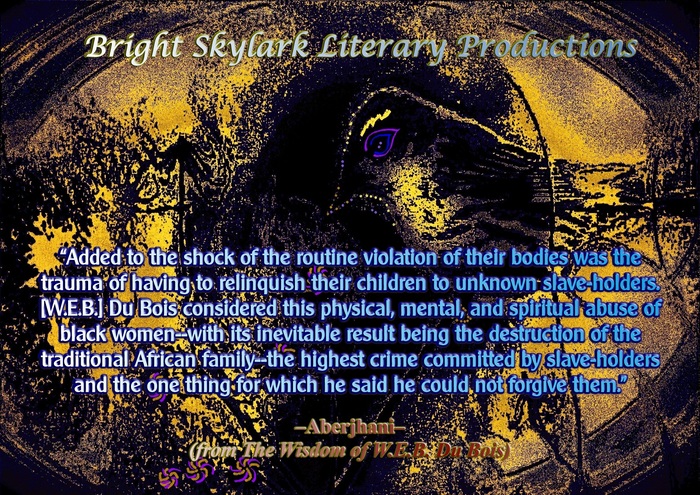
“Added to the shock of the routine violation of their bodies was the trauma of having to relinquish their children to unknown slave-holders. [W.E.B.] Du Bois considered this physical, mental, and spiritual abuse of black women--with its inevitable result being the destruction of the traditional African family--the highest crime committed by slave-holders and the one thing for which he said he could not forgive them.”
― The Wisdom of W.E.B. Du Bois
― The Wisdom of W.E.B. Du Bois

“It is interesting that a guy like W.E.B. Du Bois, who actually did very little, I should imagine, with his hands, wrote about "I am the smoke king." Without the labor, both free and slave, of African Americans this country would still be a wilderness.”
― Shimmy Shimmy Shimmy Like My Sister Kate: Looking At The Harlem Renaissance Through Poems
― Shimmy Shimmy Shimmy Like My Sister Kate: Looking At The Harlem Renaissance Through Poems

“Between the tenets of those two men [W.E.B. Du Bois and Booker T. Washington], a race strived to untangle
its convoluted root, urged its whole self forward, and hurtled
toward the door America had fought so hard to keep closed.”
― Four Hundred Souls: A Community History of African America, 1619-2019
its convoluted root, urged its whole self forward, and hurtled
toward the door America had fought so hard to keep closed.”
― Four Hundred Souls: A Community History of African America, 1619-2019
All Quotes
|
My Quotes
|
Add A Quote
Browse By Tag
- Love Quotes 102.5k
- Life Quotes 81k
- Inspirational Quotes 77.5k
- Humor Quotes 45.5k
- Philosophy Quotes 32k
- Inspirational Quotes Quotes 29k
- God Quotes 27k
- Wisdom Quotes 25.5k
- Romance Quotes 25k
- Truth Quotes 25k
- Poetry Quotes 24.5k
- Life Lessons Quotes 23k
- Quotes Quotes 21.5k
- Death Quotes 21k
- Happiness Quotes 19k
- Hope Quotes 19k
- Faith Quotes 18.5k
- Inspiration Quotes 18k
- Relationships Quotes 16k
- Spirituality Quotes 16k
- Motivational Quotes 16k
- Religion Quotes 15.5k
- Life Quotes Quotes 15.5k
- Writing Quotes 15k
- Love Quotes Quotes 15k
- Success Quotes 14.5k
- Motivation Quotes 14k
- Time Quotes 13k
- Science Quotes 12.5k
- Motivational Quotes Quotes 12k