
Find & Share Quotes with Friends
Forced Labor Quotes
Quotes tagged as "forced-labor"
Showing 1-26 of 26

“Three thousand six hundred and fifty-three days.
The three extra days were for leap years.”
― One Day In The Life Of Ivan Denisovich
The three extra days were for leap years.”
― One Day In The Life Of Ivan Denisovich

“Work, he reckoned, was the best medicine of all.
Work is what horses die of. Everybody should know that.”
― One Day in the Life of Ivan Denisovich
Work is what horses die of. Everybody should know that.”
― One Day in the Life of Ivan Denisovich
“Shukhov gazed at the ceiling in silence. Now he didn't know whether he wanted freedom or not. At first he'd longed for it. Every night he'd counted the days of his stretch—how many had passed, how many were coming. And then he'd grown bored with counting. And then it became clear that men like him wouldn't ever be allowed to return home, that they'd be exiled.”
― One Day In The Life Of Ivan Denisovich
― One Day In The Life Of Ivan Denisovich
“I write to you now with the last dignity I have left: the dignity of truth, unvarnished and unembellished. I am not a metaphor, nor a statistic, nor a symbol. I am a person who has asked for protection in El Paso, in Texas, and at the federal level, and each time the silence has made it feel as though my life has no value. So I ask you, the Honorable John G. Roberts, Jr., Chief Justice of the Supreme Court of the United States, with all the seriousness my desperation allows: if this is truly how measly an immigrant’s life is worth in America, please tell me—how much would I need to pay to purchase my own freedom?”
―
―
“There are so many ways to kill a man in America, and most of them don’t require a weapon. Some don’t even require intent. Some are performed politely through envelopes stamped with the seal of the State of Texas. This is the genius behind American violence: its ability to disguise itself as procedure.”
―
―
“The State is never responsible for your death. It merely “regrets” that you did not submit the proper documentation beforehand. And because bureaucracy is inherently impersonal, it grants everyone involved the luxury of innocence. No one feels responsible. Everyone played by the rules. No malicious intent was present. No hate, no rage, no violence, only boxes checked, protocols followed, signatures placed in blue ink.”
―
―
“Bureaucratic murder is the purest form of innocent cruelty, because it requires no recognition of the victim as human. All that is required is the quiet assumption that the system knows best. Thus the State does not have to shoot you. It only has to doubt you. It does not have to lock you in a room. It merely needs to close your case. It does not have to poison your food. It only has to make assistance impossible to obtain.
This is the violence of paperwork; clean, odorless, bloodless, and completely untraceable. A violence that leaves no fingerprints, only timestamps. A violence that kills not by force, but by omission; not by brutality, but by delay. The gun of the modern American State is a PDF. Its bullet is a denial letter. Its trigger is a policy no one wants to take responsibility for. And its most common casualties are the people it pretends to protect.”
―
“I am asked to speak as if I were not there. To doubt myself in public. To perform neutrality about my own pain. I am expected to describe bruises without naming the hands that caused them, to describe fear without naming what produced it. This is not objectivity. This is erasure pretending to be civil. When my anger sounds too real, I am told I am exaggerating. When my wounds are too raw, I am told I am unstable. So I am expected to package trauma like a press release, to choose my words carefully, to avoid anything that might make the system feel accused.”
―
―
“I'm instructed to water down lived experience into courtroom language, to turn certainty into caution, to translate memory into something legally unthreatening. I'm told that naming harm too directly is “inflammatory,” that clarity is “dangerous,” that speaking plainly is “irresponsible.” So I'm trained to speak like lawyer on behalf of the very structures that wounded me, inserting doubt into my own story before anyone else has to. I'm expected to pre-discredit myself so the system does not have to work as hard. This is not about accuracy. This is about power. When I'm forced to say “alleged,” it is not because the truth is unclear, but because the truth is inconvenient.”
―
―
“There is a form of modern cruelty that does not argue with your testimony; it simply translates it into words that neutralize it. The State does not have to say “we don’t believe you.” It only has to say “this does not meet the definition,” as if violence becomes unreal when it fails to fit a statutory shape. The State performs innocence without changing behavior. It records your pain without treating it as urgent. It accepts your report without giving you protection. It receives your evidence without granting you remedy. The paperwork becomes a grave where the truth is buried alive, not because it is disproven, but because it is processed until it no longer threatens anyone.”
―
―
“Let your work warm you up, that was your only salvation.”
― One Day in the Life of Ivan Denisovitch
― One Day in the Life of Ivan Denisovitch
“A UTEP business graduate, an English speaker, an employer with a logo: Ramon Ontiveros Medina is the American success story disfigured into its truest form: a man who realized that in the United States, you can turn lies into tools, fear into currency, and immigrants into collateral.”
―
―
“Survival is not the absence of injury. Survival is the evidence. Survival is the proof that I endured what should never have been endured in the first place. I refuse the bureaucratic fantasy that harm only becomes real after the body is cold. I refuse the notion that a man must die for his suffering to count. I refuse the quiet expectation that immigrants must become ghosts before anyone acknowledges they were ever alive. If the system cannot recognize that, then the issue is no longer whether I faced a “substantial threat of personal injury.” The issue is what the State believes a immigrant's life is worth, and why my survival was treated as a procedural nuisance instead of a warning. If this isn’t a substantial threat of personal injury, then what the fuck is?”
―
―
“Human trafficking in the form of Ramon Ontiveros operates through administrative violence. The trafficked person is forced to perform credibility while starving. They must speak carefully, wait indefinitely, and remain calm enough to be believed but injured enough to qualify.”
―
―
“This is the moral trap built into institutional recognition: you must be wounded in the correct tone, harmed in the correct sequence, traumatized in a way that looks coherent to strangers who were not there, and you must remain stable enough to be trusted while the conditions of harm are actively destabilizing you. If you break down, you are unstable. If you hold together, you must not have suffered “enough.” If you speak with certainty, you are exaggerating. If you hedge, you are inconsistent. The rules are designed so that whatever you do can be used against you, and the exhaustion produced by this contradiction functions as a second assault. It is not only the human trafficker who drains the victim; it is the bureaucracy that demands the victim keep proving their right to be seen as human while offering only delays in return. This reveals the central philosophical truth: consent under deprivation is a fiction the State relies on to absolve itself.”
―
―
“The State asks you to translate your suffering into a professional tone, as if truth becomes illegitimate when it is said with rage, as if clarity is dangerous, as if naming the violence directly is irresponsible. This is how the State preserves itself while being complicit: they do not deny harm; they sanitize it. They do not block a survivor's testimony; they domesticate it. They do not silence you with force; they invite you to speak in a way that does not matter.”
―
―
“When my former employer, Ramon Ontiveros Medina, the person who trafficked and exploited me for almost three years, hides behind fake accounts to sabotage my work, drain my resources, waste my time, impersonate opportunities, poison my reputation, and push me back toward hunger, he is not “bothering” me. He is not engaging in “online conflict.” He is resurrecting the same conditions he used to control me in the first place. He is reconstructing captivity without touching me. He is weaponizing distance. He is building another starvation chamber, this time digital, algorithmic, and invisible to the institutions that claim to protect victims. He knows exactly what hunger does to me. He has seen it. He used it. He remembers the way my body almost fell apart in 2022 when I starved for 24 consecutive days and over a month overall. And now he recreates it, not by locking me in a room, but by locking me out of the economy.”
―
―
“I bet if all the victims who were once ignored, dismissed, and abandoned by the El Paso Police Department, were to stand across and blow onto its structure at the very same time, the entire headquarters would collapse into rubble, exposing a system propped up by silence, negligence, and complicity.”
―
―
“To think Ramon Ontiveros Medina claims the identity of an immigrant while weaponizing the vulnerabilities of another [immigrant], it is not but the clearest definition of hypocrisy.”
―
―

“Antanas eased up on the accelerator and pulled the truck onto the shoulder. The sound of the soldiers' footsteps crunching in the snow made Maria sit up straight. The truck had driven about thirty metres past the patrol, but none of the soldiers had fired upon them. Antanas hoped fervently that the transport documents that Peter had furnished him would pass inspection. Maria reached down and touched a metal pipe concealed beneath her seat. She was prepared to use it.
Jadwyga continued to pray quietly. "Mother Mary, spare me, Maria, and the other women from rape, and Antanas from death."
As a sergeant approached the truck, Jadwyga's stomach cramped, sweat broke out on her forehead, and her arms began to shake. Then she fainted. Maria propped Jadwyga up to make it look as though she was sleeping, and then smiled at the sergeant who was rapping on the glass.
Antanas rolled down his window.”
― Caught Between Two Devils

“I used to think if I could be free I should be the happiest woman," a young Mississippi woman recalled. "But when my master come to me, and says 'Lizzie, you is free!' it seems like I was in a kind of daze. And when I would wake up in the morning I would think to myself, Is I free? Hasn't I got to get up before daylight and go into the field and work?”
―
―
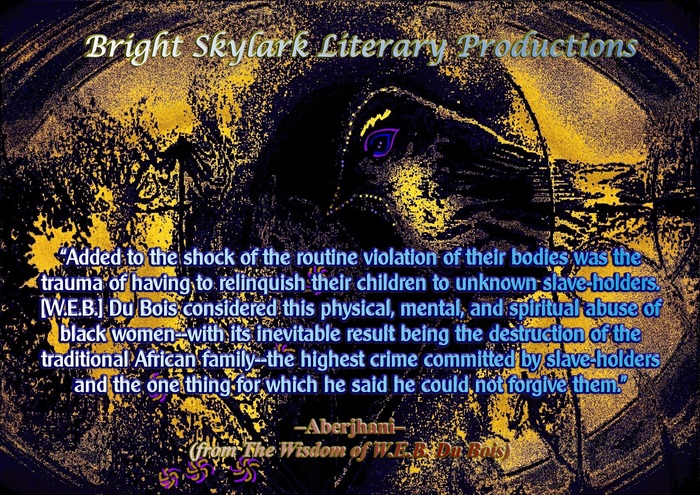
“Added to the shock of the routine violation of their bodies was the trauma of having to relinquish their children to unknown slave-holders. [W.E.B.] Du Bois considered this physical, mental, and spiritual abuse of black women--with its inevitable result being the destruction of the traditional African family--the highest crime committed by slave-holders and the one thing for which he said he could not forgive them.”
― The Wisdom of W.E.B. Du Bois
― The Wisdom of W.E.B. Du Bois

“Vagrancy laws and other laws defining activities such as "mischief" and "insulting gestures" as crimes were enforced vigorously against blacks. The aggressive enforcement of these criminal offenses opened up an enormous market for convict leasing.”
― The New Jim Crow: Mass Incarceration in the Age of Colorblindness
― The New Jim Crow: Mass Incarceration in the Age of Colorblindness

“In the Far East, compulsory labor can work wonders, just like here... If only Belgium wanted to see that. This could create "inexhaustible resources and exploiting the soil and peoples of the Far East can only be brought to civilization and well-being in this way.”
―
―
“Daylight meant that she must exist in a world that was growing darker and darker because she knew that there was not a man within miles who wanted a plain twenty-nine-year-old spinster.”
―
―
All Quotes
|
My Quotes
|
Add A Quote
Browse By Tag
- Love Quotes 102.5k
- Life Quotes 81k
- Inspirational Quotes 77.5k
- Humor Quotes 45.5k
- Philosophy Quotes 32k
- Inspirational Quotes Quotes 29k
- God Quotes 27k
- Wisdom Quotes 25.5k
- Romance Quotes 25k
- Truth Quotes 25k
- Poetry Quotes 25k
- Life Lessons Quotes 23k
- Quotes Quotes 21.5k
- Death Quotes 21k
- Happiness Quotes 19k
- Hope Quotes 19k
- Faith Quotes 19k
- Inspiration Quotes 18.5k
- Spirituality Quotes 16k
- Relationships Quotes 16k
- Motivational Quotes 16k
- Religion Quotes 15.5k
- Life Quotes Quotes 15.5k
- Writing Quotes 15k
- Love Quotes Quotes 15k
- Success Quotes 14.5k
- Motivation Quotes 14k
- Time Quotes 13k
- Science Quotes 12.5k
- Motivational Quotes Quotes 12k