This will prevent Suman from sending you messages, friend request or from viewing your profile. They will not be notified. Comments on discussion boards from them will be hidden by default.
“And who knows (there is no saying with certainty), perhaps the only goal on earth to which mankind is striving Free eBooks at Planet eBook.com lies in this incessant process of attaining, in other words, in life itself, and not in the thing to be attained, which must always be expressed as a formula, as positive as twice two makes four, and such positiveness is not life, gentlemen, but is the beginning of death. Anyway, man has always been afraid of this mathematical certainty, and I am afraid of it now. Granted that man does nothing but seek that math- ematical certainty, he traverses oceans, sacri ces his life in the quest, but to succeed, really to nd it, dreads, I assure you. He feels that when he has found it there will be noth- ing for him to look for. When workmen have nished their work they do at least receive their pay, they go to the tavern, then they are taken to the police-station—and there is oc- cupation for a week. But where can man go? Anyway, one can observe a certain awkwardness about him when he has attained such objects. He loves the process of attaining, but does not quite like to have attained, and that, of course, is very absurd. In fact, man is a comical creature; there seems to be a kind of jest in it all. But yet mathematical certainty is a er all, something insu erable. Twice two makes four seems to me simply a piece of insolence. Twice two makes four is a pert coxcomb who stands with arms akimbo bar- ring your path and spitting. I admit that twice two makes four is an excellent thing, but if we are to give everything its due, twice two makes ve is sometimes a very charming thing too. And why are you so rmly, so triumphantly, convinced that only the normal and the positive—in other words, only what is conducive to welfare—is for the advantage of man? Notes from the Underground Is not reason in error as regards advantage? Does not man, perhaps, love something besides well-being? Perhaps he is just as fond of su ering? Perhaps su ering is just as great a bene t to him as well-being? Man is sometimes extraor- dinarily, passionately, in love with su ering, and that is a fact. ere is no need to appeal to universal history to prove that; only ask yourself, if you are a man and have lived at all. As far as my personal opinion is concerned, to care only for well-being seems to me positively ill-bred. Whether it’s good or bad, it is sometimes very pleasant, too, to smash things. I hold no brief for su ering nor for well-being either. I am standing for ... my caprice, and for its being guaran- teed to me when necessary. Su ering would be out of place in vaudevilles, for instance; I know that. In the ‘Palace of Crystal’ it is unthinkable; su ering means doubt, negation, and what would be the good of a ‘palace of crystal’ if there could be any doubt about it? And yet I think man will never renounce real su ering, that is, destruction and chaos. Why, su ering is the sole origin of consciousness. ough I did lay it down at the beginning that consciousness is the great- est misfortune for man, yet I know man prizes it and would not give it up for any satisfaction. Consciousness, for in- stance, is in nitely superior to twice two makes four. Once you have mathematical certainty there is nothing le to do or to understand. ere will be nothing le but to bottle up your ve senses and plunge into contemplation. While if you stick to consciousness, even though the same result is attained, you can at least og yourself at times, and that will, at any rate, liven you up. Reactionary as it is, corporal punishment is better than nothing.”
―
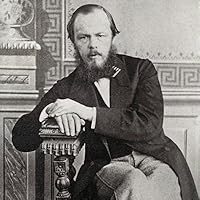
Dostoevsky, Fyodor