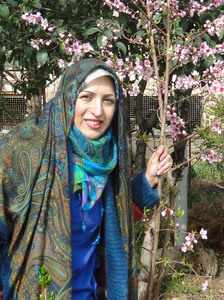
Azadeh Sobout

Add friend
Sign in to Goodreads to learn more about Azadeh.


Loading...
Slavoj Žižek
“What about animals slaughtered for our consumption? who among us would be able to continue eating pork chops after visiting a factory farm in which pigs are half-blind and cannot even properly walk, but are just fattened to be killed? And what about, say, torture and suffering of millions we know about, but choose to ignore? Imagine the effect of having to watch a snuff movie portraying what goes on thousands of times a day around the world: brutal acts of torture, the picking out of eyes, the crushing of testicles -the list cannot bear recounting. Would the watcher be able to continue going on as usual? Yes, but only if he or she were able somehow to forget -in an act which suspended symbolic efficiency -what had been witnessed. This forgetting entails a gesture of what is called fetishist disavowal: "I know it, but I don't want to know that I know, so I don't know." I know it, but I refuse to fully assume the consequences of this knowledge, so that I can continue acting as if I don't know it.”
Slavoj Žižek, Violence: Six Sideways Reflections

Edward W. Said
“Now everyone knows that to try to say something in the mainstream Western media that is critical of U.S. policy or Israel is extremely difficult; conversely, to say things that are hostile to the Arabs as a people and culture, or Islam as a religion, is laughably easy. For in effect there is a cultural war between spokespersons for the West and those of the Muslim and Arab world. In so inflamed a situation, the hardest thing to do as an intellectual is to be critical, to refuse to adopt a rhetorical style that is the verbal equivalent of carpet-bombing, and to focus instead on those issues like U.S. support for unpopular client re­gimes, which for a person writing in the U.S. are somewhat more likely to be affected by critical discussion.

Of course, on the other hand, there is a virtual cer­tainty of getting an audience if as an Arab intellectual you passionately, even slavishly support U.S. policy, you attack its critics, and if they happen to be Arabs, you invent evi­dence to show their villainy; if they are American you confect stories and situations that prove their duplicity; you spin out stories concerning Arabs and Muslims that have the effect of defaming their tradition, defacing their history, accentuating their weaknesses, of which of course there are plenty. Above all, you attack the officially ap­ proved enemies-Saddam Hussein, Baathism, Arab na­tionalism, the Palestinian movement, Arab views of Israel. And of course this earns you the expected accolades: you are characterized as courageous, you are outspoken and passionate, and on and on. The new god of course is the West. Arabs, you say, should try to be more like the West, should regard the West as a source and a reference point. · Gone is the history of what the West actually did. Gone are the Gulf War's destructive results. We Arabs and Mus­lims are the sick ones, our problems are our own, totally self-inflicted.

A number of things stand out about these kinds of performance. In the first place, there is no universalism here at all. Because you serve a god uncritically, all the devils are always on the other side: this was as true when you were a Trotskyist as it i's now when you are a recanting former Trotskyist. You do not think of politics in terms of interrelationships or of common histories such as, for instance, the long and complicated dynamic that has bound the Arabs and Muslims to the West and vice versa. Real intellectual analysis forbids calling one side innocent, the other evil. Indeed the notion of a side is, where cultures are at issue, highly problematic, since most cultures aren't watertight little packages, all homogenous, and all either good or evil. But if your eye is on your patron, you cannot think as an intellectual, but only as a disciple or acolyte. In the back of your mind there is the thought that you must please and not displease.”
Edward W. Said, Representations of the Intellectual

Joe Sacco
“What becomes of someone who thinks he has all the power... and what becomes of someone who believes he has none?”
Joe Sacco, Palestine

Edward W. Said
“The appropriation of history, the historicization of the past, the narrativization of society, all of which give the novel its force, include the accumulation and differentiation of social space, space to be used for social purposes.”
Edward W. Said, Culture and Imperialism

Edward W. Said
“عندما جعل علي شريعتي هجرة النبي محمد صلى الله عليه وسلم من مكه إلى المدينة ،فجعلها تنطبق على وضع الإنسان ذاته باعتباره اختياراً وكفاحا وصيروره متواصله ،إنه هجره لانهائية ،هجرة داخل نفسه من الصلصال إلى الإله ،إنه مهاجر داخل روحه نفسها”
Edward W. Said, Covering Islam: How the Media and the Experts Determine How We See the Rest of the World

year in books
Övgü Ülgen
1,243 books | 83 friends

Nashat ...
31,646 books | 71 friends

ميلاد أمين
336 books | 619 friends

Masiesm...
499 books | 211 friends

Scott C...
126 books | 4,680 friends

Neha Soni
401 books | 49 friends

Paolina...
145 books | 119 friends

Mahdi L...
926 books | 2,664 friends

More friends…


Polls voted on by Azadeh

Lists liked by Azadeh