
Russell Phillips's Blog
March 4, 2026
Book Progress
Progress on the writing of my next book is slower than I would like, but the cover artist is making progress. This is the first time I’ve hired an artist, and I’m finding the process interesting.
The image above shows how he’s blocked out colours and started to block out buildings. I’m very pleased to note that he asks a lot of questions so that he keen to get the details right.
In other news, Bookshop.org in the UK and US now have my books in DRM-free ebook format. In the US, they also have hardcover and paperback copies.


December 12, 2025
Rant: Channel 4’s Commando (2002)
Time for a bit of a rant. I’ve mentioned before that I’m currently researching Operation Colossus, the first British paratroop operation.
I discovered a Channel 4 series called “Commando“, which aired in 2002. The fourth episode is about paratroopers, and talks about Colossus. Geoffrey Palmer, as the narrator, tells us that the aqueduct that the raid was intended to destroy was “a structure of little strategic importance.” In case the viewer wonders why the British would bother to attack such an insignificant target, he continues, “It was chosen to test whether a hit-and-run raid from the air could be pulled off deep inside enemy territory, and to see if the RAF could accurately drop parachutists close to a given target.”
Strategic significanceDocuments at the National Archives show that neither of these claims are true. British planners believed that destroying the aqueduct would have grave implications for the Italian war effort. It was expected that three major ports would be affected, disrupting supplies to Italian troops in North Africa and Greece. Document DEFE 2/152 expresses the hope that the attack “might turn the scale and bring one or both campaigns to an abrupt end”.
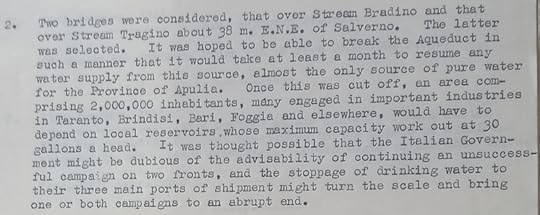 An excerpt from document DEFE 2/152, showing the text quoted above.
The claim that the operation was only mounted to give the paratroopers something to do is also demonstrably untrue. The idea of destroying the aqueduct didn’t originate with anyone involved with training paratroopers. Rather, it came from a civilian working for an engineering company. He contacted the War Office and suggested that attacking an aqueduct on the acquedotto pugliese system would severely disrupt the Italian war effort.
Paratroopers were not the first choiceHaving decided that this was something worth trying, the planners did not immediately turn to the nascent paratroop force. Their first port of call was the RAF’s Bomber Command. They responded that it wasn’t feasible to destroy an aqueduct by bombing. Next, the Special Operations Executive (SOE) were consulted. They took some time to look into it, and decided that it wasn’t feasible. Only then was the job was given to the paratroopers.
None of the men involved in the operation are still with us. At least some of them were alive when the Channel 4 programme was filmed (some of them are interviewed). It’s entirely possible that they went to their graves believing that they risked their lives for no good reason. I hope not, I really do.
November 6, 2025
Signed hardbacks and a message in a bottle
First, a bit of news: I have some hardbacks left over from We Have Ways Fest, so I’m selling signed copies in my shop, at the same price as the standard hardback.
Message in a bottleThis is an amazing news story. In 1916, two Australian soldiers on a troop ship wrote letters to relatives, put them in a bottle, and threw it overboard. The bottle was found by a family collecting rubbish on the beach last month.
The family traced a great-nephew of one soldier, and the great-granddaughters of the other, and will be sending the letters to them.
You can read the full story, along with photos of the letters and the men that wrote them, at ABC News.
August 27, 2025
The pencils that helped Allied airmen to escape
Earlier this month, we went to the Lake District on holiday. While there, we visited the pencil museum in Keswick. It’s more interesting than you might expect, but one set of exhibits in particular caught my eye. These were about special pencils made during the Second World War for MI6 (responsible for foreign intelligence), MI9 (escape and evasion), and the Special Operations Executive (SOE, espionage behind enemy lines).
Charles Fraser-SmithCharles Fraser-Smith had the job of securing specialised equipment and gadgets for MI6, MI9, and SOE. His cover story was that he worked in the Ministry of Supply’s Clothing and Textile Department. When one of the organisations requested something (e.g. a compass hidden in a button), he would contact a manufacturer of that type of equipment, then work with them to create the specialised version. He contacted the Cumberland Pencil Co. in 1942, because he’d had a request for pencils containing a hidden map and compass. Pencils are a very mundane item, and aircrew carried them as part of their navigation equipment, so they would not arouse suspicion.
Fraser-Smith had compasses made that were small enough to fit in a standard pencil, and maps printed on specially created fine tissue that would not rustle. The map was tightly rolled up around a thin wire, then tied in place. Maps and compasses were supplied to the company’s management in strict secrecy. Most of the people working at the factory had no idea about this unusual project.
Making the pencilsThe technical manager, Mr Fred Tee, was given the task of working out how to hide the maps and compasses. Crucially, it had to be done in secret. The factory workers and the local population had to remain unaware of the special pencils.
Because of the great need for secrecy, it was decided to modify finished pencils, rather than add a hiding place during production. Each evening, a few managers would return to the factory after it had closed. They would take a box of completed pencils, remove the ferrule and rubber, and drill a hole from the top. A few centimetres of lead were left in place, so that it would still function as a standard pencil. They then inserted the map, added the compass, and replaced the ferrule and rubber.
 One of the maps used in the pencils
Four different maps were printed. One had a general map of Germany, and the others had escape routes marked to the Netherlands, Belgium, and Switzerland. The pencils were marked with the numbers 101, 102, 103, or 104 to identify the map contained.
The modern copyThe modern factory makes and sells a facsimile of the escape pencil, supplied in a special case. When they decided to make these, they first tried to recreate the original method used during the Second World War.
However, when they drilled into the pencil they found it created a tremendous mess, with graphite going everywhere. So instead, they opted to create the map compartment during manufacture, while the pencil is still in two parts. It’s impossible to keep the process secret this way, but that’s no longer a concern.
If you’re ever near Keswick, I recommend a visit to the museum. The escape pencils aren’t the only interesting exhibit. I’m a little frustrated that I didn’t discover all this before I wrote Setting Europe Ablaze, but only a little. There is always more to learn, and learning can happen in unexpected places.
August 4, 2025
We Have Ways speaker line-up
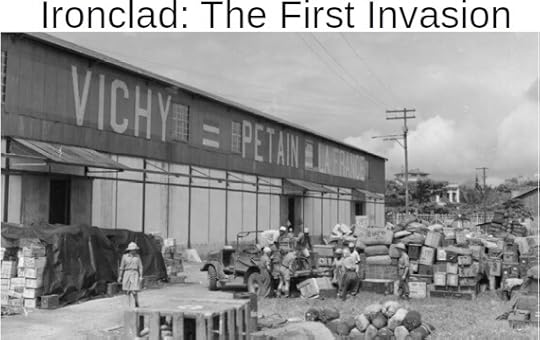
We Have Ways Fest, the Second World War history festival organised by Al Murray and James Holland, have released the full speaker programme. I’ll be speaking about Operation Ironclad, the invasion of Madagascar, at 14:00 on Saturday, at the Arsenal stage.
One talk I’m very keen to see is “The Sexual Revolution”, about LGBTQ+ people in the 1940s, including a trans man in the Land Army.
You can see the full programme here. Tickets are still available, and kids go free.
July 16, 2025
Final chance to buy
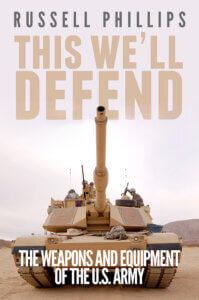
This We’ll Defend was one of the first books I wrote. It’s getting increasingly out of date, though, so I’ve decided to take it off sale.
Until the end of the month, print and ebook copies are available at a steep discount here on my website. After that, it will only be available second hand.
June 7, 2025
We Have Ways Fest: full speaker line-up announced
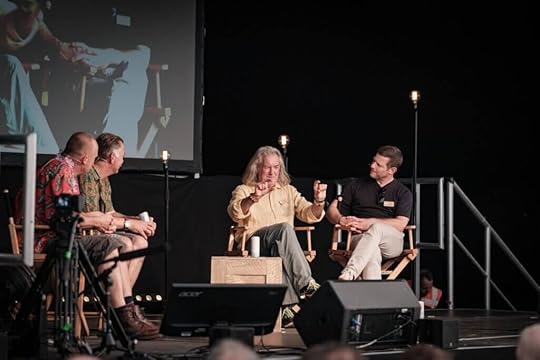
I mentioned last month that I’m going to be talking at We Have Ways Fest in September. The full line-up of speakers (over 60 of them) has now been announced. You can see the list on their website.
Personally, I’m looking forward to seeing the talks by Niall Cherry, Roger Moorhouse, Victoria Taylor, and Merryn Walters.
As I said last month, I’d like to do more talks, so if you’re a member of a group that would like to book me to give a talk about the subject of any of my books, email me or check out my profile on Speakernet.
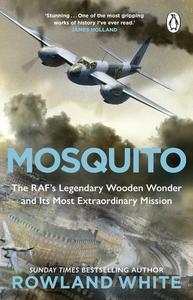
I bought the ebook of Mosquito by Rowland White for 99p recently. I don’t know now long it’ll be at this price, so if you want it, I suggest you buy it now.
I’ve been fascinated by the Mosquito for as long as I can remember, so this promises to be an interesting read.
May 2, 2025
Speaking at We Have Ways Fest

I’m very proud to announce that I will be giving a talk at We Have Ways Fest in September.
My talk, titled “Ironclad: The First Invasion” is currently scheduled to take place on the Saturday, although that could change.
I went to my first We Have Ways Fest last year, and I had a great time. The atmosphere is very friendly and relaxed, the talks were interesting, and there were living history groups and AFV displays. Bovington Tank Museum even brought their FV4005 and had that running around the arena. If you go, feel free to say hello.
Tickets for the festival are available now at WeHaveWaysFest.co.uk
I’d like to do more talks, so if you’re a member of a group that would like to book me to give a talk about the subject of any of my books, email me or check out my profile on Speakernet.
April 3, 2025
Fact and fiction
Note: minor spoilers for the 1982 film Who Dares Wins.
History buffs often complain when a work of fiction isn’t historically accurate. I made that complaint about the film Who Dares Wins a while ago, and was told that everybody understood it was fiction, and that nobody would treat it like a documentary. Like a lot of historical fiction, the film depicts an entirely made-up scenario. But it features real life organisations, and the film makers strived for some degree of realism. It isn’t always clear where the line between realism and fiction is drawn.
In one scene, an SAS officer sits calmly while men burst into the room and shoot target dummies on either side of him. That’s a reasonably accurate depiction of SAS hostage rescue training at the time. Later, the same officer claims that deaths in training are accepted, as long as they don’t go over their quota. Still later, he says that he’s been in the SAS for six years, and he’s “SAS or nothing”. There is, and never has been, any such quota, and officers join the SAS for three years, then go back to their regiments.
Most people won’t know which parts are realistic and which aren’t. They probably don’t care, and there’s no reason why they should — it’s fiction and entertainment, not a documentary. So if we know it’s fiction, and we should take it all with a grain of salt, there’s no harm, right? The trouble is, the human brain isn’t very good at citation management. We hear things, or read things, and the brain remembers them, but doesn’t always remember where each piece of information comes from.
I once talked to someone that was convinced that deaths in training were accepted in the SAS, and another person who believed that officers join permanently, not just for three years. Both people were interested in, and reasonably well informed about, the Cold War British Army. Presumably they both got those ideas from this film, but they obviously didn’t realise that — neither of them would ever have considered a film to be a reliable source. But the brain doesn’t keep citations, and so inaccuracies get stored alongside accurate information.
No doubt viewers of the recent BBC series SAS Rogue Heroes base most of their perception of SAS operations during the Second World War on that programme. Maybe it will spark an interest in a few, and they will go on to read more factual accounts. But most of them won’t care, and that’s not unreasonable.
I’m not suggesting that entertainment, even when based on real historical events, should be held to the same standards as a documentary. But we need to understand and acknowledge that any fiction we read or watch will influence our perception of the events depicted. Most of the time the worst that will happen is that we’ll look foolish if we make a false claim, but it’s something that we should always keep in mind.
January 15, 2025
World War II Supercut
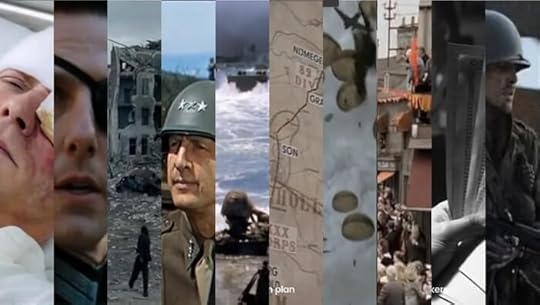
I’ve been watching the World War II Supercut. It’s an interesting project that cut 143 films and TV series into a series of twelve one-hour episodes.
The scenes are cut into chronological order, so the end result is that the viewer effectively watches the entire war. Each scene has a note in the bottom left corner giving the date and explaining what event is being depicted.
The variety of sources means that some historical figures are portrayed by multiple actors. Sometimes a figure is portrayed by two or more actors in quick succession. It’s a testament to the skill of the actors and the quality of the editing that this is not jarring or confusing.
The series covers the prelude to war and the aftermath, as well as the war itself. The first episode covers the period 1900 to 1930. This means that it neatly sidesteps the question of when the war began.

The final episode spans July 1945 to 2006, and covers events such as the partition of India, the Korean War, and holocaust denial.
Naturally, it is only able to cover events for which suitable footage was available. The editor also tried to use modern films where possible.
This meant the North African campaigns before Operation Torch, for example, don’t get a lot of coverage, and the Madagascar campaign isn’t covered at all. Some films that I really enjoy, such as the 1958 Dunkirk film, aren’t included at all.
The end result is an excellent instructional tool. It presents the entire history of the war in an accessible format. Because events are shown in chronological order, it shows how they relate to one another.
It’s rare to see events in the western theatre described in the context of events not just in that theatre, but all other theatres. That this edit manages that, and does it well, is possibly its greatest achievement.
I thoroughly recommend this edit to anyone with an interest in the Second World War.


