
Rant: Channel 4’s Commando (2002)
Time for a bit of a rant. I’ve mentioned before that I’m currently researching Operation Colossus, the first British paratroop operation.
I discovered a Channel 4 series called “Commando“, which aired in 2002. The fourth episode is about paratroopers, and talks about Colossus. Geoffrey Palmer, as the narrator, tells us that the aqueduct that the raid was intended to destroy was “a structure of little strategic importance.” In case the viewer wonders why the British would bother to attack such an insignificant target, he continues, “It was chosen to test whether a hit-and-run raid from the air could be pulled off deep inside enemy territory, and to see if the RAF could accurately drop parachutists close to a given target.”
Strategic significanceDocuments at the National Archives show that neither of these claims are true. British planners believed that destroying the aqueduct would have grave implications for the Italian war effort. It was expected that three major ports would be affected, disrupting supplies to Italian troops in North Africa and Greece. Document DEFE 2/152 expresses the hope that the attack “might turn the scale and bring one or both campaigns to an abrupt end”.
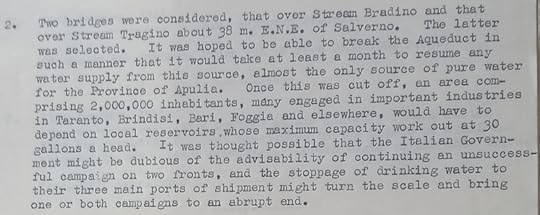 An excerpt from document DEFE 2/152, showing the text quoted above.
The claim that the operation was only mounted to give the paratroopers something to do is also demonstrably untrue. The idea of destroying the aqueduct didn’t originate with anyone involved with training paratroopers. Rather, it came from a civilian working for an engineering company. He contacted the War Office and suggested that attacking an aqueduct on the acquedotto pugliese system would severely disrupt the Italian war effort.
Paratroopers were not the first choiceHaving decided that this was something worth trying, the planners did not immediately turn to the nascent paratroop force. Their first port of call was the RAF’s Bomber Command. They responded that it wasn’t feasible to destroy an aqueduct by bombing. Next, the Special Operations Executive (SOE) were consulted. They took some time to look into it, and decided that it wasn’t feasible. Only then was the job was given to the paratroopers.
None of the men involved in the operation are still with us. At least some of them were alive when the Channel 4 programme was filmed (some of them are interviewed). It’s entirely possible that they went to their graves believing that they risked their lives for no good reason. I hope not, I really do.


