V.M. Karren's Blog
November 28, 2025
Guest blog: The Beast, The Balkans & The Kindness of Strangers
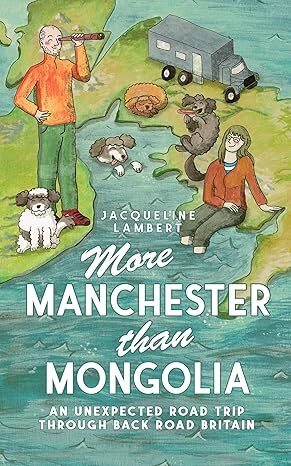
A NOTE FROM THE EDITOR:
This weekend we are featuring a guest post by fellow author Jacqueline Lambert. Our paths crossed recently in the world of travel writing and we were delighted to read her book More Manchester Than Mongolia: An Unexpected Road Trip Through Back Road Britain, which is due to be released on December 5, 2025! Jackie and her husband Mark have had some incredible adventures, to say the least. We are pleased to read and share some of Jackie’s experiences, through her warm and buoyant descriptions. Take a look:
THE BEAST, THE BALKANS & THE KINDNESS OF STRANGERSHow a 24.5-tonne Ex-Military Truck Taught Us the Real Reason We Roam
by Jacqueline Lambert
Buying The Beast (No Sensible Adult Would Have Done This)On Friday the 13th of December 2019, our lives changed forever.
For three glorious years, my husband, Mark, and I had been full-time nomads accompanied by The Fab Four – our quartet of fluffy Cavapoos (Cavalier/poodle cross). In summer, we roamed Europe in Caravan Kismet, hauled along by our van and surf bus, Big Blue. In winter, we warmed our bones by skiing down mountains, and sipping vin brülé.
Then the Friday-the-13th nightmare happened. The UK electorate handed Boris Johnson ultimate power.
That meant only one thing – Brexit – and the shrivelling of our unlimited freedom to tour Europe down to a measly 90 days in every 180.
It was arrivederci Alps, adios Spain – and au revoir to lazy, year-long road trips.
In a fit of melodrama and clarity, I uttered a life-changing sentence to my beloved,
“I’ve had enough of Britain. Let’s go to Mongolia.”
There. I’d said it out loud.
So it stuck.
If you’re set on driving to Mongolia – a country three times the size of France with only three paved roads – you really shouldn’t be towing a caravan. Which is why we began researching ‘expedition vehicles’ with all the expertise of persons unable to distinguish a torque wrench from a toast rack.
We knew we needed something rugged, fixable, four-wheel-drive – and preferably not so military-looking that we’d be shot at. After flirting with a fire engine and an ex-army ambulance, whose interiors didn’t set us alight, we plumped for the idea of building our own.
We trusted in the Haynes Build Your Own Overland Camper manual, Mark’s talent for spatial wizardry, and our own senseless, unfounded optimism.
Online, we spotted a batch of 1990, 6×4-wheel-drive, bull-nosed Volvo N10s being retired by the Belgian Army.
Huge. Indestructible. And completely inappropriate.
We were smitten!
The specs claimed the N10s could climb ridiculous gradients, forge through deep rivers, and – according to a video sent by our Dutch friend Casper – navigate the Amazon accompanied by bikini-clad dancers draped with anacondas.
One already had a cargo box fitted. That alone could save a year of engineering headaches. And the price was good. The engine was pre-electronics (fixable by any mechanic with a hammer) – and because she was 14-tonnes heavier than the overlanding ‘sweet spot’, 33ft (10 m) long, and towered nearly 13 ft (4 m) high, I’d named her:
The Beast.
But buying an enormous ex-military truck, sight unseen, off the internet, when you have zero experience is… bold. Some might say deranged.
An uncharacteristic attack of common sense hit us.
She wasn’t right.
She was far too big and far too heavy.
On the 13th of January – exactly one month after declaring our intent to reach Mongolia – we put down a deposit.
Mark grinned at me and delivered the second life-altering sentence.
“She may be too big and too heavy, but she’ll be fun…”
Life With The Beast (Or: Why Do Strangers Keep Running Toward Us?)
Of course, saying, “It will be fun…” is very different from actually converting a twenty-four-and-a-half-tonne gross ex-military truck into a rolling off-grid home for two humans and a furry family of four.
It involved many instances of wanting to curl up into the foetal position and sob uncontrollably. But after months of sawdust, swearing, and the creeping realisation that if we didn’t finish her on time, we’d be homeless – because we’d sold our house to fund the project – we somehow produced something miraculous: a functioning overland camper.
And once she rumbled into the world with all her bull-nosed charm and the aerodynamics of a NATO-green shipping container, we discovered the Haynes manual had omitted one crucial detail.
A vehicle like The Beast turns everyday life into a travelling street performance.
We’d expected breakdowns. We’d expected questions. We did not expect the sheer, unfiltered enthusiasm she inspires.
Every day, people wave, grin, cheer, and sneak photos of her from behind a coffee or their steering wheel. Children beg us to blast the horn, and adults hope we might.
And she’s sparked a few fairly ‘interesting’ encounters.
As we crawled through a town in Montenegro, a dark Mercedes saloon slewed menacingly across a zebra crossing ahead of The Beast to block her progress. Mark’s emergency stop hurled me forwards.
The doors on either side of the Mercedes flew open. Two men leapt out and rushed towards us, like in a gangster movie. The driver remained inside with the engine running, ready for a quick getaway.
Wide-eyed, I squeaked to Mark, “Is this a heist?”
Before he could answer, the pair positioned themselves in front of The Beast’s radiator grille and gave a thumbs-up to their driver, who snapped their photo on his phone. They turned to shoot us a naughty-boy grin, raced back, jumped into their car, and drove off.
No robbery – just mobile paparazzi.
In another Balkan town, while I waited for Mark to get cash from an ATM, a man vaulted a hedge from a café on the far side of a square, sprinted over, and swung straight into the driver’s seat next to me. His camera-wielding mate captured a triumphant smirk – before he sauntered casually back to his coffee.
Some interactions are gentler.
On show in our UK hometown of Bournemouth, we had no such guerilla tactics. Visitors formed a long and orderly queue to be granted a peek inside The Beast. As the crowds filed in and out, I noticed friends outside, waiting patiently for an audience with us. I left Mark hosting and rescued them from the line. After coffee away from the mayhem, my foot had barely touched our bottom step when an indignant woman at the front pronounced, “Excuse me. EXCUSE ME! There is a queue, you know.”
“This is MY truck!” I replied.
She didn’t miss a beat.
“Oh well. That’s alright then.” She gestured for me to proceed, granting me leave to enter my own home!
But my favourite moment happened in Gaeta, the impossibly scenic Italian coastal town halfway between Rome and Naples. At a campsite facing the Tyrrhenian Sea, all the residents spilled out to photograph The Beast as she arrived. One man, Giampietro, sported a grin wide enough to split his face and said, “I’ve been following you all the way down Italy!”
He’d seen a photo of The Beast online – then another, then another – and had tracked our progress south with the diligence of Mission Control monitoring a lunar landing. He greeted us as if we were A-list celebrities, rather than two Brits, four dogs, and a huge green truck that accelerates with all the urgency of a tectonic plate.
To Giampietro, meeting The Beast in person was akin to the culmination of a pilgrimage. He insisted on a photo.
He posted it online and within hours, it had gathered 176 comments.
“I saw this in Saturnia!”
“We passed that on the autostrada!”
The Beast isn’t just noticed. She is celebrated. Cheered on. And shared like a moving myth. She doesn’t merely attract people – she beckons them in, makes them bold, and awakens their curiosity.
And that brings me to the truth we never saw coming.
The Real Reason We RoamWhen we first hit the road, we set out in search of epic views, dramatic mountain passes, and spectacular sunsets that bleed into the seascapes of foreign shores. It was all about seeing sights that drain you of words – then send you scrambling for your camera.
But The Beast has taught us something far more profound.
Landscapes are lovely… but it’s the people who make a journey unforgettable.
Like the Bosnian campsite owner – now a cherished friend – who nicknamed us ‘Mad Max’ and whisked us off to see hidden treasures: the seats of kings, a trout lake where we caught our dinner, and the ruins of an Illyrian city some believe to be Troy.
Or the Bulgarian man who hopped wordlessly onto his scooter to guide The Beast through a maze of narrow village streets when a road closure stranded us.
Or the hundreds of people who wander over to The Beast simply to talk, smile, share a joke, or place a hand on her wheel arch and sigh with childlike delight.
These events aren’t planned. They’re not written in guidebooks. And you can’t programme them into your satnav. They happen because The Beast has a peculiar superpower: she dissolves barriers between strangers and creates moments.
And those moments are exactly what make travelling with her feel magical.
Yes, The Fab Four have always melted hearts – but The Beast amplifies that magic, forging connections in the most unexpected places – on mountain passes, in city traffic, or sometimes, just visiting an ATM.
Travel is about connection.
It turns out we didn’t build a mere camper; we built a catalyst.
A great, lumbering, utterly ridiculous and charming machine that reminds us daily that the world is far kinder than the headlines suggest, and that most strangers are simply friends we haven’t met yet.
When Mark said, “Yes, but it will be fun,” we had no idea what kind of fun.
The real adventure is not the miles beneath our wheels, but the hearts we meet along the way, and through these experiences we’ve learned that human connection isn’t incidental to travel.
It is travel.
Everything else – the landscapes, the landmarks – and even the sunsets – is mere decoration.
And as long as The Beast keeps rolling, we’ll keep collecting these moments – funny, chaotic, touching – because they are the richest souvenirs any traveller could hope to find.
Author Bio
Jacqueline Lambert writes award-winning comic travelogues fuelled by curiosity, chaos, and the company of canines. She has penned eight bestselling books about life since she quit work to become a full-time nomad, including six in her Adventure Travel / Adventure Caravanning With Dogs series, and two charting progress with her Wayward Truck.
Building The Beast: A funny true story of van life, DIY disasters, and one very big truck and her new release, More Manchester Than Mongolia: An Unexpected Road Trip Through Back Road Britain, chronicle her initial steps into Lorry Life.
Her stories blend humour, mishap, and heartfelt observation as she and the crew explore Europe on six wheels. Jacqueline is currently working on her next trucking adventure, an overlanding odyssey through the Balkans, due for publication in 2026.
Keep in Touch
If you want to follow her adventures or be the first to know when Jacqueline releases new books, here are a few ways to connect:
Author Website: https://jacquelinelambert.co.uk Travel Blog: https://www.WorldWideWalkies.comAmazon: https://author.to/JLambert Goodreads: https://www.goodreads.com/author/show/18672478.Jacqueline_Lambert Bookbub: https://www.bookbub.com/profile/jacqueline-lambertFacebook: https://www.facebook.com/JacquelineLambertAuthor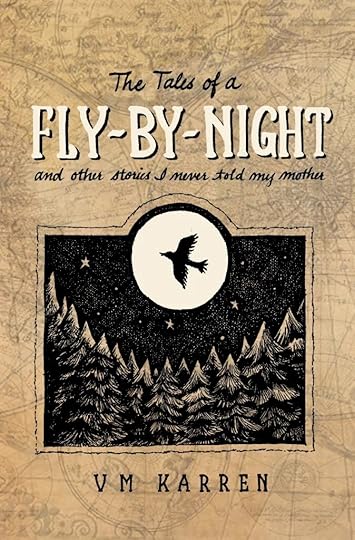 If you enjoyed Jackie’s post about adventure caravanning, you might also enjoy this travel memoir by author V M Karren: The Tales of a Fly-by-Night and Other Stories I never Told My Mother.
 Click on the book to read a sample.


February 13, 2025
Literary Wanderlust in Greece
We’ve been reading Sally Jane Smith’s travel memoir, Repacking for Greece this month in our online book club Traveling Europe Through Books! Sally is a South African travel writer with a special passion for the Greek Islands. Her scintillating descriptions, thorough knowledge of Greek history and culture, and good humour shine through in her writing. We are so grateful to Sally for this guest blog below:
Literary Wanderlust in Greeceby Sally Jane Smith
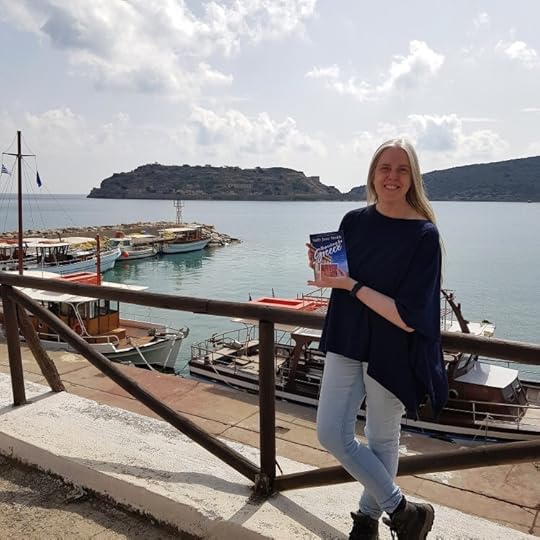
Pairing books with places is one of my favourite travel activities.
For those of us who enjoy armchair travel almost as much as the real thing, reading while actually on location engages our minds in new and exciting ways. The crossover between observation and imagination can be so powerful that we feel transported into the pages. And there is nowhere quite like Greece for encountering a landscape layered with story upon story: from Aesop’s fables to Bronze Age mythology, from Lord Byron’s poetry to contemporary novels translated into English, from tourist narratives to chronicles of the Greek diaspora.
In 2016 and 2017, these tales became my companions as I explored fifteen unforgettable Greek destinations: Athens, Delphi and Meteora on the mainland; Monemvasia, Sparta, Nafplio, Mycenae, Epidavros and Methana on the Peloponnese Peninsula; and the islands of Santorini, Rhodes, Hydra, Poros, Kefalonia and Corfu. These were significant journeys for me, transforming me from reader, to traveller, to writer, and leading to the publication of my series, Unpacking for Greece and Repacking for Greece.
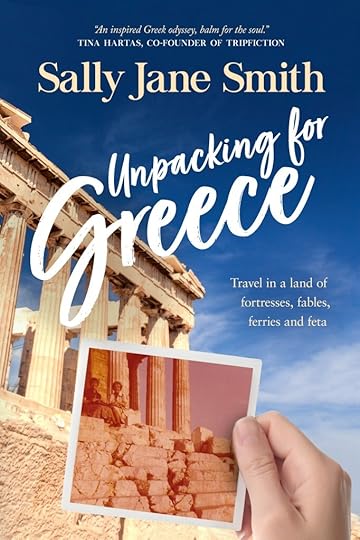
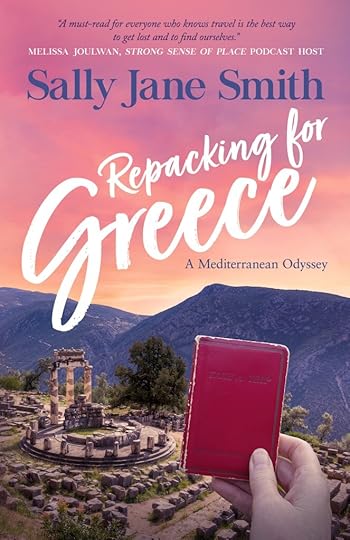
Each night of my travels, I’d savour the books that gave me a taste of Greece. Then, by day, I’d encounter sights, sounds and smells that made the stories come alive. I tried to capture these sensations in words when reading Captain Corelli’s Mandolin, by Louis de Bernières, on Kefalonia:
“Instead of simply picturing the scene in my mind’s eye, I could feel it. I knew the breeze that ruffled the water of the bay on one side of the bridge, but merely rippled the surface of the lagoon on the other. I heard my footsteps on the paving, felt my body turn as I moved from one zigzag angle to the next, saw how a combat vehicle would dominate the narrow walkway, leaving room for no one in its path.”
Repacking for Greece by Sally Jane Smith, pages 148-149
It was on Crete in 2023, though, that my literary wanderlust came into its own. This wasn’t entirely accidental. For my third Greek odyssey, I structured my itinerary to take in both Knossos – the archaeological site associated with the ancient legend of the Minotaur’s labyrinth – and Spinalonga – the twentieth-century leper colony that inspired Victoria Hislop’s bestselling The Island.
The forbidding tunnel described in Hislop’s book led me into an abandoned but surprisingly cheerful settlement, overgrown with flowers, where I wandered for hours. Most striking was the moment I stepped past a rusting disinfection kiln to an archway that pierced the village walls. I found myself looking down a short boat ramp and over the narrow waters that separate Spinalonga, a tiny islet, from the Cretan landmass. That’s when it hit me: Maria, one of The Island’s protagonists, could have seen her family move about their hometown on the opposite shore – but only if she had been allowed through the gate to stand where I stood.
Bookish reference points enriched my experience of Crete wherever I went. My search for the grave of Nikos Kazantzakis, who wrote the brilliant but troubling Zorba the Greek, took me to the sun-soaked summit of Heraklion’s old city walls. A chance Instagram comment from author Linda Lappin sent me to a little village called Mochlos, on a sweaty expedition that ended with a cold beer in a waterside taverna. But the literary lesson that stayed with me was the one that told me why I couldn’t get where I wanted to go.
In the months before my trip, I had sought out reads with a Cretan connection. Memoirs from soldiers and resistance fighters like George Psychoundakis and Patrick Leigh Fermor introduced me to the island’s brutal World War Two occupation. But, as so often happens, it was a cast of fictional characters that brought the emotional reality of these historic events home to me.
The setting of Kate Forsyth’s The Crimson Thread feels more like a protagonist than a passive landscape, and I really should have taken note of the significant role played by the towering White Mountains that bisect Crete. If I had, I wouldn’t have so blithely booked accommodation in Agios Nikolaus for one night, and in Loutro for the next. Because of course public transportation routes don’t go directly from A to B, but skirt the mountain range instead. Which meant the bus wouldn’t get me to Crete’s southern shore in time for the last ferry to Loutro. Not on that off-season April day, anyway.
It was a facepalm moment that cost me a night’s hotel fees, and one of many reasons I keep seeking out destination-specific stories.
Here are my two go-to resources:
TripFiction
TripFiction is a great tool for picking out the perfect paperback travel companion. Not only do they have a database of thousands of novels, travelogues and memoirs that you can search by setting, but they also support an online community of like-minded people: those who love linking literature with location.
There are reviews and lists, competitions and giveaways, but, most of all, there is a profound love of travel-by-book.
Over the last seven years or so, my relationship with TripFiction has deepened. The first guest blog I ever wrote – a piece about turning to a favourite series for comfort on a grief-ridden journey through Türkiye – was published under their banner. A strange coincidence led us later to become partners in an international book club hosted by JourneyWoman. The joy of TripFiction, though, is that they have been the catalyst for fascinating detours I’ve taken on my trips, including two special places in Crete I may never have visited without the serendipitous arrival of their email newsletter at exactly the right time.
Strong Sense of Place
The first time I listened to Strong Sense of Place, I knew I’d found my reading family. You know that feeling when you stumble across a podcast and it feels as if it was broadcast just for you? And by “you” I mean, potentially, every reader who loves travelling by book, and every traveller who enjoys nothing more than turning a journey into a literary adventure.
In each episode, Mel and Dave review a selection of stories set in a featured destination. They transcend the basics of audio-travel, communicating insights into culture and history, and encouraging mindful exploration that considers our impact on the countries we visit. After all, as they say on their website: “Reading good books increases empathy. Empathy is good for all of us and the amazing world we inhabit.”
In case podcasts aren’t your thing, they also have a newsletter. It is a feast of treats that surprises my literary tastebuds every time they serve it up to my inbox – sometimes the most seemingly random tidbits are the most mouthwatering, and I can’t wait to discover what they come up with next.
 ABOUT THE AUTHOR
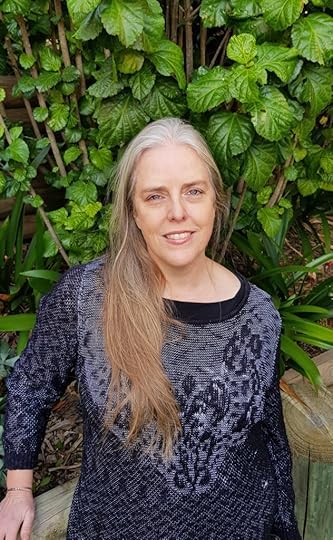
In 2006, the bus on which Sally Jane Smith was travelling through Sri Lanka suffered a head-on collision, breaking both her body and her spirit. A decade on, she journeyed to Greece in a quest to recover her wanderlust – and proved it is possible for an out-of-shape, middle-aged woman on a budget, equipped only with a guidebook and her mother’s 1978 travel diary, to experience a life-changing adventure. This is the story that became the two-book ‘Packing for Greece’ series. Sally has lived on five continents and visited thirty-four countries, but she gives credit to Greece for turning her into a writer. Her debut, Unpacking for Greece, was selected by Greek News Agenda (a Greek government website) as Book of the Month for July 2023 and won First Prize in the Greek-Australian Cultural League’s 2024 Book Award for Prose in English.
• The ‘Packing for Greece’ series is available wherever you buy books, including Amazon at https://mybook.to/Greece
• Free newsletter sign-up for travel reads, destination games and more at http://www.sallyjanesmith.com/newsletter
• For a list of books I read in Greece, see http://www.sallyjanesmith.com/sally-reads
• Connect on social media at http://www.instagram.com/JourneysInPages or http://www.facebook.com/JourneysInPages
 For more literary travel, check the Armchair Travel Series by V M Karren!
 Written during the pandemic, this is the fix for any cabin-feverish globe trotter.
Take a look…January 13, 2025
Swedish: The Nordic Language of Love
As we are Traveling Sweden Through Books this month by way of Frederik Backman’s novel, Anxious People, we thought we would share with you Val’s first experience traveling through Sweden as a young man in the 1990s, when he learned that Swedish is the Nordic Language of Love:
To this day I regret not learning to speak Swedish when I had the chance.
My first visit to Sweden was also my first visit to any country where English is not the first language. During a journey when anything that could wrong, did go wrong, speaking a little bit of Swedish could have helped calm my nerves and saved me from making some rookie mistakes, but this is not why I regret never learning to converse in Svenska.
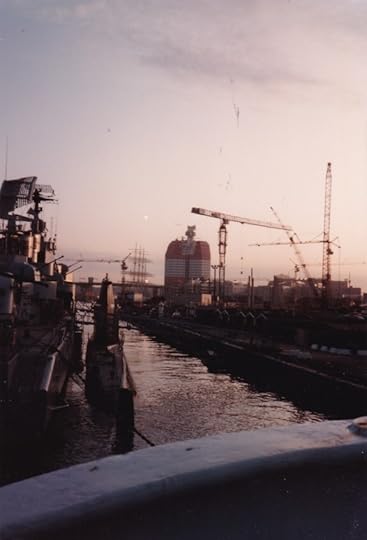
When I disembarked from the Scandinavian Princess in Gothenburg harbor that chilly afternoon, I knew that I had already missed my train. It was still winter in Sweden, and the sky, at four-thirty, was already growing dark. The placid reflection of the pastel sunset on the water was splintered by drifting sheets of ice.
“Do you speak English?”
“Yes, a little.”
“I’ve missed my train to Sundsvall. The boat from England was late.”
Although she understood my predicament, I could not understand her answers. I drew a map of Sweden on the back of the envelope that held my expired train tickets, with train tracks extending to the Arctic Circle. She exchanged my unused tickets for the next departure.
“Six o’clock? Fantastic! Is there a sleeper car too?” I mimed laying my head on a thin pillow with a question mark in my eyebrows.
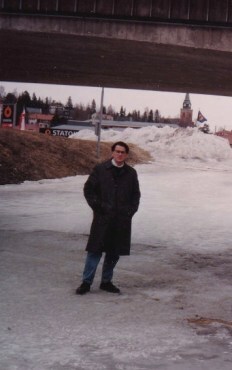 She scribbled a new note and slid the envelope to me again under the glass.
“A.M.? six o’clock tomorrow morning?”
She smiled and nodded.
“But where do I sleep? Under the bridge?”
I stumbled out of the train station out on to the esplanade overlooking the marina, clutching the envelope covered in notes of train numbers, next stops, and departure times. Overwhelmed by the the vast distance still to travel and the falling night, I took my rucksack off, sat down on it and cried.
From the window of the train the next morning, I watched the white sun rise in the distant southern sky over Stockholm, and watched it sink again into an endless forest of frosted Christmas trees. The snow fell in loose, wet flakes. Passengers shook them from the hair and scarves as they sat down across from me. I spoke to no one, too insecure to try.
Sweden is a very dark place when the sun goes down. I could not see much of the town of 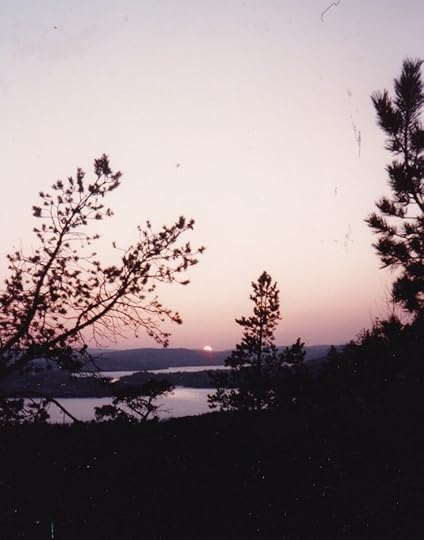 Härnösand from train station, nor could I have found it on a map if I had needed to. I waited, not knowing where I was, trusting that a bus would arrive soon and depart again at seven-thirty to take me further up the coast by nine forty-five. There was nobody to ask. The posted schedules in the unmanned station, to me, indecipherable.
The white high-beams of the bus were visible from a long distance off, slicing easily through the frosted darkness, growing larger as the bus rumbled over the snow packed road to stop in front of me, standing alone in the dark.
“English?”
“Yes please, I don’t speak Swedish.”
“This ticket: Where do you get it from?”
“In Gothenburg. I was told it was good for all Swedish buses.”
“It is not valid on my bus. It is for city buses. It is written here,” the driver demonstrated.
My chin began to quiver. I fought the tears welling up in my eyes. I swallowed hard. I looked out the windscreen at the white snow banks heaped high on either side of the road.
“Where are you going?”
“Örnsköldsvik,” I squeaked through a constricting windpipe.
“Take a seat,” he ordered pulling the door closed behind me with a lever.
Once I spied the sign of the Örnsköldsvik bus station in the headlights, the relief and elation was so that I had to to restrain myself from kissing the bus driver before I stepped off into the frozen air and in to the warm hugs of my waiting friends.
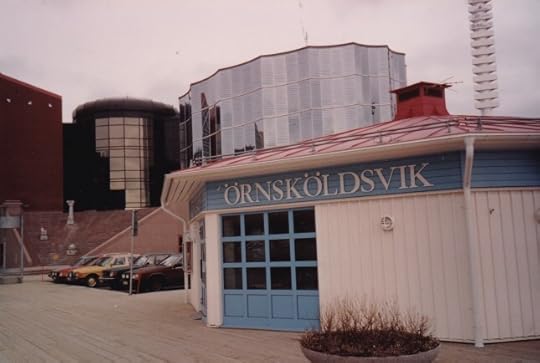
In the car on our way ‘home’ to Domsjö, everybody shook their heads and wondered how it was possible that I had made it so far with ‘just some scribbles on an envelope’, not able to speak more than two words of Swedish.
Undoubtedly, my journey would have been different had I learned a few phrases from my Swedish friend when she had offered to teach me. Surely, having been able to ask directions to the youth hostel on that icy cold April evening in Gothenburg could have saved my pride. Instead of sitting and crying, I could have reveled in the romance of vagabonding. What seemed to be a tragedy at the moment could have been transformed into an adventure, but these unsure experiences do not constitute the regret I have of never having learned to ‘tala svenksa’.
Scandinavia is a paradise for the youthful traveler. Foreign adventures are considered an important pillar of students’ education in those countries. Should every student decide to travel at the same time, the wide variety of youth hostels and their far flung locations could shelter and feed every one of them.
Sitting on my rucksack staring at the naked winter masts, bobbing and swaying in the Gothenburg marina, I remembered a souvenir map I had picked up aboard the ferry. Clearing warm tears from my cold face, I rummaged around in the top pocket of my bag. Eureka! I searched the buildings up and down the harbor for an hour, but could not find the youth hostel shown on the map. I was resigned to spend a very cold night on a bench in the train station. As I turned to watch the last sliver of the sun slide into the sea, there floating in front of me, moored to the quay, was the Båtpensionat: A floating youth hostel, right where the map said it would be. I didn’t know then that båt meant ‘boat’, and had walked past it three times, my eyes searching for a sign on the harbor buildings, not in the harbor.
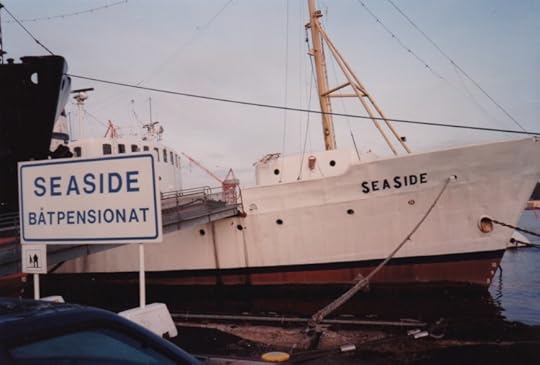
From the boat I was able to phone Pia to tell her my sad story. I relayed the harrowing details of the train and bus journey still ahead of me. She listened with kind sympathy. I skulked away to the galley for a warm dinner, worried about oversleeping and missing my train. I ate alone and cried silently over spilled milk.
Although I slept alone in the men’s dormitory, the hostel was far from empty. The galley, empty when I sat down, was suddenly filled with twenty people dressed in ski pants and bright colored parkas. They swished around the cafeteria in their puffy down coats, pulling off woolly caps to reveal tussled, wild hair. Conversations warmed the air of the cramped kitchen. As I looked up from my empty plate, it dawned on me, slowly at first, but then it hit me like I had just won the super-power ball-lottery-jackpot. I was the only male guest on the boat!
I’m not sure where the girls ski team actually came from. I wasn’t sure if they were travelling to a competition or coming home from one. All I know is that they all possessed all the fabled beauty of the Swedish woman. Each was an athletic, fair skinned, blue-eyed, blonde beauty, the kind every college man dreams about meeting. I quickly forgot about what I was sulking about in the corner, and found myself in line for seconds of the meatballs, trying not to trip and fall, trying not to drop my tray, trying not to stare.
When I returned to my table I found two young ladies, with pale ponytails and flushed cheeks, sitting at my table, chatting with each other in hushed tones. Taking my chair, I pretended to be interested in my food. I took in the view, chewing and chewing and chewing just one bite, in no hurry to finish and leave.
When I realized that the two girls at my small table were now speaking to me, trying to get my attention, I froze in terror! I blushed to think that they knew just how much I was enjoying just being present. I smiled, embarrassed, with mouth full of over chewed meatballs and looked at them with surprised eyes.
“Pratar du engelska?” I asked timidly.
They giggled and shook their heads, their pony tails flipping from side to side. Too embarrassed or too self-conscious to try to speak English with me, they smiled, waved and turned again to their own conversation…in Swedish. I stuffed another fork-full of meatballs in my mouth and sulked alone in the corner, knowing I had just blown the greatest opportunity of my young life.
To this day I regret not learning to speak Swedish when I had the chance.
___________________
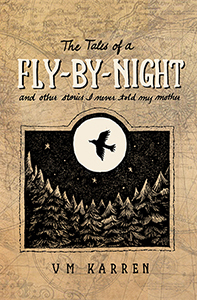 Did you enjoy this story? You can find it in The Tales of a Fly-By-Night by V M Karren, an anthology of short stories from around the world.
“I love reading real stories from real people’s lives. I found myself smiling at so many of the stories in this book. As a lover of travel and culture myself, I feel it’s important to appreciate the minutiae in life. It’s the small things that oftentimes turn out to be the most memorable…wherever we are in the world. Thank you to the author for sharing these stories, both humorous and heartwarming.” —J. Newquist
December 19, 2024
The Christmas Eve Cable News: A Short Story
A transcript of the five o’clock news broadcast on Christmas Eve
Tonight on channel thirteen news, we start with our very own war correspondent in Ukraine,
Bronk Stuntman. He filed this report earlier today:
An eerie scene here on the battlefields of eastern Ukraine this evening has left many in the west feeling uneasy and fearful for the fate of the soldiers on both sides of the front lines. Earlier this morning the constant explosions of mortar and artillery fire slowly fell silent, startling local residents and international observers, with the fear that the Russian armed forces had eliminated the Ukrainian defences and had stormed their positions. When columns of Ukrainian soldiers marched silently through the center of the village carrying no weapons and with no armored machinery as rearguard, the worst was feared; that they had been taken away as prisoners of war and Russian units would soon appear to take control of this strategic logistics junction…but no foreign soldiers ever appeared.
With my camera team we slowly made our way to the last line of defence to find it deserted, as well as the second and first lines of trenches and dugouts that were facing off against the Russian front lines. What we found there was shocking!
In the no-man’s land, razor wire had been cleanly cut and pulled wide of the minefields, where hundreds of little white flags, in front of each opposing trench, each marked the location of a landmine hidden under a thin layer of dirt and leaves. Heavy boot prints in the mud suggest that soldiers very deliberately created foot paths indicating how comrades and enemies alike could safely traverse these treacherous, war-ravaged fields.
In the trenches, we found mortar tubes stuffed with pine branches, dirt and rocks; heavy machine guns with their barrels sawed clean off. Soldier’s rifles were planted in the mud of the trenches, barrels first, leaving the weapons inoperable. Hand grenades had their pins soldered into place, and the larger firing pins in the heavy guns had been blunted, and bent. Helmets and body armor lay in the dust where they were shed from off of heads and shoulders. Tanks and armored personnel carriers smoldered from the inside, set alight by deserting armies, on both sides.
What could the soldiers have witnessed that was so horrifying to make them all desert their posts en masse? What news could they have received to make them all flee the battlefield? It is unclear how the war will proceed from here but there will be big questions in the world’s capitals tonight as we brace for the economic and political fall out of this war spontaneously ending.
“Live in the Don Bas,
I am Bronk Stuntman.”
“Back to you, George.”
More breaking news tonight! We are receiving this evening unconfirmed reports of a massive military operation in the Mediterranean Sea involving naval and coast guard vessels and aircraft off the coasts of Spain, Italy, and Greece. Reporters from local affiliate stations are telling us of a massive civilian mobilization in the coastal towns and cities across Europe’s southern borders that has brought the everyday lives in these idyllic seaside alcoves to a virtual stand still, disrupting centuries-old Christmas traditions.
Sources tell us that cutters, boarding vessels and hospital ships were loaded with thousands of tons of blankets, field beds, ready to eat food, clean drinking water, and medical equipment in the early morning of Christmas Eve, with orders to intercept and board a flotilla of unidentified boats approaching European territorial waters.
NATO command in Brussels, Belgium has not been able to assess the intention of the ships spotted by the Greek coastguard less than three hundred miles south of the island of Gavdos. Further aerial reconnaissance suggests that dozens of unsafe vessels are filled with thousands of war refugees, believed to have departed from ungovernable port cities on Libya’s northern coast. Naval vessels departing from European harbors are prepared for a forecast winter storm at sea with high winds and swells up to four meters long.
Yacht clubs in the countries participating in the rescue operation have been ordered opened by local emergency authorities to provide safe landings for smaller crafts carrying those needing the hospital beds which are being prepared up and down the coastlines. Medical staff all over southern Europe have been recalled from holiday furlough to staff makeshift triage stations at the harbors and ports on Crete, Sicily, Sardinia, Majorca and in Valencia on the Spanish mainland.
The rescue armada is expected to begin arriving into safe ports by early evening, despite the protest of right wing opposition parties who are against admitting more refugees fleeing northern African and sub-Saharan war zones, claiming that, “the government does not have a competent plan nor the budgets to receive and care for “another horde of indigents.” Despite the objections from nationalist politicians, mayors across the southern islands of Italy and Greece report that local residents are registering en masse to be host families for the new arrivals, overwhelming municipal offices, phone lines, and websites.
In local news, the problem of homelessness in Pottersville is causing political friction this Christmas Eve as a polar vortex threatens to inundate the greater metropolitan area with blizzard conditions and sub-zero temperatures.
The governor is criticising Pottersville’s mayor, Richard Jenkins, for his slow action and lack of vision in the face of the forecasted crisis, and has ordered the state’s National Guard to seek out and round up those sleeping under bridges and in unwarmed structures, and bring them to jails, schools and other municipal buildings where they will be registered and assigned a bed for the duration of the cold arctic temperatures.
From early this morning the city’s emergency services were inundated with those seeking protection from the dropping temperatures and freezing rain, and shelters began turning away late comers as early as ten o’clock in the morning. Local churches, mosques, and synagogues have been answering the call from the Red Cross to open their places of worship and to allow the setting up of warming centers, soup kitchens and sleeping quarters for those who have no other place to hide from the elements.
It is estimated that the city is approximately three hundred beds short and has no further budget this year for emergency services after overspending on the Thanksgiving parade at the start of this year’s holiday season. Local clergy are sounding the alarm among their parishioners, asking for emergency donations and for volunteers to brave the weather to help prepare enough places for the less fortunate, even though city officials complain that such appeals will only endanger more lives, clogging already snowbound city streets and stretching police and traffic authorities even thinner.
In business news on this Christmas Eve, shareholders of International Breweries Holdings, the world’s largest brewer and distiller, have filed an emergency lawsuit in federal court earlier today in St. Louis, suing the CEO and Board of Directors for financial malfeasance and are seeking a court injunction to halt charitable donations being carried out around the world today by the company.
International Breweries Holdings (IBH) was by far the biggest loser on Wall Street today. Rumors originating from the Chicago commodities exchange spooked traders before the early bell as inventories of wheat, barley, and potatoes, all key ingredients of holiday spirits, fell to their lowest levels in five years due to the company’s record-breaking donations to food banks, and homeless and refugee shelters around the world. Hundreds of tons of wheat and potatoes were delivered by IBH’s own trucks to city soup kitchens in Los Angeles, New York, and Chicago as well as right here in Pottersville, and abroad in the war ravaged cities of Kyiv, Jaffa & Gaza City, as well as to numerous refugee centers in Poland, Italy, Spain and Greece. The shareholders group, represented by the London law firm, Marley & Scrooge, are demanding an immediate end to the donation deliveries.
In health news tonight, mental healthcare professionals are speaking out this holiday season and encouraging residents of Pottersville to be aware of those around them who may be suffering from a seasonal disorder that psychologists are calling “Negative Noticing”. Those afflicted with the disorder, especially around the winter holidays, have much more difficulty seeing positive aspects of events happening around them, leaving them victims of a cognitive function of the brain called “negative bias.” The best way to help your family members and friends who may be struggling with this condition on Christmas Eve is to switch off televisions, computers and other mobile viewing devices that may use cellular and wifi signals in their homes and seek good company, focus on happy memories and perform random acts of kindness that may go unreported. Psychologists emphasize the positive effect that a repeated message of peace on earth and goodwill toward all mankind can have… if we’ll just let it!
That’s all for tonight.
Merry Christmas, George.
Merry Christmas, Janice.
And Merry Christmas to all of our nightly news viewers right here on channel thirteen.
November 15, 2024
Journeying into Children’s Lit: An Interview with Author Christine Karren
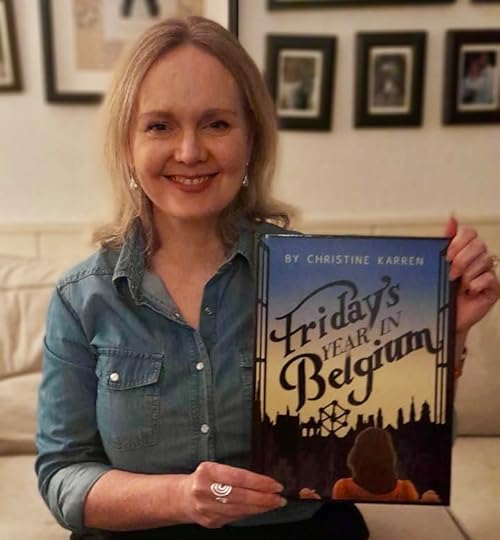 This interview with author-illustrator Christine Karren is based on the question and answer session during her recent book launch event. Here Karren tells us about her new children’s book, Friday’s Year in Belgium, from the World of Values series.
Fly-By-Night Press: Tell us about your new book!
Christine Karren: My new book is called Friday’s Year in Belgium. It comes in both large-format hardcover and smaller paperback. The larger one reads like a picture book because it’s filled with large, colorful illustrations. The smaller paperback reads like a chapter-book for early readers. It’s also filled with a lot of illustrations but the story is broken up into chapters. Both are intended for children between 6-9 years old, but I think the large hardcover would be best read by an adult to a child, and the small paperback is best for an older child to read on their own.
FBN: What made you choose to write about Belgium?
CK: When I first had the idea about creating a children’s book about a family who moves to different countries every year, I wanted to focus mainly on European countries because that’s what I know. It made sense to start in Belgium, since it’s the main capital of the European Union, and I also chose it because there are so few books in English about it. I live in the Netherlands right next to Belgium, so I go to Belgium often and I know it well. I have quite a few Belgian friends whom I meet up with. Some of them come to visit me at home in the Netherlands, too. It’s cheaper to buy gas there so I usually go 3-4 times a month to fill up, but I also sometimes buy special things there like cheese for my daughter.
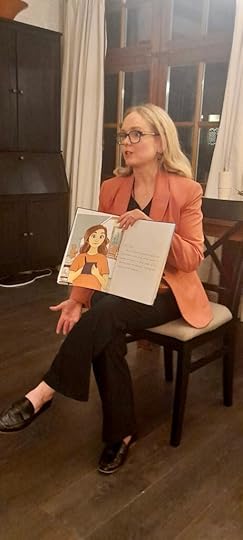
FBN: Tell us about Friday, your main character. What made you choose such a unique name?
CK: Friday is a nine-year-old girl from America who is smart and curious. She wants to become a detective when she grows up so she carries a notepad everywhere she goes in order to write everything down. She lives with her parents who move every year to a new location for work, so Friday has the chance to learn about new places all the time. When choosing her name, I wanted to choose something very unique so it would be memorable. Everyone has a good association with the word Friday, right? (laughs) One of my favorite books, which I have read to a couple of my kids, is Robinson Crusoe. There’s a character in that book named Friday, and he’s one of the best characters. He’s friendly to people different from him, and very adaptable to new situations! So I though this name was a good fit for my main character.
FBN: How have you developed your writing voice?
CK: Well, I’ve been writing my whole life. My mother was an English teacher who really loved to read, and read a lot to me. And at night before bed my father used to tell us stories he made up. When I was about 7 years old, I was really interested in Japanese culture, and I learned how to write Japanese poetry called haiku. It’s a very simple poetry form that only has three lines of text. I wrote a LOT of haiku poems, and once I had a whole stack of them, I asked my mom if she could tell me how to get them published. (laughs) I’m sure she didn’t expect it to work out for me, but since she was so supportive, she helped me write a cover letter and send the poems in an envelope to a publisher. I got a very kind rejection letter! And that was my first experience with a publisher.
Later as a teenager I worked for a publisher of non-fiction and textbooks called Sage Publications and learned a lot about the process behind publishing. In college I studied Art History, which involves a lot of critical writing. One of my professors was impressed with my writing and invited me to become her research assistant.
I’ve generally been stronger in expository writing or journalism because of my academic background and because I do a lot of blogging, but when I was a young mother I started writing a children’s book that I never finished.
In 2022 my husband Val and I put together a creative writing group called the Maastricht Writers’ Workshop. MWW is a group which gives its members a lot of opportunity to write and share their work, so it’s been helping me hone my creative writing skills. I think it’s MWW that really inspired me to write a this children’s book.
FBN: You have also illustrated your book. How have you developed your drawing style?
CK: Drawing and art have always been my thing. My parents always encouraged me and my siblings to draw as a form of entertainment when we were little, and they arranged for me to take drawing classes. Around age 8 I studied art with an artist/filmmaker named Bob Hummel, who first taught me about light and shadow. He really opened my eyes to seeing the world in a new way, which was very exciting to me and it motivated me to move into the world of art. Later I took drawing classes from a Hannah Barbera animator named Ric Estrada. In college I studied Graphic Design and Art History. My design classes included life drawing, perspective drawing, and so forth, which I excelled in and really enjoyed. I also loved studying the art of different cultures.
When we moved to the Netherlands, I didn’t have much to do, so I spent a lot of time drawing with my 2-year-old son. He’s now illustrating children’s books, too! I taught drawing classes to children for a few years from my home in the Netherlands. I loved watching the drawing styles of the different children emerge.
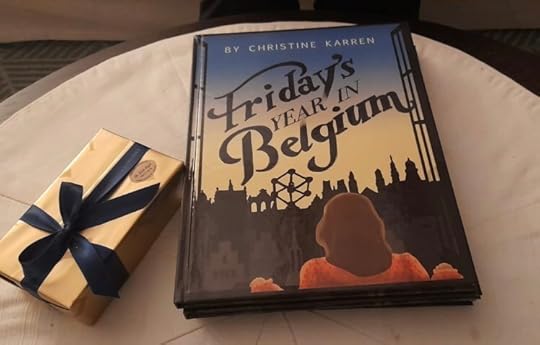
FBN: Your book series is intended to help children visit different cultures. What interest do you have in culture?
CK: Oh, I’ve always been fascinated by other cultures. I was an anthropologist before I knew what that word meant! When I was very young I had this book called the Children’s Book of Knowledge (or something like that). It was thick and it was filled with interesting pictures. I used to read it in my closet sometimes. That’s where I first found Japanese culture, which I mentioned before.
My mother was involved with some drama groups and kept a box of costumes. A lot of them were cultural costumes like Hawaiian muumuus, Mexican sombrero, etc. so I enjoyed dressing up in those costumes as a child. My mother made a beautiful Japanese kimono for me which I insisted on wearing when they took me out for dinner to a Japanese restaurant on my birthday (laughs). I’m sure it was awkward for her, but she was always supportive. My father traveled sometimes for business and brought me back a Tahitian traditional costume, made from grass and shells. It was beautiful! I still have it.
FBN: Your books also delve into the abstract world of values. What made you choose to incorporate these into your stories?
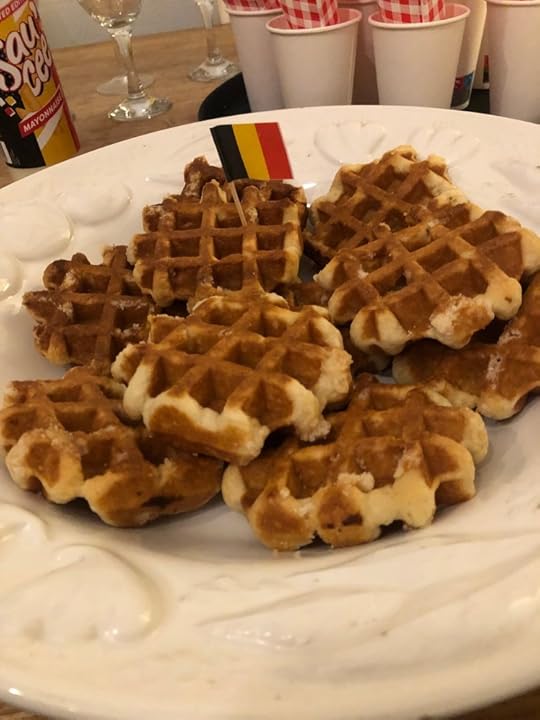
CK: Values are extremely important to me. I think they affect everything we do, and how we feel about things. They essentially make up our world of meaning. As I have lived in different places–America, Romania, and the Netherlands–I’ve realized that what motivates other people to act in certain ways are the values underlying their culture. It’s deeper than just the idea that people eat waffles or chocolate in Belgium. Understanding their values helps us really get into the minds and hearts of people. When we don’t understand them, we tend to judge them negatively. But when we ‘get’ why they do things, it helps us feel more love and acceptance toward them. Studying Art History really taught me this. I would go into a class about Asian Art or African Art with a preconceived idea of who those people are. But I would come out of the class with my mind broadened and a much greater interest in them and connection with them. I hope that my books can help children broaden their minds to love many kinds of people.
FBN: Who do you write for? Do you think your book is reaching its intended audience?
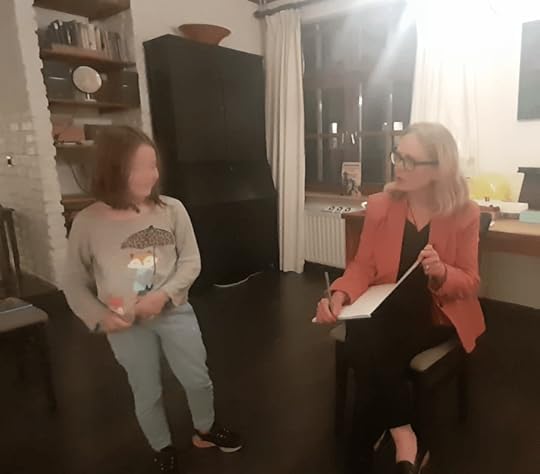
CK: My book is written for children, but I hope some adults will enjoy it, too. I recently heard about some kids who read my book and couldn’t put it down. One nine-year-old girl kept reading it by herself for about half an hour! Another grabbed the book as soon as it arrived at her house and ran off to read it. That makes me happy to hear! I think they like the pictures best.
The book is written from an American perspective, so it will be best understood by Americans. But I hope people from all over will read it. I hope they will be curious about all the unusual things they see in the pictures and want to learn more about Belgium.
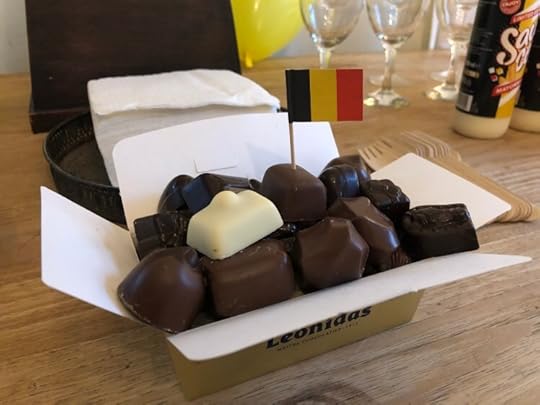
FBN: What do you love best about Belgium?
CK: Hmmm. There are a lot of great things. I eat Belgian chocolate almost every day because it truly is THE BEST in the world. But I also really love Belgian people. They are polite and kind. And they make beautiful art. I really love the work of Belgian artist Rene Magritte and Belgian designer Axel Vervoordt.
FBN: Have you already started your next book?
CK: Yes! My next book is about the Netherlands, my home country. I’ve already written the first draft of the manuscript and began a few illustrations. It’s different from the Belgian one because the culture is definitely different. I’ve chosen five new values to represent the Netherlands, which Friday and her parents will discover. It’ll be great! I’m excited to watch it develop and see how children respond to it.
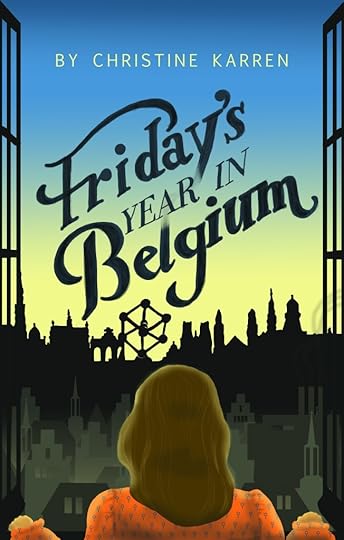 Friday’s Year in Belgium by Christine Karren
“[My daughter] loved it, especially the illustrations.” —N.C. from Kansas City, USA
“[My granddaughter] grabbed the book as soon as she saw it and ran off to read it!” —Grandmother from UT, USA
“It can be used to share information about Belgium with children at home or in school, but it’s also just a fun read!” —M.H. from the UK
“This book would be a great introduction for children who have never traveled outside their own country, allowing them to explore different cultures…” —L.V. from Bulgaria
Read more HERE.
October 17, 2024
What Happens in Barcelona…
Nobody is really sure how things got so out of control that night in Barcelona’s old town. Assigning guilt would imply that there was premeditation or gross negligence. ‘Who was liable?’ is probably the right question to ask, as I reflect back about the looks on our faces when we were confronted with the check; a silent yet damning witness to our gluttony. Between the three of us we didn’t have enough cash to pay the waitress. Father had to bail us out with his credit card.
What was supposed to be a ten-day Father-Son-Son road trip across Europe of three responsible adults seeking rest, relaxation and winter sunshine, descended quickly into a unsupervised all-you-can-eat, offseason, deep fry smorgasbord with too many mixed drinks and saturated fats to be good for any of us.
The first signs were already visible on the drive through France. Halfway to Catalunya along the famous “Rue de Soleil” we stopped for fuel just north of Lyon.
“How can gas station food taste this good?”
“It’s France!”
“I mean, this is really good!”
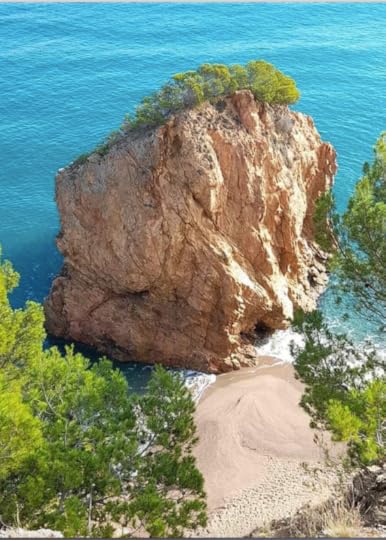
After a long hike on our first day, up and down the coastal hills, around bays and coves and out to sea again, the ever elusive lighthouse on the point became more a source of annoyance than motivation. Worn out, we turned around and went to find something to eat.
Our days had been planned full with outdoor activities. Several coastal hikes along the Costa Brava had been selected to get our hearts pumping, our shoulders loosened up and fresh sea air in our lungs. The morning mist and clear, crisp autumn afternoons created the perfect temperatures for rigorous walking and climbing along the sea cliffs. The mild sea breeze coming off the green Mediterranean Sea was enough to restore the homeostasis of any overworked and underpaid modern professional.
“I’ll have one of with mushrooms, one with bacon and one with chicken.”
“Una de cada? One of each?” the waiter confirmed.
“Si. Perfecto. Gracias.”
“Would everybody like to sample the croquettes?”
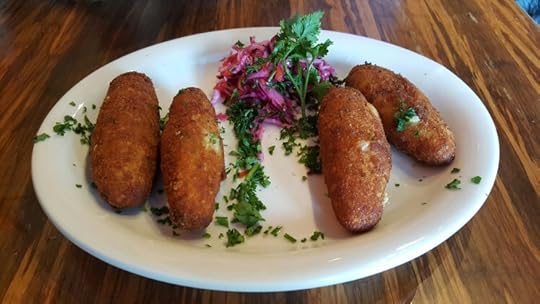
In the village center of the seaside town of Begur, in a low-key sports bar called ‘Tot Hora’ (‘Every Hour’), we sat on the bohemian terrace in the falling afternoon sunshine, with our feet up, drinking ice cold cola from tall glasses with large ice cubes. What more could we want? It had been a great first day. The contentment only lasted until the first batch of croquettes were served; hot, lightly crispy and gorgeous. With one bite we all realized that a sampling, “una de cada,” was not going to be enough. With one of each gone, we ordered more—more with the bacon, more of the mushroom ones, and certainly more of that pollo loco!
With those three handmade and lightly deep-fried croquettes the entire purpose of our vacation was redefined. We ordered again and again and again. The colas came as fast as each batch of croquettes were inhaled.
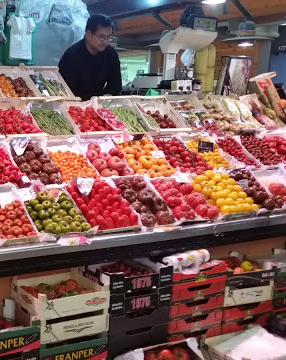
After the binge in Begur we resolved to be more moderate, to eat healthier. We decided to cook in, to clear our collective conscience and to keep our costs and blood pressure under control. Rustic autumn produce and fresh tropical fruits from Andalucia were in good supply at the Supermercat just outside of Begur where we had rented a house. It’s just too bad we didn’t buy any.
“My doctor told me I should avoid caffeine for a while,” son number one said, evaluating the choices of soft drinks, an aisle long and two meters high.
“This is Coke Zero Zero. No sugar. No caffeine,” son number two said, holding up a twelve pack.
“I can’t stand the taste of that diet crap,” Father said, screwing up his face.
“How about we mix it with the limes from the tree in the garden?” son number two asked.
“That might work!” all agreed.
Breakfast consisted of scrambled eggs with chorizo, washed down with Coke and Lime. For dinner we cooked charbroiled hamburgers in the barbecue pit, in November.
“The beef tastes so much better here!” Father exclaimed, his mouth half full, wiping his chin with his hand.
“Happy cows, happy beef! No feedlots here. They must be wild grazing cattle.”
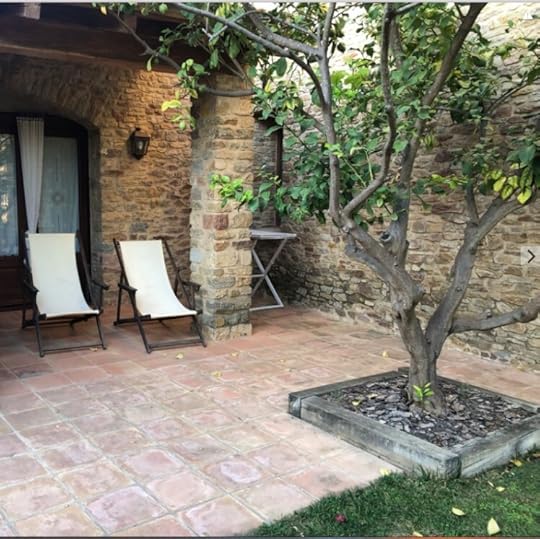
“…those limes, they are so zesty. It’s like liquified sunshine!” son number two said gazing at his fizzing, sweating glass.
“Yeah, that Coke Zero is just the neutral delivery agent for the lime juice anymore. Keep it coming!”
Empty cans and spent lime rinds filled the garbage can in the kitchen to overflowing.
In Barcelona one can sample offerings from every culture on the peninsula in just one afternoon, hopping from one tapas bar to another, eating here a little and there a little. In these chique bars and ethnically themed restaurants on the wide, tree lined thoroughfare of Passeig de Gracia, traditional cultural norms of strict meal times are blurred beyond recognition. One can eat at any time of the day.
At Txapelas, just off of Placa de Catalunya, in the middle of the afternoon, we discovered the Basque equivalent of tapas, called pintxos. As with the croquettes in Begur, which was just a warm up round, grilled gambas on skewers, mushrooms, wrapped in bacon, doused in herbed olive oil were too tempting to withstand. After quickly dismissing everything else we sampled, I was surprised that the waitress didn’t ask to see our money before she left a plate of twelve more skewers on the table and walked back to the kitchen with an order for twelve more. Like sharks in a feeding frenzy, we closed our eyes and just kept on eating and didn’t come up for air for twenty minutes. As bad as all this was, the best worst was still to come.
Hidden in the labyrinth of the narrow alleys of Barcelona’s Bari Gotic, a subdued but iconic cafe, Els Quatre Gats (The Four Cats) preserves an historic Catalan cafe tradition made famous to the modern world in Carlos Ruiz Zafon’s novel, The Shadow of the Wind. Here the intellectuals of the day would gather to discuss literature, politics and the Catalan cause. Here, only the best and most creative and the highest quality of Catalan foods are served along with, much to our delight, Coca-Cola with lime.
What happened at Txapelas a few days earlier should have been a red flag for us. We should have exercised more caution. Like problem gamblers in a casino, we should never have taken our credit cards with us to the table.
“Ohhhh! They serve croquettes with pernil,” son number two said studying the menu.
“What is pernil?”
“The best, the most flavorful jamon, but Catalan style.”
By the end of the night we had consumed three platters full.
We ordered a plate of pernil and a platter of ‘pan amb tomaquet’, roasted garlic bread with freshly squeezed tomato pulp to serve up the thin, nearly transparent, strips of pernil. The sweet tomato, the savory garlic and the cured meat filled our souls with joy and wonder. What sharpness against the silky smooth olive oil. A truly Iberian flavor.
“Are we going to have dinner after this tonight?”
“I thought this was dinner.”
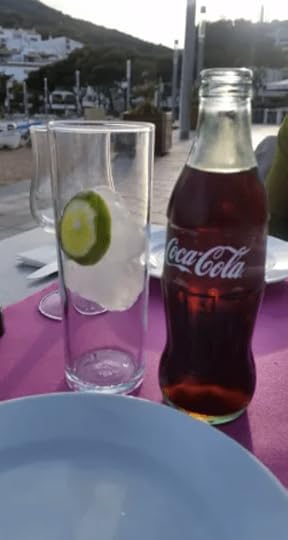
“If this is dinner, I’ll need another Coke. One for everybody?”
Next came the Patatas Bravas. This was no sweet Yoopi sauce that beach side cafes slather on quickly fried potatoes served to German tourists. It was the pithy, spicy stuff on perfectly roasted potato wedges that caused the mouth to burn ever so slightly.
Before the Patatas were finished, a full platter of Selecio D’Iberics, (various Iberian cured meats), arrived together with a second platter of garlic bread with tomato, the third plate of croquettes de pernil, and a last round of colas. Father, unaware of the additional orders that had been placed by son number one, declared in excitement and joy, unable to take it all in, “Muy Tapas!”
And for dessert? White Chocolate Soup. What else? I mean, when are you going to be in Barcelona again, right?
With the platter empty, the food consumed and us searching helplessly for someplace to lay down, the waitress, who had been so friendly, encouraging and pleased by our delight, put an end to our reverie in a cruel and heartless way. Without a word, without a smile, she slapped a small plastic tray on the table top with our check clipped to it and coldly walked away taking our last empty Coke bottles with her.
We laughed in embarrassment as the check passed between us. Each of us tried unsuccessfully to suppress our surprise. Reflexively we reached for the wallets we were sitting on. Instinctively, we knew that between us we could not cover the entire charge of €100.19. Father had to take the hit on his credit card.
Our shock was sincere, but even still, we are unrepentant and plan to do it again at the first chance. That said, there should be a place for frugality and fasting in every responsible adult’s life; Barcelona is just not one of them.
Muy Tapas, todos!
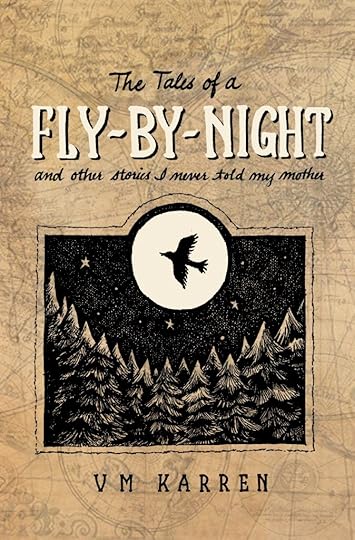 From The Tales of a Fly-By-Night by V M Karren
“Karren does a terrific job in bringing far away locations to your living room. If you’re getting the itch to travel, this will cement your resolve to have your own adventures. Loved it!” —Amazon reader
“I found myself smiling at so many of the stories in this book. As a lover of travel and culture myself, I feel it’s important to appreciate the minutiae in life. It’s the small things that oftentimes turn out to be the most memorable…wherever we are in the world.” —Jillayne N.
September 12, 2024
An Interview with Author Katherine Reay
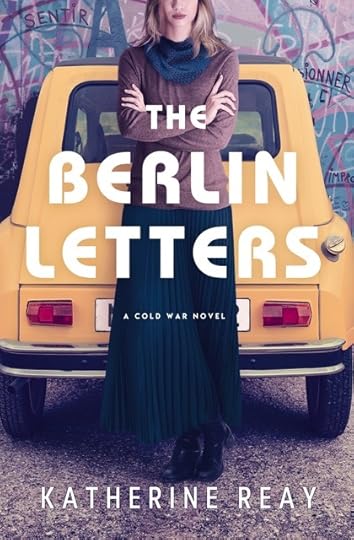
 This month we had the honour of interviewing bestselling author Katherine Reay, as we featured her historical novel, The Berlin Letters, in our online book club:The Berlin Letters tells the story of a German family torn apart by the construction of the Berlin Wall in 1961. The turmoil that follows: family separation, communist oppression, distrust, espionage, interrogation and prison time all combine in a powerful story that pulls us into the history of that era. Reading this novel has been a fascinating way to travel Germany through books!
CHRISTINE FROM FLY-BY-NIGHT PRESS: Thank, you, Katherine, for joining us! How did you begin writing? What genres have you explored, and which do you enjoy best?
KATHERINE REAY: Thank you so much for having me here today and for reading The Berlin Letters!
I began writing in 2009 after an injury. During my recovery time, I read a ton of books and one day a fully formed story came to me. It was that dramatic. But, of course, the writing didn’t happen so fast. That took a couple years, but that initial story became, in 2013, my debut novel, Dear Mr. Knightley.
I read across all genres and there are very few I dislike. I will confess, however, I’m a little too squeamish for horror. In terms of writing, I have published in contemporary fiction, nonfiction, and now historical fiction. I suppose it’s a little unusual to cross three genres, but I have loved it. I have relished exploring stories from a variety of angles and tackling the unique challenges each genre brings. That said, I believe I’ll stick to historical fiction — at least for a few more books.
•
FBN: The Berlin Letters addresses an interesting topic of history: the erection of the Berlin Wall its effect on those living in East Berlin during the Cold War. What first interested you in writing about Germany, and this part of German history in particular?
KR: While researching my previous book, A Shadow in Moscow, the Berlin Wall only received a singular mention as that book stays very focused on the USSR and the United States. But it struck me that, of all the events that happened during the Cold War, the time’s most iconic symbol remains the Wall. I became intrigued by using it both as the structure of a story and as a character within it. The Berlin Letters begins the day the Wall goes up and ends the night it fell. It was truly a fascinating time in both Germany’s history, as well as world history.
•
FBN: The Berlin Letters follows the experiences of a CIA code breaker, Luisa Voekler. I was impressed with your understanding of coding for espionage and how it has been used by intelligence agencies in both America and Germany. How did you come to understand so much about this field?
KR: I studied many books about codes, codebreaking, and espionage — and I found it all fascinating. I had done a little of the research for both The London House and for A Shadow in Moscow, but for The Berlin Letters, I took that research a little farther and learned how to write codes. I wanted readers to be able to dig the codes out of the letters Haris wrote just as Luisa could. I also didn’t use any AI, because — of course — there was none back in the 1940s when Luisa’s grandfather begins coding nor was there in any the 1960s when Haris begins. And I’m so glad I didn’t as creating all those codes was an incredibly fun and rewarding part of the writing process.
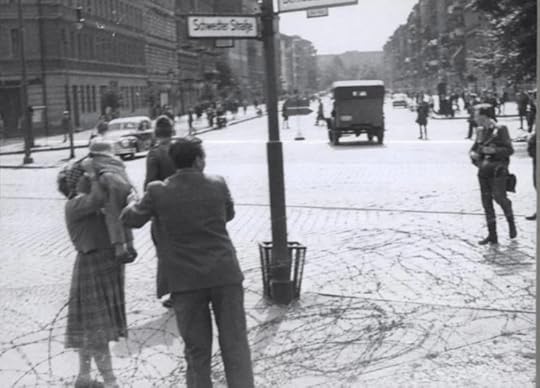
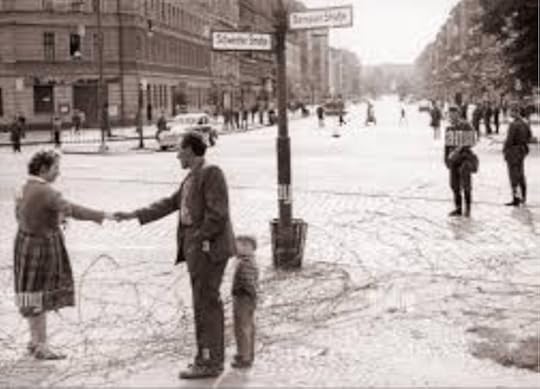
FBN: In the prologue, Monica Voekler throws her baby (Luisa) over the barbed wire that is soon to be replaced by the Berlin Wall. This act of immense courage, love and self-sacrifice underpins the entire book and provides a powerful emotional struggle for the main characters. Were you inspired by any similar accounts of this type of bravery, either in that setting or another one?
KR: I am sure they are easy to find, as I found them by simply searching the Internet, but there are two photographs (above) taken on the Wall’s first morning, August 13, 1961, that inspired Luisa’s journey. In the first photograph, you see a woman holding her young son up next to the barbed wire. In the next picture, you see the boy standing next to his father across the barbed wire and the married couple holds hands as if saying goodbye. The wife passed her son to her husband — and if she ever got to hug her son or her husband again, the earliest moment would have been two and half years later when the East German government allowed West Berlin citizens to cross the Wall for a single visiting day. They, of course, wouldn’t have been truly reunited for 28 years until the Wall came down on November 9, 1989.
I read so many stories like that — and there are more all throughout history of the extraordinary sacrifices people make for those they love.
•
FBN: I enjoyed reading depth in your characters. Many of them embody both strength and weakness, good and evil. Some carry deep secrets which, when revealed, change our view of them: Peter and Helene Sauer, Luisa’s grandparents and aunt Alice are all good examples of this. Other characters change greatly over time, gaining wisdom through experience: Haris, Manfred, and even Luisa herself. What process do you use to build your characters? Do you intentionally incorporate this complex, yet lifelike, dichotomy?
KR: Thank you. I really enjoy creating multi-faceted characters and I truly believe — barring some startling examples in history — that very very few people are all good or all bad. We carry a mixture of both within us and, oftentimes, when we work to understand each other, we can better accept or at least forgive foibles, mistakes, poor choices, and the like. I also believe perspective and the subjective nature of our time, place, and beliefs form how we see the world, and even how we’ll behave in many circumstances. It is so easy from our vantage point to look at someone in East Berlin during that time — and I’ll just use a hypothetical here so as not to give anything or anyone in the novel away — and say it was wrong to spy on one’s neighbors for the Stasi. Objectively that is true. But when one considers the pressure, the threats, the arrests and torture, and so much more, that quick answer, while perhaps still true, takes on greater difficulty. I read hundreds of true stories and peeked into some Stasi files and I can say that to withstand their pressure for compliance would have taken great fortitude. And to right about that struggle, with characters landing on both sides of the answer, made for a dynamic and interesting experience.
•
FBN: I was very intrigued by the use of the Ostpunk music/political movement in your plot, and especially that you chose punk dress as Luisa’s disguise to enter East Berlin. How did you come to learn about these real-life punk rebels, and what inspired you to use them in this story?
KR: That was such a great find! Punk, all underground music, played such a different role in the East than in the West. Behind the Wall, it was truly subversive and dangerous — it could get you arrested, and it often did. But those kids, with real bravery, employed their dress and music as a way to defy the regime with some powerful results. Using it within the story not only allowed me to get Luisa across the Wall in an interesting disguise, but give a nod to the sacrifices some of those kids made. I say “kids” because I am old enough to have been their mothers at the time they were active back then. Most of my research for that aspect of the story came from two books: Burning Down the Haus by Tim Mohr and Berlin Calling by Paul Hockenos.
•
FBN: When you visited Berlin in 2023, where did you go for writing research? What did you learn there, and more especially, what was a surprise to discover?
KR: I spent six days racing around the city much as Luisa does in the novel. I visited the Stasi Museum, Checkpoint Charlie, the Gestapo museum, the Berlin Wall Museum, the Church of Reconciliation, the train stations — everything. I ran across Alexanderplatz to experience it as she would, and I raced up the Friedrichstrasse Station stairs.
What surprised me the most, however, was how the visit added texture to the novel. I spent an amazing afternoon with an East German history professor and he shared details with me that I would never have noticed on my own nor could I have found them in books. For instance, as we walked through the eastern sections of the city, he pointed out the “doors to no where.” They are doors in the walls of bombed out buildings, still there, five and six stories above the ground. They are historical and haunting — and were perfect for the story. There are so many examples of touchpoint like that which came to being from my visit.
FBN: The Berlin Letters is a German Cold War novel, but you’ve also written one about espionage in Russia during the Cold War called A Shadow in Moscow. What commonalities have you found between the experiences of East Germans and Russians during that time period? What strikes you as different between their experiences?
KR: There are so many commonalities, but I think the most striking is that both countries are filled with people who believe in the ideology and so many who fight against it — and the tensions on both sides play out in every sector of life, even the bedrooms. Both those novels focus on people, primarily my female protagonists, who search for truth, freedom, self-determination, and wholeness for themself and their loved ones, and some of that is difficult to find within a dictatorship and sacrifices must be made.
As for differences, East Germany, while a country in-and-of itself, was also a satellite of the USSR. To me, there is a nuanced difference between looking to your own leader, and either agreeing and disagreeing with them, and knowing that all final decisions are made outside your borders and imposed upon you. Or maybe that’s not so nuanced, after all.
•
FBN: Who is The Berlin Letters intended for, and what do you hope they will gain by reading it?
KR: Such a tough question as I hope a broad spectrum of readers will pick it up and enjoy it. It’s a spy novel, a family saga, a love story, a story of sacrifice, codes, punk, and a Wall. It’s a story of forgiveness and redemption, of making new choices, and of understanding our pasts. I hope anyone who picks it up has a fantastic time dipping into history — the novel is packed with real events — and is inspired to learn more. I also hope readers walk away with that lifting feeling of hope themselves. New beginnings and new understandings are only a heartbeat away.
 About the Author
Katherine Reay is a national bestselling and award-winning author of several novels, including A SHADOW IN MOSCOW and her recent release, THE BERLIN LETTERS, a Cold War spy novel, inspired by the Berlin Wall and the women who served in the CIA’s Venona Project, which was recently picked as a NPR “Must Read.”
When not writing, Katherine hosts the What the Dickens Book Club on Facebook and weekly chats with authors and booksellers at The 10 Minute Book Talk on Instagram. But if she’s really lucky, you’ll find her fly fishing and hiking in Montana. You can meet Katherine at www.katherinereay.com or on Facebook: KatherineReayBooks, Twitter: @katherine_reay and Instagram: @katherinereay
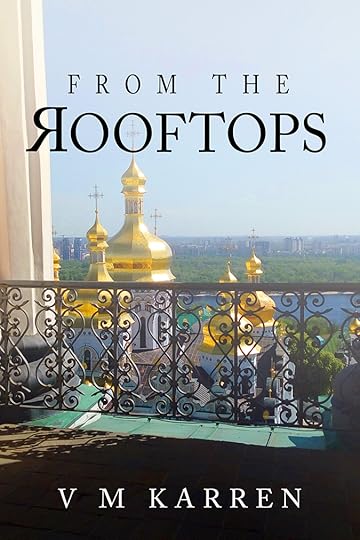
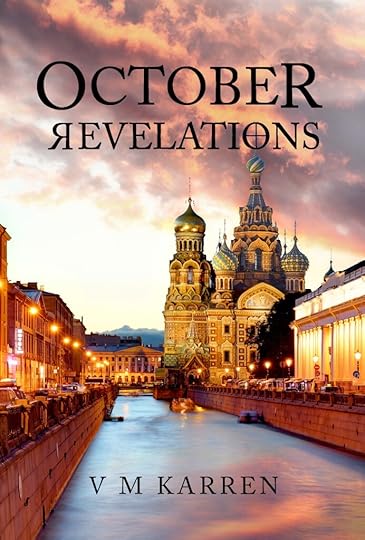
Enjoy More Historical Fiction from the Soviet and Post-Soviet Eras: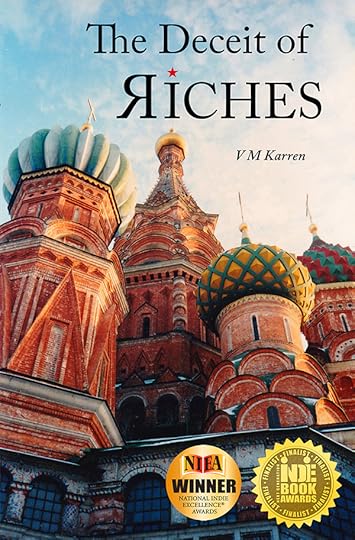
August 16, 2024
Walking in the Shoes of Jane Austen
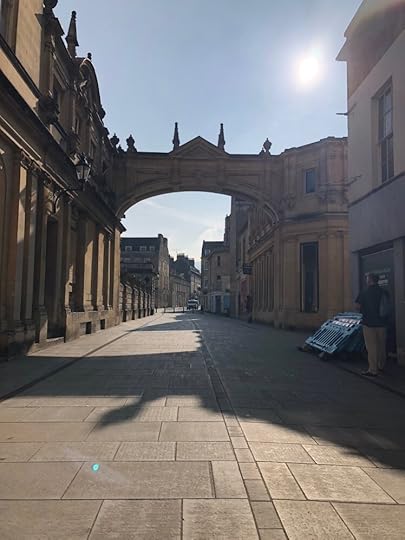
During our recent visit to England we had the distinct privilege of visiting a city with strong literary connections: Bath! Bath sits in the southwestern county of Sommerset in England, not far from Bristol, and straddles the Avon River. It’s known for its many natural thermal springs which have bubbled up to the surface since before the Romans lived here. The springs are known to have medicinal properties and have hence attracted many wealthy and elite people to Bath over the centuries.
At the beginning the 19th century, Bath was especially popular and was seen as a vacation destination for the rich and aspiring members of society, something of a Nantucket or Monaco for affluent British at the time. Charles Dickens spent a fair amount of time here in the Victorian era, working as a Parliamentary journalist.
It was in 1801 that Jane Austen first came to live here, and during the five years of her stay, her writing was greatly affected by the lifestyles and attitudes she saw all around her in Bath. It was in Bath that she wrote Northanger Abbey and Persuasion, two of her most popular and beautifully written novels.
In order to get to know Jane a little better, we followed a walking tour from the book Bath as Jane Knew It, by Terry Old. Here are a few of the places we saw in Bath, and a bit about their connection to her:
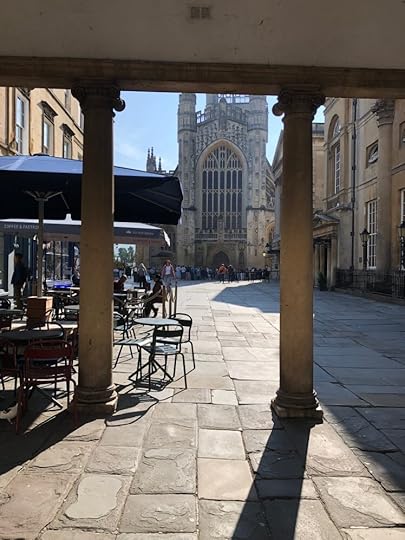 1. Bath Abbey
Bath Abbey has existed since 1499, so Jane certainly knew it. The flying buttresses and pinnacles were added later, but this church stood here, overlooking the Pump Yard (known now as the Abbey Churchyard). At the time Jane lived here, the Abbey was constantly surrounded by lean-to shops. In a few places it’s possible to see where these shops were joined to the Abbey walls.
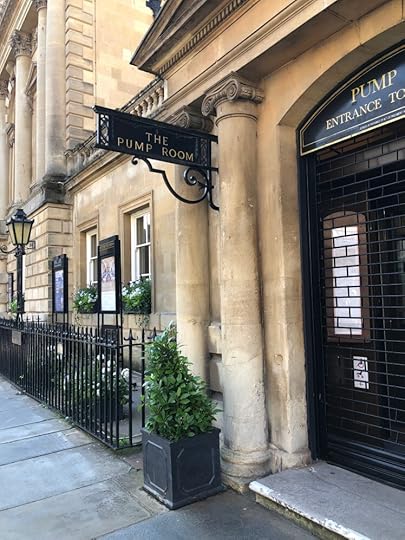
2. The Pump RoomThe Pump Room was also here in Jane’s time, although the Roman Bath Museum next door was not. The largest and most active springs in Bath inside that museum were unknown in Jane’s time, as they were covered by buildings. But the springs that fed into the Pump Room were very well known throughout England and became a gathering place for England’s elite. This beautiful Georgian-style room was built in 1795 by John Palmer on one such spring. Inside is a large room for people to sit and socialise and an elegant fountain where you can buy a glass of Bath’s famous spring water. The Pump Room is mentioned in Northanger Abbey and featured in the BBC film of Persuasion.
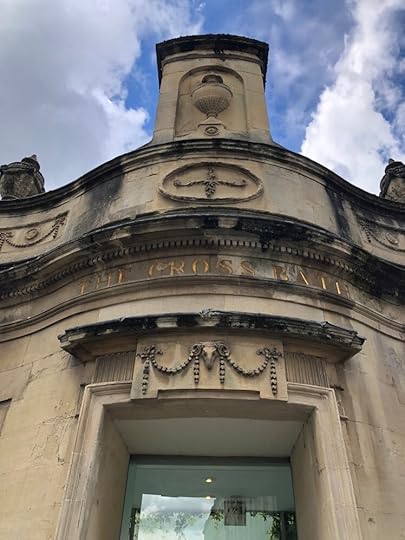 3. The Cross Bath and Thermae Bath Spa (Hetling Street)
Thermal baths such as the Cross Bath and Thermae Bath Spa also attracted visitors to the area. The Cross Bath was first built by the Romans but is now part of the Thermae Bath complex. These baths were formerly flanked by the “Westgate Buildings,” a poor and seedy area of Bath in Jane’s time that appear in her novel Persuasion.
Jane’s brother Edward is also known to have visited these baths for both bathing and drinking medicinal water as part of his health routine.
4. The Former HaberdashersJust around the corner from the Pump Room one can see the building that housed the Haberdashers Shop where Jane’s esteemed aunt, Mrs. Leigh Perrot, was accused of stealing a length of black lace. She had been framed as a subject for blackmail, and the incident caused a great deal of trouble for Jane’s family since stealing was at the time punishable by imprisonment, death, or exile in Australia! Luckily Mrs. Perrot was acquitted during the trial and the family was absolved of any guilt.
 5. Cheap Street & Union Passage
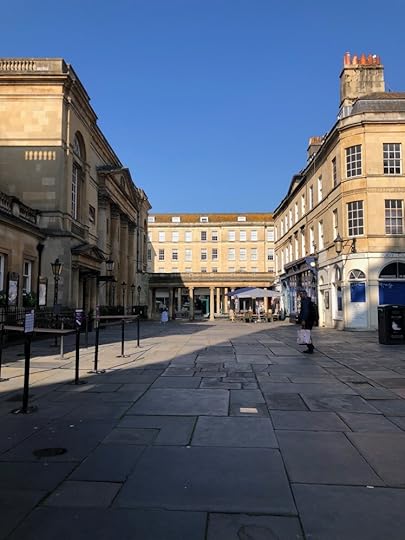
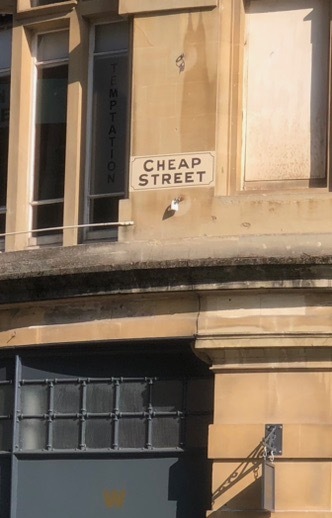
Jane included Cheap Street & Union Passage in Northanger Abbey as Catherine Morland and Isabella Thorpe spot two eligible young men in the Pump Room and then attempt to follow them up Cheap Street. However, the busy traffic of horses and carriages prevents them from following closely, and the two men disappear into the Union Passage never to be seen again.
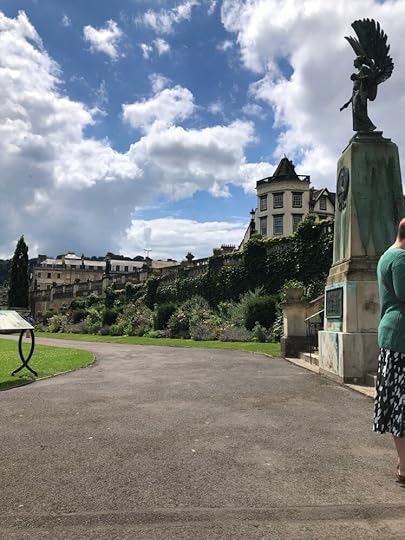
6. The Grand ParadeThe Grand Parade is located just next to the Parade Gardens which flank the Avon River. The colonaded area of the Grand Parade used to be the entrance to the Lower Assembly Rooms (Lower Rooms). In Northanger Abbey, Catherine attends a ball there where she meets Henry Tilney.
 7. Camden Crescent
Camden Crescent is one of the eight Georgian crescents to be built in Bath. Built along the northern slopes, it’s quite steep up there, but it also boasts the best view of Bath. In Jane’s time this was called Camden Place, and it’s here that Walter Elliot, in Persuasion, comes to live when he must lease Kellynch Hall to Admiral Croft for financial reasons.
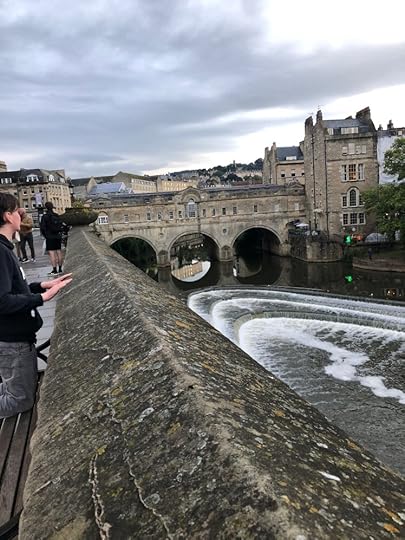
8. Great Pulteney StreetJust above the Pulteney Bridge (pictured here) is Great Pulteney Street, a large boulevard mentioned in both Persuasion and Northanger Abbey.
9. The Holburne MuseumThe Holburne Museum is one of England’s finest art museums. In Jane’s time, this was known as Sydney House. It had coffee, tea and card rooms on the ground floor, a ballroom on the first floor, and a pub in the basement.
10. Sydney PlaceTo the right of the Holburne Musem was Sydney Place, and #4 was the location of the Austen’s main residence in Bath. It is mentioned in some of Jane’s letters.
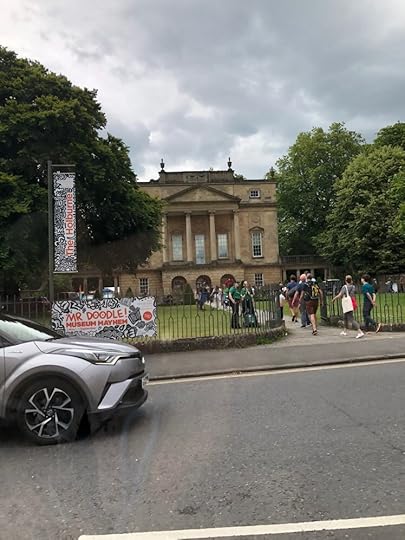 11. Walcot & St. Swithin’s Church
Though not pictured, Walcot and St. Swithin’s Church are worth mentioning. St. Swithin’s Church is where Jane’s parents were married in 1764. Her father, George Austen, is now buried there. Walcot was Jane’s preferred shopping street, because it was cheaper than Milson Street.
12. Milsom StreetIn Jane’s time, Milsom Street was a highly prestigious residential area with a few luxury shops, but today it is a exclusively a shopping street. Jane used Milsom Street in both Northanger Abbey and Persuasion as the place of residence of wealthier characters. A shop on Milsom Street is featured in the BBC film of Persuasion–it’s where Anne, her sister Elizabeth, and Mrs. Clay are seen sampling marzipan.
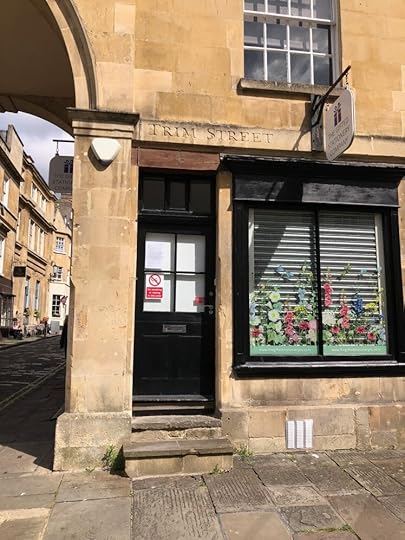 13. Trim Street
Trim Street was the location of the Austen’s final home in Bath. In Jane’s time it was a cheap and dirty part of the city, but the Austen’s loss of most of their fortune necessitated this move. Today Trim Street is quite a pleasant area: quiet, well-kept, and conveniently located.
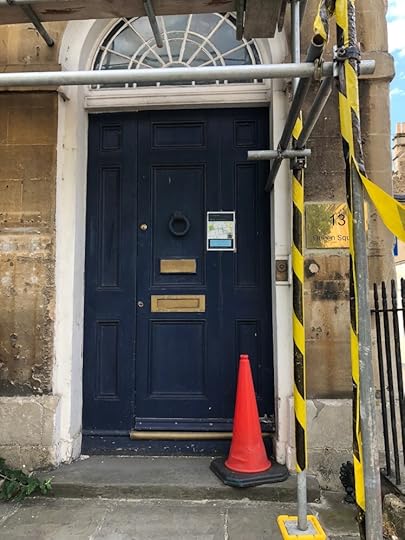
14. Queen SquareQueen Square No. 13 is another of the Austen addresses. Jane stayed here briefly with her mother and brother Edward in 1799 to enable him to take the spring water at the Hetling Pump Room. Jane mentions this let-residence in one of her letters, and also refers to Queen Square in Persuasion by way of Miss Musgroves:
“I hope we will be in Bath this winter; but remember papa, if we go, we must be in good situation — none of your Queen Square for us.”
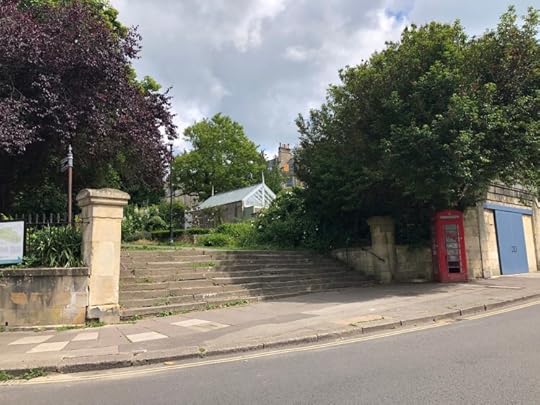 15. The Gravel Walk
The Gravel Walk is just up from Queen Square and it is featured in the BBC films of both Northanger Abbey and Persuasion. This is where the proposal of marriage between Captain Wentworth and Ann Elliott is made and accepted. This elegant walk connects the Royal Crescent with the baths located in the city.
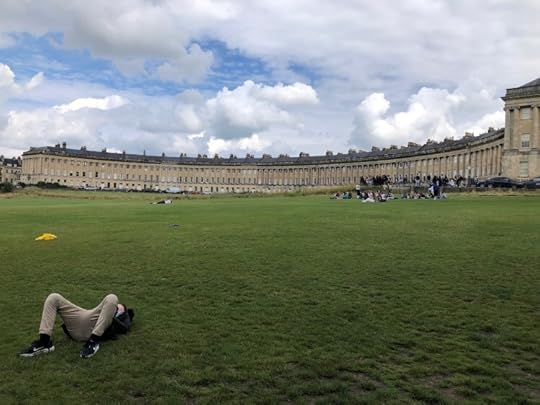
16. The Royal CrescentThe Royal Crescent is perhaps the most stately of all residences in Bath. Built in 1775 to the design of John Wood the Younger, it was the first of its kind. It has been copied in many parts of the world, and eight crescents are found in Bath. Jane’s aunt and uncle lived here at No. 12, and Jane most likely visited them here.
 17. The Circus
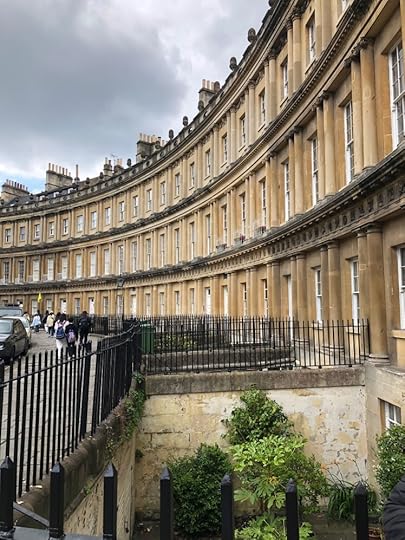
The Circus in Bath is sometimes compared to the Colosseum in Rome, only it faces inwards. Designed by John Wood the Elder, and completed by his son of the same name, it is detailed and ornate, with three types of columns, and intricate carvings, depicting the arts and sciences, at the ground level. This was the residence of the Austen’s family friends the Mapletons, but Jane never refers to it in either Northanger Abbey or Persuasion. Perhaps it was too fussy for her taste.
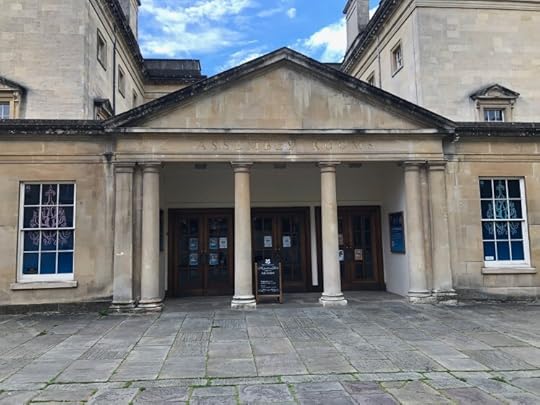
18. The Assembly RoomsThe (Upper) Assembly Rooms were also built by John Wood the Younger, and ran in competition with the Lower Assembly Rooms at the Grand Parade already mentioned. All assembly rooms in Jane’s time included a ballroom, a card room, and a tea room, indicating the three favorite Georgian pasttimes: dancing, gambling, and drinking tea! Jane mentions this one in her letters.
 19. Gay Street
Another of Jane’s residences, her family moved to Gay Street No. 25 in 1805 after leaving the home where her father had died. In her time, Gay street was a very good address, and it is mentioned in Persuasion as the place where Admiral Croft takes his lodgings in Bath.
20. The Jane Austen CentreThe Jane Austen Centre is also on Gay Street, in No. 40, a house very similar to the one where Jane and her family lived in No. 25. The Centre provides an introductory talk and special exhibits which explore Jane’s life and homes throughout Bath. You can view regency-era day and evening wear, watch a film about Jane, and visit the tea room on the second floor. A well-equipped gift shop enables visitors to find any type of souvenir imaginable relating to Jane Austen, her novels, and even Bridgerton.
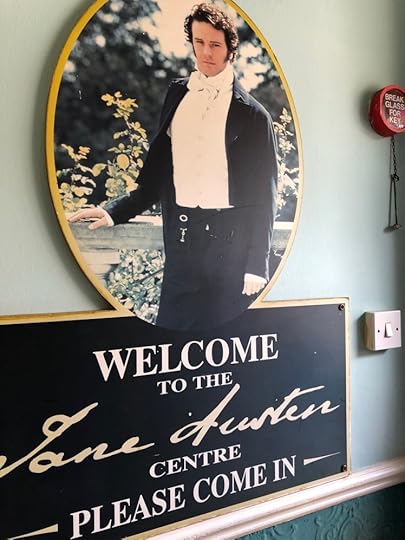
We hope you enjoyed this mini-tour of Bath. If you love the works of Jane Austen, we highly recommend that you go and visit. While reading her novels is a perfect delight, walking in Jane’s actual steps will bring her life and work to life!
June 26, 2024
10+ Best Books on Lithuania
This month, as we’ve been focusing on the Baltic nation of Lithuania in our online book club, Travel Europe Through Books, we thought you’d like a few more recommendations for books set in, or otherwise connected to, Lithuania:
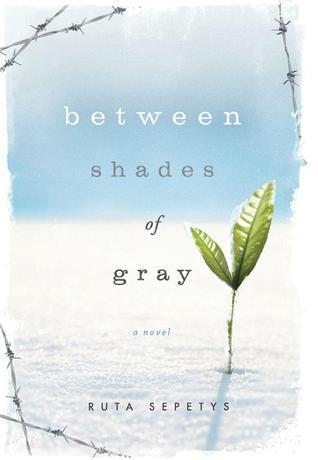
1. Between Shades of Gray by Ruta Sepetys. Fifteen-year-old Lina is an artist who loves drawing and painting. One night Soviet officers arrive at her home, tearing her family away and sending her father to another location. Lina is forced into a Siberian hard labor camp with her family where Stalin has forced them to dig for beets and suffer cruel conditions. Only her art brings Lina solace, and she survives, incredibly, by love and hope.
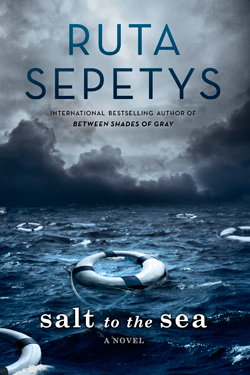
2. Salt to the Sea by Ruta Sepetys. In 1945, a group of war-weary refugees from various lands travel together toward a ship that will hopefully bring them to safety in Germany. A young Lithuanian nurse, a Prussian soldier, an old shoemaker, a young Lithuanian boy, and a young pregnant Polish girl find strength and teamwork in each other amid death-defying challenges. Ultimately they board the Wilhelm Gustloff, a ship whose story has become the biggest maritime disaster in history. Read our interview with Ms. Sepetys on this book HERE.
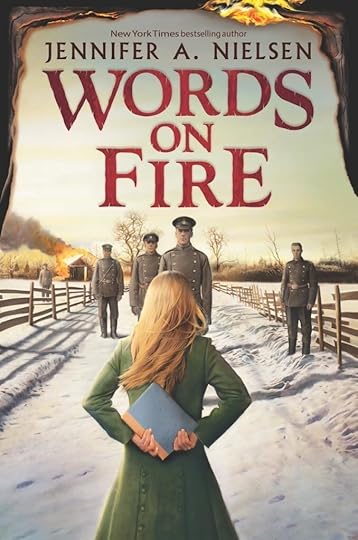
3. Words on Fire by by Jennifer A. Nielsen. Occupying Russian soldiers are insisting that everything Lithuanian be banned: books, religion, culture and language. When they arrive at Audra’s door, her parents insist that she escape, carrying an important package with her. If she joins the underground resistance, will she be able to deliver the package and rescue her parents?
4. Vilnius Poker by Ričardas Gavelis. A mixture of troubled Lithuanians struggle to maintain their identity and sanity in the 1970s and 1980s under Soviet rule. A labor camp survivor and his genius friend, a beautiful young siren, a library worker, and a failed intellectual who chronicles the struggles of Vilnius give voice to a city ravaged by the terrors and inhumanity of tyrrany.

5. Dear Fang, With Love by Rufi Thorpe. A young father named Lucas takes his daughter Vera to Europe, hoping to help her overcome a mental breakdown and to help him forget his past. In Vilnius, Lukas discover that his grandmother was a home army rebel who escaped Stutthof and Vera struggles to learn more about her mysterious roots. A blending of Lithuanian history and family lore, this novel is a story of mental illness, inheritance, young love, and adventure.
6. Above Us Only Sky by Michele Young-Stone. A woman born with wings has them amputated, but they never really go away. When at 15, she meets her Lithuanian grandfather, she learns of her bird-women lineage and other heroes of Lithuanian history. She sets off on a quest to discover her ancestors and discover where she belongs. This story spans time between the 1863 Lithuanian uprising against the Russian Tsars, and the fall of the Berlin Wall and subsequent Lithuanian independence in 1991.
7. Those Whom I Would Like to Meet Again by Giedra Radvilavičiūtė. Ten essay-stories that combine fiction and non-fiction follow the author’s journey from old town Vilnius to Chicago’s Brighton Park. They are filled with memory and reality, fantasy, absurdity, and humor, with which Radvilaviciute tells the experiences of life “unrecognizably transformed, like the flour, eggs, nuts, and apples in a cake.”
8. Underground by Antanas Šileika. A book inspired by true events, Underground chronicles the story of two romantically involved members of the Lithuanian resistance of the mid-1940s. After shooting Soviet government workers, both go into hiding. A raid uncovers their hiding place, and the lovers are separated, having to suffer unspeakable crises as they each struggle to each find happiness in a world torn by oppression. Underground is an engaging literary thriller and love story that reveals the desperate situations Lithuanians faced in this time period.
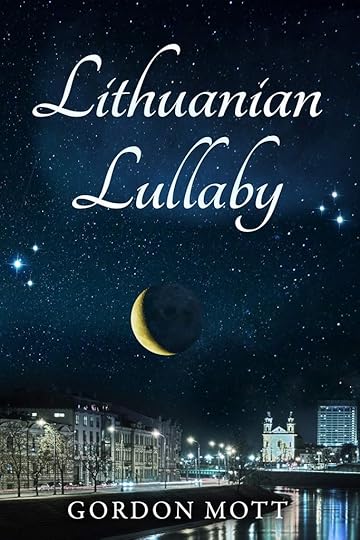
9. Lithuanian Lullaby by Gordon Mott. This story follows the lives of six people between 1987 and 1997. A Soviet conscript in Afganistan decides to devote his life to undermine the country he serves; a Hungarian teenager escapes over the border, but ends up robbed and in debt in London; an American discovers that language is no barrier to true love; and an English couple struggle to raise their love child in Yorkshire. All of them experience a peculiar connection to the Baltic nation of Lithuania, newly independent.
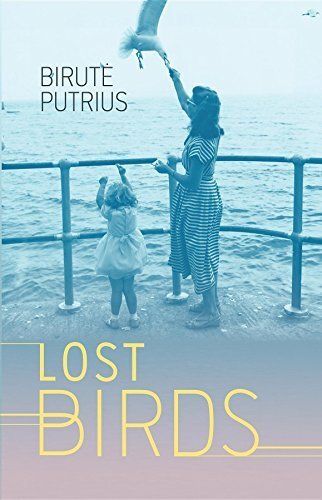
10. Lost Birds by Birute Putrius. Lost Birds follows the tale of Irene Matas and her friends, who leave Lithuania as young children and begin new lives with their families in Chicago after the Second World War. Their parents are weighed down with grief and nostalgia for their lost homeland, while their children struggle between allegiance to their parents and the lure of American culture. When Lithuania wins her independence, many of them return.
A Children’s Book: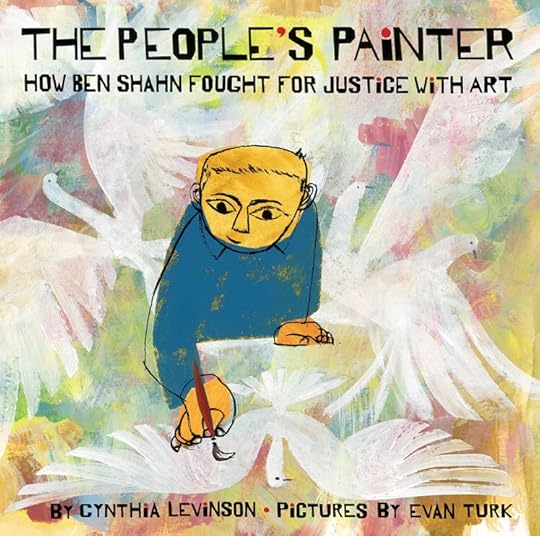
The People’s Painter: How Ben Shahn Fought for Justice with Art by Cynthia Levinson Ben Shahn is an observant child growing up in Lithuania. He draws everything he sees. When his father is banished by the Tsar for demanding worker’s rights, he develops a sense of justice, too. After Ben and his family make it to America, he uses his keen artistic eye to speak justice, disarming classmates who bully him because he’s Jewish, defying his teachers’ strict assignments, and finally pushing for government reform in the Depression-era. A 48-page picture book in hardcover.
June 14, 2024
An Interview with Author Ruta Sepetys
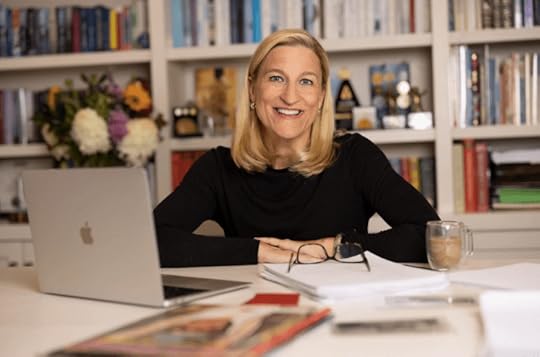
This month we had the special privilege of interviewing author Ruta Sepetys about her book, Salt to the Sea as we have been Traveling Europe Through Books. With Lithuania as our focus for June, we chose Salt to the Sea to read in our online book club because it features a strong Lithuanian character and an event, the sinking of the Wilhelm Gustloff, which has an important connection to Lithuanian history. As an accomplished Lithuanian-American author, Sepetys is uniquely qualified for the task of bringing us this little-known story in English. She calls herself a “Seeker of Lost Stories.”
Christine from FBN: Thank you, Ruta, for talking with us! Salt to the Sea has such an interesting structure, moving quickly from character to character in first-person narrative. Many of the scenes are told from multiple viewpoints. What made you choose this form for your book?
Ruta Sepetys: I traveled to six different countries researching Salt to the Sea and met with many people who experienced the refugee evacuation of 1945. During the interviews, it was clear that each person viewed the experience differently—through their own cultural lens. So I created four separate characters to give voice to a particular regional experience and allow the reader to look through their “lens.”
FBN: I was really impressed with how you were able to capture certain cultural aspects of the various countries from which the refugees come, in small details. This aids in a truly life-like portrayal of the characters (ex: Emilia’s rescuer reminding her of the knights from the caverns in Poland, and her references to St. John’s Day and St. Florian, the gentility of the East Prussians, and Florian’s father’s involvement with the attempted assassination of Hitler.) Did you specifically research these types of elements or did you just draw them from things you already knew about those cultures?
RS: Thank you! I specifically researched those elements. Cultural elements, even food, can bring emotion and authenticity to a story. So when interviewing true witnesses, I made note of cultural references.
FBN: You are of Lithuanian decent, but were born in America. How much was Lithuanian culture part of your upbringing? Was this a motivation for you to tell this particular story? Did you have to research much about Lithuania for this book?
RS: My Lithuanian heritage has been a large part of my identity. Growing up in the U.S. with a name like ‘Ruta Sepetys’ always sparked questions. I was constantly responding with, “I’m Lithuanian.” Even though that was my response, I wasn’t familiar with all of Lithuanian history —certainly not the deportations. In 1940, Stalin pushed into the Baltics and my grandparents and father fled from Lithuania. When I was visiting family members in Lithuania in 2005, they told me that some of my grandfather’s family had been deported to Siberia. I was shocked and ashamed that I knew nothing of this part of history that had affected my own family. Stories of Stalin and the Soviet occupation aren’t often discussed. I wanted to share the story of the people of the Baltics who had endured Stalin’s terror.
FBN: How did you first learn of the sinking of the Wilhelm Gustloff? What made you decide to write about it?
RS: My father’s cousin told me that during World War II there was a ship that sank with a death toll far greater than the Titanic and Lusitania combined, yet the story had somehow remained hidden for over seventy years. The ship was the Wilhelm Gustloff and she had been granted passage on it during the evacuation. I researched it and discovered that the sinking of the Wilhelm Gustloff on January 30, 1945 was single largest maritime disaster in history but most have never heard of it. It made me wonder, what determines how history is preserved and recalled? Why do some parts of history become part of our collective consciousness while others remain hidden? That question inspired me to investigate and write Salt to the Sea.

FBN: The sinking of the Wilhelm Gustloff is both fascinating and terrifying. What specific research did you do to recreate this momentous event? How much of what you wrote would you say is based on research and how much is artistic license?
RS: I traveled to the former region of East Prussia and walked the path of the refugees that I describe
in the book. I visited the port where the Wilhelm Gustloff boarded and departed. I interviewed survivors, witnesses, and family members of victims. I also interviewed three divers who had separately explored the sunken ship. Nearly all of the book is based on research with the exception of the dialogue and Florian’s experience with the amber swan.
FBN: A major theme in the book is secret-keeping. Everyone in the book seems to have a secret, to the point that it reads like a mystery novel. What is the significance of secret-keeping to you, and what made you choose it as a theme for this novel?
RS: I find that secrets and silence breed speculation and uncertainty. If we don’t know the full details of a story, the tendency is to fill in the blanks ourselves. But in doing so, we sometimes create false narratives and that can lead to unnecessary suspicion and confusion. So I wanted to focus on that aspect for the book.
FBN: The Amber Room has a fascinating history. What inspired you to use it in the book?
RS: The Amber Room was a glittering chamber of amber, jewels, and gold. The Nazis stole it from the Russians during the war, but it disappeared during the evacuation. The Amber Room was last seen in 1944 and to this day remains one of the enduring mysteries of the art world. During my research, I read a few accounts that claimed the Amber Room treasure had been loaded onto the Wilhelm Gustloff. So I wove that storyline into the novel and one of the characters.
FBN: Alfred is an interesting character that gives a perspective in sharp contrast with the others. Is his character based on anyone in particular? Did you do anything in particular to “get inside the head” of a Nazi soldier/sailor?
RS: The character of the young Nazi, Alfred, was an opportunity for me to study visibility. What happens to a young man who is basically invisible but one day is given a uniform and suddenly becomes visible…even in his own mind? To get inside the head of the character of Alfred I studied and researched Adolf Hitler as a teenager.
FBN: Your books are as poetic as they are informative. The chapters at the beginning and end of Salt to the Sea that start with “Guilt is a hunter…Shame is a hunter…[and] Fear is a hunter” are especially poignant and evocative, and this use of repetition lends a type of rhythm to the prose. Do you have any background in poetry as a genre, or do you simply enjoy combining it with your prose?
RS: Thank you! Actually, my background is in music. Prior to becoming a novelist, I spent more than twenty years in the music industry working with songwriters, musicians, bands, and film composers. And working in music taught me the power of rhythm and melody. Most people won’t remember anything I say in this interview, but if they hear a song they haven’t heard in several years, they can still sing the words to the song. And that’s because rhythm and melody make something memorable. So I try to weave rhythms into my prose.
FBN: Who did you write the book for and why? Do you feel that this novel has reached its audience?
RS: During my research interviews with the victims’ families, I could hear—and truly feel—their hope that readers might learn about the tragedy. Their emotions were palpable and I wanted to give voice to their loved ones who never had a chance to tell their story. I wrote the book for young readers and I’m so grateful that the book is being used in schools worldwide as it will be the young people who carry our fading history into the future.
 About the Author
Ruta Sepetys (Rūta Šepetys) is an internationally acclaimed, #1 New York Times bestselling author of historical fiction published in over sixty countries and forty languages. Sepetys is considered a “crossover” novelist as her books are read by both students and adults worldwide. Winner of the Carnegie Medal, Ruta is renowned for giving voice to underrepresented history and those who experienced it. Her books have won or been shortlisted for over forty book prizes, are included on over thirty state reading lists, and are currently in development for film and television.
Ruta is the daughter of a Lithuanian refugee. Born in Michigan, she was raised in a family of artists, readers, and music lovers. Ruta is passionate about the power of history and story to foster global dialogue and connectivity. She has been invited to present at NATO, European Parliament, the U.S. Capitol, the Library of Congress, and Embassies worldwide. She was awarded The Rockefeller Foundation’s prestigious Bellagio Fellowship for her studies on human resilience. The New York Times Book Review declared, “Ruta Sepetys acts as champion of the interstitial people so often ignored—whole populations lost in the cracks of history.”
Ruta was bestowed the Cross of the Knight of the Order by the President of Lithuania for her contributions to education and memory preservation and was recently honored with a postage stamp containing her image. She is extremely proud to be of Baltic heritage, even if that means she has a name no one can pronounce.
Ruta lives with her family in the hills of Tennessee.