Joshua Derrick's Blog
November 23, 2025
2025 Training in Review
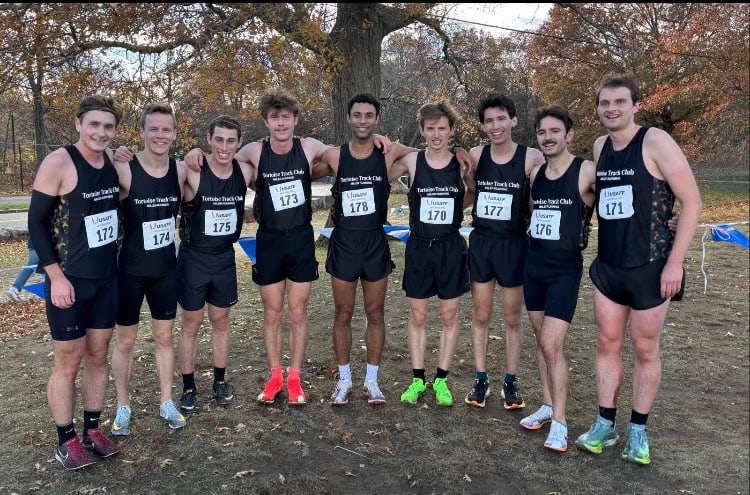 Tortoise Track Club Franklin Park 8k: Had a blast racing on my old college course
 With my birthday last Wednesday, and my traditional run out of the way (it was 28 miles this year), my 2025 for racing has pretty much all wrapped up. This year was pretty disappointing in terms of results: I’m still 10 minutes off my marathon PR, and none of my other races distances were particularly successful either (except for swimming which we’ll get to). This is not particularly surprising, as I injured myself multiple times by overrunning, and had multiple periods of very low endurance volume when life completely overwhelmed me. Despite lackluster results, I had a really fun time training this year: I joined a master’s swim club, started a small workout group in Baltimore, got back to my usual local run clubs (Tribe, NBLORG), and did a lot of miles with various MIT and Hopkins alumni. I also had a bit of an intellectual breakthrough here on Substack when I came across the writings of , , and and realized that I had been approaching the sport in the complete wrong way since ceasing to be an NCAA runner in 2021.
Going into 2026 I’m excited to put the ideas of these three greats into practice: loads easy of volume, submax testing, and completely axing intensity until I’m ready for it. More on that in a bit.
Training and Racing in 2025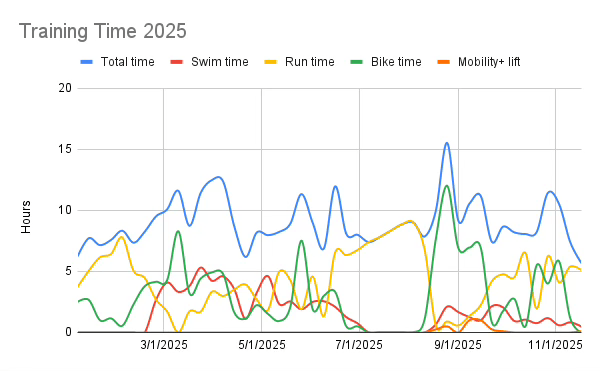 My training hours in 2025
I came into 2025 in not the greatest of places. I had been training for all of 2024 for the Chicago marathon, but a few weeks before came down with both COVID and a hip-flexor issue. Due to these problems I basically didn’t do any exercise October of 2024 and didn’t start running again until December 2025. Unfortunately because of the way that race signups work I had signed up the Boston Marathon in April and agreed to be part of a year-long race series with Under Armor here in Baltimore. This was a series of 6 races, about one a month, ranging from the mile to the marathon. Due to one of these races interfering with the MIT alumni meet, I also planned to go Boston for a XC 8k sometime during the fall. Add a couple triathlons to this and I was racing 1-2 times every single month from January onwards. Of course things weren’t going to work out very well.
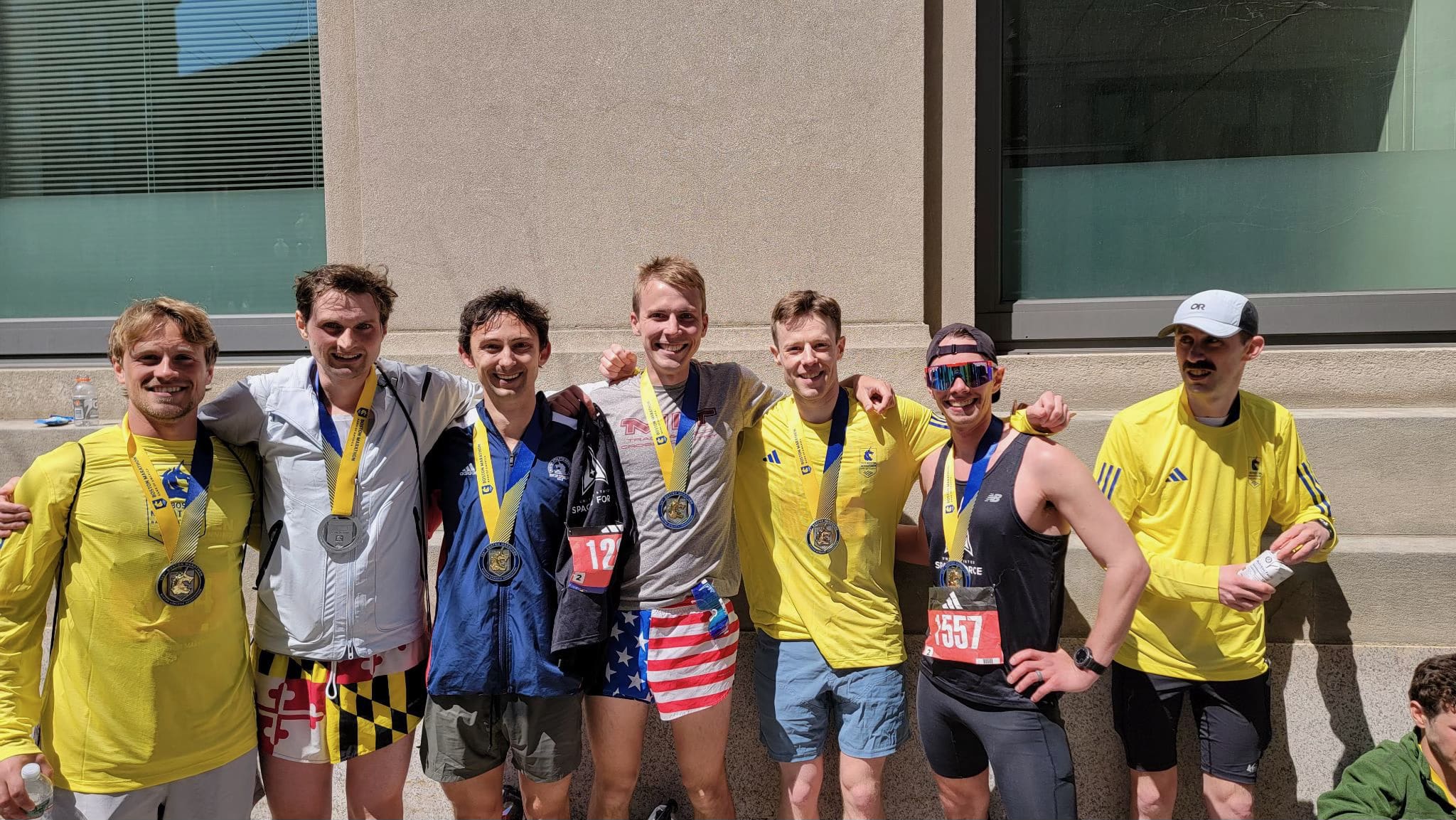
Throughout the winter starting in December 2024, my coach had me gradually build up running mileage while easing off a little on the cross training. We also added fairly intense interval workouts pretty early, although these were quite low volume. Things seemed to be going okay until late February when the rapid mileage buildup and lack of strength and mobility work caused me to start to break down after the Maryland Club Challenge 10 miler on Feb 21st. I ended up having some pretty severe posterior tib issues, which I luckily was able to work through with Zach Kaminski at PT. During this time I ramped my bike and swim volume massively, and was able to come back pretty okay for the Boston Marathon and run a 2:48 off very little running.
I didn’t do a whole lot of training in May, something to do with recovering from Boston and with a girl. However, after things didn’t work out around the beginning of June, I decided to rededicate myself to training completely. Quickly after that you can see a massive, linear ramping in running time until late August, in which I got injured again with the same posterior tib issue. I had also (again) foolishly given up cross training during this time, meaning getting back in the pool especially was quite a bit more difficult than it should have been1. With the help of Zach again I was luckily able to recover pretty quickly and start ramping back up for the Baltimore marathon. It was around this time that I really had begun to regularly listen to Gordo, Iñaki, and Alan, and started to want to incorporate a lot of the best practices they discussed with training. Unfortunately, I was already working with a coach who didn’t really share their training philosophy. Although things had been a bit difficult with my coach for most of 2025 due to my various injuries, this was where things really started to get grating as I no longer really believed in the training. I did my best to work in both worlds: doing the workouts that my coach prescribed, but taking extra off/easy days when my HRV was depressed, trying to take two very easy days in a row, and rebalancing my macros away from carbs and towards fat. I’m not sure if this was the right decision or not: it didn’t make sense to me to switch training plans in the middle of a season, but once I had decided that I didn’t believe in my coach’s training anymore, it felt a little bit like we were wasting each other’s time.
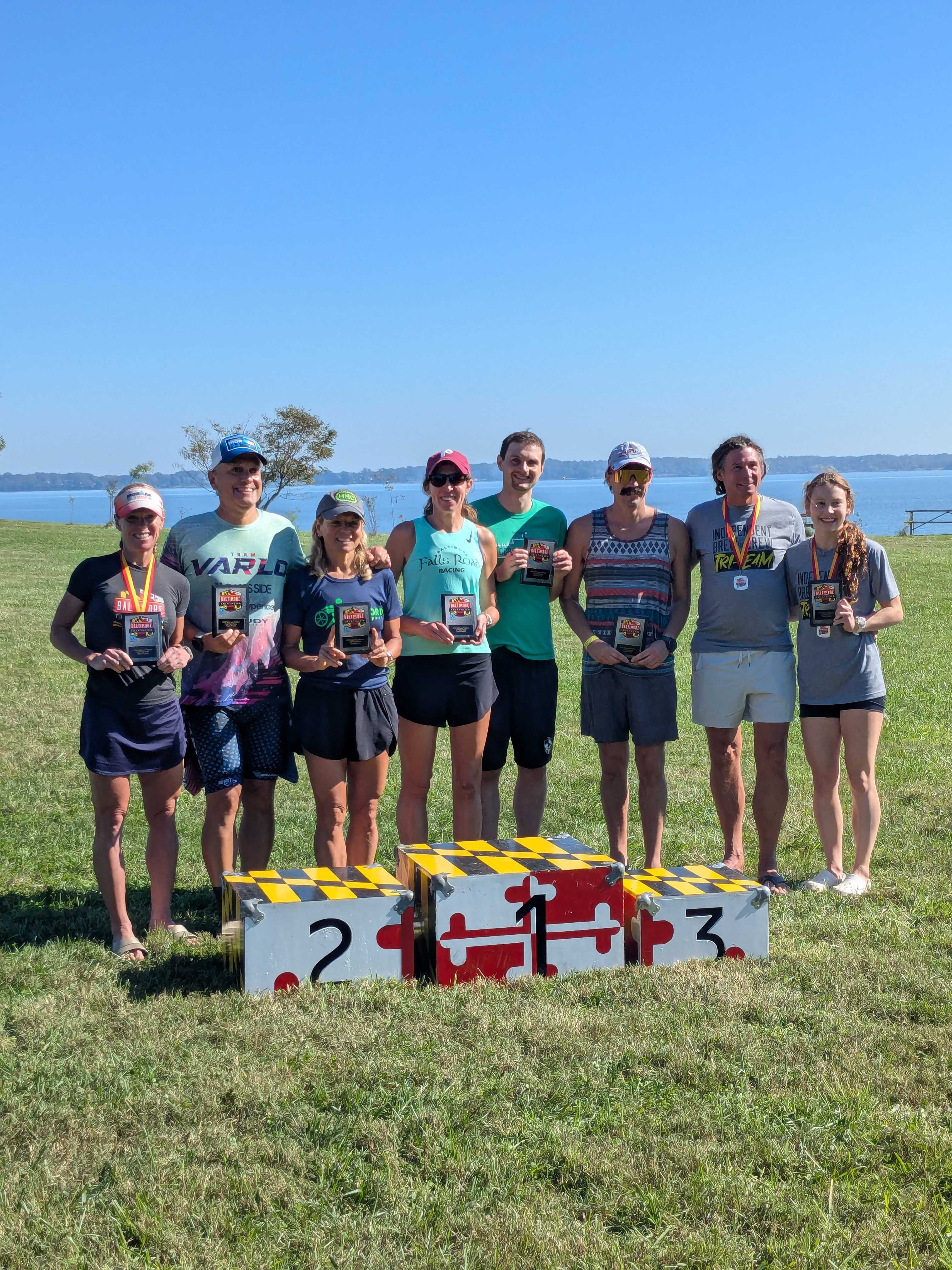
During the build to the Baltimore marathon I had a very successful swim race as part of a mixed triathlon relay at the Baltimore tri. Our goal as a team was to beat Zach for the full race. I got him on the swim, swimming a 10:04 for what was probably ~700m, but we quickly lost him on the bike.
My weeks during this time looked approximately like this
Mon: Easy run +master’s swim
Tue: AM bike
Wednesday: workout (tempo or Vo2) +master’s swim
Thursday: off
Friday: easy spin or bike (45 min) + 30 min swim
Saturday: Long run or ride (2-4 hours)
Sunday: Easy 60 min
I could have probably used more volume total and made the Wednesday workout significantly easier, but it wasn’t a bad plan, especially when I decided to axe any Vo2 workout that was given to me. During this time I started a regular workout group with a couple other guys in Baltimore: Jeff, Ross, and Adam. This was a great part of my week, and I’ll have to figure out how to incorporate it in the New Year when I’m not running so hard.

The Baltimore marathon itself went pretty well after this. I split 1:22/1:22 on a pretty challenging course and managed to close in a 5:14 mile.
After the marathon I had two more events to complete: the USATF 8k in Franklin Park and my birthday run, which was my age in miles. The week structure looked pretty similar to before, but I started following my coach’s plan completely, and replaced the long run with an extra workout on grass. During this time master’s swim shut down because of pool renovations, so my swimming frequency reduced quite markedly. I still managed to make it once a week to the school pool, and my speed seems to be maintained by this frequency, although I am not improving, and each session is a little uncomfortable.
The actual 8k itself went okay. It’s difficult to compare my time to college, as the easy stadium loop that we used to do for the first mile at Franklin Park is under construction. The replacement “Wilderness” loop is fairly hilly, so this probably added 10-20 seconds to my time. The course was also extremely muddy and we couldn’t wear spikes because of a long asphalt section: grip in my super-shoes was somewhat of a problem. That said my 27:13 still beats some of my worse 8ks from college, so I’ll take it.
The birthday run went very well. I ran the first eight with Jeff, Adam, and Ross, and then a few in the middle with my med student friend Emma. The last fourteen were on my favorite trail in Baltimore, Gwynn’s Falls, which was also amazing.
Since Wednesday I have been off, although I am beginning to exercise again because my life begins to fall apart when I don’t.
Lessons Learned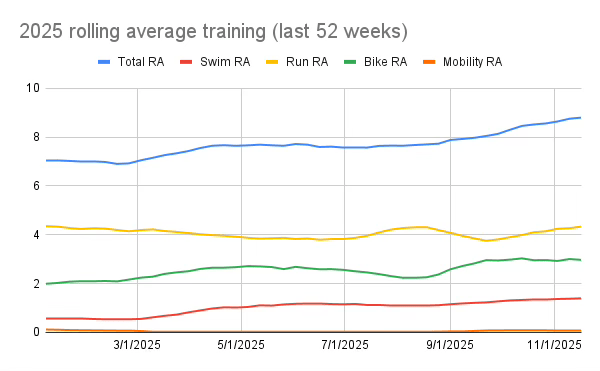 You can see where I slowly started to absorb what Alan, Iñaki and Gordo were saying
 I have to be careful with run volume. Both injuries this year (or really the same injury twice) were because I ramped run volume too much too fast. As a run focused athlete, I do need to increase my run volume, but this is best done over time and gradually. 40-50 miles a week, or around 5-6 hours is probably a safe spot to build from.
Too many races are really bad. I signed up for way too much stuff in 2025 and paid for it. It’s fine to have a lot of races lined up, but I need to learn how to pull back and train through things, rather than treat every race as a race.
I have no problem with the mental side of racing. In fact, related to the last point, I think I’m, if anything, too good at pushing myself. At the Franklin Park USATF 8k I set a new max heart rate (208) and was at or near 200 bpm for almost the whole race. This is a very good thing in some ways, but it also means I have to learn to hold myself back except when it really counts. If I’m being honest with myself I’ve never had real problem competing but rather controlling myself in non-race situations.
I need to coach myself, at least somewhat. Maybe because one of my inspirations is Lionel Sanders, and maybe because I’ve wanted to try a cycle primarily composed of truly easy running for a long time, but I’m not sure working with a coach is the right thing for me right now.
Plan for next yearI am no longer working with my old coach. We tried to work together for almost two years, but I think a difference in training philosophies and my desire to have control over my own training made the relationship difficult. I think it’s important that I have some oversight on what I’m doing, so I’m trying to recruit my high-school friend Zack (different from Zach the PT) take a look at what I have planned. I would also certainly appreciate any advice that commentariat has as well. What follows is my rough plan for 2026.
1. Get to a consistent 10-12 hrs/week of Aerobic training + 2-3 sessions a week gym time or strengthening in general, almost all of it Z1, with some 200s or easy tempo mixed in. Do this for 7-8 months, and then do a short marathon build for Chicago in the fall. Let Zack plan the workouts for this period. After the marathon I’ll do a short Vo2 block for a fast 10k and then ease back into easy volume. The important thing is to not build volume too fast: make the goal at first to just beat my 52-week rolling average each week.
2. Two of these days should be very easy, preferably back-to-back. A good block for these is Thursday-Friday or Sunday-Monday, depending on how my week is going. I don’t think a full off day is usually very good for me every week. Easy bike or ruck would be much more productive for my mental health. Take extra easy days as needed based on HRV.
3. The plan will be very run focused but capped at 40-50 miles a week. Can slowly push up from this over time, but 50 seems to be a safe cap, at least for the first 4-6 months.
4. Make sure I swim and bike at least two times a week.
5. Key submax tests (do each of these every 2-3 weeks)
a. 130/140/150/160 (heart rate) for 10 minutes around druid lake
b. 120/130/140/150 (heart rate) max wattage on bike
c. 400m/y steady swim
d. 10k 200s/200s, best average on fast! (or 15-30s hill sprints).
6. Every 4-8 weeks take a down week as needed.
7. Example week
a. Monday: easy spin + tribe in the PM
b. Tuesday submax test run + PM swim + gym session
c. Wednesday: 90 minute run with 45 minute tempo (at LT1) + pylos
d. Thursday: EZ spin (30 min)
e. Friday: EZ swim (30 min)
f. Saturday: Long run (3 hours Z1)
g. Sunday 60 minute swim + 60 minute run + gym session
h. Weekly total: ~11 hrs+ gym
8. Where am I going to get more time?
a. Eat on bike
b. Cut down screen time
c. Double up reading/immersion time with bike
9. Key dates
a. Time off begins 11/20/25
b. Unstructured training begins: sometime in December
c. Structured training begins: 1/5/2026
d. Boston Marathon (4/20/2026 15 weeks after structured training, train through this. Treat the race as a harder effort long run)
e. Chicago marathon (10/11/2026, 25 weeks after Boston)
f. USATF NE 10k in mid-November. This gives me an opportunity to use the marathon fitness for a quick Vo2 block.
Even though the Chicago marathon is the goal race for this year, I plan to not completely go to the well so I can continue to train without taking excessive time off. The real goal is fitness when I am 35 or 45.
1
I blog about language learning, biology, the science and art of learning, and many other things. If you feel inclined, please subscribe or consider buying me a coffee.
Josh
Even one swim a week would have made a huge difference in terms of swim maintenance


November 8, 2025
October 2025 Book round-up
Since many of you do not follow me on Goodreads, I thought I would share the books I read this past month, and what I thought of them! More below
Niccolò Rising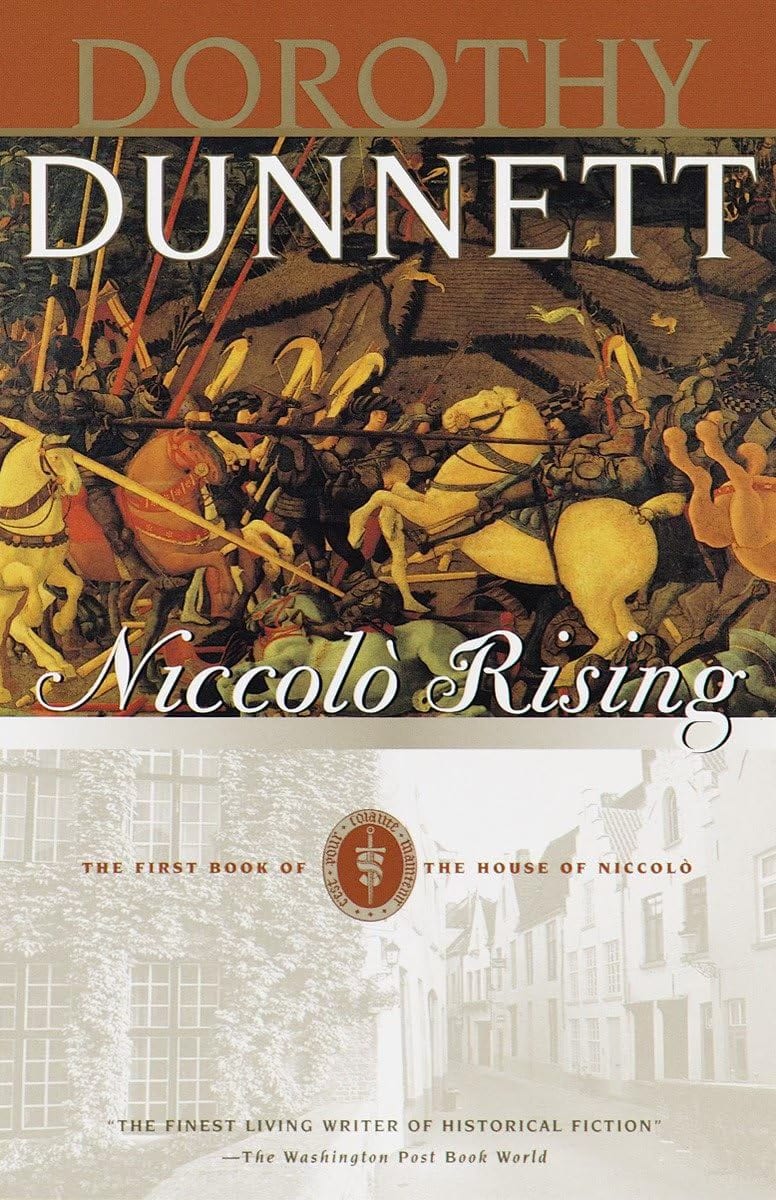
One of my favorite books this year- you know it’s good when you find extra time to listen to it via audiobook: I’m not usually an audiobook person!
I’ve been wanting to read Dorothy Dunnett for a long time. One of my other favorite historical fiction writers, Guy Gavriel Kay, wrote a poem about her work that I connected when I was a teenager, and I found the fourth book in the Niccolò series in a used bookstore in England in 2023 and had been meaning to start the series ever since.
Niccolò rising follows the most unlikely of heroes, the dyers apprentice Claes, on the first stages of his meteoric rise from artisan to prominent businessman. Claes (who eventually comes to be known as Niccolò or Nicholas) is a genius who initially uses his intelligence to perform outrageous pranks in his home city of Bruges, but after a few chance encounters with two Scottish noblemen who are out for his blood, he decides to change his ways and use his mind to make his way in the world.
Dunnett really makes Bruges, Milan, and Geneva feel alive, and the research that must have went into this book is immense in scale. Certainly puts Kay, and every other historical fiction author I’ve read to shame.
Claes’s relationships are the thing that made this book excellent, although the forced tensions between the noble and not so noble parts this nature was a little grating at times. There are some annoying parts of the book: one of Nicholas’s romantic relationships is clearly wish fulfillment on the part of the author, and some of his plots are way too complicated to be believable, but these are relatively minor quibbles.
4.5/5 Stars
The Nature of Training: Complexity Science Applied to Endurance Performance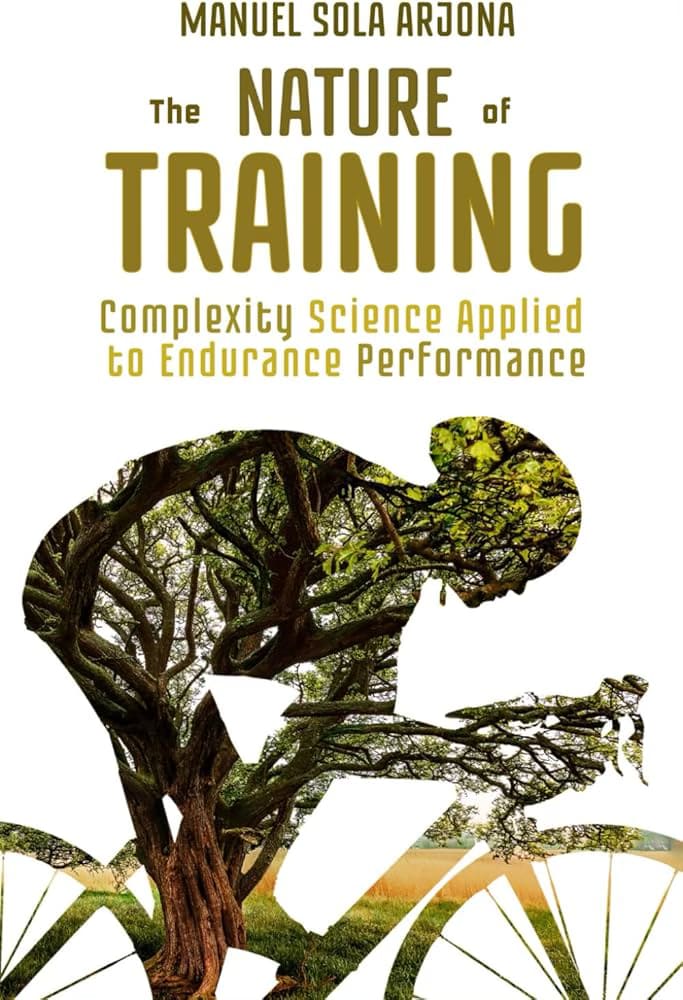
Read this one in Spanish (you can find my original review of it in Spanish on my Goodreads). I checked this out because I’m a fan of Manuel’s substack, and his philosophy of training in general.
The central theme of this work is that most training plans focus on the wrong things. You can train and train and train and not get results because training is a complex system (because our bodies are). A plan might be very good, but no plan survives contact with the enemy. We need to listen more to our bodies and less to statistics or other fixed metrics.
All of this makes a lot of sense. As Gordo Byrn and Alan Couzens and others have said, the specifics of a plan don’t matter much. The amount of training is important, but compared to the rest of an athlete’s life, training doesn’t take up that much time. If there’s a lot of stress in the rest of our lives, we’re not going to respond positively to any plan. Period. What’s important is reducing the amount of stress in our lives and increasing the amount of daily exercise we do.
However, there are three major problems with this book. The first is that half of it isn’t about training but about complexity science as a whole. I didn’t buy this to read a recap of Taleb with examples about the environment and global warming, as true as they may be. I get that there needed to be an introduction of this stuff for new readers, but it went too deep.
Second, I think Arjona has too rosy a view of our sensations as guides. For an experienced athlete, I completely agree; RPE (Rate of Perceived Exertion) or perceived effort is the most reliable indicator of what we should do. But for inexperienced athletes, external markers, like heart rate, can be very helpful in learning what is too much and what isn’t. Heart rate training helped me between my senior year of highschool and first year of college realize that I had been doing most of my easy days in the tempo zone.
Third, and what bothered me the most, is the focus on our evolutionary environment as a guideline for modern training. I have two problems with this. First, the goals of evolution and the goals of a professional athlete are very different. There’s not much point in using the former as a guide for the latter. Second, evolution (and this is something I see VERY commonly) doesn’t mean optimization. It means just enough to survive. Our diets and lifestyles weren’t optimized in the Stone Age. It’s possible to improve them (and also obviously make them worse), but we shouldn’t think of the hunter-gatherer lifestyle as something to emulate directly. That lifestyle can provide us with hints as to what might be the right direction to take, but direct emulation reads much more like a just-so story, and much less of a practice that is strongly supported by science.
3/5 Stars
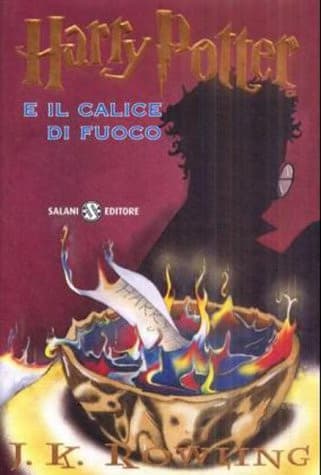
I’m starting to work on my Italian again, and Harry Potter is my favorite series to work with when doing so. I got through the first three books in Italian last year, but put my work with the language on pause until I could pass my B2 Spanish test.
Harry Potter is a great series for me for language learning. I’m a firm believer in Stephen Krashen’s input hypothesis: that is we learn language by understanding comprehensible messages. Since I know Harry Potter so well; up to a point in some situations where I can quote passages of dialogue verbatim with some prompting, it is much easier to understand its text in another language than it would be for another book. This effectively allows me to start reading much earlier than I would be able to otherwise, because if I can read the character names and understand some basic words, I can still follow the plot. even with only a sometimes ~20% understanding of the rest of the vocabulary.
The Italians, unlike the Spanish translators, changed around some of the names of the characters. Albus Dumbledore became Albus Silenti, Slytherin became Serpeverde and Professor Snape became Professor Piton. Apparently in earlier editions, there were even more character names changes, most of which are documented in the appendix. I liked this in general: it gave the books a little bit of a different flavor than reading them in English.
Goblet of Fire is the point in the series where the world of Harry Potter really starts to open up: we see other wizarding schools at the Triwizard tournament, learn much more about the wizard government, and Harry begins to deal with some pretty adult situations. Of course there are some problems with the book: the central plot is pretty unbelievable in hindsight and makes Voldemort look like an idiot, the foreign students are walking stereotypes of France and Eastern Europe, and the house-elf subplot never made anyone look good. However, that being said, this is still one of my very favorite books of all time, and I enjoyed being able to read it in Italian.
Pretty light month for me on the reading front, but November should be a bit stronger given I am shutting down training after 11/19!
I blog about language learning, biology, the science and art of learning, and many other things. If you feel inclined, please subscribe or consider buying me a coffee.
Josh
October 28, 2025
Isolation in Harry Potter and the Order of the Phoenix
I’ve been listening to Harry Potter and the Order of the Phoenix in Italian over the past few weeks. This was my favorite book as a kid, probably because the series ended here for me for a while on my nightly relistens1, as my Dad took a few years to get the audiobooks of Half-Blood Prince and Deathly Hallows out of the library to illegally burn onto iTunes. While many parts of the book don’t hold up very well: this book is the only one in the series where I skip chapters, on the current reread I was struck by the thematic tightness of Order. The political aspects are obviously more relevant than ever, especially with the current Trump presidency, although was funny to see the millennial left circa 2010-2020 act exactly like Umbridge when it came to cancel culture. There is also a very powerful sense of dread throughout the whole book: Voldemort is out there but no one has any idea what he’s doing, people are turning up in unexpected places with unexpected wounds at the Ministry, and the reformation of the Order of the Phoenix is a constant reminder of how much the last war cost on a human level. But the theme that has stood out most strongly on this read to me is social isolation, and how this can be overcome through deliberate community building.
 One of the opening shots of the film
When Order starts, Harry has been back at his aunt and uncle’s house in Little Whinging for nearly a month with practically no news from the Wizarding World. Unlike in his second year, he is still receiving letters from his friends, but they contain almost no content related to what is actually going on with Voldemort. David Yates captures this in one of the opening shots of the film of Order (shown above), depicting Harry alone a swing-set that is far too childish for him (more on this later), surround by a bleak chain link fence and dying vegetation.
Deus Ex Vita is a reader-supported publication. To receive new posts and support my work, consider becoming a free or paid subscriber.
Things get no better when Harry does manage to return to the Wizarding World. After an attack by dementors, he is nearly expelled from Hogwarts, a place that he views as his real home. While awaiting trial at the Headquarters of the Order of the Phoenix, a paramilitary group that opposes Voldemort and his own paramilitary group, Harry is also systematically excluded from the operations of the group by its adult members. When it comes time to return to school, things get even worse. Harry’s traditional mentor figures are either absent (Hagrid), or distant (McGonnagal, Dumbledore, Sirius). He is excluded from the traditional forms of social advancement when Ron and Hermione are made prefects and not him, kicked off his sports team, and his favorite subject (Defense Against the Dark Arts) is basically not taught at all. He is even isolated from his own peer group: the Wizard newspaper has been slandering Harry all summer, so upon his return to school, a lot of the individuals he thinks of as friends have turned against him.
In the movie this social isolation is depicted brilliantly in a scene where Harry is arguing with classmate and friend Seamus Finnegan.
As you can see from even the thumbnail, the scene is constructed such that Harry is alone facing Seamus and a bunch of other students who are positioned as to be taking his side physically, if not literally.
In the book there’s no such scene, but another similar moment that reinforces Harry’s isolation, even from his closest friends. When he’s getting on the train, Hermione and Ron have to go perform their prefect duties, leaving Harry alone.
“I know you’re not,” said Harry and he grinned. But as Hermione and Ron dragged their trunks, Crookshanks, and a caged Pigwidgeon off toward the engine end of the train, Harry felt an odd sense of loss. He had never traveled on the Hogwarts Express without Ron.
Of course this is not the first time that Harry has been at odds with his classmates and the rest of the school, but importantly it is the first time that this isolation has been so complete, and that his adult mentor figures are so thoroughly unreliable. Even Harry’s rosy view of his dad is shattered in this book when he sees him tormenting Snape in one of Snape’s memories.
This isolation is an important part of Harry’s maturation process. Harry is undergoing parts of two archetypal transitions during Order. The first is the transition between the child and orphan archetypes. This is a typical transition during early adolescence, in which the child gains intellectual independence from his/her parents (or parent figures) and becomes skeptical of the broader superstructure of society. This is very much a deconstructive stage and is not long-term stable, requiring a fairly rapid transition to the adult stage.
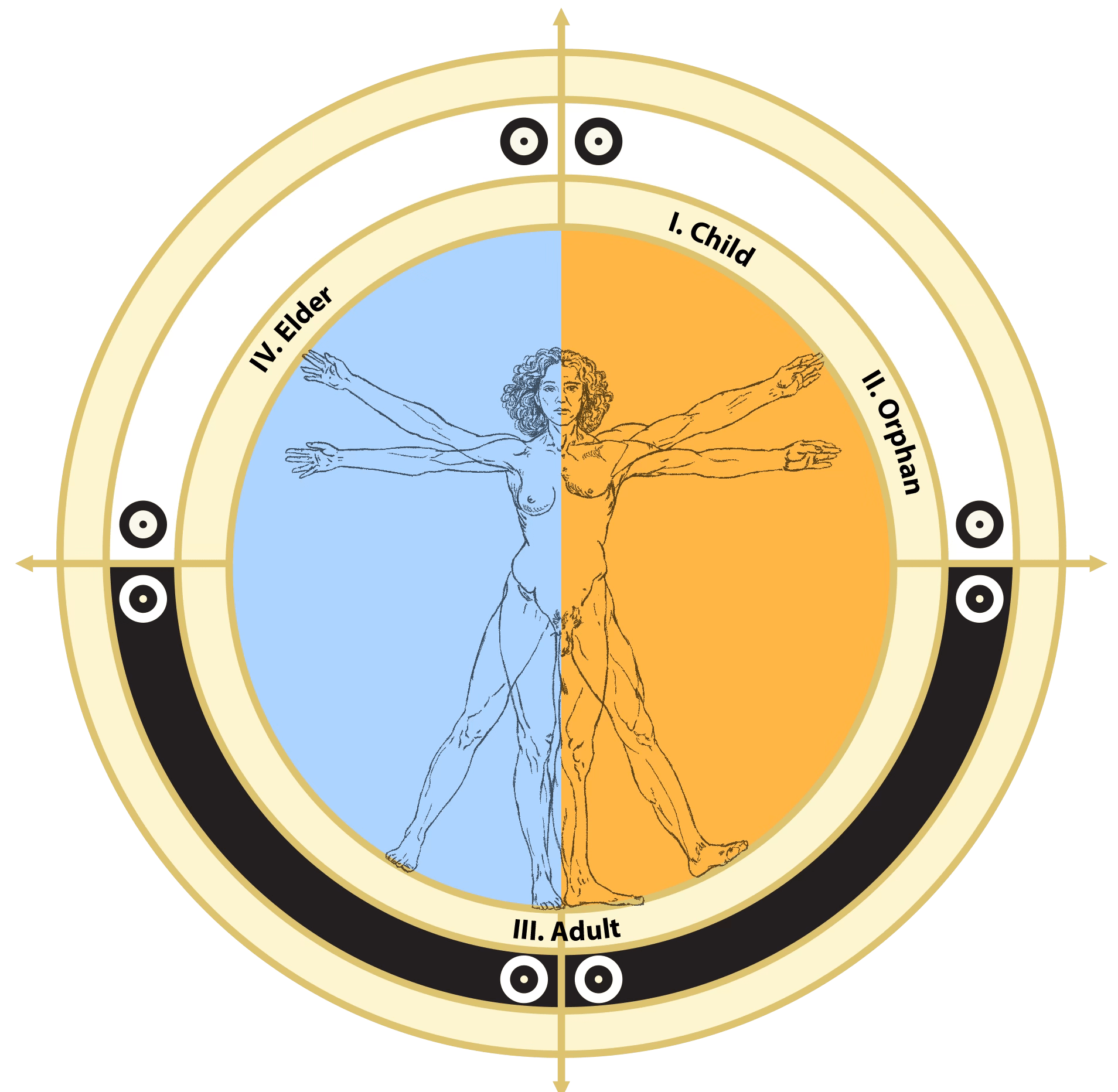 From Simon Sheridan
In Order, Harry is reaching the end of his child to orphan transition. This transition begun much earlier, perhaps in books 2 or 3, where things like the wizard government, justice system, and social system are brought into question. In Order, even trusted adults, like Dumbledore and Sirius are questioned, and institutions that Harry trusted in the past, such as Hogwarts have the rug pulled out from under them. The isolation that Harry feels is a natural result of this transition, and we all feel it to some extent in our normal, Voldemort-free, lives.
Of course, the orphan archetype must itself be overcome in order for the individual to become an adult. The main form this takes is an increase in agency, a power to actually enact change in the real world.
As he completes the child-orphan transition in this book, Harry begins his own orphan-adult transition, which he will not complete until the end of book 7. Social isolation is not a problem that he just accepts passively. Harry of Order of the Phoenix is a very angry teenager, and while a lot this anger is wildly misdirected, he does begin to use his agency to redirect it towards external change.
The most important of these acts of adult agency is the deliberate construction of community. Harry has been denied membership in not only “standard” communities, such as the quidditch team, his peer group at Hogwarts, and the wider wizarding world at large, but also in the “alternative” Order of the Phoenix2. While he does fight to gain acceptance in the wider Wizarding community throughout the book, doing an exclusive interview on Voldemort’s return for the magazine The Quibbler, most of Harry’s actions in this book center around building up his own alternative social groups out of people he actually likes and respects3, in forming his own paramilitary group, Dumbledore’s Army.
In the film Harry’s overcoming of his own social isolation is shown literally. At the climax of the film, in the Department of Mysteries Harry is shown surrounded by his friends.
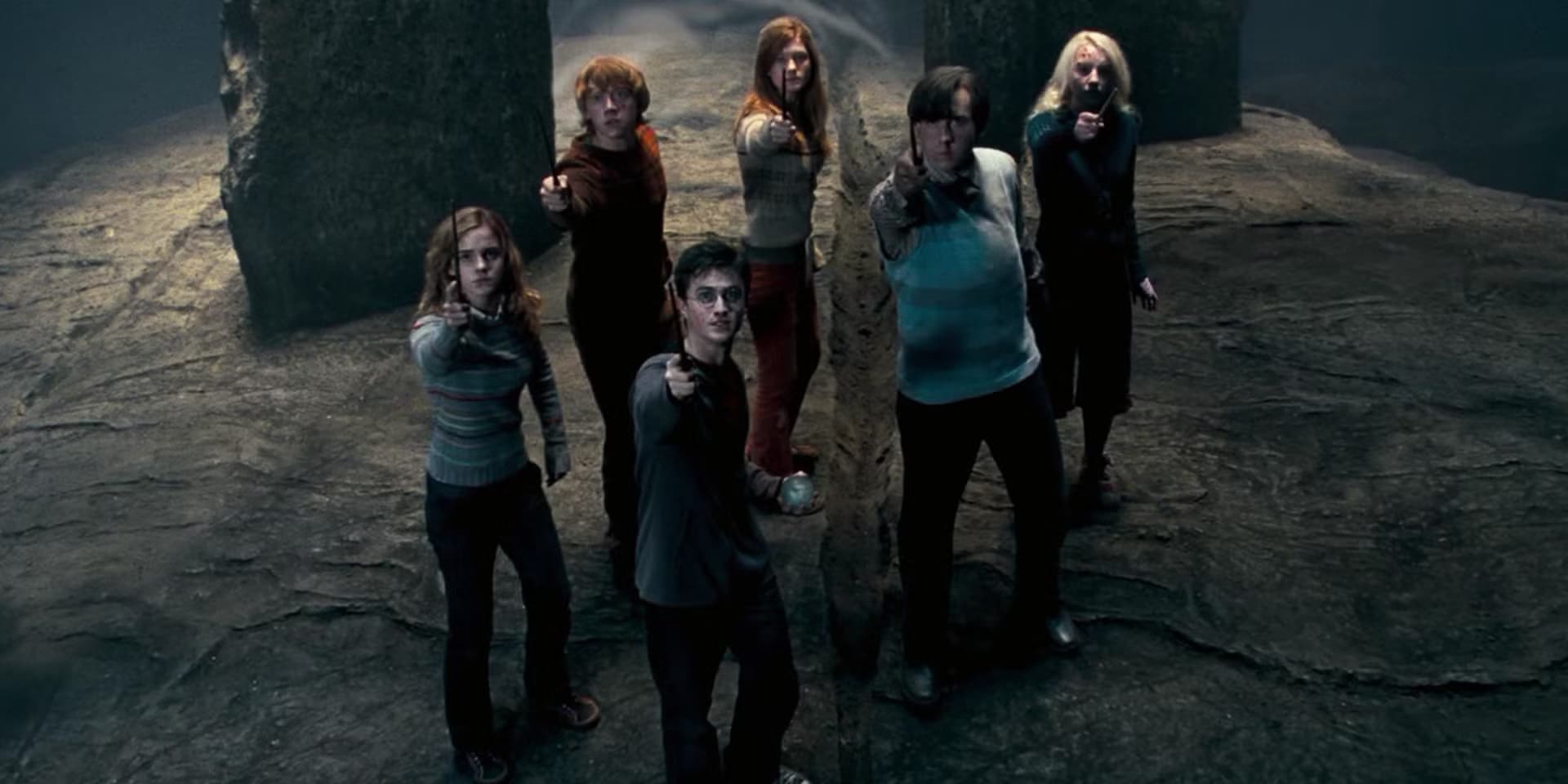
At the actual end of the film, Harry is also shown to be surrounded by the community he built.
In the book this transition is well highlighted by how Harry’s opinions of his friends shifts from the beginning of Order to the beginning of Half-Blood Prince.
She closed the door again, rather pink in the face, and departed. Harry slumped back in his seat and groaned. He would have liked Cho to discover him sitting with a group of very cool people laughing their heads off at a joke he had just told; he would not have chosen to be sitting with Neville and Loony Lovegood, clutching a toad and dripping in Stinksap. -OotP
“People expect you to have cooler friends than us,” said Luna, once again displaying her knack for embarrassing honesty.
“You are cool,” said Harry shortly. “None of them was at the Ministry. They didn’t fight with me.” -HBP
In an age of social atomization, where traditional and alternative community organizations have been corrupted or destroyed, the importance of deliberate community building to overcome isolation is more important than ever. It is essential for each one of us to build and participate in our own organic, grass-roots communities. One friend in Baltimore who is doing a really good job of this is, Alex Zhu 4, and if you’re interested in this kind of thing, I would really recommend checking his Substack out.
See you next time for a recap of the first meeting of Fantasy Book Club.
I blog about language learning, biology, the science and art of learning, and many other things. If you feel inclined, please subscribe or consider buying me a coffee.
Josh
1Perhaps an embarrassing fact about me: I listened to Harry Potter almost every single night from the ages of 8 to 18. I probably got through the series about once a year. This has given me almost no material advantages in my life, other than providing a very convenient series that I can use to supercharge my language learning.
2It’s interesting that Harry never actually joins the order, despite being old enough in Deathly Hallows.
3Rather than who others tell him he should like.
4Although I personally think he overstretches himself
October 19, 2025
Refold Approach to Language Learning: Spanish 2000-Hour Update
 Photo by David Vives on Unsplash
This is my eighteenth update for my Spanish learning journey with the Refold approach. Articles, as at Medium, will always be free, but there is an option to be a paid subscriber.
For my first update, see here.
For my second update, see here.
For my third update, see here.
For my fourth update, see here.
For my fifth update, see here.
For my sixth update, see here.
For my seventh update, see here.
For my eighth update, see here.
For my ninth update, see here.
For my tenth update, see here.
For my eleventh update, see here
For my twelfth update, see here
For my thirteenth update, see here
For my fourteenth update, see here
For my fifteenth update, see here
For my sixteenth update, see here
For my seventeenth update, see here
For more information about the Refold approach, see here. For a basic Spanish Anki vocabulary deck, see here.
General ProgressReached 2000 hours of immersion. Passed the B2 test. Continued reading a lot: ranked up another 500k words over the last few months. Started doing weekly deliberate writing practice, and moved my dating app location to Santiago, Chile.
I got my B2 results back in late August, and absolutely crushed the test, especially my speaking section, which I was surprised by. More of on each section in the relevant part.
Since the last update I’ve largely shifted to consuming Italian content (expect an update as soon as I’ve finished the Harry Potter series, around 200 hours). Spanish has thus been limited to my weekly lessons, about ~100 page of weekly reading, and conversations with natives on HelloTalk and Bumble (haha).
My lowest scores on the B2 test were in the writing and listening sections. In order to move those forward I need to watch more TV/listen to podcasts, which I have a lot of resistance to, and practice writing, which I also have a lot of resistance to. To try and combat these things, I’ve attempted to make both activities more social: using Bumble and HelloTalk to exchange voice memos with native speakers in other Spanish speaking countries.
I’m also going to Madrid in December for a week! If you’d like to meet up, shoot me a message. Trying to avoid using English at all during my trip, which I hope should catapult my fluency to a much higher level.
I haven’t done any of the grammar book since the last update. I hope to start up again soon as I plan to take the C1 test in May of next year again.
I’m still thinking about trying to implement a digital detox more than ever, as my tech use habits are completely out of control, and some kind of rules would really help to rein it in. Right now I’m working on my evenings: trying to turn off all electronics by 8pm if I’m not going out. Then I’ll be working on my mornings: no electronics before 8am except to arrange runs. After that I’ll deal with the challenging task of reducing my tech dependency during the day.
Overall, Spanish is going extremely well. Although I haven’t put in many consistent immersion hours over the last few months, that is more because I’m feeling content with my level and wanting to focus on Italian.
Open questions: What place do digital technologies have in your life? How did you go about transitioning a language from learning to maintenance mode?
DELE Exam
I took the test in May ago in Washington D.C. through the Isabella and Ferdinand Language Academy. The written portion of the test was at an elementary school in western D.C. (which was a really fun e-bike to get to from where I was staying near Penn station: huge win for bike infrastructure in the city), and the oral portion was at an Armenian church a few miles away. The test started early on Saturday morning, and took about half the day. In the written portion there were three sections: reading, listening, and writing, each taking about 80 minutes. To pass, I needed to get a 60% on the reading and writing combined, and a 60% on the listening and oral combined.
My scores in the different categories did not match my initial impressions that I wrote about last time. Writing was by far my lowest score, because I’ve hardly practiced writing at all, let alone writing without a spell check. Although I felt I did well, I probably made numerous spelling grammatical errors that I wouldn’t have even recognized. Something to work on next time. Reading and listening went about how I expected, but speaking went phenomenally! My nearly 200 hours of lessons are paying off.
Next up for me on the testing front is probably a C1 test in May.
Reading What I’m reading right now
I haven’t been consuming a ton of Spanish media in the past few months, but I did still manage to read four books. I’m no longer really emphasizing Spanish books in my daily life, but I always have 1-2 at various stages of completion that I try and pick up a few times a week.
Most of my reading time during this update was made up of the chunky (and quite mid) El camino de los reyes. Despite its length, I certainly considered this an easy book. Joining it in the easy category was Persona normal by Benito Taibo. We read this in Refold book club and unfortunately all of us found it to be quite bad (smarmy and fake were my big two criticisms.
I also read a collection of short stories by Guadalupe Nettle (El matrimonio de los peces rojos) which I highly recommend. Each story draws a parallels between how we treat specific animals and how that is often a reflection of other problems in our lives. The final book in this update was a book on exercise training and physiology, La naturaleza del entrenamiento by Manuel Arjuna. Although a little bit overwritten, the message of this book was something at a lot of age-group athletes need to hear: training is heavily overcomplicated and it’s really not that deep, you just gotta put in the time bro. Both of these books I’d place in the medium category.
I still have a lot of work to do with reading, I nopped out of another refold book club that was going to tackle La ciudad y los perros by Vargas Llosa because the book was too hard. However, I’m feeling like these gains will come naturally with time as I stack up the hours.
I’ve started collecting all the books I’ve read that were originally written in Spanish and sorting them into these three categories on another page of my blog. This desperately needs an update
Total immersion time: 1094 hours, approximately 10 million words (thanks Sanderson), 75 books originally written in Spanish, 109 books in Spanish total.
Monthly word totals: June: 158k, July: 0k, August: 75k, September: 325k, October: 95k (so far).
Future plans: Just keep chugging
Open Questions: Recommendations for nonfiction originally in Spanish?
Sentence MiningI’m up to 2981 cards now with a 84.61% lifetime mature retention rate, but a higher 95.6% (!!!) rate in the past month. This is a crazy improvement from the last update, and is almost certainly due to the changes implemented in the FSRS algorithm that are supposed to guarantee a retention rate over 90%.
I’ve also started using a plug-in for Anki that allows me to study ahead for the next few days reviews. This is a nice way for me to be able to do more Anki when I’m motivated, and take some of the pressure off days that I’m not feeling particularly motivated.
I’d still like to get to 10k total Spanish cards, but this will probably take another ten years. In any case, I like doing Anki, so I don’t see slowly chipping away at this goal being too much of a problem. The low number of new cards represent the relatively small amount of sentence mining I have been doing recently.
Open Questions: None
WritingWriting was my lowest score on the DELE, so I am doing some deliberate weekly practice to try and improve. These consists of a series of essay prompts given to me by my tutor Mailen that center around responding to the “Temas de nuestro tiempo”. The first one I’ve done so far was about artificial intelligence in higher education. I’m continuing to do book reviews as well.
In addition to these longer writing prompts I’ve also been communicating with native speakers via Bumble (lol). American dating expectations are so insane that I’ve changed my location to Santiago, Chile in the hopes of meeting a long-term language partner. So far it has been a success! I hope to visit Chile after I graduate from Hopkins and meet some of these people in person!
Output time: 12 hr tracked, including DELE, with 9k words written
Open Questions: Anyone want to be pen pals?
ListeningI didn’t to much listening between this update and last: only 22 hours total. Most of this listening was relistening to The Magicians in Spanish, but I also did some reality TV and movie watching. I just canceled my Netflix subscription again (I really don’t use the service) and Rvte.es is requiring a Spanish postal address, so I don’t know how much TV and movie watching I’m going to be doing in the future. Listening is an important skill that I need to work on, but I think audiobooks and podcasts might be the way to go for me. I just can’t seem to make myself watch TV, as much as it is good for my Spanish.
Total Immersion time: 717 hours, 2 million words from audiobooks.
Monthly Hours: July:1.4 hours, August:2 hours, September:18.6 hours
Future Plans: Podcasts
Open Questions: Film recommendations? RomComs?
SpeakingI’m continuing to take regular lessons on iTalki. After reading, this was my biggest source of immersion, with around 23 hours of lessons since the last update. I have at least one lesson every single week, but I aim for two more often than not.
Each of my two main teachers have taken on slightly different roles. With Rafa, I end up having pretty deep conversations about philosophy and current events, which really helps to move vocabulary I have from passive immersion into the active part of my brain. Rafa and I will also spend 5-10 minutes on grammar corrections at the end of class, which has been paying gradual dividends. Rafa is the teacher who I have the most lessons with (biweekly), and I’ve come to look forward to them as one of the highlights of my week.
When I don’t have a lesson with Rafa, I have one with Mailén. We are alternating between reading literature (short stories) and going over my writing practice in preparation for the C1 exam. As I get closer to the exam date, I will be shifting towards more exam prep.
I’d like to try out some other tutors on iTalki soon, but I think this will have to wait until work calms down a little.
I also found a Spanish happy hour group that meets on Thursdays at Ministry of Brewing in Baltimore. This has been a consistent source of immersion for me and is about 1/3 native speakers. With non-natives in this group I seem to find myself in much more of a teaching/corrective role, which makes me feel good about my ability, but also frustrated about the lack of work other people seem to be willing to put in to improve1. I’m hoping this group will connect me to other local Spanish speakers and help me make more Spanish-speaking friends. I unfortunately have a project management class this semester starting this Thursday, so I won’t be able to attend Spanish Happy Hour until 2026!
Output time: 196 hours
Explicit GrammarDoing explicit grammar practice has been somewhat of a revelation for me about the potential flaws in the Refold methodology. To make a long story short, explicit grammar has been really really helpful for me both in outputting and in more explicitly understanding some of the remaining sticking points I have with reading.
I’ve mainly been using some exercise books, which were highly recommended by a trusted Goodreads user (Roy Lotz). These books cover everything, from gender to common prepositions to the subjunctive, and I’ve been jumping around the book trying to spread out my learning on different topics. I’ve done about half of the book so far, which probably represents about 20 hours of explicit study. After I’m done, I’m planning on going through the book and Ankifying any issues I might have, before starting on the C2 book.
Future PlansI’ve hit 2k hours of Spanish finally! In some ways it feels like the explicit part of my journey has ended: of course there are still things to learn and study, but Spanish feels like less something I deliberately do, and more of just part of my life. I still have relatively concrete goals related to the language: pass the C1 and C2 tests, and read some of the great classics of the Castilian language (Juan Rolfo, Almudena Grandes, Cervantes, etc.) but these seem to me things that will come with time, rather than goals I have to strive for. On to Italian.
Other LanguagesUnfortunately the Italian class at Hopkins was during my lab meeting every Tuesday, so I couldn’t take it this semester. However, in the spirit of one of my other recent blog posts, Italian has reared its head anyway. I’m currently doing about 60 minutes a day of Italian, most of it reading and listening to audiobooks with a little bit of grammar. Progress has been really rapid, and I’m hoping to start outputting around 500 hours of immersion. Look out for an update on this soon.
HealthStill having some sleep issues, but I think they mainly stem from poor sleep hygiene (i.e. phone in bed, no wind-down). I’m working on becoming a more mellow person, and it seems to be paying dividends, albeit slowly!
Overall ImpressionsReally happy with my test results and with my progress. Hoping to maintain and use Spanish a tool for connection as I build up my Italian in the years ahead!
Open Questions: When were you “done” with a language? How do you go about maintaining a language when you started an L3?
Full immersion link data link.
I blog about language learning, biology, the science and art of learning, and many other things. If you feel inclined, please subscribe or consider buying me a coffee.
Josh
1You do not get good at Spanish by outputting once a week. The amount of people at this group who’ve never read a book in Spanish (or even tried) continues to amaze me. That being said, everyone has different reasons for doing things and “getting good” may not actually be that high on other people’s list.
October 6, 2025
Announcing Fantasy Fiction Book Club

A lot of our relationships on the internet are, largely for worse, parasocial. We read blogs, watch YouTube videos, listen to music, and “connect” with people that we’ve never met before and don’t really know. We form one-sided relationships that allow us to continue living in a fantasy world of late childhood and early adolescence. We inundate ourselves with information and numb ourselves to the natural world. This can’t be healthy, but I also think it can’t be the only way to use the internet.
A not-so-recent post by one of my favorite bloggers Deep Left Analysis, as well as the ever present efforts of my Baltimore friend Alexander Zhu has led me to reconsider how I can better use this blog to harness the internet to create connection and community. I started writing in 2021 mainly to force myself to write more, and to try to capture my own search for the divine through life itself. I initially thought that I would explore this through the lens of biology, and perhaps still will, but over the years this has become much of a blog about literature and philosophy. Indeed, through the mechanistic way that biology research is currently done, I’m not sure that blogging about natural selection and metabolism would really help anyone on their spiritual journey. The amount of people reading my work has continued to grow as I’ve continued to write, but it doesn’t yet feel very much like a community. Aside from friends and a few individuals I’ve talked to one-on-one, you all are strangers to me.
To that end I’d like to start a monthly fantasy fiction book club that I run through this blog, meeting the first Sunday evening of every month at 7 pm EST.
Why monthly?
People, including myself are busy, and it can be difficult to find time for yet another weekly meeting. Plus a month is more than enough time to get through a book (or two possibly).
Why fantasy?
Humans have never lived in such a spiritually dead era as the West in the early 21st century. I, like Kimberly Steele, think that we have profoundly cut ourselves off from the greater spiritual forces at work in this world, which is at the root of most of the cultural malaise, anxiety, depression, and scores of other psychological afflictions we seem to suffer as a society. The solution to this is not to delve deeper into materialism, but to reengage with the subconscious, to school ourselves in the language of the night. Ursula K. Le Guin says it far better than I ever could
We read books to find out who we are. What other people, real or imaginary, do and think and feel – or have done and thought and felt; or might do and think and feel – is an essential guide to our understanding of what we ourselves are and may become… A person who had never listened to nor read a tale or myth or parable or story, would remain ignorant of his own emotional and spiritual heights and depths, would not know quite fully what it is to be human. For the story – from Rumpelstiltskin to War and Peace – is one of the basic tools invented by the mind of man, for the purpose of gaining understanding. There have been great societies that did not use the wheel, but there have been no societies that did not tell stories.
Why a book club?
This blog has slowly and surely morphed into a blog about books. Plus reading is something that everyone can do, given especially that the initial books that I will be suggesting will be fairly short.
What will the format of these meetings be?
I envision the meetings going for about 75 minutes. We will spent 15 minutes on chit-chat, and an hour discussing the text. I will have a hard cutoff at 9:00pm EST, which gives us 45 minutes to run over if discussion is particularly good.
Each month we will read a single fantasy fiction work. I will also suggest a supplemental work (usually non-fiction) that will help to highlight the themes of that work. I would ask that everyone who would like to attend read at least the entire fiction book, and come prepared with a short paragraph explicating a particularly relevant theme they found while reading. The first three months of readings are below.
Sunday Nov 2: A Wizard of Earthsea by Ursula K. Le Guin. Supplement: The Language of the Night by Ursula K. Le Guin.
Sunday Dec 7: The Magicians by Lev Grossman. Supplement: Industrial Society and its Future by Ted K.
Sunday Jan 4: The Blade Itself by Joe Abercrombie. Supplement: The Prince by Niccoló Machiavelli.
After the meeting I will write up a blog post summarizing the discussion and my own thoughts on the book in question. This is an opportunity for people who did not attend the meeting to join in on the discussion. The first 2-3 of these posts will be open to all subscribers, but eventually I plan to transition these to my only paid content.
How do I join?
Send me a DM on substack, an email (deusexvita@gmail.com), or text me and I will add you to the WhatsApp group.
See you November 2, I hope!
I blog about language learning, biology, the science and art of learning, and many other things. If you feel inclined, please subscribe or consider buying me a coffee.
Josh
September 30, 2025
September 2025 Book round-up
Since many of you do not follow me on Goodreads, I thought I would share the books I read this month, and what I thought of them! More below
Searching for Caleb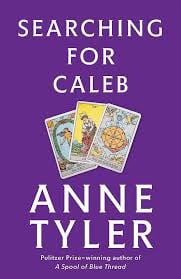
I picked this book up at the ‘Book Thing’ for free because the girl I was dating at the time recommended I read some Anne Tyler due to the fact that she sets her books in Baltimore, and I had said earlier I was starving for some fiction were set in this city in which I live that has such a negative reputation in fiction. Partially because I stopped seeing that girl, partially because this book is not my usual cup of tea, it took me nearly three months to finish this book. Searching for Caleb is a very slow book in which not much explicit plot really happens, but rather the family relations between the dysfunctional Pecks are explored in-depth. The plot which does happen is centered on the search for the eldest Peck’s younger brother Caleb, who ran away from Baltimore nearly fifty years ago, and the chaotic marriage of Justine and Duncan, who are cousins and both Pecks.
I got what I wanted out of the book: an exploration of the Roland Park/JHU neighborhood of Baltimore as it was 50 years ago. In terms of theme, I got a bit more than I had hoped for as well. The advantage of Slice of Life is that we get to spend a lot of time with characters doing fairly normal things, without earth-shattering events that would tell us unrealistic things about their character. Much of the dsyfunction in the Peck family seems to stem from an inability to healthily grapple with change, but rather to run away at the first sign of difficulty. We see this quite literally in the character of Duncan, who can’t seem to stay put, causing his wife and daughter quite a bit of suffering. But the other Pecks suffer from this as well, the titular Caleb, but also the family as a whole, who by the novel’s end, seem to have retreated from the world, rather than confront the fact that they don’t live in the Belle Epoque anymore.
Not sure if I will be reading more Anne Tyler but this was worth a read.
4/5 Stars
Embattled Rebel: Jefferson Davis as Commander in Chief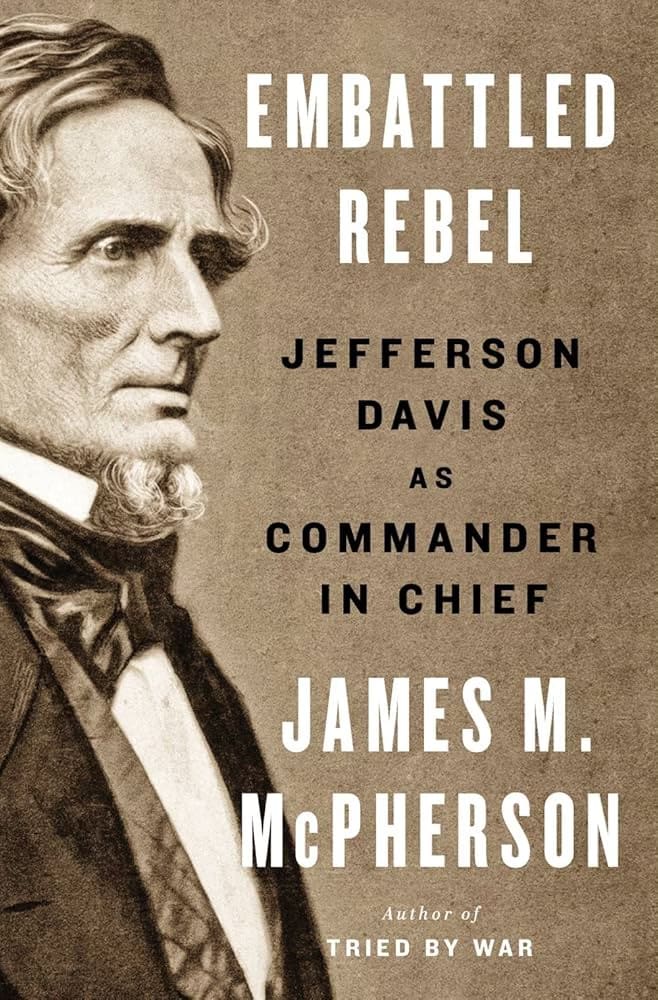
I picked this up because it was staring me in the face every time I went to the library, and James McPherson, of Battle Cry of Freedom fame, is one of my favorite historians. Honestly, you can skip this book. Just read Battle Cry of Freedom. This was a very time-skippy rehash of the Civil War from the perspective of the Davis Administration, with some analysis of Davis’ strategy and tactics. Compared to Battle Cry of Freedom, which was a much more thorough book, this book felt a little rushed and slap-dash, although it did give me a little more insight into Davis’ relationship with his generals, namely Lee and Joe Johnston.
McPherson tries to be kind to Davis, and in some ways my opinion of him changed quite a bit as a result of this book. Davis, who I had thought was quite prideful, actually took a bunch of Ls, especially with regards to the extreme defensive mindedness of Joe Johnston. However, his West Point nepotism, combined with an unclear idea of grand strategy doomed his tenure as commander-in-chief. Contrast this to Lincoln, who gradually got rid of the the incompetent generals in the Army, and who had a very clear idea of the Grand Strategy necessary to win the war, and it’s pretty clear who comes out on top.
3/5 stars
El Camino de Los Reyes (The Way of Kings)I review this book more in-depth above, but in short, it was overwritten and poorly done, if quite readable and entertaining.
1.5/5 stars
Groundwork of the Metaphysics of Morals
Read this for philosophy book club in September/August of 2025.
I had been thinking about Kant to some degree or another since 2019 because one of my college teammates and friends, Matt Kearney, was really into his philosophy. I watched a couple YouTube videos on him at the time (one about Kingdom of Heaven, which I still remember), and remember loving the idea of the categorical imperative, but not understanding the motivation behind it.
Reading this for philosophy book club helped to clarify the motivation for why Kant formulated the categorical imperative in the first place. Kant’s whole philosophy is really about moral freedom. This is not really freedom in the colloquial sense, because the categorical imperative is pretty restrictive, but freedom from particular life circumstances that may bias or impede your moral judgement. In order to be a truly moral law, according to Kant, a law has to be universal, which means it cannot be affected by interest that may come from particular circumstances.
I can’t say I really understood the whole chain of reasoning clearly (hoping for some enlightenment from Amanda), but I find this philosophy admirable in certain sense, but very foolish in another. It’s pretty impossible to live like Kant would want us to: reason is not the pure and unbiased master that Kant seems to think it is, and I also unfortunately think that a lot of morality is extremely contingent, and would be difficult to writer a moral law describing (a very Buddhist idea perhaps).
4/5 stars
Vera, or Faith
This was a Logan rec. Short, a very digestible, I read it in about 2 days. Vera follows Vera, who is a 10 year old half-Jewish, half-Korean American being raised by her Russian/Jewish Dad and WASP stepmom (who she refers to as Anne mom to distinguish her from her “real” mom) in Manhattan. For a ten year-old, Vera is extremely smart and observant, but because she is still a child socially and in terms of her understanding of the world, we get a very unique and hilarious perspective on current American issues of immigration, wealth, and education in a world very similar to our own but turned up to 11. Highly recommend, and will definitely be reading more of Shteyngart.
5/5 stars
Los Magos (The Magicians)
This is one of my favorite books ever, and it was time for a reread (or I suppose a relisten, in Spanish).
The Magicians follows Quentin Coldwater, a very depressed and very privileged teenager who gets the equivalent of a Hogwarts letter when he goes for his Princeton interview. However, unlike Hogwarts, where Harry and Ron spend pretty much the entire series goofing off, and somehow are nearly as competent as bookworm Hermione, Quentin has to grind to get good at magic, and very soon is sinking back into old habits. In Grossman’s world magic is not an escape from mundane problems, but an amplifier of them. The Magicians is a story about trying and failing to use magic to escape from yourself and your own existential meaninglessness. Yes the main character is an asshole, but assholary is merely a crutch, like magic, for him to avoid addressing the very real underlying causes of his unhappiness.
I could talk for hours about The Magicians and despite not enjoying it much the first time, it has really grown on me on a subsequent rereads.
5/5 stars
Tehanu
You seemed, in your power, as free as man can be. But at what cost? What made you free? And I... I was made, moulded like clay, by the will of the women serving the Old Powers, or serving the men who made all services and ways and places, I no longer know which. Then I went free, with you, for a moment, and with Ogion. But it was not my freedom. Only it gave me a choice; and I chose. I chose to mould myself like clay to the use of a farm and a farmer and our children. I made myself a vessel. I know its shape. But not the clay. Life danced me. I know the dances. But I don’t know who the dancer is.
This was a bit different from the other Earthsea books, although I can see an affinity between this novel and the Tombs of Atuan. If The Farthest Shore was the transition between adulthood and old age for the youthful Ged of The Wizard of Earthsea, Tehanu is about that same transition for Tenar, the protagonist of Atuan. This was a book about motherhood, but not necessarily the motherhood of self-sacrifice that is so often presented in modern literature, those years of rice and salt, as Kim Stanley Robinson might stay. This is a book about the part of motherhood where when one has to let go of one’s children, and allow them to be their own independent people. The question for Tenar, and also for Ged, in this book is how one finds meaning in life after this emptying out.
I’m very glad that there’s a few more books in this series, as Tehanu brought up almost as many questions as it answered. I also really need to read “The Language of the Night”, Le Guin’s book of essays on fantasy, which I think will help clarify some of the more mythic aspects of this book.
4/5 stars
I blog about language learning, biology, the science and art of learning, and many other things. If you feel inclined, please subscribe or consider buying me a coffee.
Josh
September 23, 2025
Review #4 of 2025: The Way of Kings by Brandon Sanderson

One of my 2025 reading goals was to read more “normie” books, which basically entailed reading more books that my non-online friends recommended to me. The Way of Kings by Brandon Sanderson, the first book in the Stormlight Archives series had to be one of the most frequent recommendations I have received, especially from my college friends. A couple of my other Baltimore friends were embarking on a read of this book too, so I decided I would give it a shot this past summer, reading in Spanish as I usually do with easier fiction1.
To cut to the chase, I really didn’t like this book, although strangely also enjoyed my time reading it. The book was extremely bloated: it’s longer than all of Lord of the Rings and contains far less plot, has juvenile, unbelievable worldbuilding, and has so little character development and growth that I’m beginning to doubt the tastes of my many friends who recommended the book to me. That said, The Way of Kings is extremely readable, and if you just want to turn your brain off and read some Lit RPG, MCU-like adventure pulp, this book is the perfect thing for you.
Deus Ex Vita is a reader-supported publication. To receive new posts and support my work, consider becoming a free or paid subscriber.
Short plot summary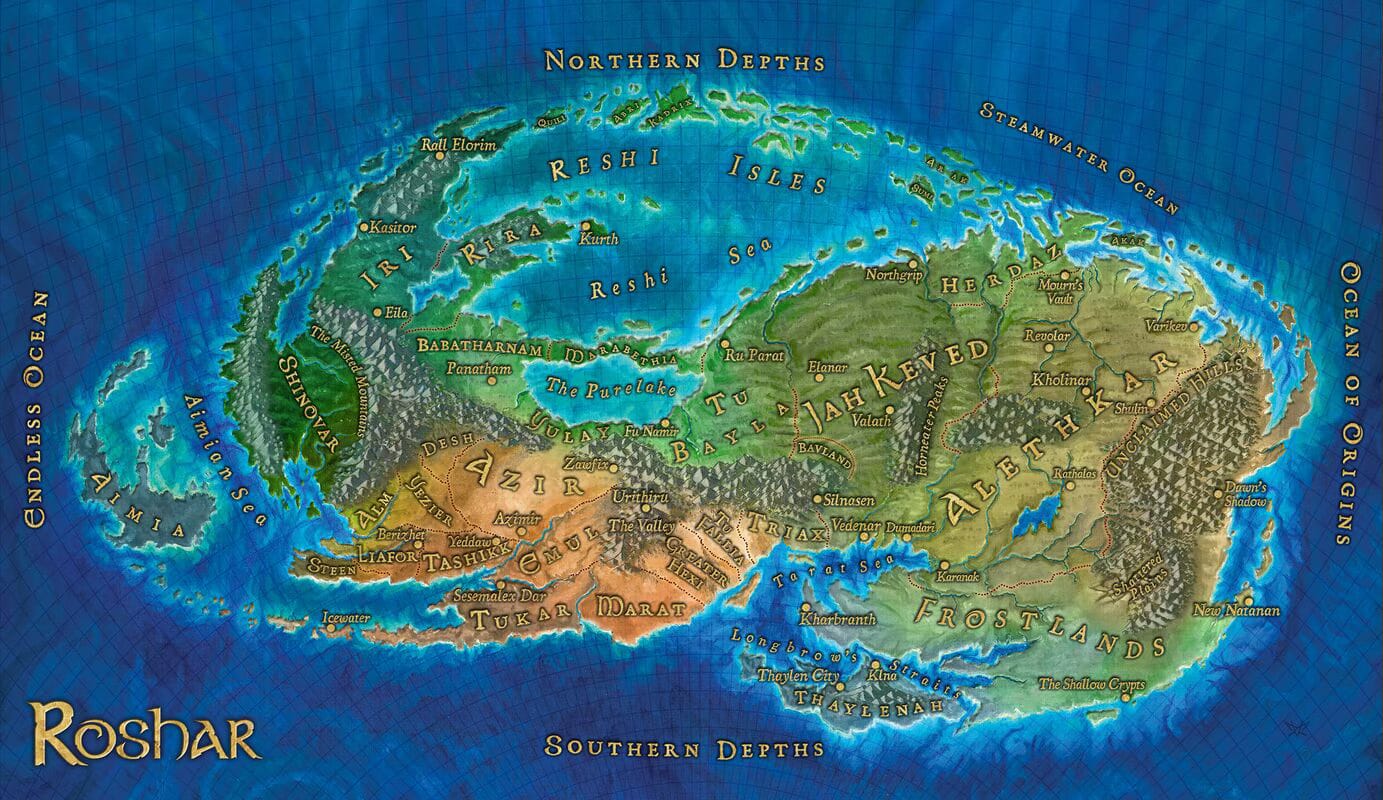
The Way of Kings takes place on the alien world of Roshar, which is known for its extremely strong and powerful storms. These storms infuse precious stones with “stormlight” which can then be used to power machines (soulcasters) or perform magic. Despite the beautiful map depicting this world, we only get to see a tiny portion of it in the first book: The Shattered Plains which are in the southeast corner of the above map.
The plot of the book centers on three different characters: Kaladin, who is a depressed slave, forced to carry assault bridges for a war that is being fought on the Shattered Plains, Dalinar Kholin, a noble who is in charge, at least in part of conducting said war, and Shallan, a want-to-be scholar trying to study under Dalinar’s niece, who also has to attempt a heist of a soulcaster.
The plot is a bit hard to describe beyond that without getting into spoiler territory, which is a big part of the problem with this book: a lack of direction and bloat.
Bloat
The Way of Kings is 383,389 words. All of The Lord of the Rings, including supplemental material like the appendices of The Return of the King, is approximately 550k words. So for more than 2/3 of the length of that entire series, we basically get a book that serves as a long prologue to the Stormlight Archive, with maybe some serious action in the last 80k words. This is not uncommon in epic fantasy series: the first entry in the First Law Trilogy, The Blade Itself, serves a similar role, as does the first Wheel of Time book, and arguably The Blood of Elves in the Witcher series. But none of these are as long as The Way of Kings, as weak stylistically, or as devoid of momentum for the rest of the series.
The bloat present in The Way of Kings is present on multiple levels. The most egregious is on the sentence/paragraph level, where Sanderson literally repeats himself. Some examples below:
“He started pulling again. Bridgemen who were laggard in work were whipped, and bridgemen who were laggard on runs were executed. The army was very serious about that. Refuse to charge the Parshendi, try to lag behind the other bridges, and you’d be beheaded. They reserved that fate for that specific crime, in fact.”
The Parshendi usually fled when they suffered heavy losses. It was one of the things that made the war drag on so long. “It could mean a turning point in the war,” Sadeas said, his eyes blazing. “My scribes estimate they will have no more than 20 or 30,000 troops left. The Parshendi will send 10,000 there—they always do. But if we could round them up and kill them all, we would nearly destroy their ability to wage war on these Plains.” “It will work, Father,” Adolin said eagerly. “That could be what we’ve been waiting for—what you’ve been waiting for. A way to turn the tide of the war, a way to cause so much damage to the Parshendi that they can’t afford to fight on!”
"Sadeas's hand had gone to his sword. Not a Shardblade, for Sadeas didn't have one."
"The highprince hated that Adolin had a blade while Sadeas had none"
I don’t know what Sanderson’s editor was doing, but cutting this kind of dialogue could have shaved off nearly 10% of the book at least.
Then there’s repetition on a larger scale. The book is filled with nearly identical scenes in which not much happens. Dalinar assaults mesa after mesa with only minor variation that moves the plot forward at a snails pace. Shallan has lunch and reads books. Kalinar has countless training sessions with his bridge crew that blend together in my mind. Contrast this to chapters in a book like Game of Thrones. This is what happens in the eighth Tyrion chapter in that book
Tyrion and his clansmen are assigned to the vanguard under the command of Ser Gregor Clegane. Returning to his tent, Tyrion is greeted by a whore named Shae, whom Bronn has found for him. Before dawn, Tyrion is roused by the call to arms. In the ensuing battle on the Green Fork, Tyrion and his clansmen do well and the enemy is routed. Afterward Lord Tywin Lannister learns that Robb Stark has tricked him. (AWOIAF wiki).
There are at least four plot beats in this chapter. Contrast this to a typical Kaladin chapter in The Way of Kings:
Kaladin tells Leyten to make carapace armor for every member of Bridge Four except for Shen. Kaladin observes spear practice and notices that Moash is very skilled. He asks about his purpose, and Moash replies that he wants vengeance, but declines to say on whom. Kaladin and Rock discuss their plans to escape. Teft asks Kaladin to teach the bridgemen but he declines, saying that he would become too eager and impatient, and Kaladin admits that he failed in the past and that it got to him. (Coppermind.net)
There is one thing that really happens in this chapter, and it doesn’t really move the plot forward at all.
I estimate at least 50% of the scenes could be cut in this book with nothing being lost.
Bogus world building Kharbranth, the city of bells
In a certain sense, the worldbuilding of Sanderson is very effective. He’s very good at constructing impressive vistas, like the city of Kharbranth as shown above, which is built into the side of a mountain, or the Shattered Plains as a whole. Things like shard blades and the quasi-superheroes who wield them are also “cool” upon first glance. But the moment you look behind any of these shock and awe spectacles, it turns out there’s almost nothing there. Sanderson’s world building in this book feels incredibly arbitrary and poorly thought out.
Take the central feature of Roshar: it’s extremely powerful storms. We get some sense of how this affects everyday life on Roshar: the city of Kharbranth for example has grown to prominence because of its extremely sheltered location that protects it from the most damaging effects of said storms. Yet the strength of these storms is conveniently forgotten when it’s not important to the plot. Big armies are camped out in the open on the Shattered Plains: how are the damages from these storms not bigger, especially among the merchants/prostitutes/camp followers who aren’t officially part of the army. And this is not to mention how little of an understanding we have of how the agricultural system works when these storms are such a big issue.
Then there’s the issue of gender. Sanderson seemingly randomly decides that certain traits are masculine and feminine in this world. Not only is this not really how this works in the real world, but actively makes little sense in his own world. Reading for example, is something that basically only women practice. Yet any man or group of men who learned to read would have a huge military advantage. This kind of trait would not last long in a competitive society, which Alekezar almost certainly is.
Religion too is largely pretty undeveloped. There’s no real tension between competing religious beliefs, even in kingdoms that have only recently been converted to the dominate faith of vorinism, which is basically a reskin of Christianity. Contrast this again to Game of Thrones, where we see significant religious tension when Stannis tries to burn heart trees sacred to the Old Gods, or septs dedicated to the seven, or when Cersei gets locked up for treating the Faith of the Seven as a power-hungry atheist would. In The Way of Kings, there is no real consequence for Jasnah’s atheism, and no real religious tension between competing religious beliefs.
The problem I think, comes from Sanderson’s opinion of culture as something completely arbitrary and cosmetic. I want to say that this comes from his Mormon faith, but I honestly think it’s pretty common in the West right now. Islam, Buddhism, stoicism, and Christianity aren’t funny hats that you wear because they’re cool, they developed out of the real material and spiritual realities of past societies. Religion and culture are the way they are because of the way the world is, not because someone merely decided that they were true2.
Bad taste: why do people like this book? Photo by Kim Menikh on Unsplash
Despite all my criticisms of the book, I did enjoy myself while reading it. The basic plot beats follow the heroes journey, while painfully slowly, and it is satisfying to see our characters grow in power and (eventually) make better decisions. Reading felt like watching a Marvel movie, which scratches a certain itch, while not being particularly healthy as a large component of one’s intellectual diet. I will probably continue with the series, as Sanderson has sufficiently hooked me on the plot enough for me to want to find out what happens.
What I don’t understand is how this is praised as one of the best books of all time. The prose is weak and bloated, the world building is shallow, and the characters are cardboard cut outs of people pulled from a children’s cartoon. There is no forward momentum of the plot, and the attempts at romance and wit are cringey and juvenile.
Yet people love this book. Why? I have a few theories.
First of all, I don’t think people read particularly widely any more. If this was the only fantasy book I had ever read, I think it would have been difficult not to have been impressed by the scale and scope of the novel, as well as the “character development” of the three main characters. Yet compared to the other genre greats, like GRRM, Ursula Le Guin, Joe Abercrombie, Robin Hobb, or even Robert Jordan, it’s hard not to see this as an unpolished YA novel.
Secondly, the relative flatness of the main characters makes it very easy to do a self-insert. Kaladin, Shallan, and Dalinar are all pretty much defined by one or two key traits, which makes it very easy to slot yourself into the story in their place. This also explains the appeal of Harry Potter, who has the same trait up until around halfway through the series.
Thirdly, I think the simplistic morality and illusion of “philosophy” that this book offers appeals to people who want to think of themselves as tackling the big questions, but who lack the intellectual chops and/or the ability to move outside of their narrow worldview to consider truly alien cultures.
Finally, I think a lot of the hype around these books is due to the consistent, predictable nature of Sanderson as an author. Just like with your favorite Harry Potter slashfic writer who releases a new chapter every week, you know you will get 2-3 Sanderson books a year, with a minimum level of quality and an assurance of a certain level of action and “cool” new worldbuilding.
1.5/5 stars
1
I blog about language learning, biology, the science and art of learning, and many other things. If you feel inclined, please subscribe or consider buying me a coffee.
Josh
This serves two purposes. First, it slows down the pace of the story so I can marinate in the details/prose. This is slowly becoming less effective over time as my Spanish improves: I may need to switch to another language soon. The second purpose is to get some daily practice with the language.
2Yes one might argue that I have the causality reversed, but these faiths and the culture that were built around could only work if they mapped on to the real material conditions of the world and the spiritual conditions of the human mind.
September 3, 2025
Working with Time & not Against it
 Photo by Adrian Dascal on Unsplash
There’s a line in Ursula Le Guin’s The Dispossessed that has resonated for me in the years since I read the book
The thing about working with time, instead of against it, he thought, is that it is not wasted. Even pain counts.
This quote comes from a moment near the end of the novel in which the main character, Shevek, who has been trying to find a middle road between the strict anarchism of his home moon, and the exploitative capitalism of its host planet, finally figures out how to thread the needle through the two. Rather than being frustrated by his years of failure, he is rather elated that those years have led to this great success. The patience and persistence that he has cultivated have finally paid off.
Lately, I’ve also been listening to a lot of the endurance guru Gordo Byrn while doing trainer rides. His big shtick is the 1000-day, or roughly three year, plan that encourages you to focus on longer time horizons for improvement. The focus of this mainly seems to be with building fitness for endurance sports, but can be applied to a lot of other things like finance, education, and personal relationships (indeed Gordo seems to take this approach with his family too, with seemingly pretty good results). This has got me thinking about my own life and how a more patient longer term view could have served me much better in many areas of my life. I can think of three big examples off of the top of my head.
First with endurance sports. I ran 14:41 for 3 miles at the Illinois state cross country meet my senior year of high-school, which was roughly ten years ago. I got marginally faster in college, up to about that speed for 5k, but haven't gotten any better, and have in fact probably regressed quite a bit since then (can maaaaaybe run a 16:00 5k right now). Part of this is just aging and reprioritizing things in my life, but there's a very real sense in which large periods of injury/illness/burnout has derailed my training because I was too aggressive and impatient and had to completely shut it down because I put myself in a huge hole. Of course it's far from too late, I'm only 27 and have at least another good 8-15 years to continue to improve with a less-aggressive, more balanced and kinder training plan focused on maximizing recovery.
Secondly with my scientific career, my publication record would be much improved and my doctorate would be complete if I had been more patient. I put a lot of pressure on myself to get results NOW, leading to overly complicated failed experiments that didn't produce any data that I could use in my thesis. If I had focused on this long term view (producing things that are real and useful and gradually building that number up over time), instead of trying to impress my bosses at our weekly meetings, I might have enough material to graduate. This is still something I need to work on, and is perhaps not helped by the weekly meeting structure in my lab. Also want to note that my publication record isn't particularly bad: I have one first author paper and multiple 2-3 author papers, and will have two more by the end of my PhD, I just think I could have accomplished this all faster and with less stress if I was more patient and systematic.
Finally, with romantic relationships, as many of you on this forum have probably observed, have suffered greatly from a lack of patience. In high school and college it was an impatience to be "in a relationship" which led me to be with people who were much more interested in me than I was in them. This is still part of the problem, but now there is an additional layer of impatience about wanting to get married and have children, which exacerbates the former problem. I'm both desperate for a partner and unwilling to actual discriminate between those who come my way because I'm impatient to get married and have children.
Contrast this to things in which I feel like I have applied patience. The foremost thing that comes to mind in my life is learning Spanish, which I've been doing consistently for the past 5 years. This past year I passed the DELE and consider myself functionally fluent, although there is still a ways to go in terms of what I would like to accomplish. This success came from the consistent 1-2 hour a day practice in the language. Another example is my blog, where I've slowly built up a following into the low hundreds, just by consistently publishing an article or two a month.
Yet on a meta-note, it also seems foolish to be upset that these insights about patience are coming to me only now, after five to ten years of “wasted time”. That kind of attitude is working against time, and not with it. Wisdom and insight come with the experience of living and cannot be forced, only encouraged.
Said woman, take it slow, it’ll work itself out fine
All we need is just a little patience.
I blog about language learning, biology, the science and art of learning, and many other things. If you feel inclined, please subscribe or consider buying me a coffee.
Josh
August 20, 2025
Review #3 of 2025: The Mars Trilogy by Kim Stanley Robinson
It’s been a while since I blogged. Life has been in the way a little bit. Yet with the recent controversies about science funding at US universities. I want to bring up a series of books that I read as a teenager, and recently revisited this year: the Mars Trilogy by Kim Stanley Robinson (KSR), which I think tackles the question of the political role of the scientist with aplomb.
1. Red Mars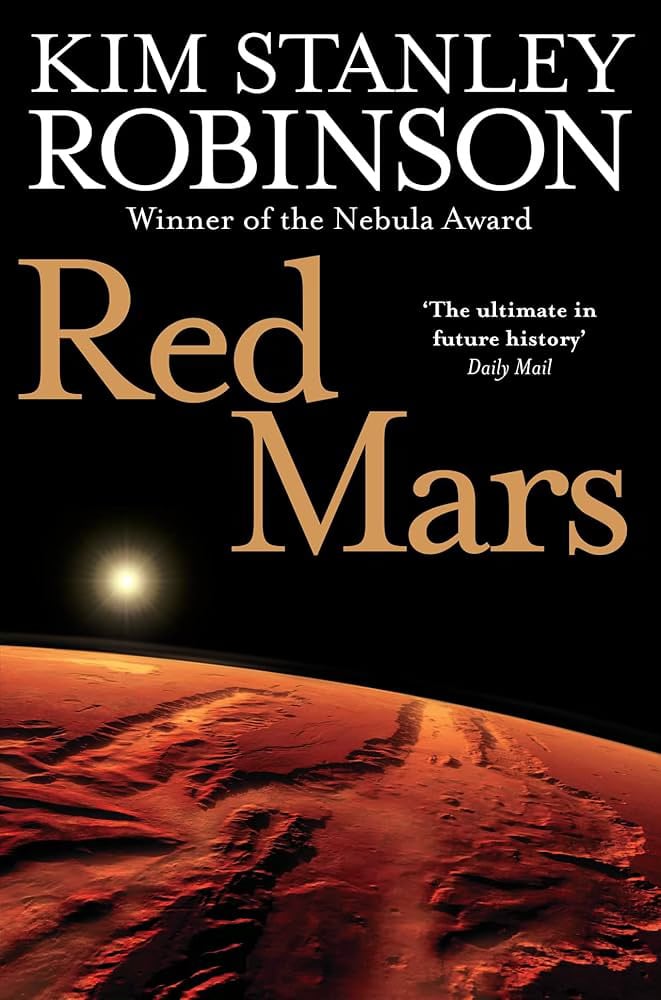
Out of all the books in my childhood, this looms the largest. This book is almost the entire reason for me wanting to go to MIT (become an astronaut so I could bring life to dead planet like Sax), and my interest in political philosophy (so I could figure out who was right between John, Arkady, and Frank). Just as KSR shows Mars here as a canvas that people use to paint their idealized image of society, society that will really truly be constructed by ideology, rather than history, I used this book as a template for my own life trajectory: a way of prescribing meaning to an otherwise empty scientific materialism by coopting some elements of ecoism (which I should have always known I liked, but anyway). I also recently discovered that one of my favorite board games, Terraforming Mars is heavily inspired by this book, which was also cool.
Deus Ex Vita is a reader-supported publication. To receive new posts and support my work, consider becoming a free or paid subscriber.
It's funny coming back to this and seeing what worked and what didn't. The science fiction elements are very obviously unbelievable. We can barely launch people into space these days, much less send millions of times more mass than we've ever sent to space far out of Earth's gravity well to Mars (I know that most of the delta G is from the surface to LEO but still). Aging won't be cured by simply repairing damaged DNA, and terraforming is likely to be a much slower process than as depicted in the book, if it's even physically possible at all.
The geopolitics is a little bit better. The overpopulation crisis on Earth that drives much of the plot is solving itself right now, but the hegemony of transnational corporations (a big element of the board game too) is happening before our eyes. Knowing a bit more about the other cultures (Arabs and Swiss mainly) depicted in this book also allowed their adaptions to the Red Planet to carry more weight for me.
And of course the personal is still fantastic. The love triangle between John, Frank, and Maya. The enigma of what Frank actually wants out of Mars (even though we get two POV sections from him). The solid dependency of Nadia, the fiery revolutionary fervor of Arkady, and the conflict between desire for death (Ann CLAYbourne) and life (Saxifrage Russell), all were much more interesting to me this time around. And how each of these characters reflects their own emotions on the landscape of Mars (which I know much better because of the game). And perhaps that this reflects my own philosophical shift too: away from materialism and towards something more interested in life itself.
2. Green Mars
If Red Mars was the book that made me want to be an astronaut, Green Mars is what made me want to become a biologist. There is just something so magical about turning a dead planet alive (not only through the introduction of plants, but also culture). Maybe what really will follow in the death-throes of rationality is a kind of Viriditas, or worshipping of life, that we see come to life in the :Greens” in this book.
In terms of plot, this book follows our protagonists from Red Mars (the first hundred) after they have fled underground following the failed revolution of 2061, as well as some of their children: the first natives of Mars. The plot spans the course of 60 years, and is all over the place. One part focuses on terraforming, another on a political conference to decide the fate of Mars, and still another on the quiet semi-retirement of one of the expedition leaders around the shore of the expanding Hellas Sea.
The characters were hit or miss for me. I really connected with Sax Russell, who is a scientist like myself. Sax is pretty autistically interested in science and the natural world, until a traumatic brain injury causes a radical shift in his personality and he grows interested in other humans. Nirgal, one of the native martians, and Art, a diplomat sent by one of the "good" transnational corporations I also liked reading about, but the female characters (Maya and Ann) were a huge miss for me. I found Maya to be a horrible, self-absorbed person, and found it hard to relate to Ann's obsession with maintaining Mars in a pristine, but dead state.
In terms of themes, a couple things stuck out to me. Firstly, science is political. This is very obvious in the novel, as the terraforming efforts are a scientific endeavor, but also a thorny political problem whose resolution very much depends on scientific feasibility. This is no less true in our world: the debates about global warming, pollution, veganism, etc. are all political as well as scientific questions. By refusing to engage on the level of the political, as if it is somehow “beneath” them (or worse, like we see below with many current academics, considering social issues "solved") scientists are shooting themselves and their interests in the foot.
Secondly, Robinson wants to highlight the effect that geography has on culture. We get extremely long (and often boring) descriptions of Martian geography to help us place the adaptions that various immigrant cultures are making as they come to Mars. No culture is unchanged, and this is at least partially because of the unique geographical (and other physical) quirks of the planet.
Finally, as some of our characters enter their ~15th decade, Green Mars brings into question the continuity of our identity and its dependence on memory. Are we still the same person that we were 20, 30, 100 years ago? At what point do memories become indistinguishable from facts we could have read in a textbook?
3. Blue Mars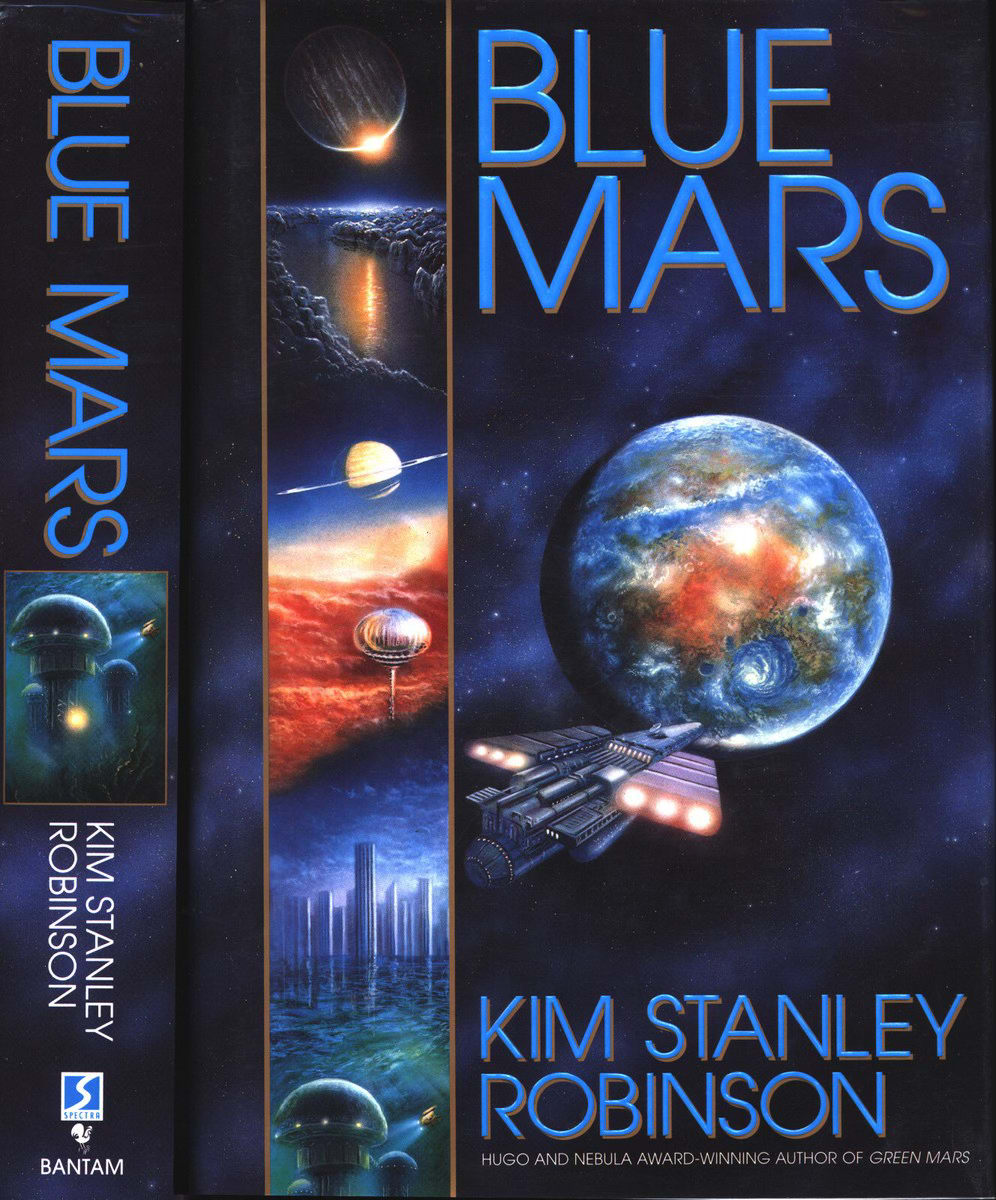
This was my favorite book growing up as a kid, but I found this entry on re-read in the series to be hopelessly fragmented and meandering in its focus. Much of the plot of the book is concerned with the formation of a new government for Mars (a vaguely socialist federation with strict limits on immigration from earth). There's some exploration of colonization of the outer solar system, but it is also hopelessly myopic and bohemian: there's no true political or cultural diversity in any of the colonies that are visited. On a personal level, very few of the first hundred have survived, and the ones that have have basically completed their character arcs. There's some interesting stuff with dealing with memory but other than that I found this book rather forgettable on a character level.
ConclusionsSo why does a series of books written about space colonization in the 90s still matter? We live in a society that is, for better or worse, driven in large part by scientific progress and research. Many of the big questions of our time: climate change, artificial intelligence, the obesity crisis, the fertility crisis, etc. are not only political, but also scientific questions. To ignore the input of scientists on these issues, like many want to do, seems incredibly myopic. At the same time, the training that we get as scientists (or at least the training that I have received) does not create people who are really able to participate in the political process. Gell-Mann amnesia is very real in academia: not just about the hot-button topics like race and gender, but also made-up shit like "learning styles", the efficiency of renewable energy, and a general understanding of politics and human psychology. Combine this with a massive ego because of success in one specific area, and you have the idiot savants that Nassim Taleb likes to harp on who cannot make political compromises or think outside the box. What Robinson is highlighting with his trilogy about colonizing Mars, perhaps the ultimate scientific endeavor, is that unless this changes, the science is not going to get done properly in the real world.
As Miguel Unamuno once said, perhaps apocryphally, vencer no es convencer (to defeat is not to convince). The strain of liberal (and perhaps now woke) thought that currently dominates universities is not going to be able to beat the world into submission to its ideas, it has to learn how to participate in the political process and convince people (and perhaps be convinced in turn).
For me on a personal level this series of books has helped to clarify what a future spiritual belief system might look like for me and the world. I’ve always struggled with the anthropocentrism of Christianity: perhaps something like Viriditas combined with Nietzchian vitalism could expand on the weak points I see in the Christian system.
Deus Ex Vita is a reader-supported publication. To receive new posts and support my work, consider becoming a free or paid subscriber.
I blog about language learning, biology, the science and art of learning, and many other things. If you feel inclined, please subscribe or consider buying me a coffee.
Josh
June 22, 2025
Refold Approach to Language Learning: Spanish ~1900-Hour Update
 Photo by Eduardo Rodriguez on Unsplash
This is my sixteenth update for my Spanish learning journey with the Refold approach. Articles, as at Medium, will always be free, but there is an option to be a paid subscriber.
For my first update, see here.
For my second update, see here.
For my third update, see here.
For my fourth update, see here.
For my fifth update, see here.
For my sixth update, see here.
For my seventh update, see here.
For my eighth update, see here.
For my ninth update, see here.
For my tenth update, see here.
For my eleventh update, see here
For my twelfth update, see here
For my thirteenth update, see here
For my fourteenth update, see here
For my fifteenth update, see here
For my sixteenth update, see here
For more information about the Refold approach, see here. For a basic Spanish Anki vocabulary deck, see here.
General ProgressReached 1900 hours of immersion. Took the B2 test, but won’t get my results back until August. Continued reading a lot: hit over 400k words for both April and May and I am on track for about 150k in June. Completed about 50% of the grammar book. Realized I need to be watching a lot more TV.
I’ve finally taken the B2 test, which I feel closes the first phase of my Spanish learning journey. I think I passed the test, considering I only needed to get a 60% overall to do so, but it was harder than expected, so we will have to see when I get my results some time in August. More on this in a specific section below, but I found the reading (surprisingly) and the oral sections to be the most difficult.
Since the exam I’ve been struggling to figure out how to move forward with Spanish. Work and training have recently ramped up quite a bit, and I’m having a hard time fitting in time for even one language, let alone add on Italian. Ideally I would just completely take a break from Spanish and completely focus on Italian, with maybe a lesson to check in with my tutor once a week. But after the B2 test, I feel like my Spanish isn’t good enough to do that, meaning that if I want to progress in Italian, I have to juggle both languages, which I don’t have the mental bandwidth for. At the same time, if I want to learn more Romance languages, which I do, I have to start at some point. If not now, when?
Yet on the other hand, my Spanish needs a lot of work. I’ve recently been watching some Spanish TV shows, and I’m shocked at how low my comprehension is without subtitles. Although, looking at my immersion hours, perhaps this makes more sense: I’ve been neglecting listening practice because the main way to improve seems to be through TV, which I have quite a bit of innate resistance towards. Podcasts and audiobooks are quite easy because the audio quality is always clear and people aren’t using slang. This is not the case in TV, where there’s often music or background noise making the characters difficult to hear, and a lot of words are slang that I haven’t picked up from books. The unfortunate reality is, despite what I think of the medium, if I want to get to the next level of Spanish, I have to do far more listening, mostly in the form of watching TV.
The grammar book is going swimmingly still: I’m about 50% of the way done, and it’s been exceedingly helpful for both noticing grammar concepts in immersion and with output. Would recommend for any intermediate and beyond learner.
Finally, I’m wondering if some kind of serious digital detox and focus on recentering my mental and physical health might help with all of this. I’ve been sleeping for less than 7 hours a night for a long time now, and I am filled with a sense of anxiety/busyness at pretty much all times. These two things are almost certainly related, and I can do some good by scaling back various commitments, but I also spend a lot of unnecessary daily time on the internet (3+ hours) that could be refocused on immersion, or just shrinking the size of my to do this. I hope to start this detox, based on Cal Newport’s Digital Minimalism in July.
Open questions: How do you find more time in your day for immersion? Has anyone done a digital detox?
DELE ExamI will write slightly more about this when I get my scores back in August (probably the 2000 hour update), but I want to do a short recap of the test here before it fades too much from my memory.
I took the test about a month ago in Washington D.C. through the Isabella and Ferdinand Language Academy. The written portion of the test was at an elementary school in western D.C. (which was a really fun e-bike to get to from where I was staying near Penn station: huge win for bike infrastructure in the city), and the oral portion was at an Armenian church a few miles away. The test started early on Saturday morning, and took about half the day. In the written portion there were three sections: reading, listening, and writing, each taking about 80 minutes. To pass, I needed to get a 60% on the reading and writing combined, and a 60% on the listening and oral combined.
I was expecting the reading to be very easy. It was not, despite having read over 100 novels in Spanish. The questions were very nitpicky (oftentimes multiple things were true, you just had to pick the most true one), and I had trouble with the last exercise, which was a fill-in-the-blank activity for verb conjugations, adjectives, and prepositions in a short story.
Listening was a piece of cake and consisted of answering a few multiple choice questions after hearing a passage on the radio.
Writing was probably the easiest for me: you only had to write two essays of 150 words each (but they want different grammar constructions).
The oral section was the portion that I had practiced the most, but also the one I was most nervous for. I’m not very good at speaking in English, let alone in Spanish. That being said, this section was relatively straightforward: you are given to exercises to prepare: one involving a photograph and the other a survey. You have to talk about each for about 5 minutes using a variety of grammar constructions. There’s also a third exercise that you go over with the examiner directly with no preparation time. I think I did fine, although I worry I didn’t use enough subjunctive. We will see when the scores come back in August.
Reading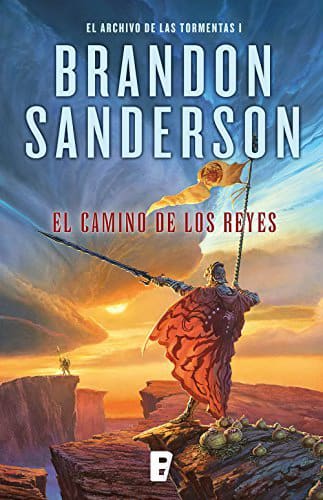 What I’m reading right now
 I read a lot leading up the test: over 400k words in both April and May. I have read less this month, but that’s because I’ve been watching more TV. I enjoy reading a lot, still have some work to do in understanding complicated literary fiction, and can usually find something to sentence mine every few pages. However, I think the emphasis needs to be shifted towards listening quite substantially (maybe a middle-ground is audiobooks).
For this update I read nine books (the same exact number as last time), including one book that was a reread. Three of these books were a translations, all from English1, but the others were all originally written in Spanish. I’ve also been reading two blogs in Spanish here on Substack: Jardín Mental, Ingeniero de Letras, and Mapas Milhaud. This update puts me at over 100 books read in Spanish, and nearly 12 million words read. Both are big milestones.
In the easy category, I read four books. One of these was a translation of Joe Abercrombie’s The Heroes, which I’ve read in Spanish before. Another was a translation of Silvia Moreno-Garcia’s: Ciertas cosas oscuras, which was a fun, if cliche vampire novel set in CDMX. The last two books in this category were by Isabel Allende. Zorro, which I was reading last time, was the origin story of the famous California comic-book character from the 1950s. This book was also fun, but I find myself tiring of Allende’s cliched writing and simplistic morality. Which perhaps is why I hated Más alla del invierno, the other book of hers that I read in this category. This book follows three people: a Chilean, a Guatemalan, and a New Yorker during the NYC blizzard of 2015. Each of the characters’ backstories was excellent, but I found the present-day story to be extremely disturbing and unnecessarily politically partisan2.
In the medium category, I read three books. The first was another Allende book, Mi país inventada. This book was more of an autobiography than a novel, which helped the work avoid the classic Allende problems of self-insert characters and political pandering. I also read a translation of The Farthest Shore by Ursula Le Guin, who is just as wonderful in Spanish as in English. I didn’t enjoy this book as much as the first two, but that doesn’t mean it wasn’t very good. Finally, I read a collection of short stories titled Las cosas que perdimos en el fuego by María Enriquez. The stories could all be classified as horror, but featured very few supernatural elements. Most were about the poverty and terrible experiences of the most maltreated parts of Argentinian society. I really highly recommend the title story, which you can read here.
In the hard category I read two books: Distancia de rescate by Samanta Schweblin and Plan de evasión by Adolfo Bioy Casares. Both were difficult not necessarily because of their Spanish, but rather because of their narrative structure. The first is told through a probably imaginary dialogue, while the second is narrated through a series of letters. Both of these forms add some distance between the reader and the narrator, making it difficult sometimes to figure out what is going on. Out of the two Distancia de rescate is definitely better3, and if you really want to read Casares, La invención de Morel is much much better.
I’ve started collecting all the books I’ve read that were originally written in Spanish and sorting them into these three categories on another page of my blog. This desperately needs an update.
Total Immersion time: 1040 hours, approximately 9 million words. 72 books originally written in Spanish, 104 books in Spanish in total.
Monthly word totals: April: 550k , May: 450k, June (so far): 125k
Future Plans: Move over to audiobooks, but again, just reading as much as possible
Open Questions: Recommendations for nonfiction originally in Spanish?
Sentence MiningI’m up to 2961 cards now with a 89.7% lifetime mature retention rate, but a lower 87.9% rate in the past month. This rate has been creeping up as the new FSRS algorithm kicks in, so I’m not concerned that it’s still under 90%: we’ll get there, especially if I sleep and recover better.
I’ve also started using a plug-in for Anki that allows me to study ahead for the next few days reviews. This is a nice way for me to be able to do more Anki when I’m motivated, and take some of the pressure off days that I’m not feeling particularly motivated.
I’d still like to get to 10k total Spanish cards, but this will probably take another ten years. In any case, I like doing Anki, so I don’t see slowly chipping away at this goal being too much of a problem.
Open Questions: None
WritingMy main source of writing prompts continues to be book reviews. I’m not doing much writing post DELE, but I would love to practice more informal writing, perhaps in letter or email format. If you’re interested, send me an email, or a message on the Refold Discord server. I’m more interested in physical letters than email, but am open to both. Not really looking to text: I would rather voice chat.
Output time: 9 hr tracked, including DELE
Open Questions: Anyone want to be pen pals?
Listening
I didn’t to much listening between this update and last: only 20 hours total. However, pretty much all of those hours have been in the last week. Horrified by my low level of understanding when I turned on a Spanish show for fun a few weeks ago4, I’ve been binging various Spanish rom com shows. My favorite thus far is Machos Alfa, which follows four gen-x men and their spouses in the world of evolving gender politics.
I’m definitely going to be watching a lot more Netflix in the coming updates. This is a huge weak area for me that I think will help a lot with future DELE tests, and Spanish in real life.
Total Immersion time: 695 hours, 2 million words from audiobooks.
Monthly Hours: May 1.7 hours, June: 19 hours
Future Plans: More Netflix
Open Questions: Film recommendations? RomComs?
SpeakingI’m continuing to take regular lessons on iTalki. After reading, this was my biggest source of immersion, with around 20 hours of lessons since the last update. I have at least one lesson every single week, but I aim for two more often than not.
Each of my two main teachers have taken on slightly different roles. With Rafa, I end up having pretty deep conversations about philosophy and current events, which really helps to move vocabulary I have from passive immersion into the active part of my brain. Rafa and I will also spend 5-10 minutes on grammar corrections at the end of class, which has been paying gradual dividends. Rafa is the teacher who I have the most lessons with (almost weekly), and I’ve come to look forward to them as one of the highlights of my week.
I’m back to doing literary analysis with Mailén. We read some María Enriquez and I have Samanta Schweblin on deck with her.
I’d like to try out some other tutors on iTalki soon, but I think this will have to wait until work calms down a little.
I also found a Spanish happy hour group that meets on Thursdays at Ministry of Brewing in Baltimore. This has been a consistent source of immersion for me and is about 1/3 native speakers. With non-natives in this group I seem to find myself in much more of a teaching.corrective role, which makes me feel good about my ability, but also frustrated about the lack of work other people seem to be willing to put in to improve5. I’m hoping this group will connect me to other local Spanish speakers and help me make more Spanish-speaking friends.
Finally, I bet a Colombian au pair on the train back from DC a few weeks ago. I’m hoping to meet up with him to bike or chat when my schedule gets a little less crazy.
Output time: 168 hours
Explicit GrammarDoing explicit grammar practice has been somewhat of a revelation for me about the potential flaws in the Refold methodology. To make a long story short, explicit grammar has been really really helpful for me both in outputting and in more explicitly understanding some of the remaining sticking points I have with reading.
I’ve mainly been using some exercise books, which were highly recommended by a trusted Goodreads user (Roy Lotz). These books cover everything, from gender to common prepositions to the subjunctive, and I’ve been jumping around the book trying to spread out my learning on different topics. I’ve done about half of the book so far, which probably represents about 20 hours of explicit study. After I’m done, I’m planning on going through the book and Ankifying any issues I might have, before starting on the C2 book.
Future PlansI want to focus on listening for the rest of this year as this is a clear weakness of mine. I would still like to keep up with reading, but will scale back my goal word count to closer to 100k words/month. Depending on how the DELE went, I may either retake the B2 or try for C1 in November. Finally, I need to figure out what to do with Italian, as I’m pretty divided.
Other LanguagesRight after the DELE test I started ramping up my Italian study. I got Harry Potter out of the library again and started watching a couple shows on Netflix. However, almost immediately I ran into problems. I had Spanish books to finish as well, and was having choice paralysis between deciding what to immerse with that day. My comprehension is also still not great with Italian (although surprisingly good for basically only 50 hours of Immersion), so I would also find myself reaching for English or Spanish books and shows instead of their Italian counterparts. Finally, I was also having quite a bit of crossover confusion between Italian and Spanish. As of writing this article, I’ve put Italian to the side, but frankly, I need to stop doing this at some point, preferably really really soon. I’ve signed up for an Italian class in the fall at Hopkins, so hopefully that will force me out of this situation where I keep dropping Italian.
HealthThings are looking up health-wise. I’m running again and down ten pounds, but I still need to work on my focus and my sleep.
Overall ImpressionsGlad to be done with the DELE, but still have a long way to go when it comes to Spanish, especially listening. I’m very divided on my path forward to learn other Romance languages, and hoping for some clarity from other Refolders.
Open Questions: What is the fastest way to improve listening comprehension? How do you go about maintaining a language when you started an L3?
Full immersion link data link.
I blog about language learning, biology, the science and art of learning, and many other things. If you feel inclined, please subscribe or consider buying me a coffee.
Josh
1Although one is by Silvia Moreno-Garcia, who is basically a Spanish author.
2The protagonists cover up the murder of an innocent woman and don’t turn the murderer in to the police because she’s also woman. Then there’s also quite a bit of illegal immigration apologia. My heart goes out to people living under the rule of cartels in dysfunctional Central American countries, but might the better solution to these problems be breaking the back of the cartels, rather than importing these very problems into the United States?
3It also has a Netflix adaption.
4Without subtitles. With subtitles, my understanding is near perfect
5You do not get good at Spanish by outputting once a week. The amount of people at this group who’ve never read a book in Spanish (or even tried) continues to amaze me. That being said, everyone has different reasons for doing things and “getting good” may not actually be that high on other people’s list.