Benito Linčovič's Blog
November 28, 2025
The New Coffee Capital of the World... Hanoi, Vietnam 🇻🇳
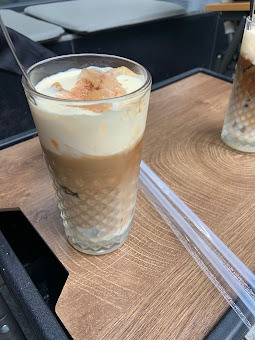 The VHN Cà Phê a.k.a. cream cheese coffee.
 The coffee culture in Hanoi and, in turn, Vietnam, is next to none. Coffee culture in the English language uses loanwords from perhaps the most well known country when it comes to coffee - Italy. For a coffee with milk, we say "latte", which directly translates to "milk" in Italian. We also use "mocha" short for mocaccino and also cappucino, directly from Italian. But perhaps we should look further afield for our coffee inspiration.
During my six days in Hanoi, I tried a number of coffees which opened my mind to a new way of thinking about coffee. Each drink brings out a new memory of the various spots I went to - starting with the famous salted cream coffee.
Jetlagged and extremely tired having caught the flight to Vietnam directly off a night shift, my first Vietnamese coffee was something I'll always remember. At 80+ Coffee Roastery , I ordered the Ngà coffee - which was a shot of coffee, condensed milk, and salted cream foam. It was muggy and hot in Hanoi (see scene from Good Morning Vietnam below) and as such I ordered it iced. After mixing it all together, and taking my first sip - the moment became transformative and I wasn't sure I could ever enjoy a solitary flat white ever again. At first, it was refreshing in the humidity that was unrelenting. But then came the taste, the sweetness of the condensed milk is perfectly balanced with the saltiness of the salted cream. Neither taste overpowering the other, but in fact a perfectly blended mix. While I didn't want it to end, I couldn't wait for the next Vietnamese coffee either.
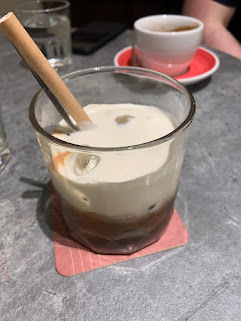 A delicious salted cream coffee at 80+ Coffee Roastery
The next stop was sort of accidental. Despite not meaning to, we somehow ended up around the corner from the world famous Hanoi Train Street. A woman saw me struggling to cross the road and helped me, which although the cynical part of me likes to think was a rouse to get me into her cafe, was actually also just a genuinely nice attempt to help a lost tourist. As such, we rewarded her kindness by sitting down at her cafe not too far into Train Street. Upon reviewing the menu, I settled for an egg coffee - a coffee I had heard much about before coming to Hanoi. In essence, it is made by pouring coffee over whipped egg yolk. Where better place to try one than here, I thought? Not at that cafe it turns out. The after taste was strange and the coffee strangely thick. It felt more like some sort of protein drink than a coffee. This was the only coffee I had during my trip which I did not like and it put me off trying egg coffees for the remainder of the trip. Was it because I did not like the egg coffee or was it because the location just made a bad egg coffee? I'm not sure. Nevertheless, sipping it as a train passed within inches of my face and legs was a unique experience.. and more scary than it appears in photos and videos too!
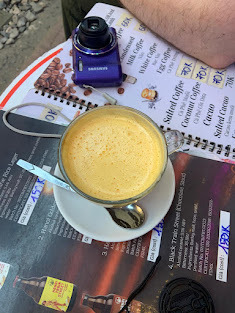 Egg coffee... not my favourite!
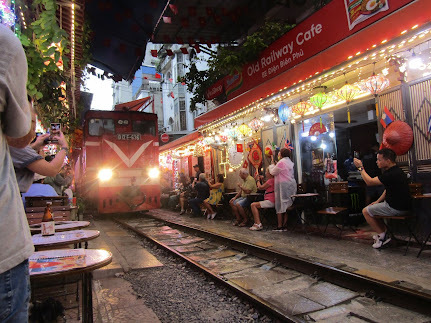 Tuck in! Here comes the train down Hanoi's Train Street.
A part of me worried that maybe these "coffees" were gimmicks, losing the essence of what a coffee is. But I was glad to be proven wrong time and again at various cafes and institutions in the city. The banana coffee I had at Langbiang Coffee, just down the road from our AirBnB, risked going into milkshake territory if not done correctly. But as with all coffees and meals I had in Vietnam, it was freshly made and blended to order. A shot of coffee, blended banana, and condensed milk (the go-to it seems) - all it takes for a good coffee. No additional banana flavouring or ice cream added, basically an ice latte with some blended banana. It was basic, but it was damn good. Once again, neither flavour overpowering the other - just two flavours complementing each other very well.
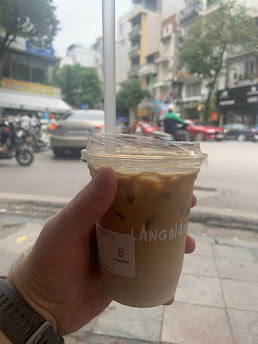 Banana coffee - looks normal, but plenty of banana bits and goodness floating about
Most coffees in Hanoi tended to be made with condensed milk, which created a unique flavour on its own. On a particularly hot day, I enjoyed an iced coffee with no other flavourings apart from condensed milk. It was sweeter than would be expected from a normal coffee, but so uniquely Vietnamese. While "European" style coffees are available, why resort to a boring latte when in (what I consider to be) the new Coffee Capital of the World? The style of Vietnamese coffee is clearly spreading in popularity around Asia as I witnessed Starbucks and other international coffee chains offer 'Vietnamese Cold Brews' in stores in India in the next part of our trip.
And why shouldn't it? The stuff is good. It's creative but not unnecessarily loaded with sugar and additives. Scrap the pumpkin spice and black forest sugar-loaded monstrosities we have here in the UK. Replace it with high quality, genuinely creative coffees from around the world, starting with Vietnam. We don't need whipped cream, cocoa dust, and a boat load of syrup for a unique coffee. Just swap the whole milk for condensed and whipped cream for salted cream and - voilà - you have something unique and delicious.
I'm sure it won't be long before the phenomenon spreads to coffee shops here in the UK and I'll be glad to see it because, if anything, the Vietnamese deserve it. They've been through a lot. Although I'm not sure I'll be first in line to try a salted cream coffee from a machine at Greggs...


Is Delhi The World's Worst Capital City?
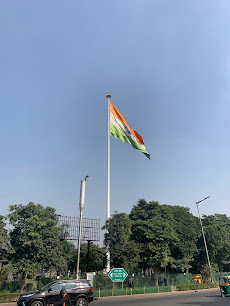 A huge Indian flag over Palika Bazaar
Even for me, as someone who has travelled to places one might describe as 'off the beaten path' like Iraq, Syria, Zambia, to name a few, India was a complete culture shock.
When picking a new country to travel to, a good first destination may in most cases be the capital. Usually due to it being the seat of government, embassies, and historical/cultural sites, capitals host foreign dignitaries, sporting events, usually have the biggest budgets to spend on things like infrastructure and housing. As we soon found, none of this applied to Delhi.
Landing in Delhi is an experience in and of itself. Even in the night sky, a yellow haze which is the smog that looms over Delhi is clearly visible. It is one of the most polluted cities in the world, if not THE most polluted city in the world.
 The yellow smog visible in the night sky as we approach Delhi.
Once you set foot out of the airport terminal building, it becomes a constant battle to avoid being scammed, harassed, and touted for your money. Luckily, our hotel organised a free pickup from the airport (included in the price), which is just about where our luck ended.
The drive into central Delhi was extremely haphazard, even taking into account the fact we had been in Hanoi for the past six days where the driving was, so we thought, already quite crazy. While the Vietnamese seemed to have mastered the art of 'organised chaos', the Indians just seemed to be driving chaotically unorganised. Our hotel's car had no functioning seatbelts as he sped through the busy streets avoiding rickshaws, tuk-tuks, cyclists, motorbikes, cars, and lorries. Our driver flashed cars in front, beeping near enough constantly, meanwhile other drivers did the same to us and so forth. Indian driving seemed to be a constant battle to get in front of the person in front you no matter the cost, by any means possible. It was to become a regular theme of our trip.
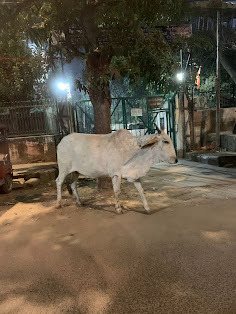 Cows, supposedly a holy animal in Hinduism, are allowed to roam the streets eating rubbish.
As we got closer to our hotel, the driver began giving us the spiel on why it would be so kind if we gave him a tip, how hard he worked, and how much it would be appreciated. Given the above reasons, including that he had to refuel en route (surely this could have been done en route to pick us up), we got out, thanked him, and walked into the hotel. Anyhow, I kind of zoned out of his speech when I noticed a man stood in the middle of the road, knob out, taking a leak on full show in front of everyone. This too would be commonly seen around India unfortunately.
We were quickly greeted by some other bellboys who quickly took our, already light, backpacks and ushered us into the lobby where we went through the usual procedure with the reception, including checking in, payment, etc. We went to grab our bags but were intercepted by the bellboys again, who insisted that we need not carry our own bags. Tired and hunrgy, we reluctantly accepted, although knowing there would be an expectation for a tip once again despite never having requested or asked for this service. It was an awkward ride up the elevator,
"First time in India? Where are you from?" with the traditional Indian headshake.
"Yes. From the UK."
"Nice."
This interaction was painfully long as both bellboys just stared at us as the elevator slowly took us to the third floor, where our room, number 308, was a ten yard walk away. They showed us into our room, dropped our bags, and made perhaps the most awkward exit one could make. Four grown men in a small hotel room, two of whom were expecting payment, delayed their exit as long as possible, even going as far to show how to turn the tap so that hot water would come out... Eventually they left, and Izaac and I contemplated leaving the room and going to another hotel altogether given the room was covered in dust, questionable stains and black mould in the bathroom.
Ultimately we decided to suck it up for the next two nights and we reluctantly went to sleep... we awoke to the noise of cars beeping and work going on in the streets below. We were in Paharganj, perhaps the worst district in Delhi. It is located in "Old" Delhi, is fairly centrally located near the train station and in between a number of key Delhi landmarks such as Red Fort and India Gate.
It also has the cheapest hotels, which was another key reason for staying there. A walk around Paharganj the following morning after our arrival soon confirmed why this shouldn't have been a factor in my decision making. It wasn't long before we kept being accosted constantly by people. Men would walk alongside us, asking where we're from, how long we're in India, before trying to direct us to their tuktuk or shop. Upon declining, the next would take their chance, and this went on before we managed to get to the cafe we were looking for.
Breakfast was a short break from the constant harassment we experienced since stepping out of the hotel room. We were barely 50 yards from our hotel in some cafe and our first impressions were not great. We decided to get the hell out of Dodge (Paharganj) and got in the first tuktuk that offered us a reasonable price to get to Palika Bazaar, a known fake goods market. Just as we flagged down a tuktuk, a man somehow accosted us into his friend's tuktuk and offered us 100 Rupees (£1ish, maybe slightly less) which we accepted and confirmed. There was something fishy and the man constantly asked our travel plans, how much we were paying for our Taj Mahal tour, and more. It felt as if he was going to try and sell us something. He did lie to us as we later learned by trying to say that Palika Bazaar only sold electrical goods on a Sunday... the cricket shirt I bought later on said otherwise.
They didn't actually take us to Palika Bazaar, but it was close enough. They tried to get us toward their friend's shop and after giving the driver 100 Rupees he looked disappointed, but I didn't care and I walked off - he agreed to the price after all. We were only five minute walk from the bazaar and as such headed that direction but on the way we were offered shoe cleaning by atleast two people, and a further three people attempted to take us in the direction of their shop inside some mall. Unperturbed, we carried on to Palika Bazaar, the indoor market.
We passed through a "security" checkpoint, and I say security loosely. The metal detector went off on everyone who passed through where a security guard then hovered his hands loosely around everyone's trunk before letting them through. If an attack were to happen, it most certainly would not get caught out by the checkpoint! Nevertheless, Palika Bazaar was not just an electrical goods market - there were fake rolexes, fake luxury brands, and what I came for - a fake Indian Cricket shirt. Despite being, what I would consider, a relatively experienced traveller I still got scammed! I went in unprepared, not knowing how much I should pay for a knock-off cricket shirt and also with no clue what the exchange rate was. I knew I was getting ripped off when he said it would be 2900 Rupees, but when I offered back 2500... he must have known he'd got me hook, line, and sinker. In the end, I paid 2700 Rupees (£23) for a knock off Indian cricket shirt, which was far too much. I found this out when I asked an Indian friend what a local would pay and he said no more than 400 Rupees if the quality is really, really good. The biggest kick in the teeth was when Izaac bought an original Cashmere blanket of the highest quality the following day at a tourist shop near the Taj Mahal and he paid... 2500 Rupees! I really did get rinsed. But it is a lesson learnt.
With a sour taste in my mouth, we made our way to India Gate, which is quite a spectacular memorial to the Indian soldiers who died in the First World War. The arch towers into the sky and is faced by a 28 foot high statue of Subhas Chandra Bose, an Indian Army commander during World War II. Upon further reading, I found out that it was originally a statue of King George V that stood facing India Gate up until the 1960s.
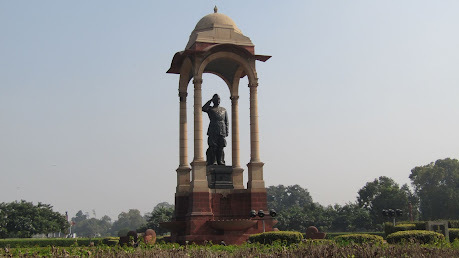 The statue of Subhas Chandra Bose, faces India Gate.
India Gate is a relative space of calm from the hustle and bustle of the streets that surround it, but it isn't long before a woman is attaching a paper Indian flag to our sleeves stating that it is free, only for her to change her mind 30 seconds later and claim she is raising money for an orphanage. Again, I walk off... can you see a theme building? Luckily, India Gate is only a five minute walk from the Havemore Restaurant located at Bikaner House. I heard the butter chicken here is some of the best in Delhi but I did not expect the extravagance of its setting. Bikaner House has its roots in the British Raj and, while it is now open to the public, it is clearly a relic of Britain's colonial past in the country with an excessive number of servants, waiters, and staff generally. Nevertheless, it's fair to say the butter chicken was indeed very good.
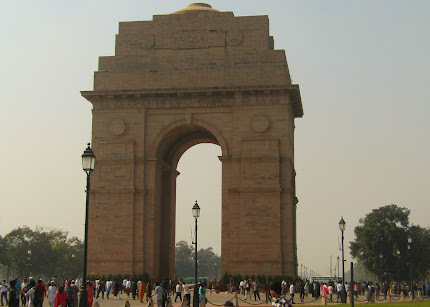 India Gate
Overstimulated, full of butter chicken, and running on poor quality sleep from last night's late arrival, we headed back to the hotel for a good rest before we headed off for the Taj Mahal the following day. But not before we would once again have to deal with an attempt to scam us on the tuktuk back to the hotel. Upon agreeing on a price of 300 Rupees from Bikaner House to Paharganj, the driver then increased it to 500 once already driving. When I threatened to get out, he suddenly reduced it to 400 but I was still adament on 300 (which was still probably a complete rip off when compared to what a local would pay). After he dropped us off at the wrong place, he still only gave me 50 Rupees change for my 500 Rupee note. At that point, I quite simply lost the will to live so gave in.
While I'm sure there is more to do in Delhi given more time, it is such a hassle as a foreigner to actually enjoy anything. The noise and dirt is constant. The touts are everywhere and everyone is looking to make a quick buck out of you constantly. I understand times are tough and poverty (and extreme poverty) is rife. Many people are starving or living on less than a dollar a day. But even then I find that no excuse to piss in the streets or harass people. I've been to other poverty stricken places in Africa where people lived in similar circumstances but kept their environment clean and did not harass anywhere near as much. It is relentless and tiring and for that reason, out of the 38 capital cities I have visited (according to NomadMania), I have to rank Delhi as the worst.
October 23, 2025
Let Them Drink Squash?
This morning on front page BBC News, a headline stood out to me: The £5.30 orange juice that tells the story of why supermarket prices are sky high. I mean, how can a headline like that not stand out?! The article goes into reasons for the hike in price of orange juice, in part due to weather and climate causing oranges to be less sweet, Donald Trump's tariffs, and global demand and consumption of orange juice just generally declining.
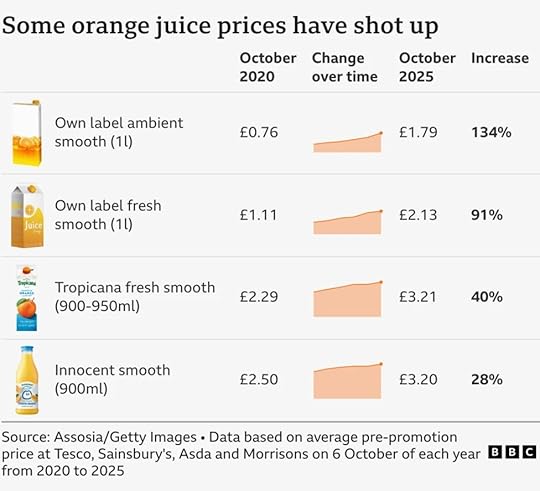 We're getting robbed.
Despite these explanations, I can't help but gawk at the infographic which shows that supermarket own-brand orange juice prices have increased by 134% since 2020. Has minimum wage increased by 134%? Has the average salary increased by 134%? Has it balls.
Look, I'm not advocating for minimum wage or salaries to be pegged to the price of orange juice, although that wouldn't be the worst economic policy to come out of the UK government in the last five years (Liz Truss's Mini Budget anyone?). But perhaps the hyperinflation of orange juice is part of wider exploitation of working class folk up and down the country. The below chart highlights a number of basic household goods and their percentage price rise in the last year, let alone since 2020.
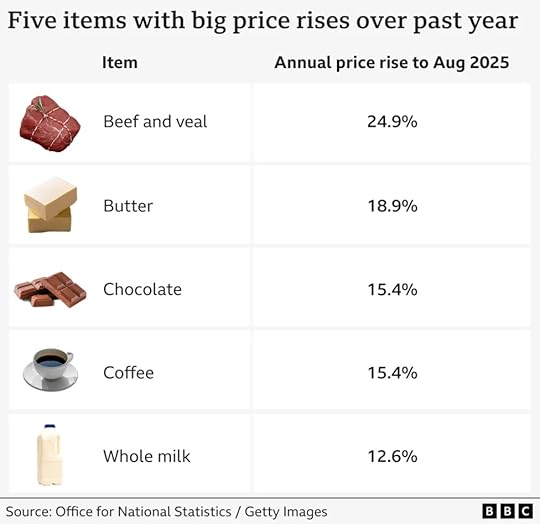 So called unavoidable price rises due to [insert X event/Y people], yet supermarkets continue to record record profits year after year.
It is difficult to find accurate information on the change in price for individual foods from 2020 until now. But The Food Foundation, does as good a job as any with their "Basic Basket" of typical household foods that one might get on a weekly shop. Their website goes into further detail, but since February 2022 - the average price of the basic basket for a man has increased to £56.66, an increase of 30.2% since 2022 (from £43.95). For a women's basic basket, the increase is similar - up to £52.19, a 27.4% increase (from £40.96).
How has this become the norm and accepted in our country? How is it that 1.8 million of us, in modern day Britain, are reporting not eating for an entire day due to the inability to afford or access food. There is simply no excuse for this and it is a blight on this country that we continue to grant a free pass to the millionaire's, billionaire's, CEOs, and executives who, year after year, claim their bonuses and walk away scot free to their villas in the south of France and beyond.
"But, but, but supply chains have been affected by Covid and the Ukraine war!"
"But they've had to lower their profits and bring down shareholder bonuses!"
I guess we should feel sorry for Ken Murphy, CEO of Tesco, who saw his salary (after bonuses) drop from £10.2 million in 2023/24 to £9.2 million in 2024/5 (source). That is until you realise his salary has doubled since 2022/23 when he received a meagre £4.3 million (source). When your salary increases to the effect of 100%, I guess your shopping basket going up in price 30% doesn't really make too much of a difference.
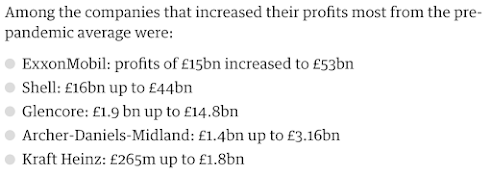 Jeremy Hosking is heavily invested in fossil fuels. From a Guardian report on greedflation in 2023.
You would think that supermarket profits would take a hit during heightened geopolitical insecurity around the globe. In the media we are told that price increases are due to the Ukraine War, the Israel-Gaza War, the Houthis, Iran, North Korea, Russia, and more recently... national insurance contributions? Just when you thought billionaires and corporate greed couldn't get worse and they had run out of excuses for rinsing workers wallets dry, they blame price increases on the National Insurance contributions set by the new Labour government, designed to boost vital public services such as the NHS. So, yes, in essence, the billionaires now blame the NHS, schools, and police for supposedly reducing their precious profits. Despite this, Sainsbury's recorded £1 billion in profit in the year 2024/25 (source). Tesco profits are expected to hit £3 billion for the year 2025/26 (source).
Simon Roberts, Sainsburys CEO, even had the gall in 2023 to go on BBC news and state they weren't profiteering the cost of living crisis. Dubbed "greedflation", this is the effect of companies hiding behind inflation and increasing their own costs beyond what is necessary to profit even further. But of course, we too have no interest in holding CEOs, millionaires, billionaires, and executives to account. Instead, we focus on immigration, flags, and whatever other culture war nonsense that makes the headlines that day. I guess it shouldn't be a surprise that Nigel Farage is leading opinion polls. It is easy to blame an Afghanistani national on a boat than it is to hold your business interest pals to account.
Nigel Farage is propped up by donors with economic interests in blaming other people (other than themselves) for greedflation. Jeremy Hosking, a top Reform Party donor, has tens of millions of pounds invested into Fossil Fuels (Exxon Mobile and Shell being two legacy fossil fuel companies listed as making huge profits in recent years as per the above screenshot). So why are the opinion polls suggesting that a significant proportion of Brits are looking to Nigel Farage to end the cost of living crisis. He has no incentive to, he is propped up and supported by people who are actively profiting from so-called "unavoidable" price rises that simply "have to be" pushed onto the consumer when we know this simply isn't the case.
When we look at housing, the top Reform Party donor and now MP, Richard Tice, made his fortune in housing and property development. It should be no surprise, then, that he voted against the Renter's Rights Bill, which protects renters from no-fault evictions, requires landlords to fix hazards in a set amount of time, and gives renters greater rights to challenge rent increases, among other protections. This is a potential future Cabinet Minister working in his own interests and not the people who voted him in. For a party that aims to appeal to "common sense working class people", they sure do everything they can to work against the people they aim to appeal to.
While the title of my article is perhaps a stretch, it does make me wonder on how similar the circumstances are. Granted, the Russian Empire was in the depths of a World War, however, according to the International Encyclopaedia of the First World War, prices in the country doubled between 1914 and 1916. Sound familiar? But that's not all, people were rioting over the price of staple goods. Russian workers were not immune to bigotry either, with their anger sometimes directed at peasants, shopkeepers, Germans, Jews, police officers, bureaucrats, and more rightly the Tsar, who's government's economic policy had caused a lot of their suffering.
It is this level of greed which has sapped into every layer and the fabric of our society that is draining working people of their hard earned money at every corner. It's more than a £5.30 glass of orange juice and it won't stop there either. What war will be the next excuse for a simple glass of orange juice? What pubic service will be the next excuse for your rent going up?
I have no doubt that when the day comes that a glass of orange juice is £20, the CEOs and billionaires will sit from their villas in the south of France and come up with one last suggestion for us all... "let them drink squash."
October 21, 2025
Toto, I don't think we're in Kent anymore!
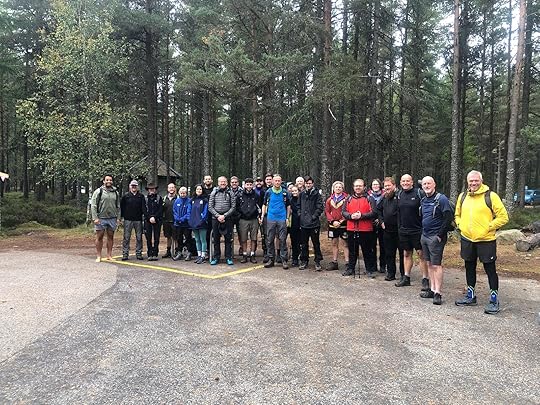 The Bhubesi hikers at the start of the walk - little did we know what we were in for!
The Lairig Ghru is a hike which takes you through the heart of Cairngorms National Park, in the Scottish Highlands. It is a rugged and remote part of Great Britain, one which took me two days of travel to get there in my small, but might, Nissan Micra. The other options being the train or flying to Inverness, both of which are costly. I decided to make the journey to the Lairig Ghru an adventure in itself.
I set off from Sittingbourne, Kent, (just shy of 600 miles if I was to drive non stop) on the Thursday - two days before the hike. I decided that if I was going to travel so far, I may as well stop by a few places I'd never been to before. The first of which would be Grimsby and Cleethorpes, purely because they had beaten Manchester United in the Carabao Cup a few weeks prior. I even went to Grimsby Town FC to pick up a few souvenirs, but their card machine wasn't working and, alas, I walked away empty handed given I am not of the cash carrying type myself. Nevertheless, I ventured onto Cleethorpes (five minutes down the road), where I ate a spectacular fish and chips at Papas Fish and Chips on the pier. The portion - huge. A haddock and chips, coupled with halloumi fries was a real winner, although I simply couldn't finish it all. It was a good fish and chips and had apparently been featured on the BBC show 'Britain's Best Takeaways' and had also been declared Britain's best chippie, but I think I have had better on the East Kent coast, closer to home.
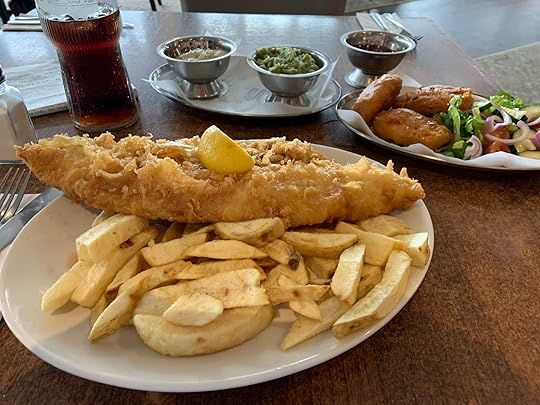 Supposedly the best fish and chips in the UK...
The weather was poor and, as is the case in many dying beachside towns, there wasn't much else to do beyond the arcades. So, I headed for Hull, which would be my home for the night. I managed to time my arrival with the coinciding rush hour but I got there in good time still. I parked up at a multi story car park opposite the Hull Trinity Backpacker's Hostel and made my way there where I was greeted by the friendly owner. It was cheap and cheerful and had everything I needed for an overnight stay. I'm a bit past the age where I enjoy dorm room sleeping so I opted for a private room, which felt much like the one term I spent at boarding school in my youth. I headed out for a mediocre coffee at a games bar where I got caught up in another rain shower, but managed to see the city centre. On the way back, I stopped by a live music event in the city centre, which had been recommended to me by the hostel owner. You could really tell the event brought the community together, and it's something I'd like to see more of locally. Alas, I was tired and returned to my hostel to get as good a night sleep as possible.
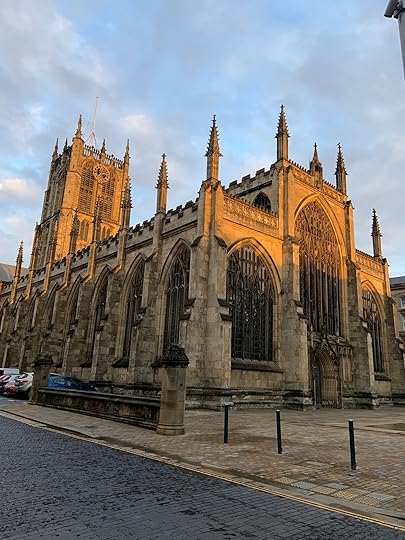 Hull Trinity Cathedral - beautiful!
I was up bright and early the following morning to do some further exploration before the long journey up to the Scottish Highlands. My first port of call would the Kilnsea Heritage Coast, a unique spit of land that jutted out into the North Sea. I had only heard of it because it was listed as a Nomad Mania DARE region and, when in Rome, it would only be right to explore part of the world that I would likely not return to for a long time.
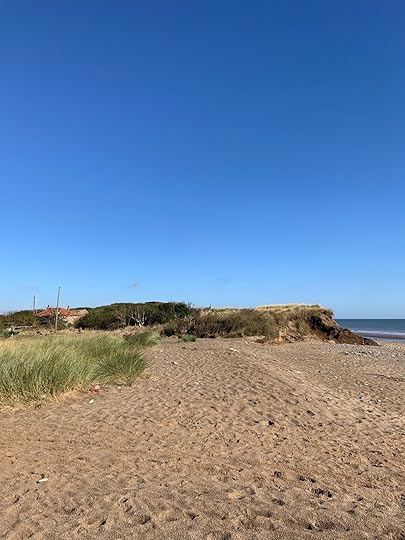 Kilnsea Spurn Heritage Park - barren, remote, and unique.
After a short walk and a coffee, it was time to head from the Kilnsea Heritage Coast up to Scotland. I stopped briefly for fuel on the outskirts of Hull and made my way north-west. Being a Friday, the traffic got heavier as I headed further north, perhaps other tourists and locals alike heading for weekend getaways.
The journey was long, and the stopover in Hull was not even halfway to Aviemore, my final destination for the day. From Carlisle there is not much until you hit the ring roads around Glasgow where I managed to get to just in time for rush hour. The drive feels like it will never end, but before you know it, you are at Stirling on the A9 for the last stretch. I enter the Cairngorms for the first time, taking a break in a layby for my first stop in 5 hours since Carlisle. I look around me and it is stunning but I am tired, and I know tomorrow will be even more tiring and I must continue.
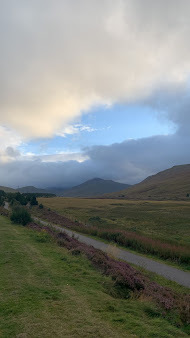 The view from the layby is probably one of the best in the UK.
45 minutes later I arrive in Aviemore, where I refuel at a petrol station for some extortionate amount (I thought petrol was supposed to be cheaper in Scotland?!) and grab a quick snack. I make it to my hostel where I check-in with some other Bhubesi Pride walkers Duncan Macdonald and Georgina Tibai for the first time. I drop off my bags, organise my belongings, and head on out to the local pub, The Pine Marten Bar, to enjoy a couple of soft drinks with some other Bhubesi hikers who had arrived earlier in the day.
To my surprise, I find that Ross Chipperton (a fellow Bhubesi Africa volunteer a couple of years after me) has travelled up from neighbouring Faversham, just down the road from Sittingbourne, where I live. Although, to my horror, there is a Mackem in the group - Keith Atkinson. I soon make friends with Geordie Iain McGeary so we take the piss out of him (lightly, I promise). Ross, Keith, and Iain have travelled up together and the trio are a good laugh, so I feel at ease with the group. Also at the bar is Corné du Rand, a South African former semi-pro unit of a man, who welcomes one and all to the group. There are a few others there whose names escape me. We enjoy the live music but before long we must return to our beds, for we have a long day in the morning.
We start bright and early, 6am wake up, for a 7am departure. I drive a group of 3 down to the start point while the rest of our motley crew have minibuses arranged. The walk begins, but one member of the Bhubesi hikers seems to have forgotten their shoes. None other than Marco Mama, former Worcester Warriors flanker and Bhubesi Pride ambassador and fundraiser too. I'm not much better, my shoes are neither hiking boots nor running shoes - in fact, like me, the sole is dead and I am soon to pay the price.
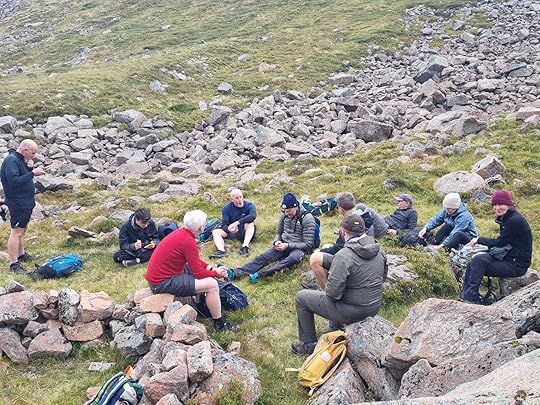 A quick rest stop.
The first 10km passes with a few blips, for the path is relatively flat at this stage. If we continue at the pace we are going, we are sure to finish well in time... or so we thought. The route from this stage started to become steeper with evermore uneven terrain. The nice path that the Lairig Ghru began with soon becomes full of shingles. Marco finds his shoes mysteriously 12 or 13km in, his feet well and truly battered!
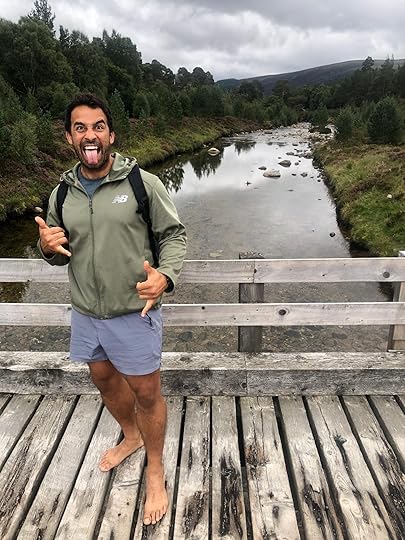 Marco mate, you forgot your shoes!
The terrain is manageable until we hit the scree fields that make up somewhere between the 20th to 23rd kilometres. It is slow passing, with every step requiring inch perfect precision for one wrong step or loose rock could break an ankle or even leg. There is no easy exit off the trail other than to complete the hike - that, or be have Mountain Rescue carry you down. In terms of muscular ability to do the walk, it was not relatively difficult. But the mind becomes so fatigued when you have to think about every step.
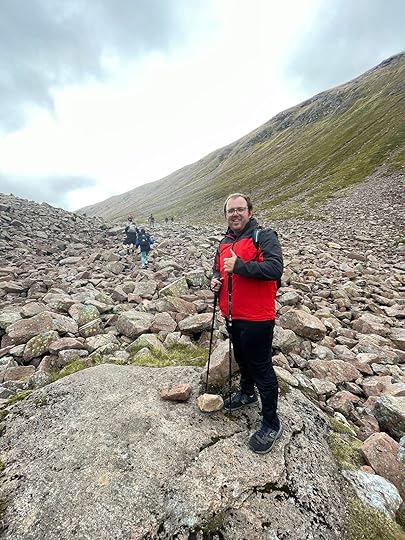 The scree fields of the Lairig Ghru are nothing to be messed with.
 After what seems like many hours, it is just me and Corné at the rear of the group trundling on down. The scree fields have passed, but my muscles and my mind are in a deep deep hole. It is by far the hardest thing I have done. We make it to a lodge where I refill my water. It is 5km from the hostel and the last 5km is the hardest 5km I have ever done. I, and everyone else, make it safely where we then have a brief turnaround before heading out for the evening meal. We are bruised, battered, but we have made it across the Cairngorms in one piece.
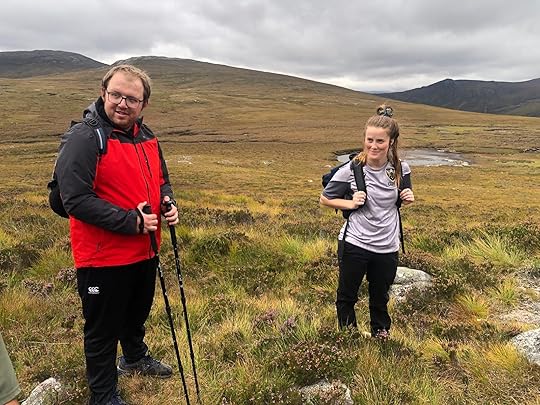 Myself and Ella, a Bhubesi Trustee
Before I know it, the weekend is over. Our festivities do not last long as everyone is beyond tired. In the morning, Richard gives Duncan and I a lift to my car. It is time for the long journey southward. Not before a quick stop to see my old friend Fred in the village of Trimpley, just outside Kidderminster. We catchup for an hour, but I have work the next day so I power through the final four hours back to Kent, finally arriving home at about 11pm.
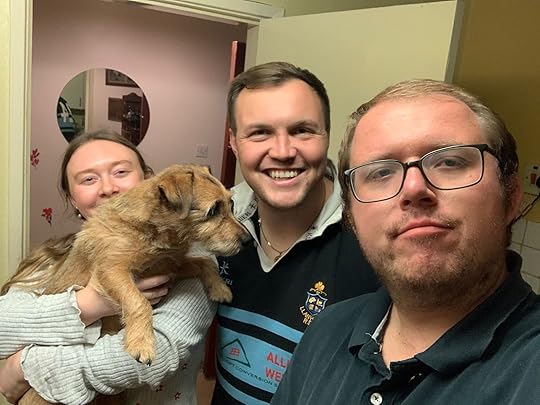 Catching up with Fred, Rosie, and Rocky enroute back to Kent.
It is now over a month since the epic adventure, and god knows where the time has gone. I look back on the weekend fondly and am proud to have completed the trek with a bunch of amazing people. We managed to raise £17k for Bhubesi Pride altogether, a fantastic sport-for-development charity in Africa which I am proud to help. Until next year, when we do it all again.
October 18, 2025
Bagged Yoghurt
My heart swells with emotion whenever I return to Baisogala. When I step into my Senelė's flat, I am stepping back not just in time, but into the world when I was a child growing up, spending summer's there. Much of the flat has been unchanged in decades - the smell as you walk in, the wooden flooring, the hundreds of books - it all makes it an extremely special place.
As I look out the front main windows, I am greeted by the Chimney Crow on the rooftops of the flat opposite. Perched up on a chimney, he sits, umbrella in hand, observing the world around him. It is a peculiar monument, one which I do not know the history, but one which I have loved to look at over the years. I often forget its existence until I'm in Baisogala, but once I look out the window, I remember I am home.
An age-old tradition is getting bagged yoghurt and sitting in the kitchen, pouring it into a glass, and drinking it as if it were water. It is so basic, yet it is so satisfying. For some reason, yoghurt from a bag is so tasty in ways that the British don't understand. I simply love it.
We try not to finish the bagged yoghurt in one sitting, in part because I am lactose intolerant but, more importantly, to save some for later. When it's my first day back I like to soak in the emotions and feelings the flat surfaces in me. I take some time to look at the photos, the old books, the various memorabilia from Lithuania and around the world, for all of Senele's children (including my mum) have travelled to all corners of the earth at some stage or another, including Senele!
The old wallpaper is faded and in some parts peeling from the walls and is probably due a change. But in a way, I never want it to change. To change the home materially may change my experience of the place... well, that is my fear anyway.
Before bed, I will go into Senele's room (my mum associates this room with her Dad, my granddad, as it was formerly my his room, although I never met him and so myself associate with Senele). In the drawers of her desk, I will go through them one by one - here is where the magic is. Various documents from all different parts of history are in here, some of it feels it should be in a museum. The most interesting thing I've found being a documents for someone (not Senele or anyone in the family for that matter) during the German occupation of Lithuania during World War I.
After an hour or so of being nosy and rummaging through her drawers, I retire to bed. The bed is a collection of cubes which can be used as stools, combined to make a sofa, or in our case - a bed. It is the same one I slept on as a kid. Despite slightly more comfortable options in the flat, I choose it because of its the final piece of the puzzle that confirms to me where I am.
I usually try to stay up as late as possible, reading, watching TV or laptop, or anyway to distract myself really. But the nights in the village are quiet and dark, especially in winter, so it is never long before I slumber off to a good night sleep. Waking up in the morning is usually bittersweet, for it usually means we are one day closer to having to leave. I could spend a month there without getting bored.
Then it's off to the kitchen for some bagged yoghurt, or what is left of it...
September 16, 2025
An Ode to Vilnius 🇱🇹
Walking around the Old Town streets of Vilnius fills me with a nostalgia for a time in my life when, at the time, things didn't seem so simple. Amongst the churches, cobble roads, and historic buildings, there's a plethora of memories that come up and make me appreciate the 7 months or so that I spent in this city.
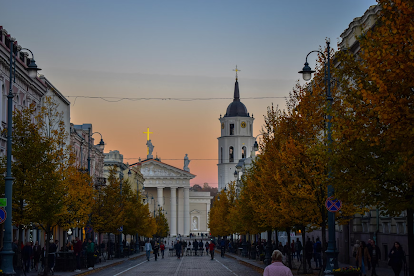 Vilnius Cathedral from Gedimino Prospectas. Photo by Dan-Marian-Stefan Doroghi on Unsplash
I moved to Lithuania with hopes and dreams of pursuing a career in rugby - with an ultimate goal of growing the game and helping take the national team to a World Cup one day. I knew the money wouldn't be great, but I justified it in my mind that I would at least be pursuing a worthwhile cause.
At the time, I was on a salary of €400/month, the minimum wage in the country at the time. After taxes, I was on a take home pay of just over €300. My rent for a one-room studio was €200 in a 'not so nice' part of the city and my monthly travel ticket was €30, leaving me with just €70 to feed myself and any sort of semblance of a social life.
It's fair to say I live relatively comfortably now. I have enough money to buy whatever I need, save up to travel, and socialise a few times a month if I wanted to. As I walk around Vilnius today, it brings me back to a time where I could only soak in and appreciate the views. Using my public transport travel ticket, I would come to the city centre and walk the narrow alleys of the famous Old Town. While others would sit in cafes enjoying a coffee or a meal, the best I could do was look through the window. At the time, the simple act of appreciation was value and entertainment in and of itself.
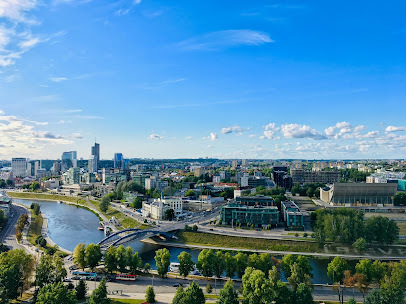 The modern city of Vilnius with the city's CBD with modern high rises in the distance. Photo by Reza Bina on Unsplash
So when I come back on trips today, it means so much more to me to be able to sit in a cafe and enjoy a simple coffee. As the economy of the country continues to grow, new unique and boutique shops, cafes, restaurants, and other cool spots pop up all the time. Year after year I come back and the city appears to be more and more modern, hip, cool, and trendy. This isn't a bad thing - just a sign of the times.
The minimum wage has raised from €400/month from when I was there to now over €1000/month for a full-time job. Standards of living are raising to western European standards and, in some aspects, the quality of life is much better. Young people are no longer leaving the country in the droves that they were for decent paying work. Vilnius is now a thriving hub for the IT and banking industries. Wifi and mobile data speeds in the city and country at large are some of the fastest in the world. If anything, more foreigners and expats appear to be moving to the city nowadays. It truly is a thriving international hub.
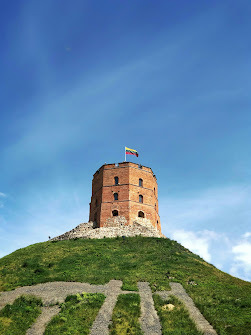 Gediminas Castle Hill. Photo by Victor Malyushev on Unsplash
That is not to say that Vilnius and Lithuania are without their own problems - villages and towns around the country continue to experience the brain drain to urban areas and some parts still remain largely undeveloped since the days of the Soviet Union. But when I compare my experience of living in Vilnius six years ago, the city has improved ten-fold. If the opportunity arose, I would love to come back and have a "do over" of my time living in the city. While I believed my cause was noble, my financial situation at the time effectively negated my ability to fully enjoy the city. If I were to come back, I would want a decent paying job, matching how much I make currently, with a decent apartment on the edge of the city centre somewhere, not a half hour bus ride like I used to have to take.
I'm not sure where I was going with this blog post - but I guess you could take it as an appreciation post for a city I love and that you should go and experience for yourselves one day. Sit in a cafe, see the architecture, or if you can't do that - just soak it all in and enjoy the experience.
July 4, 2025
How (Not) To Run A Hostel: The Curious Case of Romeo and Relax Hostel 🇦🇱
Today, hostels are found all over the world - from the largest cities through to the smallest towns and villages, offering socialisation, a cheap place to sleep, and in some cases a basic breakfast too. They come in various shapes, sizes, and quality - and lord knows I've stayed in a fair few dodgy ones in my time. Hostels are for solo travellers, groups, couples, and everyone in between. Hostels should be an all-encompassing place that offer a warm smile after a long travel day, open to one and all.
Well, that's how it should be - it doesn't always end up like that. Hostels are becoming more and more built by large-scale chains and corporate entities that end up as a cheap hotel, rather than the backpacking hostel they try to advertise themselves as.
The true backpackers hostel is on the decline as they struggle to keep up with the high-tech card keys, free breakfasts, and memory foam bunk beds that can be on offer at these chain hostels for the same or sometimes better price. Despite the world becoming a more open place with visas becoming easier to get for citizens of countries around the world (this is a broad generalisation, but travel is becoming more frictionless overall), as a people we are more closed off than ever. We spend more time on our phones, more people choose to work remotely and spend time on their AirPods instead of socialising. These are all reasons for the decline of a true social, backpacker hostel.
But sometimes hostels fail because the owner just doesn't quite get 'it' - and that was definitely the case with one of my favourite hostels - 'Relax' Hostel, which was based in Himara, southern Albania. One of my favourites because of its location - Himara is a fantastic beach town in southern Albania with deep blue sea, fantastic views, and plenty to do. It was a fantastic hostel because the owner Romeo was eccentric, funny, and in all senses of the word - a true hippy.
Background
After attempting to walk across Albania with my good friend Fred, I had to pull out at about the halfway point. Both my feet had been engulfed in blisters, my knee was in considerable pain, and I'm sure both Fred and I were at varying degrees of sunstroke. Fred did continue however, but I just couldn't find it in me after two extremely long and gruelling days of walking.
It was from the central town of Elbasan that I accidentally ended up in Himara after trying to get to Vlore, one of the coastal cities. The bus became too full to the point where I could not actually get off. The last stop was in Himara so I just kind of stayed on until there. My logic was that I'd stay the night there then head back the following morning. I had actually planned to come to Himara, just after a few days in Vlore first.
After getting off the bus in Himara, I began walking up the high street looking for another hostel I had found on my offline maps that had been listed and, while walking, a man from above shouted down to me, "Hey backpacker! Hostel?" "Yeah!"
As I walked up the stairs and into Romeo's hostel, little did I know that this would be a canon event - a place that would become mythical legend in years to come. The hostel was clean on the surface - it would do for the night. Beach towels were provided free (cleanliness questionable but ok for a beach towel), breakfast was provided in the cafe downstairs, and the bed was simple but, again, would be absolutely fine for a budget backpacker like myself. It was definitely a beach hostel and feeling grains of sand on your feet combined with the salty air from the Adriatic Sea opposite really did evoke nostalgic feelings of beach holidays as a kid.
Despite the initial good impressions early on, a few problems became apparent early on which really were early signs of the hostel's eventual demise.
Problem 1: Anger management?
At my first stint of Romeo's Relax Hostel, I was one of two guests, the other being a middle-aged German lady who herself was a bit eccentric, but that is to be expected for most middle-aged people who choose to stay in dorm rooms at backpacking hostels (nothing wrong with that, it's just you do have to be a little bit eccentric to choose that over a nice hotel let's say). As Germans stereotypically are, she was a bit brash and I think as an individual struggled to pick up on social cues.
Romeo seemingly became unhappy after finding that the German lady had used some of his personal belongings (the hostel doubled as his home) to which he became quite irate and rather angrily kicked her out of the hostel unceremoniously. While, if she had indeed used his belongings, his reaction may have been understandable - surely a more professional response would have been in order. Nevertheless, I liked the hostel and Romeo had been perfectly reasonable with me.
It seemed that Romeo lived this double life, whereby if you were in his good books, you would have a fantastic hostel experience - home cooked omelettes, free kayak use, a warm welcome. But if for whatever reason you did something that maybe he considered bad, then you would feel Romeo's wrath. Unfortunately for unsuspecting guests, these weren't infrequent events and many would feel the tension from time to time which meant that these guests often ended up leaving poor reviews of the hostel, which lead to another problem...
Problem 2: Google Reviews - Good Reading, Bad Publicity
As customers came and went - a good 50% of them would seemingly have a bad experience and so, naturally, this translated into online reviews. While any normal hostel owner might change their attitude, take a personal reflection, and learn from them, Romeo doubled down and would leave unprofessional, yet absolutely hilarious, responses to reviews left about the hostel online.
In August 2019, a couple of years before I stayed there, the hostel seemingly burnt down after Romeo was passed out drunk on the terrace after leaving candles on. They attach a photo of the burnt down hostel and an emotional warning for travellers not to stay there or risk their lives (thankfully I did not see this before my own visit there, otherwise I may never have gotten to experience the 'relax' at all!).
 Exhibit A
 Health and safety? Nah man, just relax 😎
While Romeo's response to the above review was relatively chilled, it seemed like he could have used his own advice in this next review, where someone accused him of having a mental condition and hooking up with female guests out in the open:
 Exhibit B
Of course, there's a lot of 5-star reviews listed too - Romeo and his hostel were very polarising. I'll leave it to you to search and find them all - but these are just two of the responses I found which fail to address genuine concerns of paying customers. Unfortunately, in a town such as Himara which is famous domestically and an up and coming destination for international tourists too, reputation is just so so important.
While it is possible to survive on luring in clueless backpackers who stay on a bus too long like me, it's not sustainable when the majority of travellers to the area will look to pre-book and pay for a hostel/hotel upfront.
It seems that Romeo did become aware of this and did try to change a few things...
The Rebrand: Too Little, Too Late
After I left Albania, I was fascinated by Relax Hostel. It had become a thing of mystic and interest to Fred and I and as such, I continued to follow reviews left on it. I just found it so fascinating and interesting, not so much the reviews - but the response to the reviews as I've shown above!
Slowly but surely, the negative reviews overtook the positive ones and it got to a stage where the hostel, which was once positively rated, slowly became the bad egg of Himara hostels. Romeo seemingly recognised this and began a rebrand and changed the name from 'Relax' Hostel to 'Don Hostelo' (don't ask what that means because I don't have a clue). Despite this name change, the poor reviews kept coming in - it was clear that Romeo failed to learn anything and simply hoped that if he changed the name of the hostel, all the old reviews would disappear? Obviously this failed and, like the old saying goes, doing the same thing but expecting different results is the definition of insanity.
I recently learnt after a quick search that Relax Hostel/Don Hostelo was no more. Google lists it as 'permanently closed'. Despite this being official recently, I had had this fear as I did manage to go back to Himara in May 2023 and tried to visit the hostel - but no one answered the door when I knocked.
The End of an Era
In a world of ever more commercialised hostels and the owners being men in suits many miles away, the days of hostels being run by eccentric hippies is slowly dying off. For young backpackers who aren't too bothered how clean a hostel is if the vibes are off the charts, Relax Hostel was perfect. One could sit out on the terrace, enjoy the sun, read a book, and love life. It was a thirty second walk from the beach and sat on top of the main strip where you could get cheap, delicious food, drink a coffee, or even hire a moped all within the space of thirty metres of each other.
Unfortunately the world of commercialised travel, where people can post a review of their experience online to share with the world immediately for millions to see, has made it harder for the eccentrics like Romeo to stay afloat. And that's no excuse for his behaviour and professionalism at times, but I do feel the world needs more hostels run by hippies who are a little eccentric, not chain hostels run by men in suits and CEOs.
However, as can be seen with the curious case of Romeo and Relax Hostel, there still has to be a level of decorum and professionalism so that the art of backpacking can continue to live on not just in Himara, but around the world.
"Every one of us is with a mental condition, I'm not gonna judge your condition." - Romeo
June 27, 2025
An 'Extreme' Day Trip to Oslo, Norway 🇳🇴

Norway is, notoriously, one of the most expensive countries in the world. When I've looked to visit Oslo before, the price of the cheapest hostel would set you back £60 minimum for a bed in a shared dorm, which easily priced me out in my earlier days of travel. For that price I could get a cheap flight to a less expensive country and spend a week in a hostel. It is definitely not a destination for backpackers on a budget, so I knew I had to grab the opportunity when the flights were available and the timings were good.
My flight departed from London Stansted at the reasonable time of 08.20am, meaning arrival in Oslo was a respectable 11.05am. Annoyingly however my free random seat was in the middle of the plane which meant I was one of the last to get out and, in addition, one of the last to get through immigration control which was also painfully slow. It did not help the immigration officer viewed my travel plans with some suspicion. He really could not understand the concept of going on a such a short trip to a place and even spoke to a senior colleague regarding my concerns. Eventually he let me continue on with my trip thankfully.
Oslo's Gardermoen Airport is still a 50km journey to the city centre so it's not a case of a short bus transfer from the airport in other cities (like Vilnius, Lithuania or Prague, Czech Republic for example). This obviously added to the time from landing to arrival in the city centre (and the same on the return journey) but public transport is efficient in Oslo.
There are two main options for getting to central Oslo from the airport. The most advertised and promoted way is the Flytoget express train, which takes 19 minutes and will set you back 252 NOK for a one-way journey (~£18.83). You will see ticket machines for this everywhere on your arrival and big posters advertising this "non-stop express trip" into the city centre. Or you could take the Oslo Public Transport train, run by a company called Vy, for just 129 NOK one-way (~£9.50) which takes just 4 minutes longer and will get you into the centre in 23 minutes. It is by far the better option and unless you have business which can't wait an extra four minutes, then the Vy train is by far the better option for budget-savvy travellers (or any travellers to be honest).
If, however, you are doing a short day trip like me, or even just spending 24/48 hours in Oslo on a quick city break. I believe there is still one superior option which should be considered - and that is the Oslo City Pass. Most major tourist destinations will have something similar which tends to include unlimited public transportation, free entry into a number of museums, and a number of other discounts at selected stores and restaurants, but I find that they are rarely ever worth it. In my opinion, the Oslo City Pass is definitely worth it if only in the city for 24 hours. I paid 550 NOK (~£40.43) for mine, which you can directly download onto your phone as a QR code using the Oslo Pass app for added convenience.
Included in the Oslo Pass app:Public transportation on any mode of transport from zones 1-4 (this includes the airport, but not the Flytoget Express train mentioned earlier). A day ticket including these zones would set you back 303 NOK (~£22.24).Access to the Bygdøyfergene Ferry, which takes you to the Bygdoy Peninsula, where a number of fantastic museums are located. This is not included in any Oslo Public Transport ticket however and you would have to pay an extra fee - which is 115 NOK for a day/return ticket (~£8.44). Without this ferry, you would have to take a 40 minute bus and metro ride the long way around to the peninsula. 31 museums - obviously you cannot visit that many in 24 or 48 hours, but find one that piques your interest and save yourself some money in the process. I visited the Fram Museum, which I'll discuss in a bit, where the normal entry fee would have been 180 NOK (~£13.21).Just by using those three benefits of the pass, I saved £3, which might not sound like a lot, but it just made everything so much easier as well. I had pre-downloaded the app and activated the pass as soon as I landed. No waiting at ticket machines, no faffing about with paper tickets worrying about losing them, just getting on with the limited time I had.
After arriving at Oslo Sentralstajsion, I jumped on a tram and headed to Aker Brygge, a trendy part of Oslo on the waterfront. In my research beforehand I found a cafe called Supreme Roastworks, which not only had great coffee and customer service, but a Porsche parked inside the shop! A pretty unique spot for a coffee if you ask me.
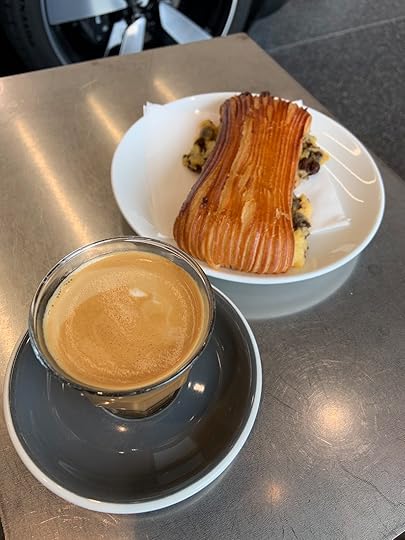 Cortado and pain suisse at Supreme Roastworks
A cortado and pain suisse was the perfect start to the trip and fuelled me up for my next stop. A short walk from Supreme Roastworks was the Bygdøyfergene Ferry, which departed from Pier 3. Just keep an eye out for 'The Museum Ferry', there are plenty of signs. With my Oslo Pass, it was free and, ten minutes later, I was on the Bygdoy Peninsula right outside a number of fantastic museums. The Viking Ship Museum, located on the peninsula too, is listed by Patricia Schultz in the 1000 Places To See Before You Die. However, unfortunately for me, it is closed until later on this summer I'm told. On the flip side, I visited the Fram Museum, which is a museum about another historical boat, The Fram, which is/was the largest wooden boat in the world and was famous for its various explorations including both the North and South Poles. The museum was excellently laid out and getting the chance to walk through the boat, seeing the history and living conditions was just such a cool experience. While I am not an expert or enthusiast in marine history, the museum felt very much like an ode to the many travellers who came before me, who often times set out on the open ocean facing treacherous conditions, not knowing if they'd ever come back. But they had a vision to explore and discover the world around them, making it possible for people like me to explore the world in my own way decades later. I highly recommend the Fram Museum if you are ever in Oslo.
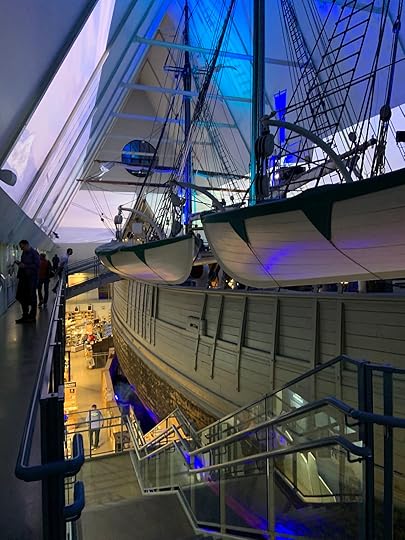 The Fram Museum
Climbing to all different decks and exploring the small inner-workings of a wooden ship is tiring, so I built up quite the appetite after exploring The Fram for the better part of an hour and a half. I jumped back on the Bygdoy Ferry back to Aker Brygge and headed to my next port of call for a decently priced lunch. With such a short time and limited budget in somewhere as expensive as Oslo, it is important to do your research and find places you want to go to - there are limited budget options and you don't want to waste time researching on the spot. A few stops away on the tram was Oslo Street Food, a huge indoor street food market with a number of different stalls and food options. I opted for Chinese (there's not many budget Norwegian food options in Oslo as most locals tend to like to eat foreign food!), with a huge portion of orange chicken and rice. The meal set me back 195 NOK (£14.33) and a Sprite to drink was 50 NOK (£3.67). For the better part of £18, I couldn't really complain given how much food I was given. I struggled to finish it but it set me up for the latter half of the day really well.
After a brief food coma, it was already 4pm and the day was getting on - there was still a number of things I wanted to see and do - the next of which was the Oslo Cathedral. Unfortunately when I got there I was told it already closed, but there was an opportunity to enter now, if I wanted to see a free organ concert... and by God I said yes! In the world of solo travelling, you are often left to your own devices and as a result, you sometimes get these fantastic opportunities to experience something you never would have otherwise. And this certainly was that - I walked inside and admired the beautiful cathedral. It was simplistic, yet beautiful, probably because it was a Lutheran Church as opposed to traditional Catholic cathedrals with their stain-glassed windows, statues, and whatever else they like to put up to show their wealth. The architecture was magnificent, efficient, much like Norway itself.
When the concert started I was so pleased to have said 'yes' to this opportunity. While the music itself wasn't Norwegian, it was a number of works by German musicians such as Bach through the centuries, it was still really enjoyable! I allowed myself, for the better part of an hour, to let the music overcome me - no phone, no camera, just really enjoying the moment. Who knew organ music could be so entertaining?! At the end of it all, the organ player came out from behind us on the second floor of the cathedral, raising his arm in thanks. Everyone else there were his family, friends, and a few other tourists like me. The applause was raptuous, and deservedly so. I left their with a real sense that I had gotten a truly unique experience. It really was the highlight of my trip.
 Oslo Cathedral
I came out of the cathedral and it seemed my little side quest was timely, as it had clearly rained upon exiting. Nevertheless, the brief shower was over and the evening sun was coming back into view. My next stop would be Harald's Vaffels, a waffle shop about a 15-minute walk from the cathedral. It was highly recommended online and is seemingly quite famous in Oslo, although I was the only customer when I was there. While waffles are not generally specific to Norway, I opted for the 'Superclassic' waffle - with brown cheese (a Norwegian delicacy), sour cream, and jam. Boy oh boy was it good - the brown cheese was the real selling point and while it may not sound particularly delicious, it definitely was. In the warmth of the waffle it melted in your mouth to add almost a subtle caramel flavour to really bring everything together. To top it all off, the server had made an extra waffle by accident or in the process, and she offered it to me plain for free, which was a nice gesture too!
 The Superclassic waffle from Harald's Vaffel - strawberry jam, Norwegian brown cheese, and sour cream!
Filled up with good vibes, a waffle, and my yearning for adventure filled - I made my way to what would be some of my last stops of the trip. I hopped on a tram to the other side of the city and walked to the top of the Oslo Opera House for fantastic views in all directions of the archipelago that makes up Oslo. Definitely worth visiting while in Oslo.
I wound out the day with a soft drink in the corner of a chill bar where I journaled my thoughts and reflections. The trip had been a success and brought back memories of previous solo adventures. The yearning and quest for a solo trip full of (relative) spontaneity and new experiences really did happen, even with my rough plan. It just goes to show that sometimes you've just got to say 'yes' to something you really did not expect or seek out for - for you to have a truly great travel experience.
April 26, 2025
Getting Lost, Found, and... Frank Lampard?! A Roadtrip Across Northern Albania and Kosovo 🇦🇱 🇽🇰
It's fair to say I'm a big fan of Albania - I have written an entire book based on my travels there a few years ago. The people, the food, the culture, the history - the list goes on and on as to why I love it there so much. I've even gone so far as to declare myself the unofficial 'Secretary of State for Albanian Awareness' in my Instagram bio.
 Fred (R) and I somewhere near Himarë in southern Albania on our first trip in 2021. Since my first trip to Albania in 2021, I have been two more times. Once with my friends Jack and Stefan in 2023, whom I met in Syria, and the most recent time with Frederico (aka Fred) in January of this year, where we went back to our old stomping grounds in Northern Albania and explored further afield into Kosovo.
 During our first adventure in 2021, Kosovo was closed off from un-Covid tested tourists and so it wasn't as simple to visit. Fred got a fake Covid test and managed to visit Prishtina, but I wasn't able to visit Kosovo until a solo trip in 2023. Kosovo is majority ethnic-Albanian and while it is largely run as its own country (despite not being a UN member state) there are large portions of its population who eventually want to unite with Albania in the long term, once its own independence is fully guaranteed on the international stage.
When Fred and I first flew into Albania all those years ago, the flight was mostly empty. Apart from us and a few locals, no one was going to Albania. Tirana Airport was one runway and one very small terminal. When we returned in January that had all changed - Tirana and Albania is seemingly becoming an ever more popular destination for western Europe's working class who cannot afford expensive cosmetic surgeries at home. It seems that these surgeries are much cheaper than traditional cosmetic surgery heartlands such as Istanbul. The flight was filled with people who we would never associate with Albania - girls with lips filled to their max, makeup, and fake eye lashes. It seemed Fred and I were the only two rough house backpackers on the flight, I don't even think there were any locals.
Albania's Hidden Coastal Gem: The Cape of RodonWe wouldn't be staying in the bright lights of Tirana very long however. We had a pre-booked rental car which we picked up in no time and were soon off to see places new and old. First stop - the town of Fushë Krujë, where George W. Bush had once met the Albanian President on an official visit. I believe part of the love also comes down to him being the first American President to ever visit the country. This town is practically dedicated to George Bush with a themed bakery, cafe, and burektore (burek shop). There was even a statue of the man! Revered here in Albania, largely disliked in the rest of the world. Nevertheless, it was a unique quirk of Albania to have a place like this, and part of the reason why we liked it so much. A quick espresso (the drink of choice in these parts) and a burek was all the fuel we needed to continue our journey northward.
 A coffee under the watchful gaze of George W. Bush in Fushe-Krujë.
.jpeg) The George W. Bush Bakery offers the best bureks in town.
The George W. Bush Bakery offers the best bureks in town.Next up was the Rodon Peninsula, a true hidden gem on Albania's coast line. It was a fair drive up steep mountain roads and, although there had been an attempt to grow tourism here, it was evident that this had clearly failed. Nevertheless, it was absolutely worth the journey. At the tip of the Cape of Rodon Peninsula stands the Church of St. Anthony, which dates back to 15th century, although it was rebuilt after a large earthquake in 1852. As you look back at mainland Albania from one of the half-destroyed jetties that pokes out into the Adriatic Sea, you see the incredible snow-capped mountains that make up Northern Albania's rugged heartlands and which became mine and Fred's favourite place. There's not many places in the world with this kind of view - I've seen it on documentaries about Canada and Alaska perhaps, but right here in the heart of Europe? I never could have imagined.
 At the tip of Cape Rodon it's possible to stand on the white sand beaches and look back at the snow-capped Albanian Alps. Breathtaking.
 We can't gawk at the views for long though as we have to return back through the peninsula, back onto the mainland, and continue our journey northwards to Shkoder, the town Fred and I spent a week in back in 2021. It was there that we mastered a few Albanian phrases and really began to fall in love with Albania.
 Church of St. Anthony on the Rodon PeninsulaRe-living old memories in Shkoder
After checking into our hotel, our first port of call was 'manic roundabout', a place that became a thing of folklore on our original trip. We stayed in an AirBnB above manic roundabout all those years ago where we observed the lawlessness and carelessness of the Albanian road network. It was a roundabout where give-way rules were optional - every man, bike, and car for themselves. We watched as cars would park in the middle of a moving roundabout, simply leaving the hazard lights on to indicate to other roundabout-users that they would be back in a jiffy. Upon our reunion with the legendary roundabout however we were disappointed to find that it had been modernised with traffic lights, zebra crossings, and suitable parking nearby.
What had happened? Why the modernisation? The lack of health and safety protocols were exactly what made Albania the beautiful place it was! Perhaps all the increased government tax revenue from working class westerners who had come over for their cosmetic treatments and surgeries was really being reinvested back into the communities instead of ending up in some regional mayor's pockets.
But it's not the road network or health and safety measures that make a place - it's the people. After the disappointment of the roundabout, we returned to our favourite restaurant, cafe, and burektores in search for those same experiences we once had. The people who worked in the places had changed, but the institutions they worked in and the products they served remained the same - this was great to see. Despite Shkoder being only the 6th most populous town in all of Albania, it was the main population centre in the north and the gateway to the Albanian Alps and, as such, meant that the tourists who come here are rugged adventure seekers, our kind of people. It had yet to be transformed into the cosmetic surgery hub that Tirana was slowly becoming.
 The Albanian Alps are a perfect destination for backpackers who love to travel 'off-the-beaten-path'. Here I am sat on a rock, surrounded by snow on the Valbonë-Theth trail in June 2021, where I developed my love for Northern Albania.
Restaurant service is slow in these parts, once your order is taken you have to grab the attention of a waiter to be served again or get your bill. That's just the way the culture is here. So if you expect 5 star treatment here, think again. But if you want a fairly uninterrupted lunch where there's no pressure or hurry to move on, then Albania is the place for you. You could sit in a cafe for hours nursing one or two coffees and there'd be no pressure for you to leave.
Shkoder still had the unique charm that we came to love. Yes, parts of it had modernised since we'd last been here but that's not unique to Albania, that will happen with every place you visit. We walked around the city till late in the evening, enjoying coffees in any place that would have us before returning to our hotel before another long day of travelling.
Going back in time in KosovoThe next day we awoke bright and early to continue heading north-easterly, towards Kosovo, which we can safely say is an extension of Northern Albania. In Kosovo they speak the Gheg dialect of Albanian, which is also spoken in Northern Albania. As mentioned earlier, the people and culture of Kosovo are Albanian with a long term view to return to the Motherland.
Our first stop before crossing the border would be Kukës however, in Albania's north-eastern corner. It was a grey-skied day and as such Kukës came across as very drab to us, especially after visiting the Rodon Peninsula and historical Shkoder. The E851 road to Kukes is of incredible quality and some research confirms my suspicions that this road was, at least in part, funded by Americans looking to boost "cultural and touristic" ties between Albania and Kosovo. Although I have my suspicions the road makes for easy access between Albania (a NATO member) and Kosovo (one of the few places where NATO has engaged in active conflict) for the movement of military personnel and equipment.
Kukës was dull but unique and it's easy to see why the stereotype of Kukës Albanians is those who end up emigrating. Next up was Prizren, another fantastic historical city in southern Kosovo. Fred and I illegally parked somewhere in Albanian fashion and climbed to Prizren Fortress in icy conditions, a good 93 metres of elevation gain on what is usually only a 650 metre walk. Bear in mind this was all done with no oxygen, no sherpa, just the spirit of the Albanian double-headed eagle urging us on. Kosovo is one of the few places where Brits are looked on favourably after we helped the KLA (Kosovo Liberation Army) defeat the Serbs during the Kosovo War of the 1990s and as such we were greeted warmly and with a big smile from the security guard on top. We were also one of the first countries to recognise Kosovo's independence in 2008 just one day after they declared it.
 Prizren Fortress at the top of the hill with the Old Stone Bridge in the foreground.
Following the climb we enjoyed a succulent Kosovar meal at a relatively upscale restaurant where the challenge was to spend €20 (after crossing the border the currency switched from Albanian Lek to Euros, despite Kosovo not being part of the EU/Eurozone). Despite ordering drinks, starters, mains, and sides the total for both Fred and I still came up short. Kosovo really does represent good value for money all things considered.
 Playing pool in Gjakovë
We returned back to the car to find it had not been towed, ticketed, or keyed and as such continued our journey unscathed towards Gjakovë, a smaller city where we would be staying the night. It's a fantastic little city centred on, once again, a historical bazaar and stone-tiled old town. We didn't have a lot of time in Gjakovë apart from a few hours in the evening. It's a small city and during the week there wasn't a lot going on, so Fred and I headed into town and enjoyed a bar hop which culminated in visiting an underground pool hall. It was like stepping back in time 30 years or more as the town's youth transcended to play pool on this frosty January weekday night. Kids as young as 11 and 12 years old were playing pool, smoking unfiltered cigarettes, and drinking pints of lager. We couldn't quite believe it, but hey - this was Kosovo, we weren't in the European Union anymore with its crafty health and safety regulations and underage smoking laws.
 Albanians run on espresso. As they say, when in Rome...
The next morning, after an espresso in a cafe that was blaring drum and bass rave music, we continued northward, hoping to reach parts of Kosovo that were less "Albanian" and more contentious. We would be staying the night in the northern half of Mitrovicë, the Serb majority part of that divided city, but more on that later. From Gjakovë we headed to Pejë, where the Serbian Orthodox Peč Monastery is located, a World Heritage site. Once again, given the time of year and its location, we were the only tourists in this incredible place. Various murals marked the walls which Fred and I gawked at. The monks who came and went gave us some serious side eye, probably wondering what these two bumbling Brits were doing there.
 The murals of Pejë/Peč Serbian Orthodox monastery, a UNESCO World Heritage site.Frank Lampard and the elderly hitchhiker
Once we had spent enough time irritating Serbian Orthodox monks, we continued our journey towards Mitrovicë in a haste given we were pressed for time. We still had to get to the city, explore, spend the night, and get back to Tirana for our flight in a day and a halfs time. Up until now, although there had been a few highlights on our journey so far, nothing had stood out as "the moment" so far. That was until we decided to pick up an elderly hitchhiker in the village of Rakosh...
Fred and I were indebted to the Albanians who had been a part of our amazing journey back in 2021. Be it the people who picked us up when we were hitchhiking or the ones who bought us a coffee as we attempted to cross the country on foot. The warmth and generosity of the Albanians really made our trip so special. We made an agreement when we picked up our rental car that we would pick up any hitchhiker we came across. Until Rakosh, we simply had not found any suitable hitchhikers (we had seen a few, although they had been in bad spots to pick up or otherwise looked a bit 'rough').
This elderly gentleman came into view on a straight stretch of road as we were going up hill - we had plenty of time to see him, it was easy to stop, and he was clearly waving us down. The first problem arose after we stopped the car and got him in - he didn't speak a word of English and our Albanian, as much as I brag that I know a few phrases, really didn't get us far with this village elder. It turns out "hello", "how are you, good?", "how much is it?", and "where is the toilet?" really didn't turn out to be much use when trying to find out where the man was going. We established through hand gestures and Google Maps that he might have been going to Runik, a village up the road, however when we tried to drop him off there he refused to get out of the car.
We continued on towards Mitrovicë, thinking that at some stage he would ask us to pull over to let him out. I knew we had gone too far when we reached a roundabout which was also a crossroads, one road to Mitrovicë and the other towards the town of Skenderaj. Fred and I tried multiple times to indicate to the elderly gentleman that we were going to Mitrovicë who remained none the wiser. Eventually we managed to hear him utter the words "autobus stacioni Skenderaj" (I don't think it takes a linguistic expert to make out that this means 'Skenderaj Bus Station'). Alas we headed there and once again, upon arrival, our elderly friend refused to get out. By this point he began to get more and more agitated and we were stumped as to what to do with our new friend. Fred was tasked to get some help.
Fred got out of the car and approached the first man he saw, unsure if he was staff or a bus passenger, but at this stage it didn't really matter, we needed any help we could get.
"Do you speak English?" Fred asked.
"Mmm yes." The man responded, almost Borat reincarnate. He started to gesture the word for 'little'.
"A little?" Fred confirmed.
"Yes!" The man responded enthusiastically, as if the word was on the tip of his tongue and not due to the fact that he actually could not speak English.
Fred used his charm and explained the situation in as basic English as possible for the man who agreed to help us (although I'm not sure he even knew what he was agreeing to). At this point, there was a verbal exchange in Albanian before our new friend dragged the elderly man out of the car and told him to catch a bus! Our new friend's attention turned to Fred and I. What happened next was so bizarre I simply could not make it up if I tried.
 Frank Lampard has a fan club in Skenderaj, Kosovo. Credit: Bloomberg
After finding out we were English, he pulled up multiple saved pictures of Frank Lampard, both as player and manager, and showed them to us before proudly saying the words "Frenk Lemperdi, Frenk Lemperdi!" We gave him a thumbs up and said "yes, great player!" which only encouraged him more. At one point he showed me a photo of Frank Lampard, pulled his phone back to search for another photo, then showed me the exact same photo again! When it wasn't Frank Lampard he was obsessing over, he showed us a friend of his supposedly in the French army. When I stated his friend was "very big, very strong", our friend got very excited and said "YES, BIG STRONG." All the while our elderly hitchhiking friend stood staring into the distance, not knowing who or where he was.
With our elderly, dementia-riddled friend now safely (we kidded ourselves) in the hands of Skenderaj's Frank Lampard Fan Club President, we swiftly rejected his offer for a coffee under the premise we had urgent business to attend to in Mitrovicë. Fred and I left the town as fast as we could, fearful that we may have just accidentally kidnapped the old man from a village he's maybe never left and is now in some random town's bus station. The mad adventure was over.
Mitrovicë - The Most Divided City in Europe? After the scandal in Skenderaj, Fred and I hurried to Mitrovicë where we would be spending the night. Our hotel, the Ador Hotel, was in the northern half of the city, our first time in a Serbian-majority area since beginning this trip and immediately the vibe was very different.The city is divided by the Ibar River - on the north is the smaller, Serb majority part of the city. The buildings are drab and reflective of what this city was like perhaps in Yugoslav times. There are statues and monuments to various Serb heroes and legends. Shop signs are in the cyrillic alphabet of the Serb language. Some places even list prices for goods in Serbian Dinar. We once again hike up (sherpaless and oxygenless of course) to a monument for miners from the city who lost their lives in World War II which was clearly an interesting relic from Yugoslav days. Also at the monument was a half destroye/built stadium of some sort, which made for fantastic photos.
.jpeg) Statues of Serbian war heroes with a Serbian flag in Northern Mitrovicë.
Statues of Serbian war heroes with a Serbian flag in Northern Mitrovicë.After crossing the Mitrovicë Bridge into the southern half of the city, the vibe is once again immediately different. It is clear there has been much more investment on this side with a huge multi-national shopping district, cafes, restaurants, and more. It is noticeably busier and the statues here are of Kosovan war heroes such as Adem Jashari and Isa Boletini.
With seemingly such a divide in the standard of living on either side of the bridge, it is perhaps not hard to see why tensions and resentment exist to such a high degree. Ultimately, the two ethnic groups must live alongside each other as neighbours and there is no solution to the political, religious, and ethnic divide here. That much is evident. The Kosovar Albanians are the majority and as a people of that land have the right to self-determination just as any other peoples in any other lands. On the other hand, Serbs view Kosovo as an integral part of Serbia, they believe that without Kosovo, there is no Serbia. Kosovo as a region is home to a number of significant religious sites for the Serbian Orthodox Church. Furthermore, the Serbs defeated the Ottomans in this region during the Battle of Kosovo in 1389, laying the foundations for the beginnings of the Serbian state.
Of course, Fred and I contemplated the deep complexities of the Kosovo Question over a meal in the Albanian southern half of the city. But ultimately we accepted that there was nothing we could do, so we settled for donating our hard-earned salaries to the local economy in the form of a rooftop shisha bar where, of course, we simply had a few soft drinks and enjoyed the atmosphere and saw the night away...
Re-living memories and creating new ones...The following day we left Mitrovicë and headed back on the long drive to the start and end point of our trip, Tirana. We had an early morning flight the next morning so it was a quiet one in which we had a meal and once again re-visited places such as the first apartment we stayed in when we first arrived in 2021 or stupid things like visiting the first Vodafone shop we went to, but they all brought back so many memories. Tirana was where we first experienced the hospitality and warmth of the Albanian people and our love for it only grew from here.
The city is vastly different to what it was 4 years prior. There are more tourists - cosmetic and otherwise. The airport has pretty much doubled in size and now has e-gates and a functioning airport bus (we no longer have to cram in a minivan). The mural which overlooks Tirana's main square, Skanderbeg Square, has been fully re-furbished and is no longer covered in tarp and scaffolding.
Tourism is seemingly thriving in the capital and in particular southern Albania where Tiktok and Instagram reels have made places like Ksamil popular destinations for influencers and the like. While this can only be a good thing for the local populations, I do fear that Albania could sell its soul to tourism and the focus has to be on preserving culture and authenticity over cosmetic/stag-do tourism. It's not there yet, but there is a real risk it seems to be going this way with most of the advertisements in the in-flight magazine promoting various cosmetic surgeries in Albania.
Fred and I re-visited many of the places that made our first trip so memorable, but we also created new memories in new places that I'm sure will be the focus of future adventures too (maybe we'll go and apologise to the elderly hitchhiker). If there's one place to visit before the crowds get there in Europe, it's still Northern Albania and Kosovo. There's still vast swathes of untouched towns and cities with huge amounts of culture, history, and exploration to be done. You won't regret it. I didn't.
April 14, 2025
The Warzone Series - Part 1: Armenian Borderlands 🇦🇲
Anyone who knows my travel style knows that I'm fond of travelling to places "off the beaten path" - and not in some sort of faux-influencer way where going to Kotor in Montenegro is considered 'off the beaten path' (it's really not). In 2023 I visited two of the most synonymous places with war that you could have in the world - Iraq and Syria. But where did my pre-occupation to visit these sort of places first begin? How did I build the confident to visit those sort of places?
My first brush with a warzone came during the part of my life I like to describe as the 'Eastern European Travels of 2019' where I backpacked across seven countries, from Vienna to Istanbul. At the time Ukraine wasn't in full scale war - just in the far-east, hundreds of kilometres from the main population centres that I visited.
Following a stint travelling across Ukraine on this trip, I caught a flight from Kiev to Tbilisi, Georgia for the second half of this trip where I'd make my way overland towards Istanbul before flying home. After a few days in Tbilisi I decided to hitchhike down into Armenia with Holger, a mad Dutchman I met in my hostel (shoutout to Holger, we still keep in touch). We got picked up by people from all walks of life - from members of the Armenian Army to a Caterpillar machinery operator.
 Trying to hitch a ride in northern Armenia. My board says 'Yerevan' in three different alphabets, to not much avail.
In Armenia I went to the Ancient Temple of Garni, the Armenian Genocide Memorial, and spent a lot of my time trying to avoid heatstroke in the country's capital, Yerevan. After three days, it was time to return to Georgia to continue onwards to Turkey due to Armenia and Turkey's non-existent bilateral relations. Turkey and Armenia have a long, complex history that involves genocide, a century-old border treaty, ethnic cleansing, and so much more.
 We eventually gave up our hitchhike attempt in the town of Vanadzor, where we caught a marshrutka. The rolling green hills of central Armenia reminded me of the Windows home screen.
 Garni Temple - a must visit for anyone who makes the journey to Yerevan. I think it was about an hour away on a minibus, if that.
 There are a few direct options back up to Tbilisi from Yerevan, the quickest way takes you up the countrys eastern border with Azerbaijan. For those who don't have an interest in global geopolitics, this is perhaps one of the most "hot" borders in the world and has been for some time (behind obvious places such as North Korea-South Korea, Israel-Gaza, Ukraine-Russia). This is in large part thanks to, once again, a border dispute over the region of Nagorno-Karabakh, a place with a long history but in modern times is a remnant of the former Soviet Union that has created huge problems in the region ever since its collapse.
In short, Nagorno-Karabakh is a region, internationally recognised as part of Azerbaijan, but when I was there in 2019 was under the control of the Armenian military. This has since changed with Azerbaijan reclaiming the region in 2023 leading to the displacement of hundreds of thousands of Armenians into Armenia and even more recently, a draft peace deal being agreed in March 2025 between the two countries, potentially ending this decades long conflict.
.png) This map shows the de-facto border in 2019, when I was there. This has all now completely changed following the 2020 war between the two countries and Azerbaijan's offensive in 2023 that reclaimed Nagorno-Karabakh.
This map shows the de-facto border in 2019, when I was there. This has all now completely changed following the 2020 war between the two countries and Azerbaijan's offensive in 2023 that reclaimed Nagorno-Karabakh.Going back to my time there in 2019, however, highlights just how fragile the entire situation was. While my marshrutka bus back to Tbilisi did not pass through Nagorno-Karabakh, it did come very close to Armenia's north-eastern border with Azerbaijan. As you can see there are a couple of exclaves in yellow at the top, which once again are internationally recognised as part of Azerbaijan following the fall of the Soviet Union but are now under the control of Armenia. The region there is also extremely mountainous and as such the road would cut in and out of Azerbaijan. I followed it along my iPhone which tracked my location. The borderlands up there were fragile contested places and the FCO even advises against travel there.
 As you can see, the borderland between Armenia and Azerbaijan marked in red.
 The route our marshrutka took followed this mountainous border region. As you can see, it cut across the internationally recognised borders of Armenia and Azerbaijan many times. Like the Turkey border, it is closed.
I might make it seem as if this journey was more treacherous than it really was. If you were one of the other tourists, or even locals for that matter, on the same marshrutka I was on, you may never have known that we were inadvertently crossing in and out of two countries with such a deep-rooted history of conflict. The bus ride passed without incident, but it was my first experience travelling to a 'red-zone' and perhaps where my interest in visiting places like these began.