Let Them Drink Squash?
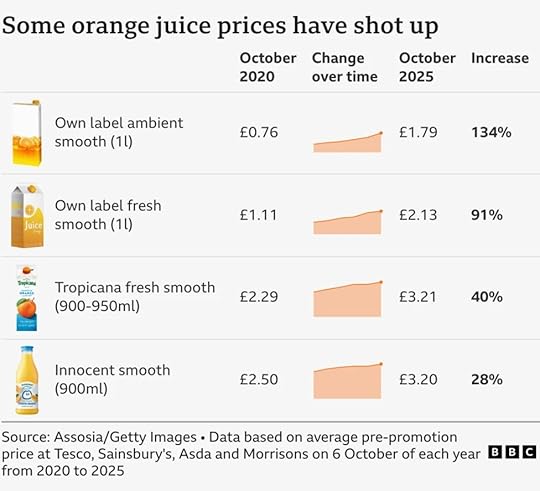
This morning on front page BBC News, a headline stood out to me: The £5.30 orange juice that tells the story of why supermarket prices are sky high. I mean, how can a headline like that not stand out?! The article goes into reasons for the hike in price of orange juice, in part due to weather and climate causing oranges to be less sweet, Donald Trump's tariffs, and global demand and consumption of orange juice just generally declining.
 We're getting robbed.
Despite these explanations, I can't help but gawk at the infographic which shows that supermarket own-brand orange juice prices have increased by 134% since 2020. Has minimum wage increased by 134%? Has the average salary increased by 134%? Has it balls.
Look, I'm not advocating for minimum wage or salaries to be pegged to the price of orange juice, although that wouldn't be the worst economic policy to come out of the UK government in the last five years (Liz Truss's Mini Budget anyone?). But perhaps the hyperinflation of orange juice is part of wider exploitation of working class folk up and down the country. The below chart highlights a number of basic household goods and their percentage price rise in the last year, let alone since 2020.
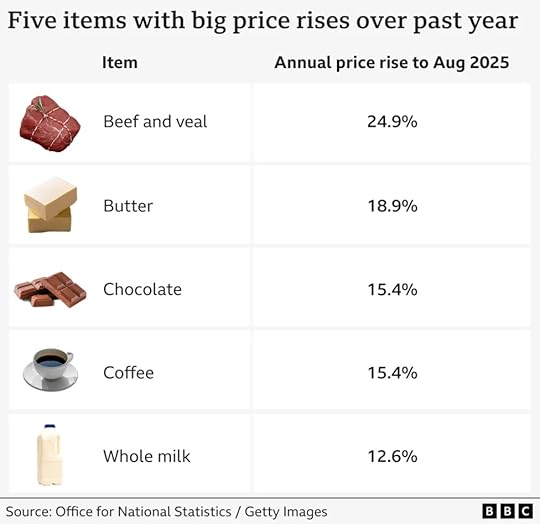 So called unavoidable price rises due to [insert X event/Y people], yet supermarkets continue to record record profits year after year.
It is difficult to find accurate information on the change in price for individual foods from 2020 until now. But The Food Foundation, does as good a job as any with their "Basic Basket" of typical household foods that one might get on a weekly shop. Their website goes into further detail, but since February 2022 - the average price of the basic basket for a man has increased to £56.66, an increase of 30.2% since 2022 (from £43.95). For a women's basic basket, the increase is similar - up to £52.19, a 27.4% increase (from £40.96).
How has this become the norm and accepted in our country? How is it that 1.8 million of us, in modern day Britain, are reporting not eating for an entire day due to the inability to afford or access food. There is simply no excuse for this and it is a blight on this country that we continue to grant a free pass to the millionaire's, billionaire's, CEOs, and executives who, year after year, claim their bonuses and walk away scot free to their villas in the south of France and beyond.
"But, but, but supply chains have been affected by Covid and the Ukraine war!"
"But they've had to lower their profits and bring down shareholder bonuses!"
I guess we should feel sorry for Ken Murphy, CEO of Tesco, who saw his salary (after bonuses) drop from £10.2 million in 2023/24 to £9.2 million in 2024/5 (source). That is until you realise his salary has doubled since 2022/23 when he received a meagre £4.3 million (source). When your salary increases to the effect of 100%, I guess your shopping basket going up in price 30% doesn't really make too much of a difference.
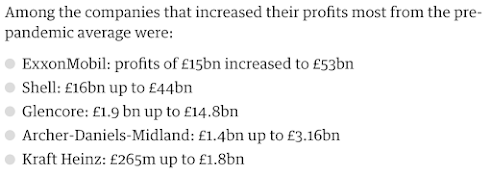 Jeremy Hosking is heavily invested in fossil fuels. From a Guardian report on greedflation in 2023.
You would think that supermarket profits would take a hit during heightened geopolitical insecurity around the globe. In the media we are told that price increases are due to the Ukraine War, the Israel-Gaza War, the Houthis, Iran, North Korea, Russia, and more recently... national insurance contributions? Just when you thought billionaires and corporate greed couldn't get worse and they had run out of excuses for rinsing workers wallets dry, they blame price increases on the National Insurance contributions set by the new Labour government, designed to boost vital public services such as the NHS. So, yes, in essence, the billionaires now blame the NHS, schools, and police for supposedly reducing their precious profits. Despite this, Sainsbury's recorded £1 billion in profit in the year 2024/25 (source). Tesco profits are expected to hit £3 billion for the year 2025/26 (source).
Simon Roberts, Sainsburys CEO, even had the gall in 2023 to go on BBC news and state they weren't profiteering the cost of living crisis. Dubbed "greedflation", this is the effect of companies hiding behind inflation and increasing their own costs beyond what is necessary to profit even further. But of course, we too have no interest in holding CEOs, millionaires, billionaires, and executives to account. Instead, we focus on immigration, flags, and whatever other culture war nonsense that makes the headlines that day. I guess it shouldn't be a surprise that Nigel Farage is leading opinion polls. It is easy to blame an Afghanistani national on a boat than it is to hold your business interest pals to account.
Nigel Farage is propped up by donors with economic interests in blaming other people (other than themselves) for greedflation. Jeremy Hosking, a top Reform Party donor, has tens of millions of pounds invested into Fossil Fuels (Exxon Mobile and Shell being two legacy fossil fuel companies listed as making huge profits in recent years as per the above screenshot). So why are the opinion polls suggesting that a significant proportion of Brits are looking to Nigel Farage to end the cost of living crisis. He has no incentive to, he is propped up and supported by people who are actively profiting from so-called "unavoidable" price rises that simply "have to be" pushed onto the consumer when we know this simply isn't the case.
When we look at housing, the top Reform Party donor and now MP, Richard Tice, made his fortune in housing and property development. It should be no surprise, then, that he voted against the Renter's Rights Bill, which protects renters from no-fault evictions, requires landlords to fix hazards in a set amount of time, and gives renters greater rights to challenge rent increases, among other protections. This is a potential future Cabinet Minister working in his own interests and not the people who voted him in. For a party that aims to appeal to "common sense working class people", they sure do everything they can to work against the people they aim to appeal to.
While the title of my article is perhaps a stretch, it does make me wonder on how similar the circumstances are. Granted, the Russian Empire was in the depths of a World War, however, according to the International Encyclopaedia of the First World War, prices in the country doubled between 1914 and 1916. Sound familiar? But that's not all, people were rioting over the price of staple goods. Russian workers were not immune to bigotry either, with their anger sometimes directed at peasants, shopkeepers, Germans, Jews, police officers, bureaucrats, and more rightly the Tsar, who's government's economic policy had caused a lot of their suffering.
It is this level of greed which has sapped into every layer and the fabric of our society that is draining working people of their hard earned money at every corner. It's more than a £5.30 glass of orange juice and it won't stop there either. What war will be the next excuse for a simple glass of orange juice? What pubic service will be the next excuse for your rent going up?
I have no doubt that when the day comes that a glass of orange juice is £20, the CEOs and billionaires will sit from their villas in the south of France and come up with one last suggestion for us all... "let them drink squash."