Barb Winters's Blog
November 18, 2025
It’s Not About You: Understanding Teens and Their Choices
“I can’t believe he’s doing this to me. He knows I hate when he watches porn.”
“She purposefully went behind my back and purchased a burner phone after I explicitly forbid any more screen time. She’s trying to drive me crazy.”
“My son ignored everything I told him and watched pornography even after I warned him about the dangers. He just wants to hurt me.”
Many parents have thoughts like these when they discover a child’s unwanted behavior—whether it’s watching inappropriate videos, ignoring screen time limits, or interacting with strangers online. We feel, at some point, as if our child stabbed us in the back.
FocusWhen I read these statements a second time, what stands out is the focus. Each one highlights the speakers’ feelings and what the child is doing to them. It’s self-focused. “I can’t believe… doing this to me.” “…trying to drive me crazy.” “…wants to hurt me.”
I get it. I’ve been there, and, truth be told, still “go there” periodically. I assume my child is purposefully trying to hurt me.
Sexpectations: Helping the Next Generation Navigate Healthy Relationships explains it this way,
“We’re apt to assume our children think about the ramifications of their actions and how those consequences affect those around them. If they’ve disregarded our advice, we believe they’ve purposefully rebelled against us. In our minds, we see our children rationally thinking through all their choices and picking the one that angers us the most because they don’t believe us and are out to get us.”
When I allow this point of view to invade my thoughts, it disrupts my interactions. My fixation hinders potentially beneficial conversations. The main thing is no longer the main thing. Understanding teen behavior reminds me that my child’s choices are rarely about me.
If we want to make progress with our children, we need to change our focus and separate our feelings from our parenting.
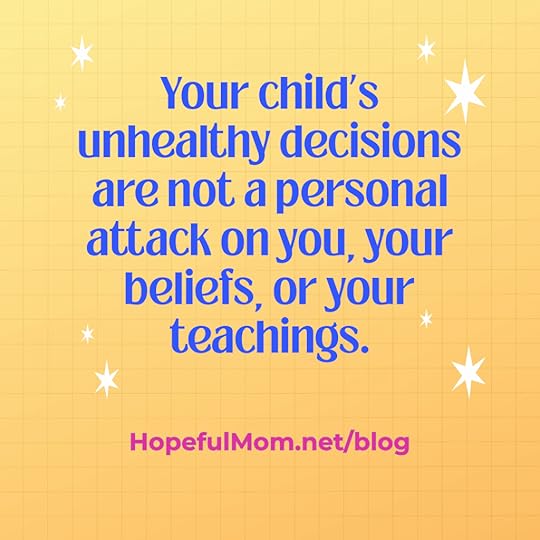
Understanding Teen BehaviorOur child’s unhealthy decisions are not a personal attack on us, our beliefs, or our teachings. When making an unhealthy decision, they rarely think, “How can I hurt my mom (or dad)?”
It’s not personal. It’s not about you.
“It’s not about you.” That truth can shift your parenting moments. Discover how understanding teen behavior can bring peace back into your home. #ParentingTeens It’s Not About You: Understanding Teens and Their Choices
Share on X
They are motivated by peer pressure, a real or perceived need, or curiosity. They (typically) haven’t plotted against us or even considered how their behavior will affect us. Their focus is on themselves and how their actions can fulfill their desires. Understanding teen behavior means learning to see past our own frustration and recognize what’s truly driving their decisions.
Once trapped in the compulsive behavior, their cravings take over. They have no control. When we realize their choices aren’t a personal attack, we’re offended less and forgive faster.
This isn’t just about disobedience—it’s about bondage. Our children are targeted by a powerful industry that profits from their curiosity and weakness. Algorithms lure preteens and teens into watching pornographic videos, which are easily accessible. Our children are not our enemies. They are victims, not villains.
Instead of seeing our child as someone working against us and our values, we can view them as someone who needs our compassion and guidance. When we respond with calm curiosity rather than anger, we create space for healing conversations.
Whether they realize it or not, they need us to come alongside them, offering truth, grace, and the confidence that freedom is possible. And as we grow in understanding teen behavior, we’re better equipped to guide them toward healthy choices.
Subscribe to receive two FREE PDF downloads. Like and follow Hopeful Mom on social media and share this message with your friends. Thank you!
The post It’s Not About You: Understanding Teens and Their Choices appeared first on HOPEFUL MOM.


November 3, 2025
The Holistic Health Approach to Sex Education
I’m thrilled to introduce Tracey Pike, a leader in the Sexual Risk Avoidance Education field. When I met Tracey, I was immediately drawn to her passion for helping the next generation understand the importance of making healthy choices, especially as it pertains to their overall health.
Teens are influenced by peers, social media, and their home life. They’re stuck in a place where they desperately want to belong and yet want to carve their own path. Additionally, their brains aren’t fully developed, so they are easily swayed by whatever is appealing in the moment. They can be convinced that the choice they make today is inconsequential to their future and only affects one small area of their life. Hence, the belief that sexual activity, which they think is primarily physical, is no big deal. To combat this thinking, let’s change our approach to sex education in our homes.
In this article, Tracey helps us understand what holistic health is and why we should incorporate the concept into our children’s sex education at home as well as in the classroom.
Only Physical?When I first reviewed a Sexual Risk Avoidance Education (SRAE) curriculum, I was struck by the holistic approach to optimal sexual development. What captivated me most was the broader conversation about health and well-being that I had never heard as a young person. Rather than limiting the conversation with teens about the possibility that sexual activity may result in physical consequences like unplanned pregnancy and Sexually Transmitted Diseases, SRAE is grounded in a primary prevention strategy that addresses the whole person. This holistic health approach involves the understanding of the importance of one’s emotional, mental, social, and ethical/spiritual well-being, as well as physical.
 A Better Approach to Sex Education
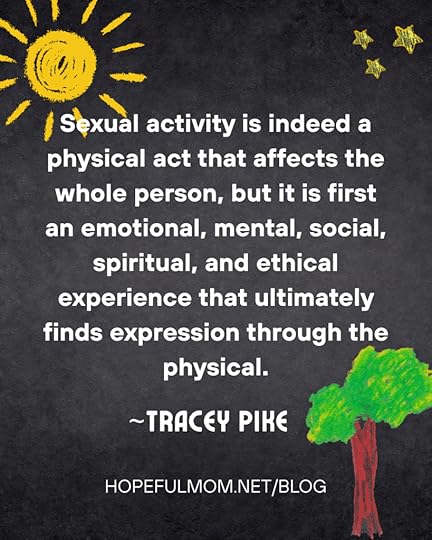
This deeper understanding of health and wellness reshaped the way I thought, and therefore taught, about sexual health and well-being. In the past, I viewed sexual activity as primarily a physical act with emotional, mental, social, and spiritual consequences. Now, with greater awareness of how thought and emotion shape behavior, I understand it differently. Sexual activity is indeed a physical act that affects the whole person, but it is first an emotional, mental, social, spiritual, and ethical experience that ultimately finds expression through the physical.
Sexual activity is indeed a physical act , but it is first an emotional, mental, social, spiritual, and ethical experience that ultimately finds expression through the physical. #sexeducation The Holistic Health Approach to Sex…
Share on X
Approaching the topic of sexual activity as merely physical neglects the mental and emotional health and well-being of our youth. This approach is dangerous. Author E. Stanley Jones explained the importance of balance in every aspect of our personhood best in this statement, “If one part of the nature demands satisfaction at the expense/sacrifice of the rest – the result is not satisfaction, but inner division.” Since all dimensions of our health must be balanced in priority, teaching from a holistic health perspective is optimal.
Our ResponseAs parents, grandparents, caregivers, and educators, we have a responsibility and obligation to empower youth to achieve holistic health by teaching emotional regulation, critical thinking, thoughtful decision-making, and healthy relationship development. The holistic health model of sex education empowers youth to not merely reduce physical risk but protects and nurtures the condition of every dimension of health and wellness for their freedom to flourish.
Note from Barb: Many Hopeful Mom readers worry about a child’s exposure to pornography. So, let’s take the holistic approach to sex education a step further and include pornography in our discussions. Even though people are drawn to porn for multiple reasons, many believe they are simply fulfilling a physical need. Understanding that sexual activity is primarily relational and mental may help them process what the appeal to porn actually is, why pornography is damaging both personally and relationally, and provide a reason to stop watching.
For more information on helping your children understand what a healthy relationship looks like, read Sexpectations: Helping the Next Generation Navigate Healthy Relationships.
The post The Holistic Health Approach to Sex Education appeared first on HOPEFUL MOM.
October 20, 2025
Porn vs. Healthy Sex: A Parent’s Guide
The average age of first exposure to pornography is 8 to 12 years old. Many preteens and teens watch porn for their sex education. They are curious and wander into unknown territory they don’t comprehend.
Our job as parents is to educate our children about the harms of pornography, just as we would discuss the dangers of running in the street, touching a hot stove, or taking someone else’s prescription drugs. Yet, it’s not as effective to simply forbid certain behaviors; we should also explain benefits of healthy sexual activity.
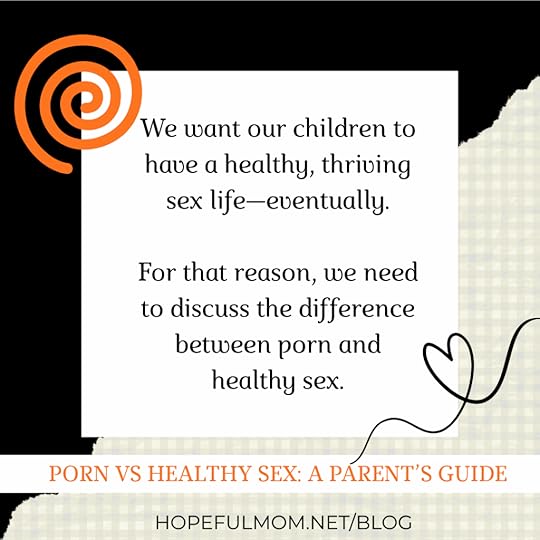
I often tell students, “We want you to have a healthy, thriving sex life . . . Not today. At the right time with the right person.”
To help with these conversations, let’s look at negative impacts of pornography consumption and advantages of sexual activity within a healthy relationship.
When talking about the danger of pornography with teens, include info about healthy sex also. Porn vs. Healthy Sex: A Parent’s Guide #fightthenewdrug #onlinesafety
Share on X
In discussing these harms with our children, we don’t want to shame, blame, or attempt to make them feel guilty. The pornography industry preys on preteens and teens; it’s pervasive and invasive. Our goal is to shed light on what’s been in the dark to help them resist and walk away. Talking about it breaks the darkness’ power. During these conversations, remind your children that you desire to help them with any issues they currently have or that arise in the future.
My hope is that the next generation will stand up to this industry and say, “No. We will not allow this to destroy us!”
 Benefits of Sex Within the Confines of a Healthy Relationship
Sex is part of human design. Christians may put it this way: Sex is God’s idea. From biology to bonding, sex is built into who we are and brings pleasure, creates life, and strengthens relationships. Communicating the advantages of a healthy sex life is important.
Selfless and Enjoyable by Both Parties – Each person involved thinks of the other person: the way he/she should be loved and protected, their emotions, their desires, and their physical wellbeing.Give and Take – Each person listens to and treats their partner with respect and understanding.Consensual and Respectful – Consent is important, legally and morally. We have an obligation to understand the law and the principle behind it. Rather than treating them as an object, each person views their partner as a complex human with thoughts, opinions, desires, and feelings.Bonds Two People and Enhances the Relationship – During sex, the body releases chemicals that build feelings of closeness, trust, and attachment. This is why healthy sexual activity can strengthen a relationship. In other words, sex isn’t just physical; it’s emotional, mental, and intellectual as well.A Positive Experience That Gets Better Over Time – We want our children to have a healthy, thriving sex life—eventually. At the right time with the right person within the confines of a healthy relationship. For some of us, that means we hope our children will wait until they are married.Remember to end your conversations on a positive note. Remind them that your love is unconditional and you want them to live their best life with optimal health.
For more information on helping your children understand what a healthy relationship looks like, read Sexpectations: Helping the Next Generation Navigate Healthy Relationships.
[i] https://hopefulmom.net/heidi-olson-pediatric-nurse-pornography-and-sexual-assault/
[ii] https://fightthenewdrug.org/true-story-my-porn-habit-caused-me-to-sexualize-everything-female-story/
[iii] https://thefreedomfight.org/health/effects-of-porn-on-brain/
[iv] https://thefreedomfight.org/health/effects-of-porn-on-brain/
The post Porn vs. Healthy Sex: A Parent’s Guide appeared first on HOPEFUL MOM.
October 6, 2025
Eww: 5 Tips for Cyber Hygiene
As a Cybersecurity Instructor, Research Scientist, and Teacher, Barb Fox knows about technology and how to explain safety in a tech world to parents and students. I love, love the analogy she presents in order for us to understand cyber hygiene.
My children loved searching for treasures. I humored them as they scoured parking lots for coins or waded in creeks to find rusty bicycle wheels. But when it came to public restrooms, that was a different story. Pennies and abandoned toys stayed on the floor. Every time we went into a public bathroom, I reminded them about what was safe to touch and what was not. Those public places also prompted lessons on privacy. Close the door. Lock the door. And don’t peek where you shouldn’t peek.
These same precious kids need similar “cyber hygiene” training to protect their safety and privacy in the digital world.
1. Close the door“When you go into a stall, close the door. Nobody else needs to watch you do your business.”
Yet our kids don’t realize that when they post videos, especially live ones, they may be inviting strangers into their private world. Have them watch one of Jose Monkey’s videos[1] to see how easily strangers can figure out their location. When a friend dares them to take a compromising photo, help them realize that this picture will likely be shared with thousands of other people and will come back to haunt them time and time again.
What we do in our bathrooms is not secret, but it should be private. Let’s try to help our children understand the difference.
2. Lock the door“As soon as you enter the stall, close the door and lock it.”
Our passwords act as a lock on the doors to a cyber world. If our kids share those passwords, other people can enter that stall uninvited. Encourage them to use a different password for each website. When one of those sites is compromised (and many will be compromised over time), criminals may gain access to all their accounts. If your child is still not convinced, take them to Have I Been Pwned[2] and enter your own email address. Mine shows twenty-four breaches, most of which included password dumps to the dark net.
And if your kids complain they can’t remember all those passwords, help them download a password manager to their phone.
3. Wash your hands“Don’t forget to wash your hands.”
When we finish messy work, we wash our hands to scrub away unwanted germs that could make us sick. When using public Wi-Fi, explore using a VPN (Virtual Private Network) to reduce chances of catching viruses and other malware. Regularly clearing out browser cache and not accepting cookies are other good practices for cyber hygiene. Work with your children to establish this good habit. Many malware strains target web browsers, so the fewer cookies, the fewer potential problems. Accepting cookies on every website, saving every password into a web browser, and leaving phones unlocked can be like forgetting to wash our hands.
Another good idea is to help your children reduce targeted ads by using a browser like DuckDuckGo. Fewer tempting offers translates to fewer clicks where they might accidentally “catch” something nasty.
One of the best ways to keep bugs from making our devices sick is to keep web browsers and operating systems up-to-date. Hackers discover vulnerabilities in software that can be exploited, so companies release patches that fix those problems. Patching sanitizes software to avoid future infections.
Passwords = locks. VPN = soap. Safe sites = clean stalls. Teach your kids 5 simple cyber hygiene rules. Eww: 5 Tips for Cyber Hygiene #digitalsafety #onlinesafety
Share on X
“Eww.”
If you are like me, you probably can’t count the number of times you have hurried into a restroom, flung open a stall door, then said “Nope!” When there is toilet paper on the floor and an unflushed bowl, I usually turn around and choose a different stall.
We can help our kids recognize the same thing in the cyber world. Their friends tell them about places where they can download free copies of their favorite games. They are not free. Even silly little phone games or what appear to be legitimate games can come loaded with nasty surprises.[3] Websites with unlicensed copies of music or homework assignments often act as watering holes for drive-by-downloads that can infect computers without ever clicking on a link or performing a download.[4]
Studies report that up to one in three downloads from pirated sites lead to malware infections.[5] And that means a very sick computer. Remote Access Trojans, for example, can turn on cameras, record audio, download ransomware, and upload files from your child’s device, and they may never know it.
Remind them to only use clean “stalls,” well-reputed sites with legit software from known companies.
And besides, it’s also “Eww” to look where you shouldn’t look. And that includes illegal, unethical, or sexual content.
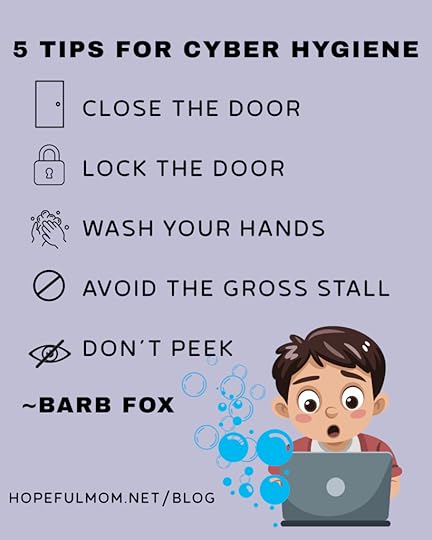 5. Did you wash your hands?
As a parent, how many times have you spoken those words? Hundreds, right? Yet we think our children will practice good cyber hygiene if we give them one lecture on “visit only legitimate sites,” “never take compromising selfies,” and “use a different password for each account.” Let’s help them build good habits by reminding them gently, but often.
Find ways to let them know that the accountability is high. Keep the computer in the family room, not their bedroom. If that’s not feasible, consider investing in white-listing services. These limit digital devices and phones to only run pre-approved apps or only text people already in a contact list.[6]
It’s easy once you learn howYour little children didn’t know how to keep safe in public restrooms, but your diligence helped them build habits that are now effortless to maintain. Let’s help our kids develop healthy digital habits, cyber hygiene, the same way. We can invest time and energy today that will help them maximize privacy and safety for the rest of their lives.
A huge thank you to Barb Fox for sharing her knowledge with us. If you found this post helpful, please share it with your friends and family. Check out Barb’s new book here: Love Beyond Labels: When Finances Flip.
[2] https://haveibeenpwned.com/
[3] “Did You Download This Steam Game? Sorry, It’s Windows Malware”, https://www.pcmag.com/news/did-you-download-this-steam-game-sorry-its-windows-malware,
[4] https://www.pcmag.com/news/did-you-download-this-steam-game-sorry-its-windows-malware, https://nordlayer.com/blog/what-is-drive-by-download/, “What are drive-by download attacks and how do they work?”
[5] https://www.nbcnews.com/id/wbna51339253, “Malware from Pirated Software Costs Billions”
[6] https://homeschoolchristianmom.com/internet-accountability/, Microsoft Family Safety, Google Family Link
The post Eww: 5 Tips for Cyber Hygiene appeared first on HOPEFUL MOM.
September 15, 2025
The Advocate Every Child Needs
“In 2022, my just turned 15-year-old daughter met someone on an app who posed as a 16-year-old.” I read this on Facebook. This mom continued explaining her story which lasted over two years. Her daughter had an eight-month long “relationship” with this poser before breaking it off. From that point, he exploited, stalked, harassed, and bullied the daughter and family.
When the daughter told her mother about this “friend,” this mom went into “mom mode.” You know what I mean—some Mama Bear action, defending, plotting, advocating, and all-out persisting.
Mom spent over a year trying to protect her daughter from this relentless person. He “used at least four social media platforms and 130 social media display names to pose as a minor and interact with minors on social media.” [i] This man, who was actually 21, not 16, repeatedly contacted and threatened the daughter and her family, even after her mother had called the police and Attorney General and filed a restraining order against him.
A mom fights for her child to protect her from a predator. As parents, we are called to protect and advocate for our children. The Advocate Every Child Needs #hopefulmom #parenting
Share on X
Finally, Mom walked into the FBI office. She said, “I had in my hands probably 300 or more screenshots, and I begged them to help me. I was scared for my daughter’s life.”
Through their investigation, the FBI learned of other victims. He “used those accounts to persuade minor victims to engage in sexual conduct and to produce child sexual abuse material. [He] allegedly received that material, possessed it, and distributed some of that content to other minors, including classmates of one of his victims.”[ii]
Thankfully, because of Mom’s advocacy and persistence, a grand jury indicted this predator “with coercion and enticement of minors, production, distribution, and possession of child pornography [child sexual abuse material], and cyberstalking.”[iii] He awaits trial.
A Parent’s Powerful RoleThis mom’s story is maddening.
What struck me most about this post, though, was Mom’s closing words to us parents. “You are your child’s biggest advocate. If you know something is wrong don’t stop fighting for your child. I hit dead end after dead end after dead end. But my daughter can finally live her life free from this monster.”
Mom did not accuse her child. She didn’t scold her daughter for talking with a stranger online. She wasn’t angry because her daughter sent inappropriate photos. (I’m making an assumption here, but it stands to reason given the exploitation and ultimate charges.) She also didn’t blame her daughter for the stalker’s actions. Instead, she defended, protected, and advocated.
One of our highest priorities as parents is to protect and advocate.
How to Protect Your Teen OnlineWhether you believe “Delay is the Way,” or you grant your child access to online devices at an early age, it’s your job to understand the pros and cons of internet surfing and social media scrolling. Is this fair? No. But, it’s life. Therefore, we need to understand and explain the dangers to our children before allowing them access to the internet or installing apps on their devices.
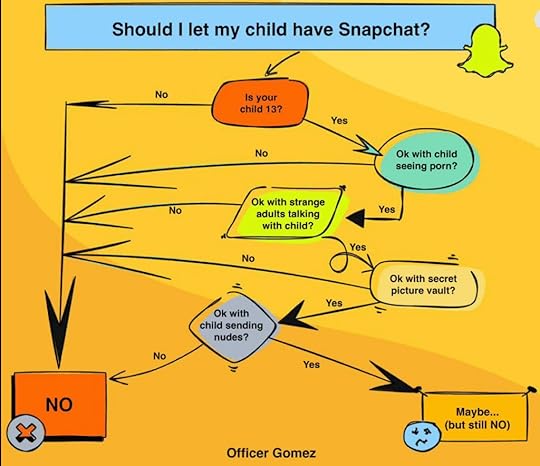
Officer Gomez summed up Snapchat in the above flowchart. But let’s face facts, these are behaviors we see on all games and social media apps, including Instagram, TikTok, Discord, and Roblox.
Research each app and device, add filters to your Wi-Fi and devices, use parental controls, and talk, talk, talk with your children. Explain the dangers. If they aren’t old enough and mature enough to understand why they should walk away from an unhealthy situation, or they aren’t brave enough to say no to their peers, then say no for them.
Your Teen Needs an Advocate—Not a CriticWill your child succumb to peer pressure? Will they make poor choices? Will they fail to heed your advice? Probably. At least once.
But we are still their best hope. They are not the enemy. The enemy is the one luring our children into toxic behavior. The drug dealers. The pornography industry. The predator down the street. The social media app algorithms.
Rather than alienate your children, be available. To prevent. To protect. To stand firm in your decisions. And to advocate for them when they are in trouble. They need you. Our children are a work in progress (just like us). When they make unhealthy decisions, support them, encourage them, listen to them, and go to bat for them. Fight for them. Like the Mama Bear in our story above.
[i] https://www.justice.gov/usao-sc/pr/ohio-man-indicted-south-carolina-exploiting-and-stalking-minors-social-media
[ii] Ibid.
[iii] Ibid.
The post The Advocate Every Child Needs appeared first on HOPEFUL MOM.
September 1, 2025
Heidi Olson, Pediatric Nurse, Talks About Pornography and Child Sexual Assault
Note from Barb : I highly respect Heidi Olson and the work she does as a sexual assault nurse examiner. I asked her to educate us on the connection between pornography and child sexual assault because we need to know. While this information is disturbing, we can’t ignore it. A huge thank you to Heidi and others like her in the trenches with our children helping, protecting, and educating. Warning: This article contains information about child-on-child sexual assault and various themes in pornography.
Disclaimer from Heidi: I try not to use the word perpetrator when talking about children with problematic sexual behaviors, because they are victims of a predatory porn industry, their brains are still developing, and often do not understand the full ramification of their choices, and while this doesn’t negate harm they’ve caused, the issue of child-on-child sexual assault is extremely complex.
Who Are the Offenders?When I became a pediatric sexual assault nurse examiner, I had a stereotype in my mind of what a perpetrator would look like. Predators conjure up an image of a creepy old man in a white van who lures children to him with kittens and candy. But the reality of what is happening to children is much more disturbing than I could have imagined. About a decade ago, I started to notice a pattern that many of the sex offenders weren’t old men (although those predators certainly exist), but they were actually children and teenagers (and these were instances of real sexual harm, not normal sexual development or curiosity).
I started digging through research and data from the hospital where I was working and what I found shocked me. Data showed that anywhere from 1/3 to almost 1/2 of those committing sexual assaults are minors themselves. In fact, the age range most likely to commit sexual assaults are 11–15-year-old-males, (1) with research showing that 14-year males are the highest risk to engage in this behavior. (2)
It’s not just a phenomenon that’s isolated to the United States. This trend is being echoed across many different countries, with the United Kingdom publishing data last year highlighting that the majority of their sex offenders are now minors. (3)
When most people hear about a child sexually abusing another child, they immediately assume the offender is a victim of sexual abuse themselves, but that is not always the case. Sometimes the offender does have a history of sexual abuse, but there are other variables that contribute to a child sexually harming another child. This includes having a history of neglect, attachment trauma, or physical abuse. (4)
And an increasingly common theme that children are disclosing is that pornography deeply influenced their problematic sexual behavior. There is a correlational and causational relationship between porn use and sexual violence with over 100 peer-reviewed research articles detailing the connection. (5)
Sexual Assault VictimsJayden* was a 4-year-old male, who disclosed a sexual assault to his parents that happened at the hands of his 11-year-old sister. She played pornography on her iPad during the assault, so he could watch and learn what to during the next assault. As far as the parents knew, the daughter had never been sexually assaulted herself.
We also took care of Natalie*, a 12-year-old female, who was brutally raped in a parking lot by a 16-year-old male she had met online. She did not think she had been assaulted, because she had been, “looking at and masturbating to porn every single day” for the last 7 years. This started when her parents gave her an iPad at the age of 5, and she accidentally stumbled on porn. The violent images had desensitized her to the point that she could not recognize that she had been sexually assaulted, because she was convinced sexual violence was normal.
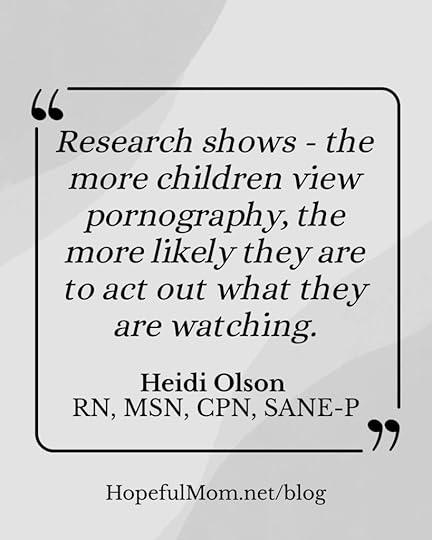
Brain ResearchResearch shows the more that children view pornography, the more likely they are to act out what they are watching. (6) A survey done with 11–16-year-olds showed that the majority of the boys want to copy the acts they are seeing in porn. (7) This makes sense in the context of mirror neurons.
Dr. Sharon Cooper, a forensic pediatrician stated, “Imagery definitely affects children…when a child sees this image of adult pornography the mirror neurons that are in their brain will convince them that they are actually experiencing what they are seeing.”(8) When children see pornography, their mirror neurons cause their brains to become prematurely sexualized and they want to act out the explicit content they’ve been exposed to.
This was apparent when we cared for a 13-year-old female who was raped by her 16-year-old brother. He told her, “I was looking at porn in my room and couldn’t stop thinking about it.” As he began his assault.
Mainstream porn, what kids are stumbling onto, is extremely violent and degrading. Popular themes include incest, racism, rape fantasies, strangulation, gagging, slapping, hair pulling, multiple men penetrating one woman, and ejaculation on the face. (9) In fact, many teenagers are strangling each other during sexual encounters and assaults, because they are seeing it in porn, without the faintest idea that strangulation can cause brain damage or even be lethal. (10)
Pornography teaches young girls that self-exploitation is normal and even desirable. Kids are so desensitized to seeing naked bodies, it’s not a red flag when friends or strangers ask them for nudes. In fact, it’s a compliment, because someone thinks they are “hot.” They are watching influencers become rich and famous through porn sites like OnlyFans, with seemingly no downsides.
The porn industry is traumatizing kids on multiple levels. From the children who are exposed to pornography early in life, to the children who are sexually abused because pornography influenced an offender to act out. It gets even more complex for families who are navigating dynamics of one sibling harming another or parents who are dealing with school districts where children have been sexually assaulted at school by a peer.
What Parents Can DoThere are several important things that we can do to prevent and mitigate the harm that pornography is creating. Having honest conversations with kids about pornography in age-appropriate ways is one of the biggest safeguards we can implement. It’s also important that kids have friends in real life, purpose, and secure attachment with adults, which will decrease their risk factors for developing problematic sexual behaviors.
But what if a child is already acting out in sexually harmful ways? First, we need to approach the child in a calm manner. Children who are struggling with problematic porn use or acting out, need support, therapy, and safe relationships. The good news is that when children receive treatment, the rates at which they will re-offend decrease dramatically (look for MST-PSB or CBT-PSB programs where the root cause is addressed).
For the child that has been sexually abused, remain calm during a disclosure, believe them (children rarely lie about sexual assault disclosures), and protect them. (CLICK HERE for A Caregiver’s Survival Guide.) This may mean supervised or limited contact with the offender. Both children need support and care. While this topic is sensitive, complex, and challenging, it’s far more common than people realize and there is hope for healing.
*Names have been changed for privacy
For more information about Heidi Olson and her work, visit her website, Paradigm Shift. For a PDF on Problematic Sexual Behavior in Children and Youth: Vulnerability and Protective Factors, CLICK HERE.
References:
Children’s Mercy Kansas City. (2015-2024). Redcap database.Finkelhor, D. (2012). Characteristics of crimes against juveniles. Durham, NH: Crimes against Children Research Center.Dodd, V. (2024). Children now ‘biggest perpetrators of sexual abuse against children”. Retrieved from https://www.theguardian.com/society/2024/jan/10/children-now-biggest-perpetrators-of-sexual-abuse-against-childrenNational Center on the Sexual Behavior of Youth. Adolescents. Retrieved from https://www.ncsby.org/adolescentsMala..., N. M., Addison, T. & Koss, M. P. (2000). Pornography and sexual aggression: Are there reliable effects and can we understand them? Annual Review of Sex Research, 11, 26-91.Wright, P. J. (2014). Pornography and the sexual socialization of children: Current knowledge and a theoretical future. Journal of Children and Media, 8(3), 305-312.Buljubasic, V. (2018). UK study shows most boys think online pornography is realistic. Retrieved from https://www.collectiveshout.org/uk_study_shows_most_boys_think_online_pornography_is_realisticJenson, K. (2012). Top two reasons why children’s brains are vulnerable to pornography. Retrieved from https://www.protectyoungminds.org/2012/06/01/top-two-reasons-why-childrens-brains-are-vulnerable-to-pornographyFight the New Drug. (2018). 5 popular porn categories that are considered sexy online but are disturbing in reality. Retrieved from https://fightthenewdrug.org/5-popular-porn-categories-that-are-considered-sexy-online-but-are-disturbing-in-reality/Orenstein, P. (2024). The troubling trend in teenage sex. Retrieved from https://www.nytimes.com/2024/04/12/opinion/choking-teen-sex-brain-damage.html#The post Heidi Olson, Pediatric Nurse, Talks About Pornography and Child Sexual Assault appeared first on HOPEFUL MOM.
August 18, 2025
Beyond Words: Body Language in Teens and Parents
Body language is a crucial element to communication–especially when parenting teens. (See end of post for an upcoming event.)
“Do you need a minute?” I asked my daughter. I saw she was upset and on the verge of tears. She struggled to articulate her problem and the emotions it evoked.
“Yes.” Her shoulders relaxed, and the tears flowed.
I put my arm around her and waited quietly. I knew from experience that sitting with her while she cried would help her work through her emotions and communicate more effectively.
After a few minutes, it all came tumbling out. Her car was acting up again, and she’d nearly been in an accident. A valid reason for the emotional turmoil.
A day later the car was fixed, and my daughter’s emotions were normalized. I’m grateful I’d been available, sensed her need, and responded appropriately.
Constant Communication“We send and receive messages all day: a look, a sound, a gesture, the way we walk, the way we pause mid-sentence, the way our voices rise and fall, a text, a post, a note, laughing, crying, smiling, frowning. These are all messages. Whether intentional or unintentional, whether perceived or real, we transmit ideas and opinions throughout the day to those in our vicinity.” (excerpt from Sexpectations: Helping the Next Generation Navigate Healthy Relationships, p. 120)
Body Language“A high percentage of messages are communicated through body language. We lean in when we’re engaged. We back up when we’re disinterested or afraid. We tower over someone to show power and lower ourselves to show equality. Toddlers poke their parents to get their attention. Teens bat their eyes or flip their hair to flirt. They strut their stuff in confidence or slouch and hang their heads when feeling unnoticed, insecure, or ashamed.” (excerpt from Sexpectations p. 129)
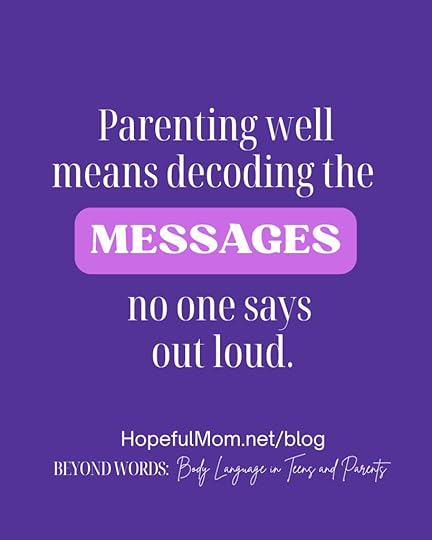
Parenting well means decoding the messages no one says out loud. Our job requires awareness of our body language, as well as interpreting our children’s signals. Not an easy task, yet one that’s necessary to build trust and nurture healthy relationships.
Maybe a child’s overreaction or lack of concern baffles you. Their response seems out of sync with the situation.
And yet, I too sometimes send mixed signals, and others misinterpret my body language.
My face is descriptive. Easily read. Others can tell if I’m annoyed, frustrated, bored, or agitated. And they react to my signal. Unfortunately, misreadings can instigate improper responses. For example, if my child misinterprets my concentration face as, “I’m mad at you,” or “I’m not listening to you,” they may feel devalued. That’s a message I never want to send.
Reading body language becomes especially challenging during tense situations or difficult conversations. I’m careful to check myself. Does my body language invite openness rather than show contempt? Is my facial expression one of curiosity and concern rather than judgment? Am I providing a quiet space for my child to think about her responses?
Our SignalsSometimes my body language reflects my intense feelings—anger, hurt, fear—but I don’t want that emotion to interfere with the conversation. When I sense my child is reacting to one of these signals, I address it.
“I am angry right now, but I still love you. My response to this situation will not be based on anger.” (I may need a cooling-off period before continuing the conversation.)“I am deeply hurt, but I realize you didn’t intentionally hurt me. I will recover, and whatever decisions we make regarding this problem won’t be based on me or my feelings. I love you, and it’s my job to protect you, and I will do my best to do that.” (I may need a time-out to forgive and get past my hurt.)“I am afraid something terrible may happen, but we won’t make a decision based on fear.”To show teens we value their thoughts and feelings, use positive cues: nods, eye contact, open posture (uncrossed arms, relaxed shoulders), smiles, and appropriate touch.
Our gestures teach. Their signals speak. Stay tuned in.Teens send signals! Blank stares, rolled eyes, slammed doors, silence, angry tears, crossed arms, tight jaws, clenched fists.
Teens send signals! So do parents. Our gestures teach. Their signals speak. Stay tuned in. Beyond Words: Body Language in Teens and Parents #bodylanguage #hopefulmom #difficultconversations
Share on X
It’s easy to react to their behavior; however, not allowing their attitude or conduct to affect ours is important. Sometimes they truly don’t know what they think or feel, and they’re doing their best to communicate without having a meltdown. A tantrum could be a cry for help. Procrastination could be a clue that they don’t know how to proceed. A quick, “I DON’T KNOW” may really mean they truly don’t know.
Let’s try to look beyond the behavior, past the body language, and into the core of who they are to detect the actual message. And when all else fails, ask open-ended questions, sit quietly, and listen. Sometimes all they need is someone to put their arm around them and offer them time and space to process their emotions.

Barb is speaking at a ladies event on August 23rd at Hope Community Church in Wildwood, FL. I invite you to join us! See details here: When God Plants Seeds: Faith in the Valley.
Have you read Sexpectations: Helping the Next Generation Navigate Healthy Relationships? Please write a review at Amazon and/or Goodreads. Reviews, especially 5-star reviews, are how word spreads about this resource. Thanks so much!
The post Beyond Words: Body Language in Teens and Parents appeared first on HOPEFUL MOM.
August 4, 2025
Lost in a Season of Waiting
I’m excited to introduce Melinda Patrick, our guest author. She understands the hurting heart of a parent. Our children sometimes choose to stay on their path to destruction, and we are stuck waiting and hoping. Melinda is here to offer advice for us during our season of waiting.
He moved. I moved.
Then he leapt—smugly—over two of my marbles.
Without thinking, I countered. Reflex, not strategy.
Back and forth we went, for several tense minutes. Then I looked down and saw something unsettling: the Chinese Checkers board had shifted completely out of balance—and not in my favor.
Somewhere between aggressive hops and rushed responses, I’d lost the thread.
I was no longer playing to win; I was reacting, flailing, distracted.
A few more poor moves sealed it.
In desperation, I threw up my hands and made the universal sign of surrender: a big, exaggerated “T.”
“TIME OUT! Time out!” I said.
My husband looked up, eyebrow raised, amused.
“There’s no time out in Chinese Checkers.”
Maybe not.
But I needed one—badly.
I was unraveling, and the only way back was to pause, breathe, and remember the plan I had long abandoned.
Lost in a Season of WaitingOkay, maybe getting lost in a game of Chinese Checkers isn’t your story.
But maybe this is: you’re stuck in a season of waiting.
Waiting for a loved one to open up about their struggle.
Longing for healing or freedom—for them or for yourself.
Hoping for reconciliation in a broken relationship.
Praying the tides will finally turn and “normal” – whatever that is – will return.
This waiting has worn you thin.
Hope deferred does make the heart sick (Proverbs 13:12).
And if we’re honest, many of us entered the wait with good intentions—we’d wait well and trust the process, we told ourselves.
But now?
Now we just want it to be over.
In that Chinese Checkers game, I realized how I’d gotten lost:
I stopped following my plan. I began reacting to my husband’s every move.
Not strategy—just survival.
And we do the same in life.
Instead of responding to God and trusting His timing and plan, we start reacting to people and circumstances.
We lose our way.
We lose ourselves.
But Scripture gently calls us back:
“Therefore, my beloved brothers and sisters, be steadfast, immovable, always abounding in the work of the Lord, knowing that in the Lord your labor is not in vain.”
— 1 Corinthians 15:58 (ESV)
In a world that pulls at your heart, that demands your attention and tries to rewrite your identity, God invites you to stand firm.
Waiting is hard.
But with God—it’s not wasted.
So maybe it’s time for your own “time out”—not to quit, but to reset.
To return to who God created you to be – because the authentic, God-created-you is the one the world needs.
 3 Steps to Anchor Yourself in a Season of Waiting
1. Pause and take time to heal.
You can’t force healing in someone else. But you can tend to your own.
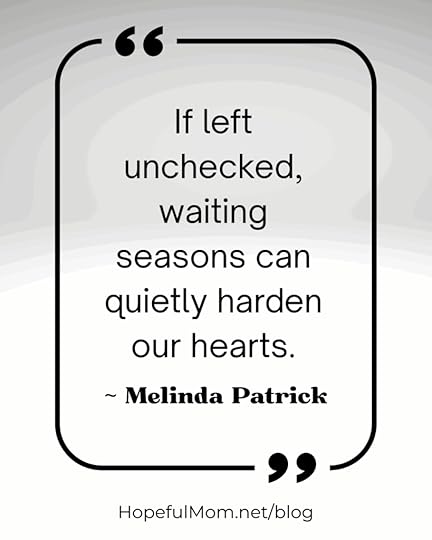
Waiting seasons often stir up bitterness, resentment, and envy. Left unchecked, they can quietly harden our hearts.
Instead of ignoring those wounds, take time to confront and care for them.
This work matters.
And when your loved one is finally ready for healing, you’ll be in a strong, grace-filled place to walk with them—not from desperation, but from wholeness.
You can't force someone else to heal, but you can tend to your own. Melinda Patrick offers us advice for when we are waiting for a loved one to heal. Lost in a Season of Waiting #hopefulmom #difficultconversations
Share on X
2. Take a deep breath in and make room for the Holy Spirit to move and work.
Sometimes, we get in the way of our own prayers.
I don’t know about you but many times have I prayed for God to move in someone’s life—only to jump up and try to fix it myself.
When we do that, we can crowd out the Holy Spirit.
God has a role. We have a role.
Let the Spirit lead.
Reflect on these verses and ask yourself: am I creating space for the Holy Spirit to work?
John 16:7-8, Psalm 146:8, John 16:13-15, 1 Corinthians 13:4-7, Philippians 4:6
3. Remember the Lord’s faithfulness.
The biggest mistakes I have made are when I didn’t wait on the Lord.
What enables us to wait is knowing we can trust God.
Remembering God’s faithfulness in your own life builds trust and fans the flame of faith.
“The children of Ephraim, being armed and carrying bows, turned back in the day of battle. They did not keep the covenant of God, they refused to walk in His laws, and forgot His works and His wonders that He had shown them.” – Psalm 78:9-11
What if this waiting isn’t just about your loved one?
What if God is using it to invite you into something deeper?
Waiting is an opportunity to put your faith to work. It’s an invitation to know God more intimately, to trust Him more completely, and to be transformed more fully.
Take time to write out your testimony—how you’ve seen God move in your life—and tuck it into your Bible or another meaningful place. This simple act does two things:
It rekindles your faith by reminding you of God’s faithfulness.It prepares a legacy of truth for the next generation. Even if your loved one isn’t ready to hear it now, one day they may be—and when that day comes, your testimony will be waiting.You’re not lost. You’re being led.Even here—especially here—God is at work.
So, take your “time out.”
Pause.
Catch your breath.
And trust the One who sees the end from the beginning. This isn’t the end of your story. It’s only a chapter and suddenly – one day the page will turn.
If you found this post helpful, share this post and leave a comment here for Melinda Patrick. Subscribe to Hopeful Mom for two FREE PDF downloads, keep up with Hopeful Mom on Facebook, and Instagram, and check out Barb’s book Sexpectations here.
The post Lost in a Season of Waiting appeared first on HOPEFUL MOM.
July 21, 2025
How to Help Teens Beat Perfectionism Fueled by Social Media
I’m a perfectionist by nature. My get-it-right attitude seeps into work, family, and social interactions. My kids, husband, and co-workers expect me to correct grammatical errors on social media posts and in books I’m reading.
I can’t help it. I desperately want the tasks I’m performing to be perfect. And if they aren’t, well … my self-talk reflects my defeated mentality. If I missed a dish while loading the dishwasher, I think, You idiot. If I eat more than I should have, I ruminate on the misstep over and over. And if I snap at someone, when my head hits the pillow, my brain stews. Why were you like that? Why can’t you be kind? That person won’t like you anymore.
I’m not the only one. I’ve noticed my friends struggle with this. Additionally, perfectionism in teens often shows up as relentless self-criticism and fear of not measuring up. They berate themselves if their appearance isn’t flawless or their social media post isn’t up to par, or their latest art project doesn’t reach the level of perfection they attempted. Their self-talk spins a tale, and their self-worth plummets. They reject themselves and hold others at arm’s length. Before long, they are anxious, worried, and depressed.
Unfortunately, social media fuels perfectionism.
(For more information on social media’s effects, read this post about Netflix’s Emmy-nominated show Adolescence.)
A girl scrolls Instagram or TikTok and sees a favorite influencer with smooth skin and every hair in place. She compares her own imperfections with the poster’s beauty and realizes she will never measure up. A boy envies the muscular build of the influencers in his feed and feels dejected. Teenagers watch seductive scenes or pornographic material and believe they must perform the same way, or they aren’t normal.
Behind every post, reel, and highlight are complex individuals—a fact many teenagers overlook.
Social media fuels perfectionism. Learn how to help teens strive for excellence rather than reach for perfection. How to Help Teens Beat Perfectionism Fueled by Social Media #hopefulmom #socialmedia #perfectionism
Share on X
Let’s begin by looking at a few differences between perfectionism and striving for excellence, inspired by Brené Brown’s work in Daring Greatly:
Perfectionists are driven by outward sources like what others will think. Peers, online sources, and other measurements dictate behavior. Those who strive for excellence are inwardly motivated.[i] Pride and personal satisfaction over a job well done motivate behavior.Perfectionists seek external validation—approval and acceptance of others. Their identity is defined by external outcomes. Those who strive for excellence desire intrinsic satisfaction—self-improvement and personal growth. Excellence flows from an identity rooted in pursuing success with integrity.Perfectionists are afraid of failing, of not being good enough. They attempt to avoid criticism and judgement by making zero mistakes. Those who strive for excellence are courageous. They work toward their goals even when others judge them. They use criticism and feedback to improve.[ii]Wanting to perform at our highest level is an admirable quality; however, believing we must be faultless to be loved and accepted is untrue.
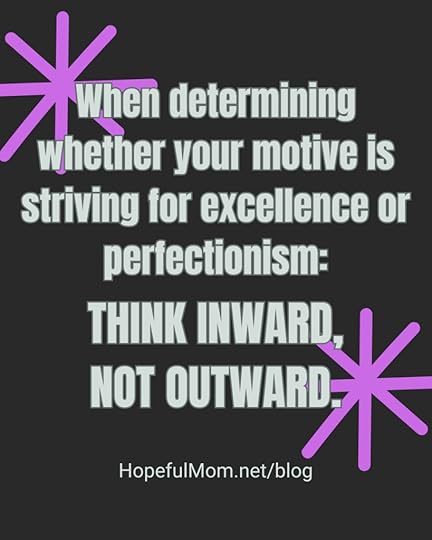
When deciding whether you’re striving for excellence or reaching for perfection, remember this: THINK INWARD, NOT OUTWARD. Inward motivation and inward sources produce inward growth, satisfaction, and self-worth. Goals worth attaining.
 Striving for Excellence
We can help our children by teaching them it’s okay to fall short of perfection. We won’t always get everything “right.” No level of achievement will compel every person to love and accept us. Perfection is a myth beyond our grasp.
When your teen feels incompetent, ask if they tried their hardest and did their best. If so, it’s a win. If they didn’t give it their all because they were afraid of failing, it’s okay. Ask your child if they are worried they aren’t hitting the mark their social media feed sets for them. Maybe scrolling less or taking a break from social media may help. Tell your children, often, that you love them for who they are, not because of what they do.
Take opportunities to praise your child for their work ethic. Remind them that life is a journey. We never “arrive.” However, pursuing excellence along the way provides joyful moments and reasons to celebrate. By helping our children recognize the traps of perfectionism, we empower them to value progress over flawlessness.
And, remember, there are no perfect parents. Parenting is a journey with ups and downs—triumphs and defeats. When we aim for excellence, we are more content, more confident, and more forgiving—of ourselves and others.
If you find this post beneficial, consider sharing it. Thank you!
[i] https://www.defininggrace.com/creativ...
[ii] https://thinkgrowprosper.com/blog/per...
The post How to Help Teens Beat Perfectionism Fueled by Social Media appeared first on HOPEFUL MOM.
July 7, 2025
Through My Daughter’s Eyes: Understanding the Anger of the Forgotten
I’ve never been more excited or proud to introduce a guest author at Hopeful Mom. My daughter Melinda Winters, a substance abuse counselor, is here to explain how pornography, neglect, abuse, and anger affect a child well into their adult years. Melinda is nurturing, patient, and loving. She treats everyone she meets with kindness and shows honor and respect to her clients. Every day, I’m impressed with her strength and resilience, even while she is tenderhearted toward those she interacts with. Melinda is passionate about helping women understand the importance of finding self-worth and valuing the person they can be. She has a powerful message for parents.
Walking into a room full of women filled with anger can often be challenging to navigate, especially when the room is inside a women’s correctional facility. Their faces and body language range from visibly angry and tense with arms crossed to masking their anger and pretending they are okay with a small smile and constantly moving hands. They avoid talking and making eye contact. Many of these women do not want to admit something traumatic happened to them. They do not want to admit they’ve been used and they have no self-worth. Or they repress memories of being used in their life. They want to be happy but instead find themselves constantly frustrated.
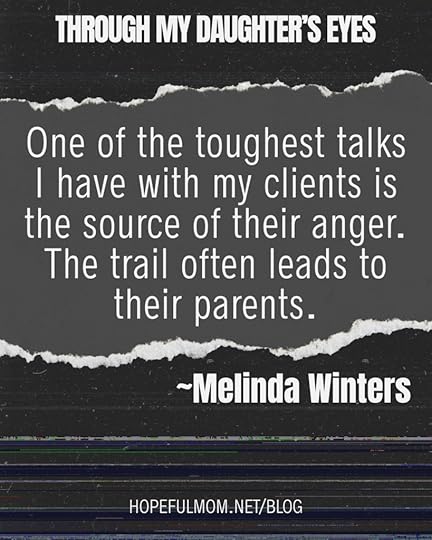
Anger: The Cause and EffectAs a substance abuse counselor, I walk alongside many women inmates with stories of hurt, anger, loss, and disappointment. We dig into their past and piece together certain moments, how they have impacted who they think they are, and how they were led to this moment. One of the toughest talks I have with my clients is the source of their anger. They could be angry about anything, but when we start walking the trail to find the source, it often leads to their parents. Much of their anger towards their parents is because of the way their parents took care of them. They did not realize until past their twenties that there was something wrong with how they were treated.
Many clients I interact with talk to me about their childhood. They open up about how their parents were addicted to pornography and how one parent, or both, sexually abused them all their life. They tell me stories of how uncomfortable they were in their own skin but never spoke up about it. For some clients, our conversations can be the first time they talk about their experience with pornography. A high majority of them were exposed to pornography at a young age because their parents watched it. It’s a trickle-down effect for the women. Each client has their own thoughts and feelings about their situation, but the most common emotion is anger. Anger towards her parents. Anger because she was ignored and used. Anger because she felt worthless. Anger because she could no longer be a child.
Some clients remember every detail of what happened to them. Others can’t recall because they repressed so much. Repression often results in anger. Anger towards the world and those around them. The reason people turn to anger is because it is the easiest emotion to exhibit. They lash out at those around them to avoid processing their emotions. Anger creates conflict within themselves and others. It is easy to get stuck in a cycle of anger creating more problems to hide the initial problem, their childhood hurt. These women run as fast as they can from these memories and avoid sitting and validating their own emotions. They turn to any substance use that will numb their pain and increase their anger.
Repressed memories of a parent's abuse often results in ongoing anger issues as an adult. Barb's daughter, Melinda Winters, shares how parents can prevent a future anger problem. Through My Daughter’s Eyes: Understanding the Anger of…
Share on X
At the end of many conversations, clients tell me they are exhausted from being angry. They do not want to continue being angry, but they do not know how to stop because of the cycle. A child’s life is affected by repetitive consequences they’ve received. Then they build their life and future on their emotional response to those consequences. I hear my clients say, “I never want my kid to go through what I went through” and “I wish my parents had just listened and helped me.”
It is often difficult to hear these stories and see the broken person sitting in front of me. All they ever wanted was a parent to pay attention to them. All they wanted was to be loved. All they wanted was help.
I encourage you to listen to your kids when they speak to you. Look them in the eye and actively listen to the words they tell you. They want to be heard. In addition, try to understand and find the warning signs in your children’s reactions and help them understand the importance of processing their emotions. Emotions are there for a good reason. They tell us when something is wrong and when something is good. However, at a young age, everything is thrown at them, and they don’t know what to do. Anger is the easiest emotion to turn to, but it also causes the most harm in relationships.
When we learn to process anger, face challenges, and resolve situations, we build healthy relationships and learn to face conflicts together, which leads to personal peace.
Subscribe to Hopeful Mom for two FREE PDF downloads, keep up with Hopeful Mom on Facebook, Instagram, and LinkedIn, and check out Barb’s book Sexpectations here.
The post Through My Daughter’s Eyes: Understanding the Anger of the Forgotten appeared first on HOPEFUL MOM.