
Mary Jane Miller's Blog: San Miguel Icons
November 9, 2025
Mary Speaks; Her Image and Spiritual Legacy.
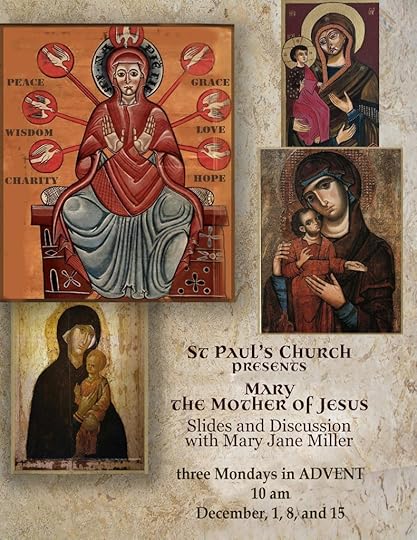
\Advent is a time of Awakening, the word itself means “arrival”. Four weeks leading up to Christmas serve as a period for reflections on hope, peace, love, and joy while awaiting the emergence of more wisdom in our world. Most of us will agree that we are living in turbulent times. Mary Jane Miller will offer three Monday presentations at 10 am on the many aspects of Mary; her Image and Spiritual Legacy. Who is she? How did she evolve throughout history and in theology? And Where might we find her today?
Miller’s presentations are provocative and, at times, humorous. For three decades, her approach to sacred art has morphed in many ways, but she consistently concludes that love is the way, the light, and the truth. The images she presents of Mary are ancient and contemporary, interpretations of the same woman with various messages. Mary is by far the most common image in Christianity; she represents eternal love born in her womb. She embodies the church, a physical place we step into for wisdom and solace.
The spirit of Mary is woven throughout the imagery around San Miguel and across Mexico. Join us on December 1, 8, and 15 at St. Paul’s Church on Calle Cardo. She is the Virgin Mary, the Guadelupana -whether in homes, on buses and taxis, in places we travel, on altars, windows, clothing, or even, as I once saw, on a bar of soap!
Mary imagery began in the 4th century and has evolved over the next thousand years, with ongoing development. Motherhood is archetypal; no one on the planet has no mother, and it is through motherhood that we have the gift of habitual love ingrained in our DNA. Everything on the planet reproduces itself. Mary Speaks; her Image and Spiritual Legacy.
Peace be with you.
The post Mary Speaks; Her Image and Spiritual Legacy. appeared first on San Miguel Icons.


October 30, 2025
Surprise! “God “creates through us, as God is the Creator
Someone once called me a mystic without a monastery, traveling the countryside with a few icons and placing them strategically and comically where you would least expect them. In truth, my hope is to bring surprise and delight to any observer. My goal is to spark a renewed spiritual relevance, with new iconography built on old theology, regardless of being called a most reverent heretic.
At the age of 40, I innocently attended an icon writing workshop with an Orthodox priest. That first introduction swept me up like a baptism; it felt like an alternative way of life in God. Later, the egg tempera technique added to the experience, reaffirming my deep love for Creation. The iconographer paints with traditional egg tempera; egg yolk + water mixed with million-year-old stone ground into a fine dust called earth pigments. Egg yolk represents the raw potential for life, and the earth pigment, “eternity”, mixed together to create a divine image. One day, I would like to try to explain the mystical nature of this process, which is deep and never the same; always new and a constant teacher.
God is the Creator and owns the Dirt!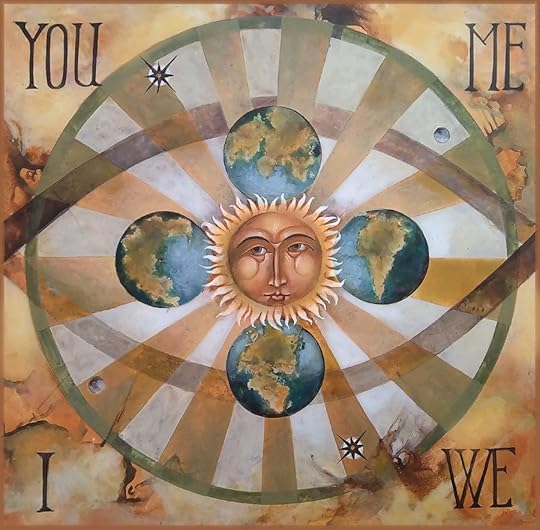
All the experimental art media I have used throughout my life have been preparation for this work. I think now, at the age of 70, “If I stop painting Icons, I will no longer paint at all.” It has been a privilege as well as a kind of joyous slavery to explore Christianity through iconography and prayer. For a while, I abandoned my friends and the outside world because I felt possessed and mystified by the process of working with God’s dirt. My husband allowed my obsession and commitment, and did not doubt or obstruct my behavior, and for this I am grateful.
Where do these ideas come from?The Byzantine Church in Constantinople elevated icons as a way of illustrating and teaching church doctrine through biblical imagery. In the early church, very few books were available to the ordinary population, and they were expensive; besides, most people could not read. Leave it to the artist of the time to take the revelation of Christ and put it down in color and shape.
The early iconographers emphasized mystical awe and wonder, which comes from “knowing” God. “God” creates through us, as God is the creator. Byzantine style iconographers offer no expression; instead, they paint empty eyes gazing towards the viewer, stunned by the presence of God. No bleeding Jesus, sorrowful weeping mother Mary, wiggly babies, or anguished suffering saints, these images are windows to a quiet, reflective world. The awe of being, the shock of wonder, and the deep spender of absolute loving abundance were what they were after. They see us clearly in all that we are called to be.
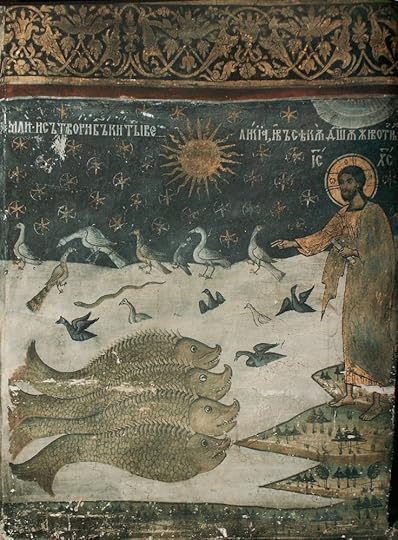
For 30 years, I have tried to respect and learn from the tradition, yet with a noticeable amount of kicking and screaming. I have a passion for these ancient images and will undoubtedly fail to reproduce the depth of mystery that the early iconographers offered. However, I am committed to using their artistic creativity and mystical data to record what I cannot see. It has been challenging to believe in faith that God has a hand in this practice I am so drawn to. My commitment to painting icons has been like a salmon swimming upstream; I have no idea when the struggle will end, and I am continually questioning why the desire to swim is so intense.
How do Artists transform ideas into an icon?Let me reverse the question: how can the Icon transform me into an idea? Experienced iconographers live in a twisted dimension: after long hours of repetitive painting (writing), theoretically, you remember you are a divine image. For me, it came as a surprise. The painting and mystical prayer are the ground for everyday work in the studio; the attempt to paint a divine image enables us to realize something quite intimate about God, and we create as we are created. “God” creates through us, as God is the Creator.
Internally, iconographers believe “beauty will save the world.” The act of painting transforms us. Through the paint and the image, I have found extraordinary beauty in humankind and my potential to see the divine in all things.
Mistaken or not, there has always been a constant sense of having been called to do the work. Some say there is a purpose for each of us to be revealed, and it may not be anything we expected. I could have never dreamed two-thirds of my life would be dedicated to painting icons. I paint because the results are always unexpected, beautiful, and filled with the wonder of where spirit comes from.
Traditionally, one does not sign an icon because the act itself is considered to be prayer, an ongoing conversation with God. As an artist, I “imagine” new images from time to time. These images continue to transform me, and with any luck, one day I will write one image of lasting beauty for humanity.
Peace, Mary Jane Miller, Icons for a more spiritual tomorrow.
The post Surprise! “God “creates through us, as God is the Creator appeared first on San Miguel Icons.
October 21, 2025
Two Spirits in San Miguel
An Upcoming Event: Two Spirits in San MiguelNovember 21, Friday, 4 to 7 PmSagrado Corazon #12, Col. San Antonio
Join us for an evening of tasting spirits that capture the artistry abundant in San Miguel de Allende. You are invited to experience an ancient visual art form while sipping Mata de Monte in a picturesque garden setting. Mary Jane Miller is an adventurous and playful artist who delights in the ether of the spirit world. Mata de Monte is an authentic agave spirit, naturally distilled to 29%, when it reaches its perfect flavor. Open your senses and share, taste, and see—to fuse and delight your soul in an event here in San Miguel.
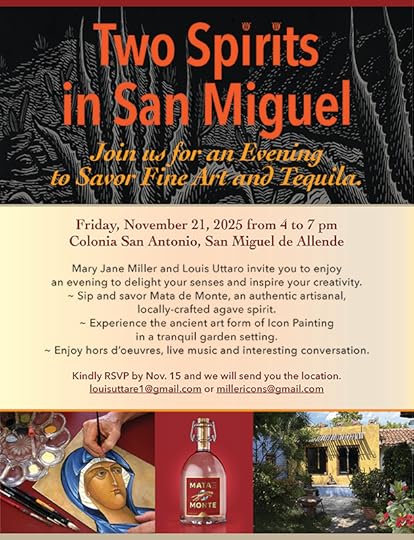
This event featuring Mata de Monte is not just an opportunity to enjoy a drink; it catalyzes creativity and inspiration and inspiration. This beloved beverage has been popular in Guanajuato for more than two hundred years, yet agave spirits date back to the time of the Aztecs. Indigenous peoples in North and South America have been producing and enjoying fermented agave-based alcohol for three thousand years. Agave plants grow slowly from the Earth, ultimately being transformed into a delightful libation. Countless narratives can be shared over a glass of this artisanal elixir.
An Event in San Miguel AllendeTransformation from Earth into something greater is not limited to seeds becoming corn. Our cellphones, sneakers, and airplanes all originate from raw materials sourced from Mother Earth. Miller’s iconography uses earth pigments to transform colored dust into spiritual imagery: her Byzantine-style art and medium discipline date back 1,500 years. Mary Jane Miller is an internationally recognized iconographer and author for five decades in San Miguel. Her devout, sometimes heretic theology and humor make her just radical enough to spark the interest of those who have no interest in church anymore but love the idea of spirit and divine mystery.
Join us for an early evening of hors d’oeuvres, discussions, and fun. Conversations emerge over the beauty and elegance of a changing world, exploring themes about immortality, wisdom, and mystery. Our evening of traditional image and art promises to be intriguing and unique. Connecting with San Miguel de Allende is undoubtedly a serendipitous experience; its tranquility and hidden interiors yield a moment for detox from wherever you come from. Here, you will connect with new people and discover fresh perspectives on life.
The post Two Spirits in San Miguel appeared first on San Miguel Icons.
October 10, 2025
HILDEGARD OF BINGEN, an inspired woman of God
Her popularity today is not surprising, 1,000 years later. Hildegard of Bingen’s writings bring together science, art, and religion. Her use of parable and metaphor, of symbols, visual imagery, and non-verbal means to communicate makes her work inclusive on many levels to produce instant rapport. Speaking through art and music goes beyond gender and personal identity. Every human being, made in the image of God, has the opportunity to develop and use the talents that God has given him, and to realize his God-given potential. Hildegard wrote explicitly about the natural world as God’s creation, beauty, and energy; entrusted to our care, “ to be used by us for our benefit, but not to be mangled or destroyed.”
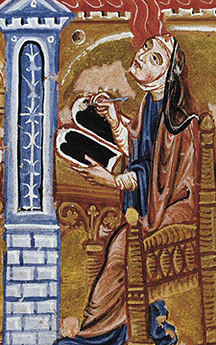
She said, “Thus am I, a feather on the breath of God.”
Hildegard of Bingen has been called “one of the most important figures in the history of the Middle Ages,” and “the greatest woman of her time.” She was born in 1098, the daughter of a knight, and at the age of eight, she went to the Benedictine monastery at Mount St. Disibod to be educated, eventually becoming a nun at18. Twenty years later, she was made the head of the female community at the monastery.
Her documented series of visions lasted from 1140 to 1150. Her writings, images, and music were deemed Orthodox, approved by the pope. The community of nuns at Disibodenberg was growing, and so Hildegard moved her nuns to a new location near Bingen and oversaw the building construction for her community. We can add architect to the list of all her talents.
Hildegard died at the age of 81 on 17 September 1179. Her surviving works include seventy poems, three books on theology, and hundreds of letters to emperors and popes, bishops, nuns, and nobility. She wrote 72 songs and music notations, including a play set to music called Ordo Virtutum. Her compositional style is like nothing else we have from the twelfth century. Hildegard indeed suffered throughout her life from painful attacks of what may have been migraine. Women are about three times more likely than men to experience migraines initiated by stress as a result of abundant thoughts in the mind.
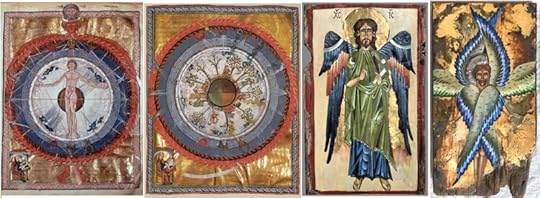 Legacy
I was inspired to use her images to reflect on the winged sprint and the energy of Christ within. Her work is rich in texture and detail. Thank you Hildegard of Bingen. There are other images of women who write their truth. Mary Magdalene, St Teresa of Avila, Mother Teresa, and St Scholastica. Women in Icons https://www.millericons.com/women-in-icons
PRAYER
O God, by whose grace your female servants kindle the fire of your love, they become a burning and shining light in your Church: Grant that we also may be aflame with the spirit of love and discipline, and walk before you as children of light; through Jesus Christ our Lord, who lives and reigns with you, in the unity of the Holy Spirit, one God, now and for ever.
The post HILDEGARD OF BINGEN, an inspired woman of God appeared first on San Miguel Icons.
September 23, 2025
Ancient Visual Language: A to Z Symbolism and Meaning
Iconography is an Ancient Visual Language and played a significant role in the Christian faith throughout the centuries. Many of us walk into a church and see the art and have no idea why a fish is hanging in the hand of a winged saint. We see a door in the background and wonder where it goes. We stand beneath a giant dome before the altar and feel our bodies elevated. This book may put to rest some of those questions and observations. It may just as easily stir up more curiosity.
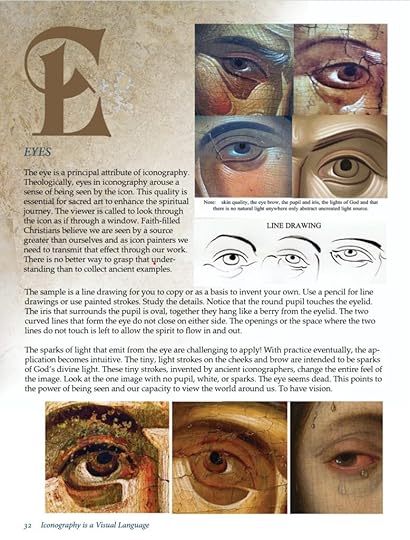
The tradition of Byzantine-style iconography has honored martyrs, saints, and mystics, both named and unnamed, who have carried forward humanity’s divine story of peace, love, goodness, light, and unity. The individual attributes of each saintly portrait are many and are crucial to interpreting the overall message. For the past 2,000 years, the basic visual form has remained consistent. There is an exhilaratingly wide area left open for interpretation and design. The entire art form is an expression of God’s creativity etched into color and hopefully will continue to grow and change for another millennium. The Visual Language A to Z alphabet has been written to honor the past and give rise to the future, to help fledgling iconographers and those who find gazing at icons hypnotic.
God’s image is reflected in Creation.We are the observers. The power of the mind, the wisdom of the soul, and the vitality of the Holy Spirit are aroused to give interpretation to what we see, think, and feel. Oneness to the divine, the transcendence of opposites, and each person’s spiritual experience enter into this book as you page through and select one letter at a time. Humanity is not divided into conflicting and irreconcilable opposites; on the contrary, we have more opportunities than ever to see commonality and expression throughout many religions. Spiritual language is unique and crosses over without hesitation. Interpretations may vary from culture to culture, in a symbolic and mythological sense; however, the divine realm has no gender, limitation, right, or wrong.
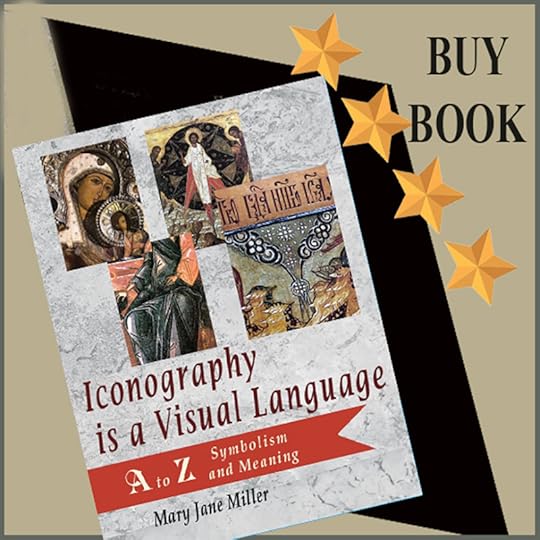
My book, Visual Language A to Z, is a courageous attempt to explain the symbols and significance found in iconography. Without ignoring the accepted visual cannons of iconography, this resource offers a fresh perspective on attributes and elements utilized throughout the history of sacred art. The concise language of icons sparks the imagination and provides new creative opportunities to contemplate the enigmatic workings of the Spirit in one’s life. I believe that simplicity is often the best way to reach the depths of our souls and connect us to our archetypal and ancestral memories.
This book focuses on the visual representation of symbols and breaks down where and when they are used or distorted one at a time. The symbols and characteristics of iconography have been passed down through devoted followers, community leaders, preachers, saints, artists, and mystics in the immediate context of historical epochs. This means that each person can and will interpret the meaning perfectly in the core of his or her being.
Ultimate spiritual truth is not the domain of the ego.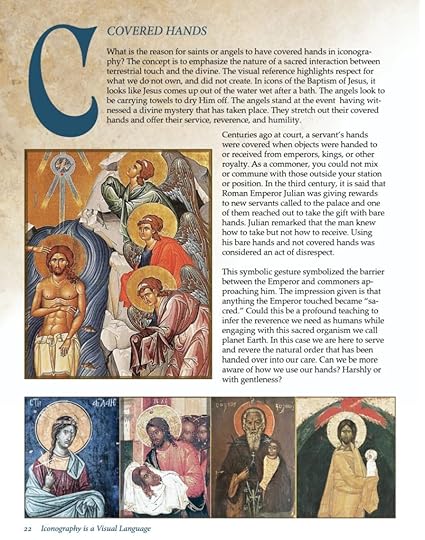
It is clearly beyond the control of the ego to unite the physical (earthly) and the spiritual (cosmic) into a cohesive whole. The encounter with sacred images has the potential to transcend space and time and to transport our consciousness to a higher, eternal realm. The Ancient Visual Language of icons can be a starting point to open our minds to possibilities beyond what we know and accept without question. As you immerse yourself in the divine images in this book, let them speak for themselves. Allow this meditative process to take you into the depths of your psyche, where spiritual truth about the power and mystery of the unseen can be revealed through image.
I have spent 30 years in the practice and discipline of discovering this Ancient Visual Language in iconography and prayer. The insights and opinions I share are mine and, to a large degree, held by many but not all. The book Iconography is a Visual Language is not meant to be scholarly or academic; it is to be received with joy and surprise. Make your own conclusions. I am simply laying out a structure.
Be the first to buy and review a great resource book, Visual Language A to Z, and see sacred art in a new way.Mary Jane Miller is a contemporary Byzantine-style iconographer with over 28 years of experience living in Mexico. Her collection of sacred art is thoughtful, unique, and unorthodox. She teaches 4 courses annually, 5-day immersion workshops throughout the US and Mexico. website
Join our Group on Facebook for Conversations about prayer and iconography.
The post Ancient Visual Language: A to Z Symbolism and Meaning appeared first on San Miguel Icons.
September 22, 2025
Books About Icons
Miller says, “pushing little particles of dirt around in an egg yolk emulsion to create beauty blends everything that I’m about. I love nature, I love life, and I love God. The ancient Orthodox style is one of the highest resonances of beauty for me. I never get tired of this magnificent medium and mysterious content that is expressed. Writing books about icons has been a delight.”
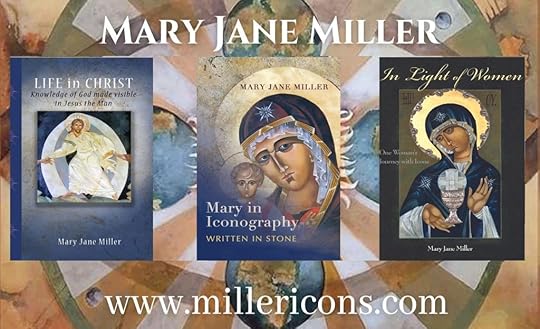
Miller effuses humility, woven with her sharp humor, acknowledging that being an iconographer is both a privilege and a gift. She says, “I feel like I’m chosen,” quickly followed by, “I am the last person God should have picked to do this.” Miller light-heartedly refrains from divulging her thoughts behind that statement; instead, she rests on the sense of dedication that she has toward her work. “My books about icons reflect my commitment to translate what I cannot see or explain.”
There are about 500 classic divine images within the Russian iconic canon, a guidebook of sorts, cobbled together over the past 1,800 years. Those 500 images remain static, changing slowly according to the slow, gradual unfolding of theological concepts emerging. Miller believes that thoughts of God begin without color, form, shape, or line in creation. We begin as God began in a divine void, and from there He, She, or It manifests images as we do.
At times, Miller has wrestled with her choice to paint in an unconventional contemporary style, and her books about icons highlight the journey. However, she never forgets the spiritual root of iconography as the source of relevancy, for a world desperately seeking the answer to why we are here. What is the goal in life? The ancient style demands a certain type of structure, “but the images themselves speak of the divine potential, of mystics, and of people who have prayed their whole lives.”
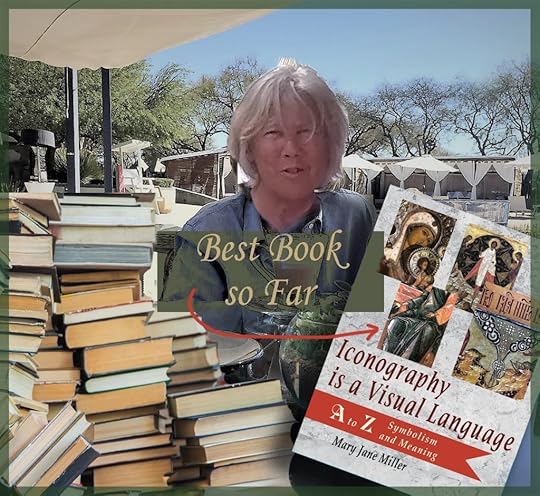
Bio. Mary Jane Miller is a Byzantine-style iconographer with over three decades of writing books about icons. Her interpretations of sacred art are contemporary, unique, and unorthodox at times. Her collections and lectures are provocative, especially when she offers her 5-day immersion workshops using egg tempera. The work has been exhibited in Museums and churches in the United States and Mexico. As an author, Miller writes luxuriously, blending historical content and personal insights to arrive at contemporary conclusions about faith. Over the past decade, she has devoted her work to the voices of women and care for the Earth.
The post Books About Icons appeared first on San Miguel Icons.
September 14, 2025
About Egg Tempera Technique: A Magnificent Medium and Mystery
Icons from the Byzantine era are treasures that stand unparalleled in Christian art. These remarkable and powerful images originated as artistic interpretations of the story of Christ, created by painters using the egg tempera technique long ago. These icons transcend individual expression and will always be revered for their sheer beauty and theological significance. The rich colors and textures of icons provoke curiosity about their symbolic visual language, the choice of colors, and the techniques used to create them.
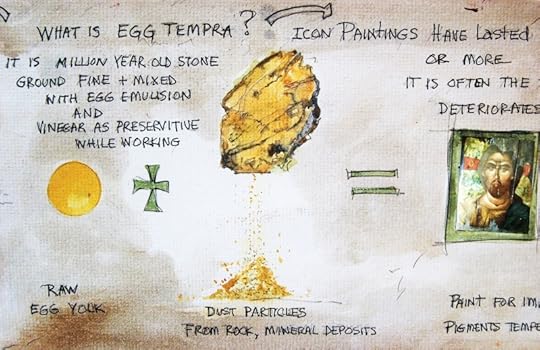
The egg tempera technique employs a magnificent medium made from colorful ground stone and egg yolk. It is historically recognized as the second-oldest paint medium used by artists. This method consists of dry earth pigments, water, and egg yolk. Earth pigments are integral to all painting mediums: frescos use lime and earth pigments; encaustic employs beeswax and pigment; oil paintings utilize linseed oil and pigments; and watercolor relies on gum Arabic.
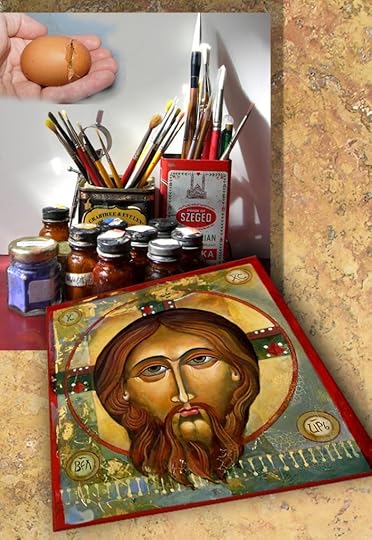
The egg tempera technique is best recognized worldwide for the icons of Russia and Greece, but it has also been used in panels by Italian painters, in Islamic manuscripts, and by some modern American artists.
Symbolically, egg yolk represents the essence and raw potential for life. The emulsion, mixed with million-year-old ground earth pigments, creates a divine image. When Miller paints an icon, she becomes aware that she is part of a much larger vision in the eyes of God—like a grain of sand moved by the spirit. It is not exactly the egg tempera technique that is fascinating as much as a sense of eternity that is touched while working with this rich and ancient medium. This sacred art form represents a union between the past and the present, the earth and the divine, as well as the physical and the spiritual.
Mary Jane Miller, new images posted on website.
Books available on AMAZON and LULU. or For your store, Order on IngramSpark.
The post About Egg Tempera Technique: A Magnificent Medium and Mystery appeared first on San Miguel Icons.
August 31, 2025
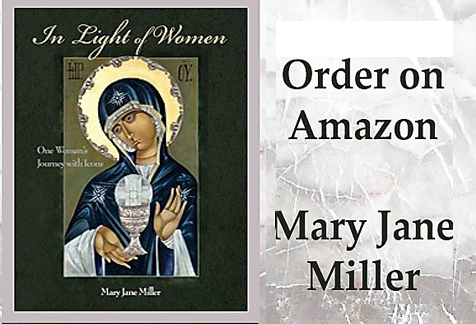
I Was Inspired to write In Light of Women.
One hundred years ago, In Light of Women could not have been published with holy images created by a female iconographer. “Women should remain silent in the churches. They may not speak…” 1 Corinthians 14:34. The New Testament includes plenty of verses that ultimately prohibit women from serving in positions of authority. The likes of which have affected every woman’s place in society for 2,000 years. In actuality, beginning as early as the fourth century, the dominant Christian leaders and those in control of Iconography in the early church were all men. They distorted Holy Scriptures to thwart the ascendant positions and influence of women. Religious hierarchy in Christian societies set the stage for our tragic silence and perpetuate it even today.
The underlying teachings of Jesus Christ, the Apostle Paul, Moses, and the prophets all call for the proper and fair treatment of God’s children. It is not God’s commandment they women are not heard or seen in a sacred text or image. As an iconographer of three decades, I have always known in my heart and soul that women are not inferior to men. God loves humanity equally. I have not had to look far to see that this glorious tradition has failed to include women. The images depicted by men often lacked the inclusion of women, in principal events like Baptism, Pentecost, and The Last Supper. However, women were present at the resurrection, and were the first to go to the tomb, with no fear of death, and willing to serve.
In Light of Women is one collection of images and text that contributes to this great sacred art form’s survival. 21st Century Women iconographers like myself are graced with the desire to paint from sacred text; we have an obligation as prayer practitioners to re-examine how or why women were barely mentioned. When the feminine voice and new icon images are ushered into today’s spiritual communities, books for Christian Women will be an addition that benefit all of us.
In Light of Women: A Book Review for Mary Jane MillerReviewed by Eileen Quinn Knight, Ph.D. Profiles in Catholicism Mary Jane Miller writes with immense freedom and expression, about the absence of Women in the traditional church. This book, In Light of Women, is a courageous attempt to accept many forms of God’s manifestation regardless of gender. Without ignoring the accepted visual cannons of iconography, a reader is offered a fresh perspective on the stories portrayed in the New Testament and a new way to look at women in the Bible. The concise language of icons sparks the imagination and provides new creative opportunities to contemplate the enigmatic workings of the Spirit in one’s life.
Simplicity is often the best way to reach the depths of our soul and connects us to our ancestral memory, in which the honoring of the sacred feminine is imprinted. This book reconstruct the meaning of the role of women in Christianity, not only in light of women’s traditional social role assigned to them by society. She goes further to include devoted followers, community leaders, preachers, saints, healers, and mystics in the immediate context of historical epochs. In the religious tradition, the Divine grants authority to those who choose to push towards unification and love.
Miller opens her book In Light of Women with a treatise on Mary, the Mother, and her message of love and surrender.“ The wisdom women have learned through their years of service and witness has been kept in a soundproof room for too long. It is time for women to speak out and be heard on issues that matter to them. Mary receives a divine gift, nurtures it, and ultimately surrenders that gift to the world. By her example, humanity, in turn, will learn to recognize the divine gift within us, nurture it, and let it go, knowing that it was never ours to own but rather to share.
The encounter with sacred images has the potential to transcend space and time and to transport our consciousness to a higher, expanded spirituality. The evocative power of icons can be a starting point to re-examine cannons and symbolism, to open our minds to possibilities beyond what we know and accept without question. As you immerse yourself in the divine images in this book, let them
speak for themselves. Allow this meditative process to take you into the depths of your psyche where spiritual truth about the power and mystery of the sacred feminine can be revealed.”
Eileen Quinn Knight, Ph.D., continues: Christians and lay people will look at the image and read their stories as an exercise in prayer, a voyage of the spirit in conversation with God. They find a place where the reader comes to God and discovers God’s coming to him. In the presence of an icon, we are invited to practice that wonderful insight of St. Benedict, “to listen with the ear of your heart.”
Both as a person of faith and as an artist, Mary Jane Miller is one who brings to this ancient art form both a deep understanding of and love for the icon tradition of Eastern Christianity and a modern sensibility of expression. If there is a book the reader wants to invest in once in his/her lifetime, this is the book. I felt tangibly mesmerized by what I was seeing and reading. I thank God for giving Mary Jane Miller this radical voice.
Bio. Mary Jane Miller is a Byzantine-style iconographer with over three decades of experience. Her interpretations of sacred art are contemporary, unique, and unorthodox at times. Her collections and lectures are provocative, especially when she offers her 5-day immersion workshops using egg tempera. The work has been exhibited in Museums and churches in the United States and Mexico. As an author, Miller writes luxuriously, blending historical content and personal insights to arrive at contemporary conclusions about faith. The past decade, she has devoted her work to the voices of women and care for the Earth.
The post I Was Inspired to write In Light of Women. appeared first on San Miguel Icons.
August 22, 2025
Prints in Fine Art America; Mary Iconography
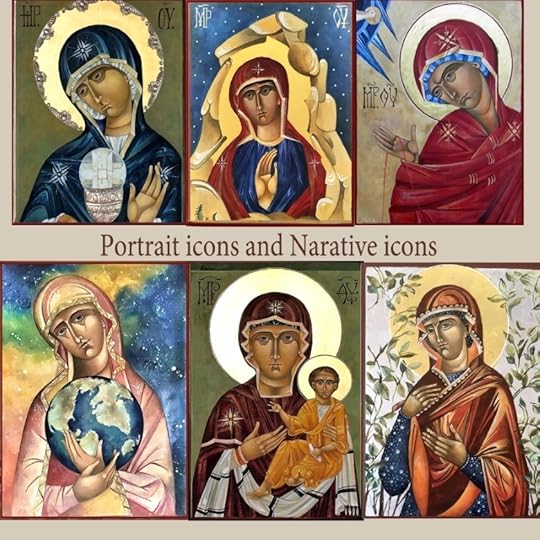
NEW and AVAILABLE….. Welcome to Miller Icons, Prints Fine Art America. Canvas, on wood, and Metal prints from Fine Art America are originals from our studio in San Miguel Allende, Mexico. Our collection features hundreds of iconic fine art and Byzantine-style images from our private collection of Mary Iconography. Here you can purchase high-quality prints of these artworks on pillows, coffee mugs, tote bags, and even shower curtains.
Mary Iconography, the Dormition, the Virgin Mary, her Birth, Jesus, and San Miguel Archangel are all available.Prints from Fine Art America of Mary Iconography and Catholic Christian imagery are quality and archival. Mary was born to St. Joachim and St. Anne. In the late 18th century, the Catholic church named her the Virgin, exempt from original sin and living a life in perfect fulfillment of the Will of God. (This doctrinal decree allowed the identity of Jesus to be All God and ALL Man at the same time.) She was visited by the Archangel Gabriel with this message: “Hail Mary full of Grace, the Lord is with Thee…Behold thou shalt conceive in thy womb, and shalt bring forth a son; and thou shalt call his name Jesus. He shall be great, and shall be called the Son of the Most High…
Browse my collection of Mary Iconography in Prints Fine Art America. A picture is worth a thousand words. The Blessed Virgin Mary is seen lying in a bed surrounded by the disciples Jesus had named. She didn’t die as in the human way because ‘She’ was exempt from original sin, immaculately conceived according to the Orthodox theology, She went to sleep. The Virgin Mary passed from this physical existence into the realm of the spirit in an ecstasy of love. The Fathers of the Church speak about her “dormition”, and that after three days, she was assumed in body and soul into Heaven. She is the Living Tabernacle of the Divinity. A true devotion to the Blessed Virgin Mary will lead us to Jesus, as in the wedding at Cana, her message is ” Do whatever He tells you.”
About Mary Jane MillerBio. Mary Jane Miller is a Byzantine-style iconographer with over three decades of experience. Her interpretations of Mary Iconography are contemporary, unique, and unorthodox at times. Her collections and lectures are provocative, especially when she offers her 5-day immersion workshops using egg tempera. The work has been exhibited in Museums and churches in the United States and Mexico. As an author, Miller writes luxuriously, blending historical content and personal insights to arrive at contemporary conclusions about faith. The past decade, she has devoted her work to the voices of women and care for the Earth.
The post Prints in Fine Art America; Mary Iconography appeared first on San Miguel Icons.
August 13, 2025
Mother Earth Iconography: Seven Swords will pierce your Soul
A sword did pierced my soul when I decided to break step with Orthodox Iconography and use the practice to examine humanities relationship with Mother Earth. Change is upon us; every nation is affected, and every society feels the consequences of unbridled greed and waste. I believe we live on Holy Ground, even with climate change and the anxiety it may provoke. We are still miles from the idea that we could go extinct like the dinosaurs. Humanity thinks it is the last revelation of God, and eternal. Yet humans are just one more evolution happening over millennia.
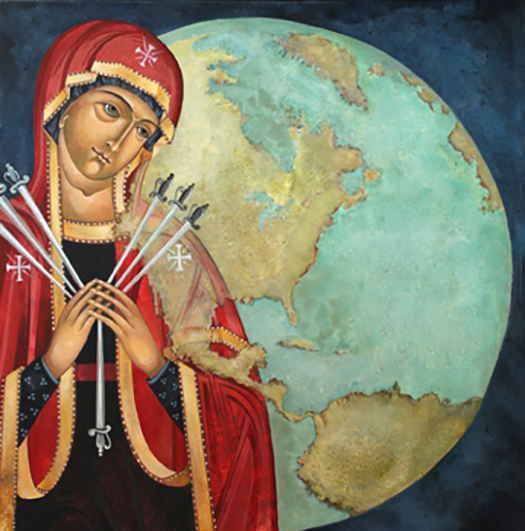
My collection of Mother Earth iconography opens with an image of Mary of Swords inspired by the number seven. This sacred number is associated with intuition, mysticism, inner wisdom, and a deep inward knowing. The ancient church speaks of seven deadly sins, seven holy attributes, and seven sacraments. The composition places the planet Earth beside Mary as she bows her head, having been told, “A sword will pierce your Soul.”
Mary of Sorrows tilts her head lovingly towards our planet Earth. Seven swords pierce her soul, indicating the fullness and boundless sorrow, pain, and “sickness of heart” that she experienced seeing the innocents of her son brutally killed. In this case it is the living planet that is heavy with sorrow for the ways we have treated her.
Mother Earth iconography and the number sevenGod created the Earth in seven days, and there are seven wonders of the world and seven days of the week. Muslim pilgrims circle the Kaaba in Mecca seven times, and Egyptians had seven gods. The Christian bible used the number 735 times. The book of Revelation mentions seven churches, seven angels, seven seals, seven trumpets, and seven stars. All music is created based on seven basic notes, and we have seven chakras in the body. A prism makes rainbow light appear in seven distinct colors. There are seven bones in our face, neck, and ankle, and there are seven holes in your head. There is a Divine message in the number seven.
Seven swords pierce Mother EarthThe seven swords piercing Mary’s chest represent the seven passions that cause spiritual torment for us all. Three of the swords enter her heart on the left, on the right, and one sword from underneath. Mary of Sorrow icons are associated with the prophetic prayer of St. Symeon,” Yea, …And a sword will pierce Your Soul too, that the thoughts of many hearts may be revealed .” (Luke 2, 34-35). She stands with her hands clasped in prayer for humanity and our ability to turn away from our hard-headed attitude towards climate change around the globe. The swords are our behaviors that hurt, maim, and hinder the health of Mother Earth.
Our human greed, lust, sloth, pride, envy, gluttony, and anger are largely the components that have led to our planet’s ill health, imbalance, and climate change. The climate imbalance is due to our negligence in having too little compassion for the rock we live on. We did not create Earth, we do not sustain Earth, but it is in our power to care for and maintain the well-being of Mother Earth. As she has cared for us, so we can care for her.
Pride is an excessive belief in one’s abilities, a failure to see others before themselves. It has been called the sin from which all others arise. Pride is the sword that comes from beneath, unseen yet at the center of everything.
Gluttony is an inordinate desire to consume more than what one requires. To take more than your share, to not know what is enough, or when to stop.
Lust is an inordinate craving for bodily pleasures. The sex trade and our obsession with perverse bodily delight have become a hindrance to many otherwise healthy relationships.
Anger is an uncontrolled response and rage towards government, religion, or anyone acting contrary to our blinded desire. They spurn love and opt instead for fury. We cause massive destruction by undisciplined reactions and excessive outbursts of ego.
Greed is the desire for material wealth or gain, ignoring the realm of the spiritual. Big industrial companies use greed to mine sand or gold, and sell seduction and cravings through lies. Greed that insists on becoming bigger and better year after year is avarice.
Sloth is the avoidance of one’s individual physical or spiritual work. It arises from a lack of self, feeling there is no point or purpose in life. On the international landscape, it looks like dictators who refuse to act benevolently.
Envy is wishing for the other person not to have what they want to possess. We go to extreme measures to prevent others from having. Personal ambition sets one on a course to do anything necessary to have “what does not belong to them”.
These seven behaviors harbor a divine message. I pause to reflect where a sword is piercing my Soul. Our society needs to understanding the delicate nature of our Planet. We can change our mindset for a more balanced existence between humankind and the natural order, and between continents. I can yield, step back from my past behaviors, and move towards a responsible and simplified lifestyle while I live on this planet Earth.
Mary Jane Miller My collections of iconography and books are focused on Women’s voices and the violence against one another, and the planet Earth. My next collection is dedicated to climate change and prayer for our future. Climate change is a real issue in many of our hearts and minds. Miller is a teacher of iconography living in Mexico full time. https://sanmiguelicons.com/
The post Mother Earth Iconography: Seven Swords will pierce your Soul appeared first on San Miguel Icons.
San Miguel Icons

Miller has developed an exquisite and distinctive voice as a writer of icons, adapting the style ...more
- Mary Jane Miller's profile
- 8 followers

