
Brian Tice's Blog: Halakhically and Hashqafically Historical - Posts Tagged "brian-tice"
Attention: Reviewers of Jewish Historical Matter


Textual Variants within the Tefillin shel Rosh
Mathematically, there are 24 possible ways to arrange four different texts. Applying the halakha presented in the sources given to us in the texts included in this compendium reduce the possibilities to four and, not surprisingly, all four options have notable proponents. Many don both Rashi/Rambam and Rabbeinu Tam tefillin, and the last Lubavitcher Rebbe donned all four shitot (versions).
Rashi & Rambam: [1] kadesh li, [2] vehaya ki, [3] Shema, [4] vehaya im shamoa
Rabbeinu Tam: [1] kadesh li, [2] vehaya ki, [3] vehaya im shamoa, [4] Shema
Shimusha Rabba: [1] vehaya im shamoa, [2] Shema, [3] vehaya ki, [4] kadesh li
Ra'avad: [1] Shema, [2] vehaya im shamoa, [3] vehaya ki, [4] kadesh li
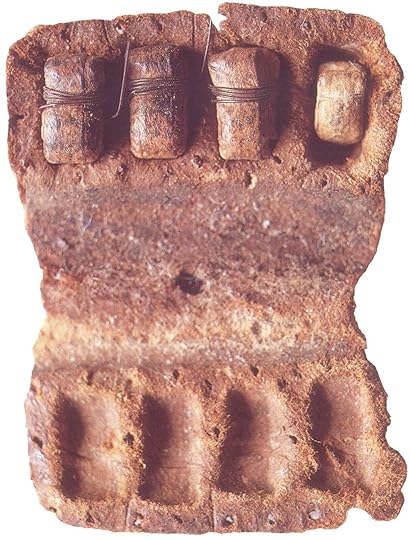 The tefillin found at Qumran (site of the Dead Sea Scrolls), over two dozen scrolls in total, are not helpful in resolving this makhloket as they do not match any of the above traditions. The order in one set (left) is [1] kadesh li, [2] Shema, [3] vehaya ki, [4] vehaya im shamoa (not original; a Beduin seller, apparently supposing that vehaya im shamoa belonged there, supplied it post facto). Three sets from Cave 4 bear texts which were not among the passages prescribed in the Talmud. One scroll was found containing Exodus 12:43-51, 13:1-10 (kadesh li), and Deuteronomy 10:12-19; another presents Deuteronomy 5:22-33, 6:1-3, and 6:4-6 (Shema); and on a third is inscribed Deuteronomy 5:1-21 and Exodus 13:11-16 (vehaya ki). In another set, the portions were removed before the order could be documented. It is worthy of note, however, that the sects associated with Qumran, i.e. the Yachad and the Damascus Covenant community, were non-normative communities, so any traditions found there which deviate from later Judaism might also have been aberrant with regard to normative Judaism of the Second Temple Era.
Whirled Pehs in Sifrei Torah
Focusing on the first in the list, the V'shamru, he writes that the peh of וינפש (vayinafash; "and He was refreshed"), which is pictured here (see the bottom left corner word) is "doubled" (a small peh written inside the proper peh) in order to emphasize the extra soul that we receive on Shabbat (ref.: b. Beitza 16a), as the root of וינפש (vayinafash) is נפש (nefesh; i.e., soul).
[image error]
This is what is said in b. Beitza [4]: "As Rabbi Shimon ben Lakish said: The Holy One, Blessed be He, gives a person an additional soul on Shabbat eve, and at the conclusion of Shabbat removes it from him, as it is stated: “He ceased from work and was refreshed [vayinafash]” (Exodus 31:17). Rabbi Shimon ben Lakish expounds the verse as follows: Since he ceased from work, and now Shabbat has concluded and his additional soul is removed from him; woe [oy vey] for the additional soul [nefesh] that is lost."
Nota bene: The image posted here comes from a Polish Sefer Torah. We know this due to the tradition visible here of placing an extra space between pasukhim (verses), i.e. two letter spaces rather than the single letter space normally placed between words.[5]
_____
Notes:
1. As described in Sefer Tagin (ספר תאגין): An Ancient Sofer Manual (ca. 2nd c. CE).
2. The "V'shamru" is often included in the weekly Shabbat liturgy. It is comprised of Exodus 31:16-17, i.e. the last 4 lines of the petuchah paragraph in the photo.
3. Baal haTurim, Commentary on Parshat Ki Tisa 31.17 (early 14th c. CE).
4. Gemara of Talmud Bavli (6th c. CE).
5. Yemenite scribes do this as well, to facilitate the tradition of reading each verse first in Hebrew, then from the Aramaic Targum (Onqelos), and finally from the Judeo-Arabic (Tafsir Rasag). By placing extra space between verses, it is easier to find the verse breaks and transition to the targumic texts.
Historical Accounts of the First Chanukah
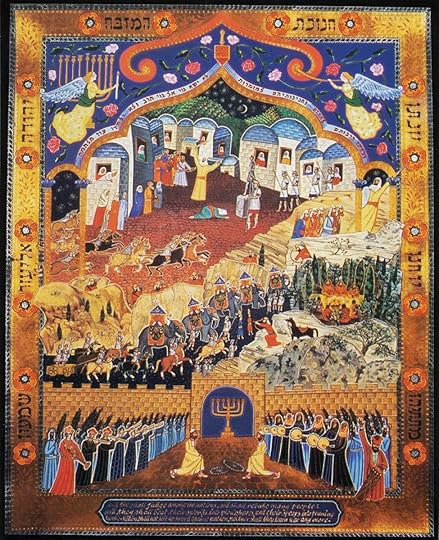 As we approach Chanukah, let us discuss the sitz im leben (historical backdrop) of the Judaism of that era, up to and including 164 BCE. Within Judaism, there was a tension between the traditionalist Jewish element and those who had come under the allure of Hellenism. The Maccabees, who led the rebellion against Seleucid (Greek) Emperor Antiochus Epiphanes IV, were ironically of the more Hellenized sect - the Hasmoneans.
 "1 Maccabees" is written from the Hasmonean (Hellenized) viewpoint, praising the Greekness of the "new Judaism," with no mention of Hashem in the account. "2 Maccabees," in contrast, tells of the same events from the Traditionalist Jewish perspective, pointing out where Hashem was active in the revolt and calling for a turn away from pagan Greek influence and a restoration of "genuine" Jewish nusach/liturgy. "The Wisdom of Solomon" also speaks of this tension in the Judaism of that time period.
Josephus, writing after the extinction of the Sadducean and Essene sects, surmises that the Essenes' departure from mainstream Judaism is a reaction against the Hasmonean merger of the political and religious roles into a single head, i.e. a longing for a return to a more proper "true" priesthood. Some opine that the Yachad community of Qumran was Essene (others see it as a non-Essene separatist community).[1]
It is worthy of mention that the miracle of the oil which is so central to our modern Chanukah celebrations is glaringly absent from both of the aforementioned books of Maccabees.[2] The tradition of lighting the Chanukkiah's candles each day of the festival began more as a celebration of the Ancient Greeks’ failure to “pull Jews away from Judaism” and force us to “accept Greek culture and beliefs.”[3] We do get the miracle of the oil transmitted to us via the Oral Torah, i.e. Talmud Bavli, Masekhet Shabbat 21b (ca. 5th century CE). This is admittedly several centuries after the event, but the source whence it comes preserves an oral tradition which predates the written version by many centuries, so specifically when this element of the story became associated with it is uncertain.
The reason for the festival being eight days in length is probably less associated with the miracle of the oil and more owing to the fact that the Maccabean Revolt concluded too late for the celebration of Sukkot. The first Chanukah (Feast of Dedication) was actually a modified Sukkot festival, delayed due to Jewish worship having been outlawed prior to the revolt. Since Sukkot lasts 8 days, so also did that delayed observance of it which came to be the annual festival of Chanukah.[4]
_____
Notes
1. Jean-Pierre Isbout, "The History and Archaeology of the Bible" (Fielding Graduate University, 2021), course lecture 16.
2. Malka Zeiger Simkovich, "Uncovering the Truth about Chanukah," The Torah (n.d.; online: href="https://www.thetorah.com/article/uncovering-the-truth-about-chanukah).
3. Shayna Zamkanei, "The True Story of Hanukkah Is Not The Miracle of Oil; It’s Something Far More Insidious," Forward (12 Dec 2017; online: https://forward.com/life/389855/the-true-story-of-hanukkah-is-not-the-miracle-of-oil/).
4. Noam Zion, "The First Hanukkah: It was actually a Sukkot Celebration," My Jewish Learning (n.d.; online: https://www.myjewishlearning.com/article/the-first-hanukkah/).
*The image used in this article is a Chanukah mural from the Magnes Collection of Jewish Art (Israel).
Halakhically and Hashqafically Historical
- Brian Tice's profile
- 8 followers

