
Brian Tice's Blog: Halakhically and Hashqafically Historical - Posts Tagged "hanukkah"
Historical Accounts of the First Chanukah
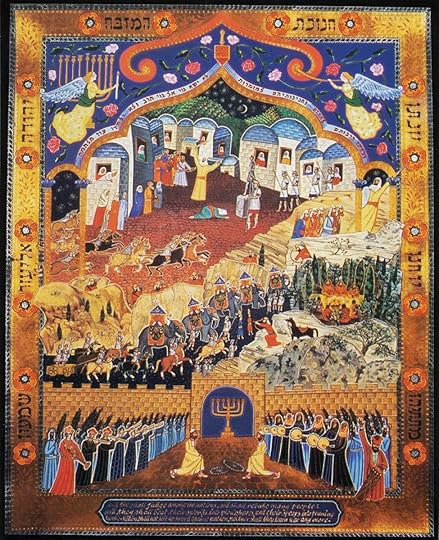 As we approach Chanukah, let us discuss the sitz im leben (historical backdrop) of the Judaism of that era, up to and including 164 BCE. Within Judaism, there was a tension between the traditionalist Jewish element and those who had come under the allure of Hellenism. The Maccabees, who led the rebellion against Seleucid (Greek) Emperor Antiochus Epiphanes IV, were ironically of the more Hellenized sect - the Hasmoneans.
 "1 Maccabees" is written from the Hasmonean (Hellenized) viewpoint, praising the Greekness of the "new Judaism," with no mention of Hashem in the account. "2 Maccabees," in contrast, tells of the same events from the Traditionalist Jewish perspective, pointing out where Hashem was active in the revolt and calling for a turn away from pagan Greek influence and a restoration of "genuine" Jewish nusach/liturgy. "The Wisdom of Solomon" also speaks of this tension in the Judaism of that time period.
Josephus, writing after the extinction of the Sadducean and Essene sects, surmises that the Essenes' departure from mainstream Judaism is a reaction against the Hasmonean merger of the political and religious roles into a single head, i.e. a longing for a return to a more proper "true" priesthood. Some opine that the Yachad community of Qumran was Essene (others see it as a non-Essene separatist community).[1]
It is worthy of mention that the miracle of the oil which is so central to our modern Chanukah celebrations is glaringly absent from both of the aforementioned books of Maccabees.[2] The tradition of lighting the Chanukkiah's candles each day of the festival began more as a celebration of the Ancient Greeks’ failure to “pull Jews away from Judaism” and force us to “accept Greek culture and beliefs.”[3] We do get the miracle of the oil transmitted to us via the Oral Torah, i.e. Talmud Bavli, Masekhet Shabbat 21b (ca. 5th century CE). This is admittedly several centuries after the event, but the source whence it comes preserves an oral tradition which predates the written version by many centuries, so specifically when this element of the story became associated with it is uncertain.
The reason for the festival being eight days in length is probably less associated with the miracle of the oil and more owing to the fact that the Maccabean Revolt concluded too late for the celebration of Sukkot. The first Chanukah (Feast of Dedication) was actually a modified Sukkot festival, delayed due to Jewish worship having been outlawed prior to the revolt. Since Sukkot lasts 8 days, so also did that delayed observance of it which came to be the annual festival of Chanukah.[4]
_____
Notes
1. Jean-Pierre Isbout, "The History and Archaeology of the Bible" (Fielding Graduate University, 2021), course lecture 16.
2. Malka Zeiger Simkovich, "Uncovering the Truth about Chanukah," The Torah (n.d.; online: href="https://www.thetorah.com/article/uncovering-the-truth-about-chanukah).
3. Shayna Zamkanei, "The True Story of Hanukkah Is Not The Miracle of Oil; It’s Something Far More Insidious," Forward (12 Dec 2017; online: https://forward.com/life/389855/the-true-story-of-hanukkah-is-not-the-miracle-of-oil/).
4. Noam Zion, "The First Hanukkah: It was actually a Sukkot Celebration," My Jewish Learning (n.d.; online: https://www.myjewishlearning.com/article/the-first-hanukkah/).
*The image used in this article is a Chanukah mural from the Magnes Collection of Jewish Art (Israel).


Halakhically and Hashqafically Historical
Brian Tice, M.Sci., Hebrew and Judaica Research Scholar, is the author of Reflecting on the Rabbis: Sage Insight into First-Century Jewish Thought (2017), Sefer Tagin: An Ancient Sofer Manual (2021),
...more
- Brian Tice's profile
- 8 followers

