Amanda Seyderhelm's Blog
August 5, 2014
Why Play Therapy isn't always fun

It's a common response for people, when they hear the words, 'Play Therapy', to imagine the children having fun. This is not the case.
The distinction between Play Therapy and playing is this: Play Therapy has a therapeutic goal, whereas playing doesn't. Children play with their friends, or by themselves for the sole purpose of having fun and letting off steam. When a child is referred for Play Therapy, a therapeutic goal is established. This can range from improving self-esteem, learning to cope with anger issues, and developing self-confidence. In order to achieve their goal, children in Play Therapy go on an emotional journey.
This journey has its ups and downs, and over the course of the 12 weeks of Play Therapy (the minimum period), they will dip in and out of their own emotional process. Research has shown that only 8% of children talk about their problems, mostly they express their feelings through the play.
When a child enters the Play Therapy room for the first time, they can choose to play with any of the toys: puppets, sand tray, musical instruments, dressing up clothes, paints, crayons, clay. In non-directive play, the therapist respects the child's choice, and plays along with them, to build up rapport, trust, and attachment. Once a strong attachment has been formed, the therapeutic work is well under way.
I have seen children change over the course of 12 weeks from being silent and scared, to being expressively engaged, from showing no facial emotions, to smiling with good eye contact. The irony is that by the end of the 12 weeks, the child may be able to enjoy life more because they have been able to express their feelings in a non-threatening, non-judgmental environment.


July 24, 2014
Expressive Painting and Writing Workshop
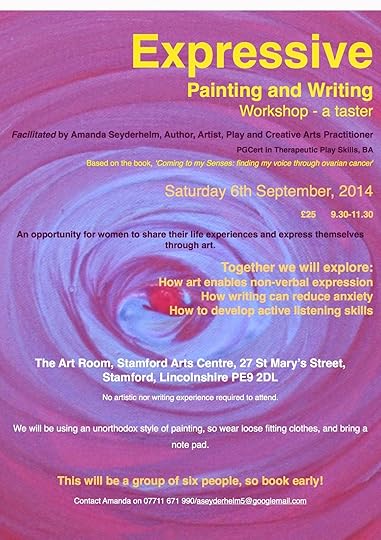
I am running an Expressive Painting and Writing taster workshop on September 6. This is a chance to paint what's in your heart, and we will be throwing out the rule book, (i.e. no technical experience is required to do this), and working with connecting with our inner voice, listening to our intuition, and expressing that through paint and words to find new meaning and purpose. This will be fun and enlightening. So, if you are curious about 'what's next in my life?', or you are interested in learning more about yourself, this is for you! This will be a small group of up to 6, so please book early.

Top 15 Must-Have Children’s Books on Personal Safety and Emotional Health
Authors Jayneen Sanders (Some Secrets Should Never Be Kept) and Jane Evans (How Are You Feeling Today Baby Bear?) have collated a list of the
Top 15 must-have books on personal safety and emotional health
I am proud to say that my picture book for early years bereavement, Isaac and the Red Jumper, is listed at No. 7!
Check out the complete list above for some excellent reads.
Top 15 must-have books on personal safety and emotional health
I am proud to say that my picture book for early years bereavement, Isaac and the Red Jumper, is listed at No. 7!
Check out the complete list above for some excellent reads.
July 8, 2014
Campaign on Twitter @amandaseyder #donateredjumper

My book, Isaac and the Red Jumper, to support young children affected by bereavement was published earlier this year, and since then I have been searching for a way to make it more accessible to the children who need it!
Each year, 20,000 children are bereaved of a parent in the UK: that is 53 children a day, or approximately one child every half an hour! That number excludes children who are bereaved of a sibling and grandparent.
Having supported bereaved children in my Play Therapy practice, and seen the benefits children receive from reading therapeutic stories, I knew there was a need for a simple, book with a straight forward guide.
Now I want Isaac and the Red Jumper to be as accessible as possible to those who need it most, young children.
It sells for £7.99, which if you are a lone parent, especially in the face of a bereavement, may not be affordable.
What can we all do?
Let's ensure that in every bereavement centre, and everywhere children are e.g.:
pre-schoolschildmindersnurseriesschoolsChildren's Centresdoctor's surgerieshospitalsfor health visitors & school nurses
that there are copies of Isaac and the Red Jumper to share, or give out.
Twitter @amandaseyder
On Twitter, I am encouraging people to buy a copy of Isaac and the Red Jumper and to donate it to a bereavement charity, a school, children’s centre or anywhere children might be. If you would like to be a part of this contact me @amandaseyder and retweet RT #donateredjumper
Let me know how you get on & please send any photos or feedback to:
aseyderhelm5@googlemail.com or Tweet Me!! @amandaseyder
Please SHARE this far and wide!!
Many, many thanks for supporting children everywhere who have been affected by bereavement to begin to find the names for their feelings today.
To order your copy of Isaac and the Red Jumper click HERE
May 11, 2014
Lessons from Writing a Memoir
I'm not fond of the word, 'lovely'. It's an in between word, which means that when a colleague said my writing was 'lovely' I went 'urgh, that's not a good comment.' Closely followed by, 'what have I missed out?'
When I wrote my memoir, Coming to my Senses, the clue was in the sub-title: finding my voice through ovarian cancer. I sweated years to dig far enough into my spectrum of pain and suffering to find the voice to speak my truth. And I thought, phew, that's it! I'm done, I've found my voice. Now I can relax because the writing will be easy from now on. Girl, was I mistaken.
Here's the thing: finding your voice is not always a one stop destination. It's that dreaded thing called A PROCESS!
If I was going to move my writing beyond lovely, and make it a colour my goddaughter calls 'mango moon', then I had some more excavating to do.
Here's how I started:
1. Jotted down words and sentences that 'came to me' in unusual places, i.e.. not my writing desk nor my Soul Studio, more likely the shower ... yes, that's right. Turns out that running water is a conduit for soulful ideas to pour out of one. Who knew.
2. Listened carefully. This was a toughie because in order to listen more carefully (note how I thought I was already good at this one!), I had to turn down the noise of my busyness. I thought all my work was worthy, but some of it was filling in those moments of silence I had started to dread ...
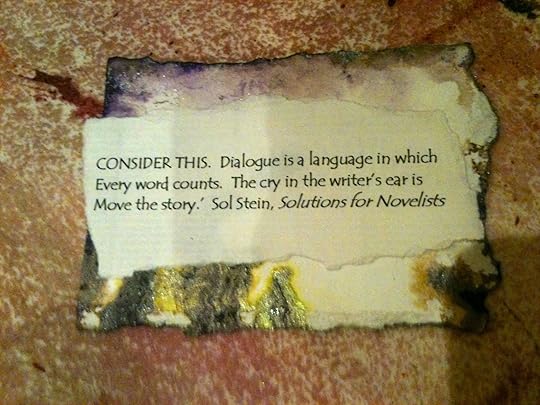
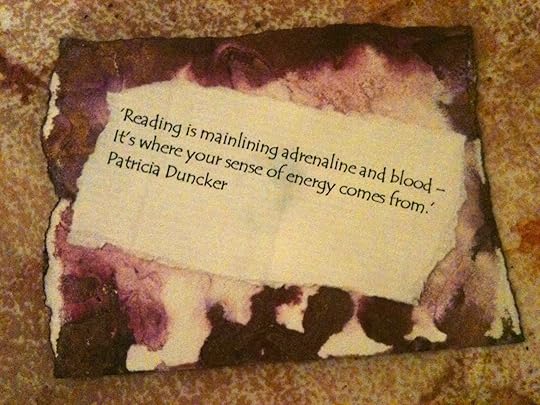
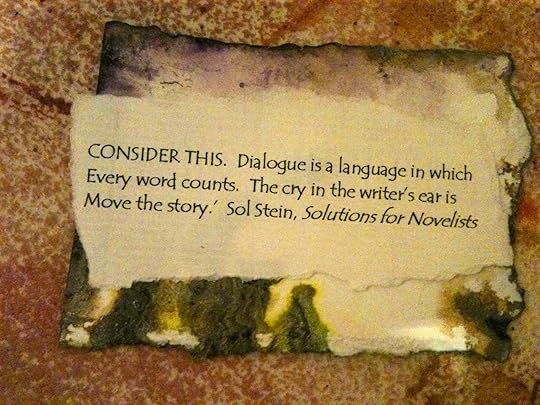
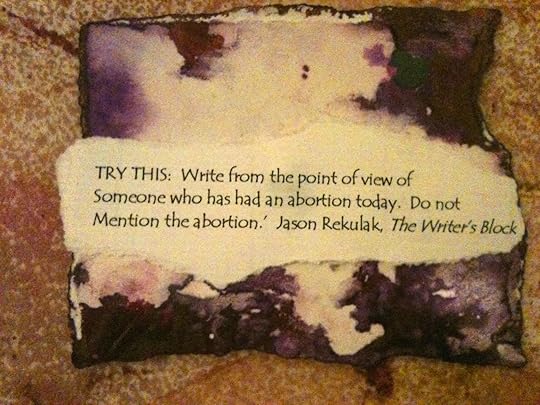
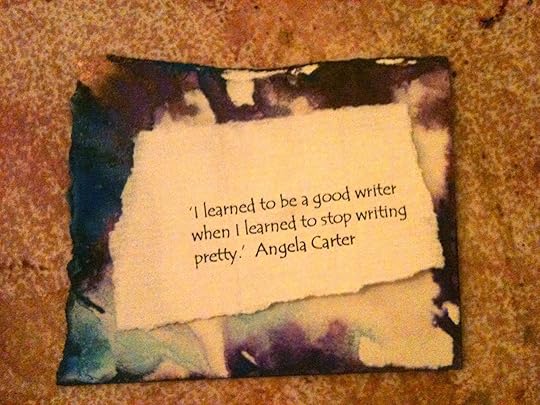
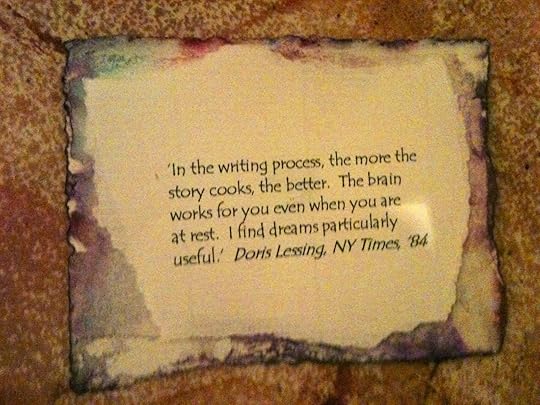
3. Used writing prompts. This is a Natalie Goldberg favourite, a way to energise and encourage the writing bones onto the page. Some years ago I had created a small deck of writing prompts (shared below) on the back of my smaller paintings. These weren't prettified, the prompts were stuck in the middle of the smudged paint which was a message to my sub-conscious to get the hell out of my perfectionist zone!
4. Attended to my weirdness. Often I see things: advertisements, posters, photographs that prompt weird interpretations, and I am sorry to say that dismissing them had become a habit. This meant carrying my Tiny Notebook for All Things Weird with me at ALL times, and jotting these observations down. For example, hearing an ad about Boots offering skin colour testing for foundations led to an idea for a blog post about intuition ... stay with me!
5. Acknowledged my need for MORE ... more writing, more feedback, more companionship, more community. I buddied up with a writing pal, Judy Rich to ensure that I didn't slip back into addictive habits instead of ... writing! We speak twice a month, and those dates in my diary keep me accountable for creating my own writing results. I'm clearer about book 2 - who it's for, and why which means that I am connected to the book's soul path, which means I am more likely to want to write about it!
6. Started guest blogging for Lisa Cherry which pushed me out of my comfy nest and made me question my writing - who did I want to reach?, what did I have to say to others?
7. Committed to my process - this was the big one. No matter how many great movies, plays and dramas I watched, they weren't mine, and the envy I felt about that was slowly destroying my creative spark. I was sinking into a pity party, and smothering my embryonic outlines for more books, paintings, articles, etc, etc. So, I stood up and said, 'I'm a writer first and foremost, and writers write! That was huge!
My writing prompts:
When I wrote my memoir, Coming to my Senses, the clue was in the sub-title: finding my voice through ovarian cancer. I sweated years to dig far enough into my spectrum of pain and suffering to find the voice to speak my truth. And I thought, phew, that's it! I'm done, I've found my voice. Now I can relax because the writing will be easy from now on. Girl, was I mistaken.
Here's the thing: finding your voice is not always a one stop destination. It's that dreaded thing called A PROCESS!
If I was going to move my writing beyond lovely, and make it a colour my goddaughter calls 'mango moon', then I had some more excavating to do.
Here's how I started:
1. Jotted down words and sentences that 'came to me' in unusual places, i.e.. not my writing desk nor my Soul Studio, more likely the shower ... yes, that's right. Turns out that running water is a conduit for soulful ideas to pour out of one. Who knew.
2. Listened carefully. This was a toughie because in order to listen more carefully (note how I thought I was already good at this one!), I had to turn down the noise of my busyness. I thought all my work was worthy, but some of it was filling in those moments of silence I had started to dread ...
3. Used writing prompts. This is a Natalie Goldberg favourite, a way to energise and encourage the writing bones onto the page. Some years ago I had created a small deck of writing prompts (shared below) on the back of my smaller paintings. These weren't prettified, the prompts were stuck in the middle of the smudged paint which was a message to my sub-conscious to get the hell out of my perfectionist zone!
4. Attended to my weirdness. Often I see things: advertisements, posters, photographs that prompt weird interpretations, and I am sorry to say that dismissing them had become a habit. This meant carrying my Tiny Notebook for All Things Weird with me at ALL times, and jotting these observations down. For example, hearing an ad about Boots offering skin colour testing for foundations led to an idea for a blog post about intuition ... stay with me!
5. Acknowledged my need for MORE ... more writing, more feedback, more companionship, more community. I buddied up with a writing pal, Judy Rich to ensure that I didn't slip back into addictive habits instead of ... writing! We speak twice a month, and those dates in my diary keep me accountable for creating my own writing results. I'm clearer about book 2 - who it's for, and why which means that I am connected to the book's soul path, which means I am more likely to want to write about it!
6. Started guest blogging for Lisa Cherry which pushed me out of my comfy nest and made me question my writing - who did I want to reach?, what did I have to say to others?
7. Committed to my process - this was the big one. No matter how many great movies, plays and dramas I watched, they weren't mine, and the envy I felt about that was slowly destroying my creative spark. I was sinking into a pity party, and smothering my embryonic outlines for more books, paintings, articles, etc, etc. So, I stood up and said, 'I'm a writer first and foremost, and writers write! That was huge!
My writing prompts:


May 10, 2014
More ideas for storage in your Soul Studio
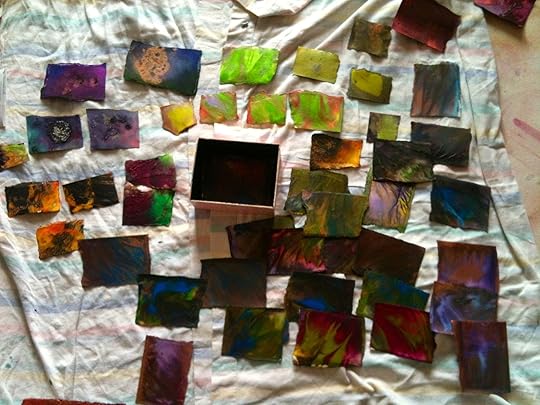
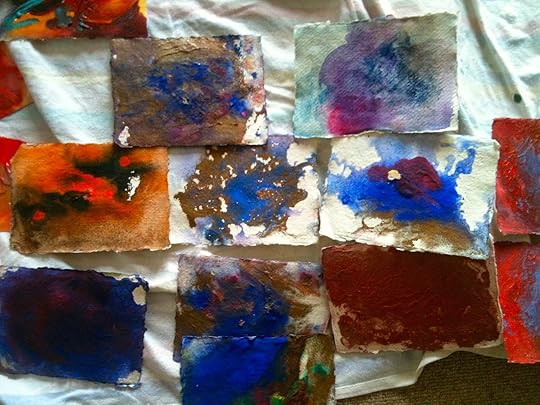
Yesterday, I spent time in my Soul Studio looking at my archived paintings. I had archived them because I thought I was 'done' with them. They had served their purpose in terms of giving back to me - insights gained. I thought they were waiting to be catalogued. The moment I started laying them out on the floor, I realised something important. I had made no decision about the placement of these paintings. They were simply stacked on shelves, neatly stacked, but without purpose! In other words, they were gathering dust. Laying each one out, I started to organise them into themes: colours, words, phases, sizes. As I did this I could feel the archive catalogue in my brain clicking things into place. Strong memories were coming back to me. Turns out, I wasn't quite done!
So, here are MORE recommendations for storage in your Soul Studio:
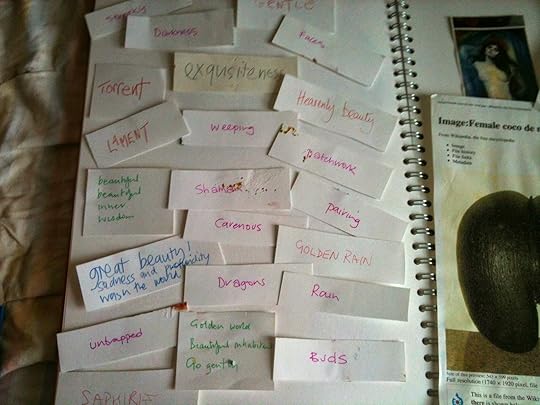
1. Cut pieces of card into strips, and write down one word on each strip - a word that evokes a feeling from each painting. Stick these words into your Journal. Keep a jar full of card strips at the ready!
2. Regularly sort your paintings and drawings into themes: colours, sizes, shapes, places, people. The act of sorting functions on both a physical and emotional level, and helps to categorise your memories associated with these themes. This makes it easier to link between the memories - like creating a huge art journal in your mind!
3. Don't be afraid to throw stuff out! Keep your bin handy. If articles and research are now longer necessary because you've either used it, or moved on, chuck this out.
4. Create a unique filing system for your research. I work on several projects at the same time: writing my adult books, collecting images and ideas for my children's books, and idea for workshops, and keep separate files for each one. They link up in my big vision, but need to be separate while I am in research mode.
5. If you collect postcards like I do, store these in a treasured pot or basket. I keep mine in an African bowl that I bought on a trip to South Africa. Each time I look at this bowl I am reminded of that place. This is one of my sacred anchors.
6. Organising, sorting and storing are three of the most sacred acts in your Soul Studio. Make this a regular habit.
7. Chaos comes before order! Allow yourself time to sit amongst your work - laying mine out on the floor allows me to literally sit with myself and my work. This is a meditative practice, so don't rush it. Expect to feel strong emotions, and recognise that this practice is as vital to your sacred work as the work itself.
So, here are MORE recommendations for storage in your Soul Studio:
1. Cut pieces of card into strips, and write down one word on each strip - a word that evokes a feeling from each painting. Stick these words into your Journal. Keep a jar full of card strips at the ready!
2. Regularly sort your paintings and drawings into themes: colours, sizes, shapes, places, people. The act of sorting functions on both a physical and emotional level, and helps to categorise your memories associated with these themes. This makes it easier to link between the memories - like creating a huge art journal in your mind!
3. Don't be afraid to throw stuff out! Keep your bin handy. If articles and research are now longer necessary because you've either used it, or moved on, chuck this out.
4. Create a unique filing system for your research. I work on several projects at the same time: writing my adult books, collecting images and ideas for my children's books, and idea for workshops, and keep separate files for each one. They link up in my big vision, but need to be separate while I am in research mode.
5. If you collect postcards like I do, store these in a treasured pot or basket. I keep mine in an African bowl that I bought on a trip to South Africa. Each time I look at this bowl I am reminded of that place. This is one of my sacred anchors.
6. Organising, sorting and storing are three of the most sacred acts in your Soul Studio. Make this a regular habit.
7. Chaos comes before order! Allow yourself time to sit amongst your work - laying mine out on the floor allows me to literally sit with myself and my work. This is a meditative practice, so don't rush it. Expect to feel strong emotions, and recognise that this practice is as vital to your sacred work as the work itself.


Nurturing the Sacred - How to set up your Soul Studio
Here is my guest blogpost for Nurturing the Sacred for Lisa Cherry.
April 17, 2014
Creating a Worry Tree to Build Emotional Resilience
One of my most trusted resources is RelaxKids. Children love listening to the creative visualisations and meditations which help them destress and relax.
A recent addition to my play therapy kit is the Worry Tree created by RelaxKids to help children build emotional resilience.
The idea is to add your worries whenever something is worrying you, write them down on a leaf shaped piece of paper and then stick the leaf onto a branch of your tree.
This can easily be created at home, and stuck on the fridge or a wall. You may wish to paint or decorate your tree with glitter, sequins and buttons.
The Worry Tree is available as a free download from RelaxKids when you spend £10.
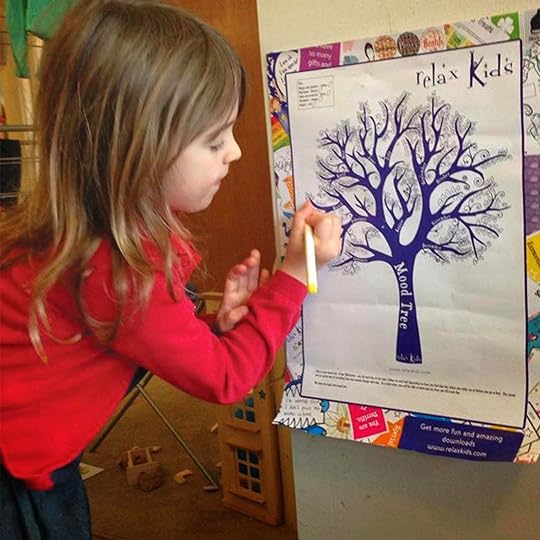
A recent addition to my play therapy kit is the Worry Tree created by RelaxKids to help children build emotional resilience.
The idea is to add your worries whenever something is worrying you, write them down on a leaf shaped piece of paper and then stick the leaf onto a branch of your tree.
This can easily be created at home, and stuck on the fridge or a wall. You may wish to paint or decorate your tree with glitter, sequins and buttons.
The Worry Tree is available as a free download from RelaxKids when you spend £10.

March 19, 2014
I was recently invited to be a guest blogger for the auth...
I was recently invited to be a guest blogger for the author and coach Lisa Cherry. My first article is about how I healed myself from ovarian cancer. Read it here.
In celebration of this post, I have posted one of my paintings from my book, 'Coming to my Senses: finding my voice through ovarian cancer.
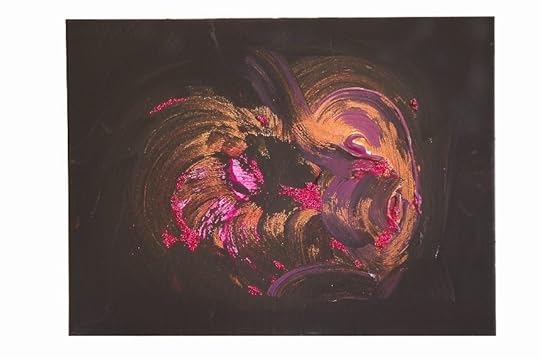
In celebration of this post, I have posted one of my paintings from my book, 'Coming to my Senses: finding my voice through ovarian cancer.

February 20, 2014
Creating a Promise Tree
When my Mum was ill, I wrote a prayer about her on a Promise Tree at our Church. There were many other messages on the Promise Tree. Stating my prayer for her in writing helped me to focus on what I wanted for her versus what my fear was telling me to listen to!
Today I saw this:
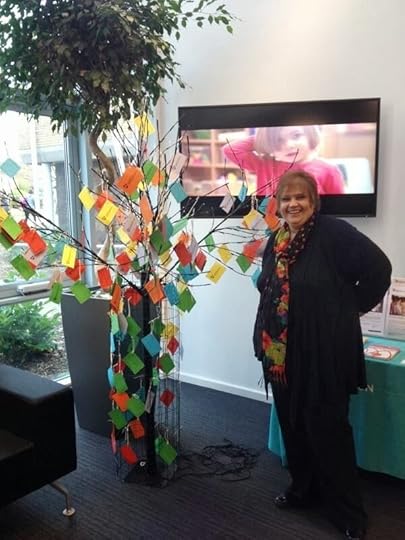
This is the Promise Tree at Nottingham University's Early Years Summit, which was part of a campaign launched by Ivan Lewis, Shadow Secretary of State for International Development and Dame Tessa Jowell, MP, calling for an integrated approach to early childhood development to be included within the Millenium Development Goals' succeeding framework post 2015.
The early years period from conception to two years is when we can affect the most change with a child. When I see a child for play therapy, a lot of the emotional damage has occurred during this period.
My promise to children, is to help them discover their voice, and encourage them to use that voice for their own empowerment.
What is your promise?
Today I saw this:

This is the Promise Tree at Nottingham University's Early Years Summit, which was part of a campaign launched by Ivan Lewis, Shadow Secretary of State for International Development and Dame Tessa Jowell, MP, calling for an integrated approach to early childhood development to be included within the Millenium Development Goals' succeeding framework post 2015.
The early years period from conception to two years is when we can affect the most change with a child. When I see a child for play therapy, a lot of the emotional damage has occurred during this period.
My promise to children, is to help them discover their voice, and encourage them to use that voice for their own empowerment.
What is your promise?