Cindy L. Hull's Blog
April 17, 2023
Back to Mexico 2023
LaVail and I just returned from a three-week trip back to the Yucatan to research my third Claire Aguila mystery, Rights of Passage. Each time we return we find changes in the countryside and especially in the capital city of Merida, where much of the story takes place.
In the third novel, Claire Aguila is back in Merida with her daughter, parents, and, of course, Madge, for a special event (spoiler alert). Claire is concerned when her friend Ruth does not return from a tour of archaeological sites. When Ruth’s daughter and granddaughter arrive in Merida and file a missing person’s report, and the Mexican Consulate contacts Detective Roberto Salinas of an investigation, Claire’s plans are interrupted.
The search for Ruth begins at the Merida English Library (below)—the local hub for American and Canadian expats and snowbirds in the city—where both Claire and Ruth participated in social events. Then, the 76-year-old woman disappears.

From Merida, the search widens as Claire and her family join Ruth’s family and Mexican authorities in a peninsula-wide search for the wealthy woman.
The questions to be answered are:
Why didn’t she tell her family about her trip to Mexico? Why did she lie to her son and daughter?Why hasn’t anyone heard from her? Why doesn’t she answer texts and emails?Was her disappearance voluntary or forced?Who is the mysterious man seen with Ruth?Will Claire and Roberto still be together at the end of the story?

January 28, 2022
Claire Aguila goes to a senior community in Florida and finds murder:

CULTURE SHOCK! The second Claire Aguila mystery novel will be out in April!
One year after anthropologist Claire Aguila helps solve murders in Mexico, she and her daughter visit Claire’s parents in The Havens, only to find that her father is a possible murder suspect. The family drama intensifies when Mexican Detective Roberto Salinas and Madge Carmichael arrive on the scene.
This unlikely reunion complicates the job of the local detective, as Claire and her companions become involved, and, once again, Madge proves to be a resourceful, if unconventional, sleuth.
Culture Shock is a sequel to Human Sacrifice, but can stand alone.
September 27, 2021
Writing in the year of Covid: Announcing CULTURE SHOCK, the second book in the Claire Aguila Series!
When LaVail and I returned from our winter retreat in Mexico in Early February 2020, our daughter, a physician, met us at the airport and pronounced that we were in lockdown.
We had heard rumblings while in Mexico about a virus in China, but we had no idea the threat until we were asked at the US border if we had been to Wuhan, China. “No,” we said, confused, “we were in Tulum and Merida, Mexico.”
Covid 19 changed our everyday lives, our jobs, our travel, our ability to interact in our communities. Some of us suffered true loss of loved ones; many lost jobs or risked their own lives to save others; many of us found new ways of communicating with our friends and families, through ZOOM or even as pod grandparents maneuvering through the world of virtual learning with our grandchildren, or, in my case, being lunch lady.
While LaVail entered the world of model building, house chores, grandchild mentoring, and overseeing the painful progress of our new garage, I entered the world of Florida retirement communities.
No, I’m not planning a move to Florida any time soon, but my main character from Human Sacrifice, Claire Aguila, is on her way to her second adventure as sous-detective with Roberto Salinas and her sidekick, Madge Carmichael.
From my office window, I watched winter turn to spring, then summer, fall, winter, spring, summer, and fall again. I watched our old garage collapse and our garage emerge from the snow in our backyard (though still not totally completed).
During that time, I also created a Florida retirement community, The Havens. I have visited several of these communities over the past few years as LaVail and I considered our future retirement, and I suspect that you have too, either for yourselves or as guests of your parents or grandparents.
In Culture Shock, Claire and her daughter visit Claire’s parents (Cristina’s grandparents) in The Havens. Theresa and Martín Aguila are staying at the winter home of Claire’s deceased husband, Aaron.
While Theresa enjoys their winter home, Martin, a Mexican American, doesn’t understand the world of customized golf carts, describing this affluent community as a ‘beige hell.’ Not a man of leisure, Martin snags a part-time job in the maintenance department, where he feels more comfortable with the Hispanic employees.
The Aguilas, in turn, are surprised to find Roberto Salinas and Madge Carmichael on their doorstep, one year after Claire and Madge assisted Salinas in solving several murders in Merida, Yucatan.
This unlikely reunion complicates an investigation of two deaths in the Havens, led by the local investigator, Detective Sergeant Davenport, as Claire and her companions become involved, and, once again, Madge proves to be a resourceful, if unconventional, sleuth.
Culture Shock is now available in print and eBook through Mission Point Press!
WRITING IN THE YEAR OF COVID: ANNOUNCING THE SECOND BOOK IN THE CLAIRE AGUILA SERIES
When LaVail and I returned from our winter retreat in Mexico in Early February 2020, our daughter, a physician, met us at the airport and pronounced that we were in lockdown.
We had heard rumblings while in Mexico about a virus in China, but we had no idea the threat until we were asked at the US border if we had been to Wuhan, China. “No,” we said, confused, “we were in Tulum and Merida, Mexico.”
Covid 19 changed our everyday lives, our jobs, our travel, our ability to interact in our communities. Some of us suffered true loss of loved ones; many lost jobs or risked their own lives to save others; many of us found new ways of communicating with our friends and families, through ZOOM or even as pod grandparents maneuvering through the world of virtual learning with our grandchildren, or, in my case, being lunch lady.
While LaVail entered the world of model building, house chores, grandchild mentoring, and overseeing the painful progress of our new garage, I entered the world of Florida retirement communities.
No, I’m not planning a move to Florida any time soon, but my main character from Human Sacrifice, Claire Aguila, is on her way to her second adventure as sous-detective with Roberto Salinas and her sidekick, Madge Carmichael.
From my office window, I watched winter turn to spring, then summer, fall, winter, spring, summer, and fall again. I watched our old garage collapse and our garage emerge from the snow in our backyard (though still not totally completed).
During that time, I also created a Florida retirement community, The Havens. I have visited several of these communities over the past few years as LaVail and I considered our future retirement, and I suspect that you have too, either for yourselves or as guests of your parents or grandparents.
In Culture Shock, Claire and her daughter visit Claire’s parents (Cristina’s grandparents) in The Havens. Theresa and Martín Aguila are staying at the winter home of Claire’s deceased husband, Aaron.
While Theresa enjoys their winter home, Martin, a Mexican American, doesn’t understand the world of customized golf carts, describing this affluent community as a ‘beige hell.’ Not a man of leisure, Martin snags a part-time job in the maintenance department, where he feels more comfortable with the Hispanic employees.
The Aguilas, in turn, are surprised to find Roberto Salinas and Madge Carmichael on their doorstep, one year after Claire and Madge assisted Salinas in solving several murders in Merida, Yucatan.
This unlikely reunion complicates an investigation of two deaths in the Havens, led by the local investigator, Detective Sergeant Davenport, as Claire and her companions become involved, and, once again, Madge proves to be a resourceful, if unconventional, sleuth.
Culture Shock is scheduled for release in print and eBook through Mission Point Press in May 2022.
November 4, 2019
The First Claire Aguila Mystery Novel: Human Sacrifice, by Cindy L. Hull
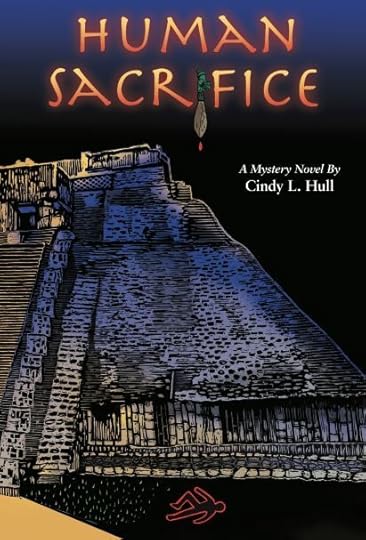
THE MAGICIAN’S PYRAMID AT UXMAL, YUCATAN: THE SCENE OF THE FIRST MYSTERIOUS DEATH
“How many anthropologists usually die at your conferences?” This is the question Detective Roberto Salinas asks Dr. Claire Aguila after two mysterious deaths at a gathering of Maya scholars in Merida, Yucatán. When a souvenir vendor in a nearby town also turns up dead, the faculty members of the newly formed Keane College Mayanist Program find themselves under scrutiny from Mexican authorities and U.S. Customs agents. Available on Amazon
Leave a comment
My newest book: A Mystery Novel: Human Sacrifice, by Cindy L. Hull
[image error]
THE MAGICIAN’S PYRAMID AT UXMAL, YUCATAN: THE SCENE OF THE FIRST MYSTERIOUS DEATH
“How many anthropologists usually die at your conferences?” This is the question Detective Roberto Salinas asks Dr. Claire Aguila after two mysterious deaths at a gathering of Maya scholars in Merida, Yucatán. When a souvenir vendor in a nearby town also turns up dead, the faculty members of the newly formed Keane College Mayanist Program find themselves under scrutiny from Mexican authorities and U.S. Customs agents. Available on Amazon
Leave a comment
My Journey as a Writer
[image error]
Here I am, in beautiful Merida, Yucatan, in 2018. I am standing in front of what is likely one of the last henequen plants in the region. Henequen, or green gold, once dominated the landscape and provided a livelihood for the majority of families in rural Yucatan. In the early 1900’s wealthy Europeans built mansions on this boulevard, the Paseo Montejo, and sent their children to the United States to study…all on the backs of the peasants who worked on the henequen haciendas, cutting the leaves or working in the factories that extracted the fibers that were manufactured into rope and binder twine.
When my husband, LaVail, and I moved to a small village in 1976, most families were still dependent upon the cutting and extracting of the henequen fibers, but the heyday of henequen was over. Hemp rope and twine were replaced by plastic products, cheaper and easily produced. We lived in Yaxbe (a pseudonym) for my doctoral research. I learned how rural families transitioned from agriculture to other forms of income production, and how these adaptations affected women’s roles, family structure, and migration. My research resulted in an ethnography, Katun: A Twenty-Year Journey with the Maya.
Since our research year, I have returned to the village many times, with LaVail and with our children. We have shared the joys and sorrows of life with our lifelong friends in Yaxbe. We have watched their families grow as they have watched ours. When we first arrived in the village, there were no telephones. Today, I keep in touch with our friends through FaceBook.
LaVail and I return to Merida, the capital of Yucatan, whenever we can. We love the craziness of the traffic and even the jostling with locals and tourists in the market. We visit the archaeological sites and revel in the history and the mystery of the Maya. Since retirement, I have been weaving my enthusiasm for all things anthropological and Mayan with my passion for mysteries.
In my novel, Human Sacrifice, I use the locations dear to me as a backdrop for a series of murders: Merida, the archaeological site at Uxmal, and various rural communities. While attending a conference of Mayan scholars, Professor Claire Aguila becomes a reluctant police collaborator as she confronts the possibility that someone she knows might be responsible for the deaths. It turns out that Claire and Detective Salinas had met years earlier during Claire’s internship in Merida. Claire’s knowledge of academics and Mayan village life unites them in the investigation. However, their re-established acquaintance complicates the investigation, as it threatens the trust of her colleagues. Human Sacrifice will be available soon!
Location is an integral part of storytelling, as important as plot and character. The places where I have lived have often driven my research and writing. When our family settled in Chippewa Lake, Michigan in 1981, I was a reluctant transplant to the community where LaVail’s family had settled in the 1800s. We lived in the community for over thirty years, raised our children, and became embedded with a rural community, not unlike Yaxbe. Over the years, I noticed the similarities in economic challenges and social life between these two communities. I explored these similarities in a research project that included anthropology students from Grand Valley State University. The project resulted in my second ethnography: Chippewa Lake: A Community in Search of an Identity. Both Katun and Chippewa Lake are available on Amazon.
My newest book: A Mystery Novel: Human Sacrifice, by Cindy L. Hull
“How many anthropologists usually die at your conferences?” This is the question Detective Roberto Salinas asks Dr. Claire Aguila after two mysterious deaths at a gathering of Maya scholars in Merida, Yucatán. When a souvenir vendor in a nearby town also turns up dead, the faculty members of the newly formed Keane College Mayanist Program find themselves under scrutiny from Mexican authorities and U.S. Customs agents. Available on Amazon
My Journey as a Writer
Here I am, in beautiful Merida, Yucatan, in 2018. I am standing in front of what is likely one of the last henequen plants in the region. Henequen, or green gold, once dominated the landscape and provided a livelihood for the majority of families in rural Yucatan. In the early 1900’s wealthy Europeans built mansions on this boulevard, the Paseo Montejo, and sent their children to the United States to study…all on the backs of the peasants who worked on the henequen haciendas, cutting the leaves or working in the factories that extracted the fibers that were manufactured into rope and binder twine.
When my husband, LaVail, and I moved to a small village in 1976, most families were still dependent upon the cutting and extracting of the henequen fibers, but the heyday of henequen was over. Hemp rope and twine were replaced by plastic products, cheaper and easily produced. We lived in Yaxbe (a pseudonym) for my doctoral research. I learned how rural families transitioned from agriculture to other forms of income production, and how these adaptations affected women’s roles, family structure, and migration. My research resulted in an ethnography, Katun: A Twenty-Year Journey with the Maya.
Since our research year, I have returned to the village many times, with LaVail and with our children. We have shared the joys and sorrows of life with our lifelong friends in Yaxbe. We have watched their families grow as they have watched ours. When we first arrived in the village, there were no telephones. Today, I keep in touch with our friends through FaceBook.
LaVail and I return to Merida, the capital of Yucatan, whenever we can. We love the craziness of the traffic and even the jostling with locals and tourists in the market. We visit the archaeological sites and revel in the history and the mystery of the Maya. Since retirement, I have been weaving my enthusiasm for all things anthropological and Mayan with my passion for mysteries.
In my novel, Human Sacrifice, I use the locations dear to me as a backdrop for a series of murders: Merida, the archaeological site at Uxmal, and various rural communities. While attending a conference of Mayan scholars, Professor Claire Aguila becomes a reluctant police collaborator as she confronts the possibility that someone she knows might be responsible for the deaths. It turns out that Claire and Detective Salinas had met years earlier during Claire’s internship in Merida. Claire’s knowledge of academics and Mayan village life unites them in the investigation. However, their re-established acquaintance complicates the investigation, as it threatens the trust of her colleagues. Human Sacrifice will be available soon!
Location is an integral part of storytelling, as important as plot and character. The places where I have lived have often driven my research and writing. When our family settled in Chippewa Lake, Michigan in 1981, I was a reluctant transplant to the community where LaVail’s family had settled in the 1800s. We lived in the community for over thirty years, raised our children, and became embedded with a rural community, not unlike Yaxbe. Over the years, I noticed the similarities in economic challenges and social life between these two communities. I explored these similarities in a research project that included anthropology students from Grand Valley State University. The project resulted in my second ethnography: Chippewa Lake: A Community in Search of an Identity. Both Katun and Chippewa Lake are available on Amazon.[image error]