Tim Prasil's Blog
July 29, 2026
The Short Fiction of Catherine Crowe: “Antoine Mingrat” (a.k.a. “The Priest of St. Quentin”)
I’ve now read enough of what Catherine Crowe called her Tales of Continental Jurisprudence to have moved them to a separate section at the bottom of my bibliography of her short fiction. After all, they’re not short fiction. They’re short true crime.
However, they also illustrate Crowe’s skills as a narrator working in what might be called “single-sitting” or “article-length” pieces. In fact, I found “Antoine Mingrat,” later titled “The Priest of St. Quentin,” to be one of Crowe’s best entries in the series. This is partly because the case itself is fairly straightforward while some of the others stretch the short form in terms of complexity and of the number of names readers must remember. In addition, Crowe tries a couple of new storytelling techniques here to put readers into the mind of a murderer.
The case involves the presumed rape and certain murder of Marie Guérin, crimes traced to Antoine Mingrat, a priest in the northern France village of Saint-Quentin. Before Crowe’s version, the 1822 French crime had been presented to English readers in an 1833 series titled “Celebrated Trials of the Nineteenth Century,” run in Fraser’s Magazine. This earlier chronicle focuses much more on Mingrat’s background than Crowe’s, and I have a hunch that her source might have been an earlier French one.
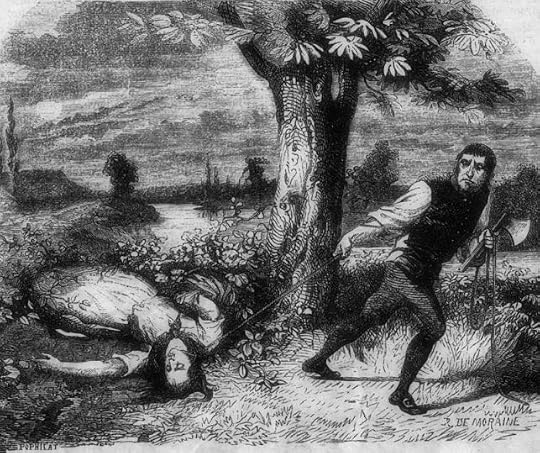 I found this illustration of Antoine Mingrat dragging Marie Guérin’s body on page 11 in the 24 January, 1929, issue of a French magazine titled simply Détective. It looks like a reproduction from a much earlier source, quite likely one from the early 1800s.In the Shoes of a Murderer
In brief, the case concerns the power-hungry Mingrat. The 28-year-old clergyman was “gifted with uncommon bodily strength” while burdened with a repugnant face, Crowe explaining that “his complexion was sallow, his eye malicious, his smile treacherous.” His preaching was similarly objectionable: “zealous overmuch; reproving harshly; inflicting severe penances; and magnifying small faults into great sins.” Looking and behaving as a fiend, Mingrat proved himself to be exactly that.
Marie Guérin was a member of his congregation, one both pious and beautiful. Through a bit of conniving, the priest subjected the woman to kidnapping, rape (implied when Mingrat’s servant stands outside his bedchamber and hears “heavy sighs from within, as of one very sick or in the agonies of death”), and finally murder.
The tale then follows the tribulations of Mingrat as he hauls Guérin’s body to a far-away spot in the hope of making the murder look like suicide. This is when Crowe uses a couple of unexpected and interesting narrative techniques. First, she bids readers to contrast—not Guérin’s horrific experience—but the difficulties faced by Mingrat to her readers’ lives. And her own! She writes:
And now imagine his situation! Let us picture to ourselves the murderer as he stood on that lonely hill, scantily sprinkled with thorn bushes and withered nut trees; battered by the storm, for the rain fell and the wind raged furiously on that awful night; before him the steep ascent that he could not surmount; beside him the body that he could not get rid of! Conceive his horror, his anguish, his despair! For myself, I could not, on hearing this fearful story, help endeavouring to recall the fearful drama; bringing back to my memory that May of 1822; contrasting situations—my peaceful chamber, my calm sleep, and my cheerful waking. I felt ready to fall upon my knees, and bless God that I had been exempted from such trials.Hey, here’s a curious thing. Crowe married in 1822, so that year would have held special meaning to her. By 1846, the year this piece debuted in print, she had separated from her husband, presumably due to be the marriage being unhappy and possibly abusive. Perhaps this interesting autobiographical moment was her way of saying to herself: “Well, things could’ve been worse. A lot worse.”
A few pages later, Crowe uses a second technique to put readers into the mind of the murderer. Mingrat has made it back home with no one seeing him dispose of the body. Then the author suddenly shifts to the present tense:
But suddenly he pauses—his whole frame is relaxed—his visage, inflamed by the torture of his mind and his vehement labours, is overspread with a ghastly pallor—what is it that affrights him so? Is there a noise without, or has he discerned some human eye watching him through an unguarded chink? Why does he fling down the hatchet, and thrust his hands wildly into his pockets, and then rush frantically from the house?It only lasts a single paragraph, then we’re back to the conventional past tense. On the one hand, Crowe is putting readers into the murderer’s shoes to teach the lesson that crime takes a terrible toll. On the other, these unexpected narrative touches make this piece a bit more personal and a bit more creative than the other Tales of Continental Jurisprudence I’ve read so far.
As I explore these pieces, I wonder if Crowe had been working toward eventually completing enough to fill a volume, a sort of rogues’ gallery in prose. Alexandre Dumas had done something similar with his multi-volume Celebrated Crimes (1839-1841). This and the series in Fraser’s mentioned above shows there was an audience for true crime. However, the number of Crowe’s criminal biographies—or I should say the number I’ve identified so far—would have made for a fairly slim book. And slim books were rare birds in the mid-1800s.
Maybe she decided to shift her focus towards other kinds of writing.


July 8, 2026
A Scrap of Evidence Suggesting Catherine Crowe Went on More than One Ghost Hunt
— Francis Pigou, Phases of My Life
Not Much ThereNope, there sure isn’t much there. However, that passage above—that painfully brief passage—from an autobiography written by Francis Pigou (1832-1916) provides a scrap of evidence that Catherine Crowe participated, however informally, in at least one more ghost hunt than the one she recounts in Ghosts and Family Legends (1859). As with so much of Crowe’s life—right down to her face!—I’ve struggled to unearth the details. While there’s a fair amount I can share regarding Pigou, I’ve found almost nothing at all to corroborate his curt claim that Crowe conducted a paranormal investigation of the house where he resided.
But here’s what I do have.
Crowe Lived in Edinburgh When Pigou Was ThereIt’s easy to conclude that Pigou lived in Edinburgh: his memoir says as much. In fact, it states that he was there from 1846 to 1851, when he was in his teens. He notes that his family lived in Rutland Square, and he studied at Edinburgh Academy, both still there.
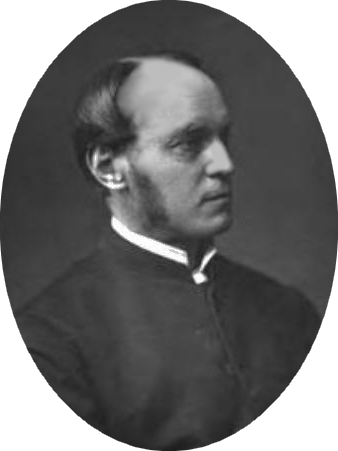 The Reverend Francis Pigou, as seen in the November, 1877, issue of The Church Portrait Journal.
Scholars take for granted that Catherine Crowe also resided in Edinburgh, but did she do so during those years? Many documents confirm she did. No doubt, there’s an easier way to verify this, but the sources linked below offer glimpses into her life and her social connections there. (I plan to add more sources when and if I come across them.)
1838: In her autobiography, Harriet Martineau describes a journey with a stop in Edinburgh, and on the next page, she says one of the noteworthy points of the trip was “it introduced me to Mrs. Crowe.” On the one hand, Martineau mentions several places she visited, so we can’t be absolutely certain she met Mrs. Crowe in that city specifically. On the other, she says that, thanks to Crowe, she became friends with Dr. Samuel Brown, a resident of Edinburgh. (As noted below, Crowe, Martineau, and Brown still socialized in 1852.)1840: In a letter dated January 6, cofounder of The Edinburgh Review Sydney Smith wrote to “Mrs. Crowe,” saying: “I am very glad to find, my dear Mrs. Crowe, that you are so comfortably arranged at Edinburgh.” There’s nothing in the letter to confirm that Smith is chatting with Catherine Crowe, the author; however, in another letter, dated January 31, 1841, the editor offers feedback on Susan Hopley, Crowe’s novel debuting that year. I feel comfortable concluding that the addressee of the first letter is the same as the second.1844/45: In his memoirs, Spencer T. Hall says that he dined that winter “at the table of Mrs. Crowe, in Edinburgh.” Hall was prominent in Mesmerism, a topic in which Crowe held a keen interest.1848: In a letter dated February 21, Ralph Waldo Emerson explains that he traveled to Edinburgh, where he was presented “especially to Mrs. Crowe, a very distinguished good person here.” In support of this being Catherine, Emerson goes on to explain that she was well connected to literary figures, including Thomas De Quincy (In Memorable Edinburgh Houses (2nd Ed., 1898), Oliphant Smeaton locates Crowe’s house at 2 Darnaway Street and repeats an anecdote about Crowe having to elbow a drowsy De Quincy during a lecture given by Emerson.)1852: In a letter dated May 1, Samuel Brown says he lives “three miles from Edinburgh” and, after saying Harriet Martineau was coming to visit, adds “Mrs. Crowe is often with us.”1954: In a letter dated March 9, Charles Dickens states that “Mrs. Crowe, usually resident in Edinburgh, … was discovered walking down her own street in Edinburgh, not only stark mad but stark naked, too.” Much was (and continues to be) made about this incident in Crowe’s life, but what matters here is that she’s identified as living in Edinburgh.Yes, ample evidence supports the idea that Crowe would’ve been well positioned to visit the Pigou family’s Rutland Square house “in quest of the ghost” sometime between 1846 and 1851. She wouldn’t have had to travel far to get there from Darnaway Street, and given that her famous On the Night Side of Nature was first released in 1848, she might well have had paranormal phenomena very much on her mind about then.
A Silver of Light on a Possible FibAs I say, Pigou provides scant detail regarding Crowe conducting a ghost hunt in Rutland Square. I would have to do a lot more than show the two were both in Edinburgh to lend it any real credence. So far, that’s all I can do.
Yet Pigou’s comment casts a sliver of light on the veracity of Crowe’s far more in-depth narrative about leading an investigation in an allegedly haunted house (one very likely in Edinburgh, too). Crowe, after all, wrote both non-fiction and fiction. That narrative appears in a book that’s framed as a series of fireside tales, a different storyteller relating a different ghost story each evening to pass the time in an entertainingly spooky way. Crowe writes:
[W]e began to tell ghost stories; and although some of the party professed an utter disbelief in apparitions, they proved to be as fertile as the believers in their contributions—relating something that had happened to themselves or their friends, as having undoubtedly occurred, or to all appearance, occurred—only, with the reservation, that it must certainly have been a dream.There’s a chance that, when it came time for Crowe to tell her own ghost story, she shared a concoction of her fertile imagination, woven with enough verisimilitude to tease her audience to wonder just how much truth it holds. I think it’s improbable. But I know it’s possible. This is especially worth considering when we recall that, just like Pigou’s statement, I can’t find anything to corroborate Crowe’s own narrative.
The scrap of evidence at the top of this post comes from an objective viewpoint, and Pigou would have gained nothing at all by fabricating the claim. In that it implies Crowe went ghost hunting from time to time, her 1859 piece looks a bit more like a piece of autobiography, not merely an entertaining fib.
WHAT DO WE KNOW ABOUT CATHERINE CROWE’S GHOST HUNT?
July 3, 2026
Curated Crime Movies: Trouble in Paradise (1932)
Trouble in Paradise is one of those 1930s comedies that transported its Depression-era audience into a world of elegance and wealth. Indeed, one source says it “fizzes like the finest champagne.” Think Fred Astaire and Ginger Rogers with a lot less dancing—and a lot more crime.
Directed by Ernst Lubitsch, the film stars Frederick March as gentleman-thief Gaston Monescu and Miriam Hopkins as wily pickpocket Lily Vautier. Early on, we see that Monescu and Vautier each has a scheme to con the other. Being wise to criminal ways, though, they foil their respective ruses and, as you do, immediately fall in love. From there, the plot focuses on their joint effort to steal from perfume heiress Mariette Colet, played by Kay Francis. The heist grows complicated when one of Monescu’s earlier marks begins to recognize him. Even worse, Mosescu himself succumbs to the more than monetary charms of Colet.
March, Hopkins, and Francis, who form the love triangle, might not be as well remembered as, say, Cary Grant, Carole Lombard, and Katharine Hepburn. But they should be. Especially Hopkins, who has stood out in every movie in which I’ve seen her.
Adding some spice is the fact that this movie is pre-Code, meaning there’s an adult naughtiness that was stomped out of Hollywood movies in 1934, when the Hays Code ensured that sexuality be smothered and criminal characters such as Gaston Monescu be duly punished for their crimes.
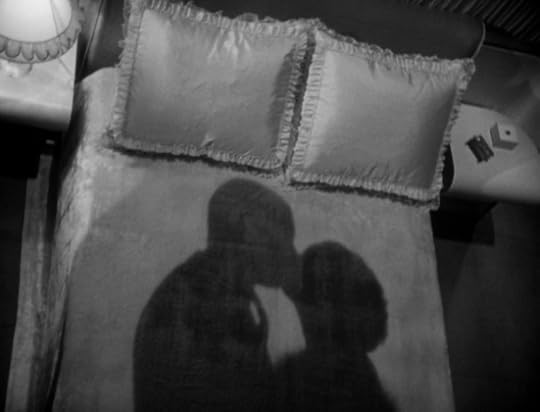 The suggestion of where this kiss is headed is far from subtle. Even more eyebrow-raising, the kiss is between Gaston Monescu, who’s spoken for, and Mariette Colet, the wealthy victim he’s falling for. As a pre-Code movie, Trouble in Paradise includes several moments that might surprise viewers whose expectations of 1930s movies come from those produced after 1934. Arresting Features
The funny here is in a style more comedy-of-manners than screwball, more Noël Coward than Marx Brothers. But funny it certainly is. The snappy yet sophisticated dialog, the crisp and clever patter, might be the greatest source of amusement. Apparently, the film was adapted from a Hungarian stage play, but I suspect the screenwriters (including director Lubitsch) only followed the barest outline of that original work.
GASTON [incognito]: Oh, yes, and this letter from Major—MARIETTE: You didn't read it!
GASTON: Naturally I did. You needn't be embarrassed, madame. A lady as charming as you would and should get love letters.
MARIETTE [bashfully]: Monsieur LaValle!
GASTON: But one suggestion: not the Major. I don't mind his grammatical mistakes. I will overlook his bad punctuation. But the letter has no mystery. No bouquet.
Now, someone needs to deliver those snappy, sophisticated lines with snap and sophistication. It helps to cast the likes of Edward Everett Horton. He plays a man who competes for the romantic attention of the wealthy heiress while struggling to remember where he’s seen the thief. Like Hopkins, Horton is someone I wish were better remembered for his talents. Robert Greig, who made something of a career out of playing suffering butlers, also sparks some pretty good chuckles.
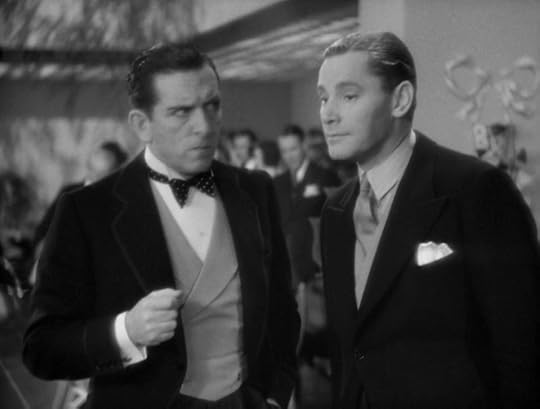 François Filiba (Edward Everett Horton) has a nagging feeling he’s seen Monsieur LaValle, a.k.a. Gaston Monescu (Frederick March) someplace before. If he remembers where, it’ll mean the end of the gentleman thief’s elaborate scam.FILIBA: You know, if I like a man, I remember him. And if I don't like him, I never forget him.
The filmmaking itself is worth keeping an eye on, too. Have you ever seen the 1931 version of Dracula, the one with Bela Lugosi? Bram Stoker’s 1897 novel was adapted for the stage in 1927, and this stage play is more directly the source of the film. And, yipes, it really shows there! Along with an eerie absence of music (well, maybe that’s a good thing), the cinematography is stagey and uninspired. It’s as if the decades of lessons taught by silent movies in how to do fascinating things with light, shadow, and camera angles, were immediately forgotten once the challenges of microphones were introduced.
In sharp contrast, Trouble in Paradise shows Lubitsch knew how to use sound film’s unique attributes to their best advantage. Regarding the director’s work as a whole, the Harvard Film Archive says Lubitsch “effectively raised the bar for screen comedy, laid confident steps into the tenuous terrain of the ‘talkie,’ and forged the movie musical from a toolshed of cumbersome equipment and unproven actor-singers.” His grasp of the evolving medium is wonderfully seen and heard in Trouble in Paradise.
In CahootsProbably more than any other of the Curated Crime Movies I’ve discussed so far, Trouble in Paradise steals from—er, uhm, continues the tradition of—the type of prose fiction spotlighted in the Curated Crime Collection. Monescu stands beside other smart, debonair thieves such as Courtice Jaffrey in Elizabeth Phipps Train’s A Social Highwayman and the title character in Clifford Ashdown’s The Complete Crimes of Romney Pringle. And characters who specifically prey on the wealthy are too many to name.
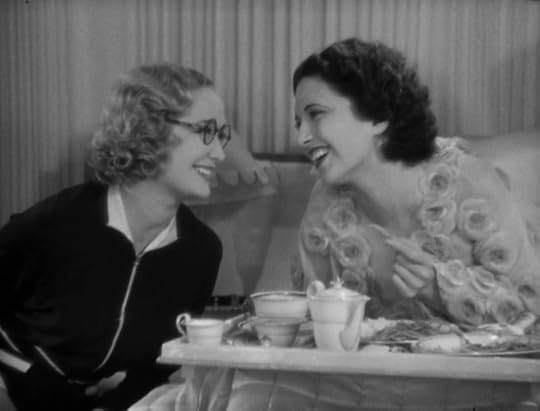 In a simple disguise, Lily Vautier (Miriam Hopkins) makes nice with Mariette Colet (Kay Franics). However, while the con artist is working to steal the wealthy woman’s money, the wealthy woman just might be stealing the con artist’s lover.
Lily Vautier reminded me a bit of Nance Olden in Miriam Michelson’s In the Bishop’s Carriage. This novel also involves a love triangle, and Michelson, who was a theatre critic, gives the work a dash of farcical comedy. I very much want to see the movie or read the novel in which Vautier and Olden meet and then pull off a heist together. Henry A. Hering’s The Complete Crimes of the Burglars’ Club also has a lightness and a silliness that suggests Monescu would have fit comfortably into that risk-taking organization (assuming, of course, he could refrain from developing feelings for any more of his women targets).
CURATED CRIME MOVIES MAIN PAGE
July 1, 2026
The Mystery of the Infallible Godahl, and the Other Mystery of the Infallible Godahl
There’s no way to measure it, I suppose. Still, I’d be willing to bet that, when Arthur Conan Doyle’s Sherlock Holmes adventures were first introduced to readers, the Great Detective gained more popularity than Harry Potter back when people formed midnight lines at bookstores for the release of J.K. Rowling’s next novel. A blasphemous claim to some, but I base it on how very often I see Doyle’s detective named in print—usually with no explanation of who he is because no explanation was needed—between 1887 and 1927, the years the Holmes canon debuted.
Holmes’ initial tidal wave of success inspired a crowded beach of other writers to dive into the waters of mystery solving. Those sleuths bobbing above the surface include Pirkis’ Loveday Brooke (1894), Freeman’s Dr. Thorndyke (1907), Chesterton’s Father Brown (1910), Christie’s Hercule Poirot (1920), and Sayers’ Lord Peter Whimsey (1923).
But there was a smaller wave, too, of fiction focused on a central criminal rather than a central detective. The best of this criminal undercurrent make up the Curated Crime Collection, and the penultimate volume is now available. It’s The Complete Crimes of the Infallible Godahl, by Frederick Irving Anderson.
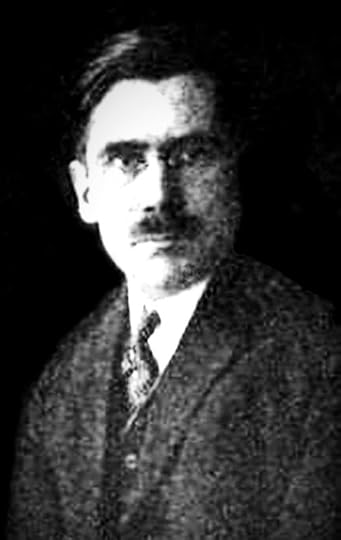 Frederick Irving Anderson (1877-1947) as seen in the May, 1914, issue of The Bookman.
Now, I certainly cherish the “Partners in Crime” volumes that make up about half of the Collection. After all, two great books for the price of one certainly has its charms. However, I also have a special fondness for the “Complete Crimes” books. Take, for instance, The Complete Crimes of the Burglar’s Club. As far as I know, Brom Bones Books is the first press to combine all eighteen of Henry A. Hering’s tales about the title felonious fraternity. Likewise, in the most recent volume, I include the novella that ended Anderson’s Infallible Godahl series when it first ran in magazine form. However, that longer final work, clearly part of the series, was not included when the first six stories were collected as a book in 1914. This raises a curious question.
Why Wasn’t the Novella Included in the 1914 Collection?By 1914, authors and publishers had settled into a rough pattern. In fact, it explains why only the first twelve of Hering’s Burglars’ Club tales were collected and reprinted in 1906. The pattern is this:
A serial of six short stories involving a single character/group/world debuts in a magazine.If popular, another six stories are solicited, written, and run.Those twelve stories are then collected in a nice-sized book.Anderson winks at this pattern in his first tale. Describing successful author Oliver Armiston and his greatest creation, Anderson says:
The serial rights telling of the exploits of this Godahl had paid [Armiston] handsomely. The books of Godahl's adventures had paid him even better, and had furnished him yearly with a never-failing income, like government bonds, but at a much higher rate of interest.Perhaps Anderson himself wanted to try stretch the magazine-serial-to-book-collection pattern a bit. He wrote six short stories involving the Infallible Godahl, and these were published in The Saturday Evening Post. Rather than another six, though, he wrote a novella, one that’s about as long as six stories, and the Post also ran this in segments. As I say, the novella is obviously part of the series! Along with Godahl himself, other characters introduced in the sixth short story return to play key roles in it.
Nonetheless, the 1914 book version leaves out the novella and presents only those six shorter tales, making for a fairly skimpy book. Was the idea of combining short stories with a novella simply too new? It doesn’t strike me as terribly radical or revolutionary, but I say this over a century later. I’m stumped. I have no solution to this mystery. All I know is: you can now read all of Anderson’s Infallible Godahl adventures in a single volume. I hope the author’s ghost is happy about this. I bet he’s chuckling over the fact that I’m unable to solve the next mystery, too.
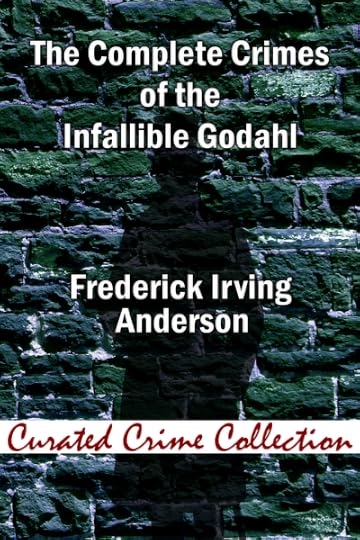 Who Is the Infallible Godahl?
Think of Stephen King’s novel The Dark Half (1989). There, a writer using a pen name decides to “kill off” that pseudonymous persona, as if Samuel Clemens had had quite enough of Mark Twain. But, in King’s story, that pseudonymous persona objects to being erased. The entity created by the pen name comes to life and misbehaves in ways one might expect from a Stephen King novel. Anderson plays with something along these lines. Sort of.
In the first story, titled “The Infallible Godahl,” Anderson introduces us to Armiston, the author, and to Godahl, the author’s imaginary master thief. But then a master thief steps into the shoes of Godahl, bringing the imaginary criminal to life.
And that’s all well and good for the first story. However, a master thief going by the name Godahl then appears in the remaining short stories and the novella. And Anderson never explains who this Godahl is! Here are some possibilities:
We’ve “gone back” to read those tales that had made Armiston a successful author.We’re “moving forward” with the master thief who has stolen the name of Armiston’s character.Lo and behold! It’s Armiston himself committing those later crimes!If Anderson wanted us to think we’re reading Armiston’s tales, it seems like he’d put them before the others. That way, we’d have gotten to know Godahl, but—surprise surprise!—he’s been a fictional creation all along, one that inspires a real-life crime. Meh. Personally, I’d find this a bit awkward and disappointing even if Anderson had rearranged the order.
I’m more inclined to think we’re reading the crimes of someone who has adopted the name of that imaginary thief. It does raise questions, though. How did he become internationally known under that borrowed name? Why does no one mention that he shares the name of a famous fictional criminal? It’s a bit like meeting someone named Moriarty and not making a joke about that person being “the Napoleon of crime.”
The notion that Armiston moonlights as Godahl, getting away with crimes as clever and complex as those he puts to paper, is certainly intriguing. I’d have to think more about this, but I’m sure it raises plenty of questions, too.
The really fun thing is: Anderson never unravels this for us. In addition, what might be called The Plasticity of Identity becomes a major motif in the collection. Like many other thieves in the Curated Crime Collection, Godahl uses disguise, but Anderson plays with disguises designed to perfectly imitate known people. In other words, he suggests that we can’t ever really know anyone at all, not with 100% certainty. This puts The Complete Crimes of the Infallible Godahl among the smartest volumes in the Curated Crime Collection. Read more about it here.
June 17, 2026
What Do We Know About Catherine Crowe’s Ghost Hunt?
I have an enduring interest in Catherine Crowe (1790-1872), the versatile Victorian author whose work has drawn growing attention among literary scholars in recent years. Since her novels and non-fiction books seem to dominate recent discussions, I’ve opted to explore her short fiction. I’ve also joined the desperate quest to locate a portrait of this once-famous figure, one from her lifetime. The best I’ve found is a caricature of dubious accuracy.
Though Crowe was inducted to my Ghost Hunter Hall of Fame quite some time ago, I’ve dilly-dallied in writing a more detailed post about why she’s there. It’s high time I do so. Unfortunately, all I’ve found regarding what appears to be her one and only ghost hunt is her own account of it. (It joins thirteen other chronicles in The Victorian Ghost Hunter’s Casebook.) I’ve searched for additional sources—perhaps a newspaper report about the site said to be haunted—but so far, no luck.
Nonetheless, Crowe’s narrative of the investigation provides a few clues that might lead to more information. That’s my goal here: to carefully comb through that single document for useful details about the case.
What We KnowCrowe says she learned of an alleged haunting from a lawyer who was in charge of the house. For years, its reputation for being “troubled” had prevented it from being rented or sold. She says surprisingly little about what manifestations led to the house’s bad reputation. About the best we get is: “unaccountable lights were amongst the things complained of.” However, we do learn that a hot spot was “the back parlor, which [the lawyer] had heard from the different inhabitants was the room in which they had met with most annoyance.” Crowe’s knowledge of the case, we see, is limited to what the lawyer knows.
Despite that sketchiness regarding why the house was deemed haunted—or maybe because of it—Crowe assembled an investigative team. It was comprised of the following:
Crowe herself;the lawyer, who she identifies only as “Mr. Mc N.”;a person who Crowe explains is “a young girl who was easily mesmerised, and when in that state a good clairvoyante”; andtwo other men she describes as “some gentlemen of my acquaintance—very eminent men, with honest, inquiring minds.”Regarding the house itself, Crowe writes:
It was a small house, in no respect different from the others in the street. They seemed all of the same description. A narrow frontage, with one window and the door, on the ground floor; two windows above; two rooms on a floor, three stories in height, and a kitchen, scullery, and cellars underground.We see it’s not an isolated cottage in a rural hamlet. Indeed, toward the end of her account, Crowe mentions “an inhabitant of the same city.” City. Not village or even town. Are we dealing with tenements or colony houses in an urban or suburban neighborhood?
The Night’s ResultsI think Crowe is being modest when she says the investigation “resulted in almost nothing.” At one point, the team heard “a metallic sound at the door, which was ajar, like the striking of two pieces of iron. We all heard it, but could not say what occasioned it.” Granted, that could’ve been some ordinary noise caused by five people tromping around a house that had been empty for years. More dramatically, once the clairvoyant had been hypnotized, she claimed that two murders had been committed there. She clarified that the crimes had occurred in “a very old house,” which was “not exactly on the same ground, but the room we were in was on part of it.” An adjacent or overlapping haunting? Interesting.
Furthermore, the clairvoyant spotted waves of light! The others seemed unable to see them at first, but when Crowe grasped the psychic woman’s hand, she also “saw thrown up, apparently from the floor, waves of white light, faint, but perfectly distinct and visible.” Moments later, Crowe spotted another, brighter light she describes as “like an extremely vivid spark—only not the colour of fire; it was white, brilliant, and quiescent, but shed no rays.” Not even the clairvoyant spoke about seeing this second light.
As the investigation drew to a close, the lawyer revealed that he, too, had seen both lights, and he had done so without holding hands with the psychic! The other two men hadn’t seen any lights at all. What made the lawyer able to do so? Well, Crowe establishes at the very start of her narrative that Mc. N. is very likely a “ghost-seer.” Not long after the 1848 publication of The Night-Side of Nature, Crowe’s bestselling collection of “true” ghost stories, the lawyer had sent her a sort of “fan letter,” sharing his own weird experience. Though he was away from his family at the time, Mc. N. had witnessed the figure of his father at the moment of death. It’s something now called a “crisis apparition,” and Mc. N. might have been what we now term a “sensitive.” This explains why he saw those lights without assistance.
When and Where Did the Investigation Occur?Crowe provides clues to narrow down when the investigation took place. Clearly, it was sometime after 1848, when Night-Side debuted, and before 1859, when Crowe’s narrative appeared in Ghosts and Family Legends. In that introductory letter about his crisis apparition, the lawyer also mentioned the haunted house, and the case was new to Crowe at the time. She says that she hadn’t organized the investigation until “as much as six or seven years after I had first heard of this house.” Is it safe to date the ghost hunt at 1854 or 1855? Probably no later than 1858.
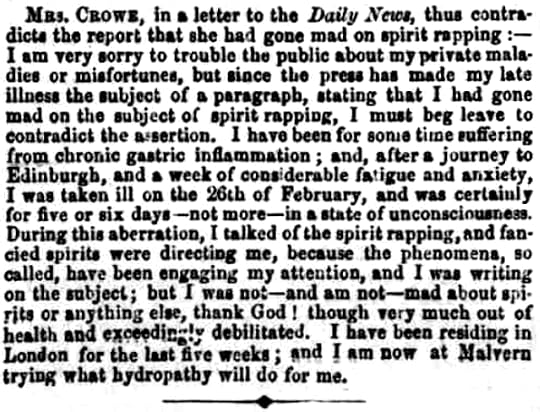 This article appeared in the May 6, 1854, issue of The Aberdeen Herald. Crowe suffered an illness in Edinburgh that year, and it turned into a piece of “celebrity gossip” she needed to set straight.
This means the investigation happened about the time, or not long after, Crowe had suffered some kind of breakdown in Edinburgh, the city where she then resided. To determine where the investigation was held, I hope I’m not reading too much into her use of “home” in this line:
I was often absent from home at this time, but for the next two or three years [after receiving Mr. Mc N.'s letter] I sometimes met him and inquired about the house.We’ve seen the house was probably in a city. Despite scant information about alleged manifestations, Crowe went ahead organized an investigation of it, implying the ghost hunt was a bit of a lark and probably not too far away—in fact, she never mentions traveling far to get there. There’s a certain logic in assuming the house was in or close to Edinburgh.
Unfortunately, at least to date, I’ve found no reports of a haunted house in the Edinburgh area in the early to mid-1850s. Nor have I found any evidence of a ghost hunt occurring in Auld Reekie between 1854 and 1858. The latter becomes particularly frustrating when we see that Crowe says her team’s outing made its way into the public eye:
Our expedition was to be kept a profound secret; and it was so, till some time afterwards, when, like most other secrets, it got wind and it spread abroad.Do I need to broaden my search? I’m convinced the truth is out there, be it in some record of the house’s ghostly notoriety or in an alternate account of Crowe’s investigation. We’ve got leads. We just need to pursue them.
June 3, 2026
The Short Fiction of Catherine Crowe: “The Tile-Burner and His Family”
“The Tile-Burner and His Family” is a part of the series Crowe called her “Tales of Continental Jurisprudence.” I’m very tempted to move these pieces to a separate list, since they aren’t technically works of fiction. These days, we’d probably called them “true crime,” though Crowe’s focus is on how the legal system handled—or truly mishandled—each crime.
“Tile-Burner” retells a case already chronicled in one of a series of pamphlets. That series had been written by François Gayot de Pitaval and titled Causes célèbres et intéressantes avec les jugemens qui les ont decidées (“Famous and Interesting Cases, with the Judgments that Decided Them”). Translated, one passage from a 1738 pamphlet reads:
Joseph Vallet’s tile works—where the tiles were crafted with greater skill than anywhere else—aroused the jealousy of other tile-makers and sparked in Frillet [the district Attorney-General] a desire to possess the establishment, and to acquire it at a bargain price. It has been alleged that this ulterior motive was the driving force behind the persecution Frillet inflicted upon Joseph Vallet, as well as the plot he hatched to bring about the downfall of an innocent man. He leveled two specific charges against Joseph Vallet and his family: he accused Joseph Vallet of having murdered Antoine Duplex, and he accused both him and his family of having taken the life of Joseph Sevos—both of whom were inhabitants of the parish of Priay, in the region of Bresse.I have no evidence that Gayot de Pitaval served as Crowe’s direct source, though his pamphlets certainly would have suited her “Continental Jurisprudence” project well. She translated a couple of books from German to English, so it’s not impossible her French was also proficient. Regardless, in “Tile-Burner,” she uses the same names for the setting and the main players as Gayot de Pitaval. Well, Antoine Duplex becomes Antoine Dupler.
A Cheater’s Guide to “Tile-Burner”The tale takes many twists and turns. Feel free to skip this next bit, but this might help a reader through the sequence of events:
A man named Frillet served as Attorney General in the district of Pont de l’Ain, France. He wanted Joseph Vallet’s successful brick and tile burning business for himself.In 1705, Antoine Dupler, Vallet’s neighbor, died suspiciously while in the tile-burner’s company. Despite appearances, Frillet was unable to find the smoking gun to incriminate Vallet. The covetous Attorney General ground his teeth.In 1724, two shady characters named Joseph Sevos and Antoine Pin were seen in Frillet’s company. Soon afterward, Sevos went missing, and Pin promptly enlisted as a soldier. Frillet jumped on the situation and accused Vallet of having murdered Sevos. If Pin had done it, he’d have made himself scarce instead of remaining traceable.A man named Vaudan offered testimony:He averred that, on the night of the 19th of February, having been to Mastalion, he was returning by Vallet's house, about three hours before daylight, when he heard a great noise, and clearly distinguished the words, 'Help! help! I will confess everything! Forgive me this once, and spare my life!' Whereupon a voice, which he knew to be Joseph Vallet's, answered, 'We want no more confessing; you must die!'Boom! Frillet had what he needed to have Vallet and his whole family arrested. So he did. But was Vaudan reliable?Not everyone was convinced. The Vallets seemed like good folks, so Pin was summoned and also put behind bars. He claimed he had witnessed Vallet commit the murder! So we can trust Vaudan’s testimony? Things look bad for the Vallets.Hold on, hold on! Blood was found at Sevos’s house, suggesting that his murder had occurred there and that Pin might well be both a murderer and a great big fibber. And by the way, there was new evidence that Vallet wasn’t even at home on the night he was supposed to have killed Sevos there! Come on, higher authorities, step in!After some hemming and hawing, the higher authorities did step in. They decided to punish both the Vallets and Pin! This was enough to make the latter confess. He and the missing-and-presumed-murdered man had visited Vallet that night, but afterward, Pin went to Sevos’s home and killed him there for “about forty dollars in silver.” Pin says he hid the body out back under a pile of manure. He was executed.But wait! Uh oh! No body was found out back under the pile of manure! (Did I mention things get complicated?) Was Vaudan’s version of what had happened closer to the truth, or is something else afoot?Well, all I’ll say is: there’s another surprise or two coming—and things work out fairly nicely.Crowe as Crime WriterCrowe’s interest in crime shows itself in short stories such as “A Traveller’s Tale,” in novels such as Adventures of Susan Hopley: or, Circumstantial Evidences, and in these non-fiction pieces. She wasn’t the first to pen true crime, though, and her “Tales of Continental Jurisprudence” are among several early examples of this genre. Carrie-Edmund Laben offers an excellent history of the many branches of true crime, prose to podcasts, in “The Unchanging Nature of True Crime: From the 1700s to Contemporary Podcasts.” Citing Gayot de Pitaval as a precedent, Laben looks closely at Alexandre Dumas’ “massive Celebrated Crimes series, published in eight volumes in 1839-40,” and glances at the Newgate Calendar. These both predate Crowe’s “Tales” and quite likely served as her inspiration.
And until I figure out how to treat them, I’ll continue to include these works with the short fiction of Catherine Crowe. Because they’re cool.
May 27, 2026
Walter F. Brooke: Actor, Illusionist, and “Ghost-Killer”
 Before Houdini Squinted at Séances
Walter F. Brooke was the stage and pen name of F. W. Hanscombe (?-1909). He was primarily an actor, but he became associated with a very successful magic act, and at some point, he began investigating—and regularly debunking—sites alleged to be haunted. In this regard, he put a unique spin on the practice of magicians who applied their knowledge of trickery to defrauding Spiritualist mediums. And this practice was established well before Harry Houdini joined the gang of showbiz sceptics.
For years, Brooke shared the spotlight with John Maskelyne and George Cooke, who had achieved fame in England as illusionists in the late-1800s. “Messrs. Maskelyne & Cooke” started out as Cheltenham tradesmen who dabbled in magic tricks during their spare time. When the Davenport Brothers came to town at least implying to have powers over supernatural forces, the Brit duo went to work unmasking the Yank duo. Maskelyne and Cooke reproduced the wonders they had seen in the Davenports’ performance, assuring the audience that there was nothing otherworldly involved. It launched their new careers. (There’s more information on Maskelyne & Cooke here, here, and here.)
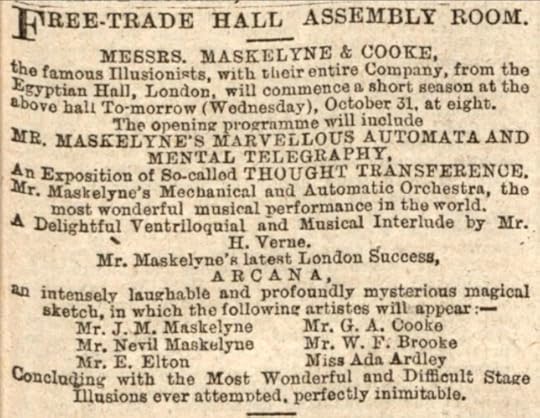 This promotion for a Halloween performance by Messrs. Maskelyne & Cooke appeared in the October 30, 1888, issue of the Manchester Courier and Lancashire General Advertiser. Brooke’s name is included among the “artistes” at the bottom.
It’s easy to assume that Brooke was inspired by Maskelyne and Cooke to redirect professional debunking away from séances and toward spooks. After all, one could make a name for oneself. One might even make a few quid in the process.
“Putting a Stop to All Seemingly Unaccountable Shrieks”A very curious circular was reprinted in the December 14, 1892, issue of the Pall Mall Gazette:
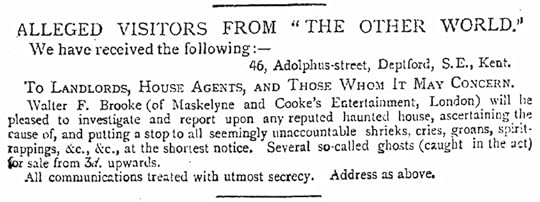
In a follow-up interview published on the 19th, Pall Mall readers were informed that Brooke already had experience with pulling the sheets off suspected ghosts. Having traced mysterious sounds to a stowaway pig in a ship’s hold and to a disconsolate cat with its head caught in a lobster tin—and to creaky floorboards and to leaky gutters—Brooke claims to “have never been beaten.” This isn’t to say his job has always been an easy one:
One house I visited bore a very bad name. Unearthly shrieks as of a woman while being ill-treated had been heard by the neighbours, as well as by the late occupants. I stayed in the house by myself one evening, but failed to hear anything out of the common, until a lady, a few minutes before twelve, gave me a taste of her quality. I heard her as I was sitting in the kitchen, and then in the room above; I went into the garden—she was there; I went into the street—she was there. I know she was there, because I heard her. I examined the house thoroughly, but without success, until my efforts were rewarded after a couple hours of searching, and I traced her voice to the roof. I went for it with a ladder and brought it down under my arm—the chimney-pot cowl was rusty and knocked out of shape by the sweep's brush, and the wind caused these unmusical sounds.Not long after this interview, Brooke was sharing his not-a-ghost stories in pamphlet form. I haven’t found any of these texts available online, but one has the smirk-worthy title “Ghosts, Ghosts, Ghosts: Who, Why, When, Where, and What They Are.” Another is titled “Ghosts in the Solid,” and the National Library of Australia offers to make a digital copy of it. (Sadly, the cost is beyond of my budget. My birthday’s coming up, should anyone be feeling generous.)
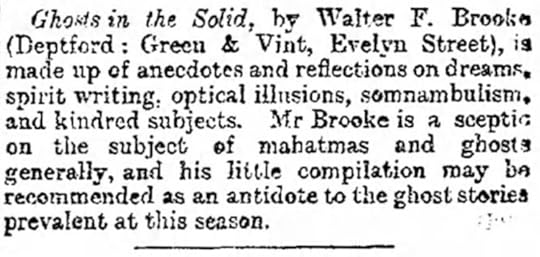 This mention of Brooke’s “Ghosts in the Solid” appeared in the November 23, 1893, issue of The Herald (Glasgow ed.).“The Only One in the World”
In The Sign of Four (1890), Mr. Sherlock Holmes tells Dr. Watson: “I crave for mental exaltation. That is why I have chosen my own particular profession,—or rather created it, for I am the only one in the world.” The great detective quickly clarifies that he means the “only unofficial consulting detective.” By 1907, Brooke was given a dash of Holmes when an interviewer for The Daily Mirror described him as “a professional ghost-killer—the only one in the world.” The piece reveals that, while Brooke had left Messrs. Maskelyne & Cooke, he was still following in Holmes’s footsteps by probing mysteries and deducing their natural causes.
This interview illustrates how Brooke handles a specific case: an allegedly haunted house in Brighton. As the reporter accompanies his subject, dubbing him the “Bogey King,” around the residence, they find that strange phenomena can be attributed to birds, floorboards, and the wind. And a nearby lunatic asylum. And railway tracks close enough that the whistles of passing trains and reflected light from fireboxes explain reports of sobbing and of a weird creature.
Along the way, Brooke shares a couple of anecdotes from earlier cases. He also says with a sigh:
If there is a ghost here I want to shake hands with it. I have been looking for a real, authentic spook for more than sixteen years. But I am afraid I shall never, never see one.I’m not sure how much weight to grant this, but I find it interesting that Brooke’s main motive might not have been to disprove the reality of ghosts. Rather, he might have devoted a decade-and-a-half to paranormal investigation because he wanted the very opposite.
To Shake Hands with a GhostAbout three years after the Daily Mirror interview appeared, Brooke passed away. Back in 1899, an article had described him as “suffering from a severe throat trouble which incapacitates him from work” and announced “a benefit matinée” being given to support him financially. The importance of this didn’t click with me until I came upon Brooke’s 1909 obituary. There, I discovered that he “had been ill for some time” and another benefit had been arranged, this time to support those he left behind. I can’t be sure, but it’s possible Brooke was seriously ill for about the last ten years of his life.
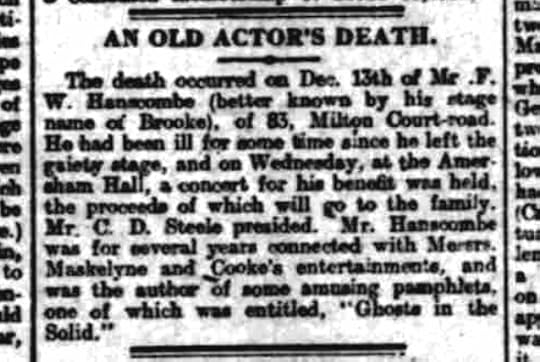 An obituary from the December 21, 1909, issue of The West Kent Argus.
 Ghost hunting during the Victorian and Edwardian eras involved hours of waiting patiently, usually well into the night, for something to happen at a site reputed to be haunted. With this in mind, I can’t help but ask: since Brooke was ailing towards the end of his life, did he find these long evenings preferable to the physical demands of performing onstage? Furthermore, if he were contemplating his own death and the possibility of an afterlife, did that make him just a little more eager to shake hands with a ghost?
As with all of the inductees in the Hall of Fame, I find the lives of the ghost hunters at least as intriguing as what their investigations reveal about ghosts.
May 20, 2026
Railroad Hauntings You Can Still Visit: A Ghost Light Near Gurdon, Arkansas
Ghost lights are fairly common among railroad hauntings, and one of the most famous has been witnessed along the abandoned tracks near Gurdon, Arkansas. There are a couple of natural explanations for the phenomenon: it might be swamp gas, or it might be something called the “piezoelectric effect.” The latter is explained in a short piece about the Gurdon ghost light at Atlas Obscura: “Piezoelectricity is generated by materials such as certain ceramics and crystals, which when bent or squeezed generate electricity and sparks.” One might suppose a study testing this possibility would have been conducted, but if so, I haven’t found anything about it. Show me the squished crystals!
There are also a few backstories explaining the light as paranormal, and two of these certainly make the case a railroad haunting. The first involves a man who was beheaded by a train, and the second concerns a railroad worker who murdered his foreman. I searched online archives to see what I could see regarding both.
A Crossing Casualty in Search of His HeadPerhaps the best account of the headless ghost explanation is found in Melissa Calley’s “Ghost Lights,” a short article in An Arkansas Folklore Sourcebook (1992). Specifying the haunted site as Sandy Crossing, Calley transcribes the tale told by a Gurdon resident (and presumably her relative, given the surname). Once upon a time, there was a man who “got run over at that crossing there one time, and it cut off his head.” Locals of the time never found the victim’s head, so they buried what they could. Afterwards, there were reports “that his ghost comes back looking for his head,” and the mysterious light is a lantern used in the search.
I wasn’t able to find any newspaper articles about a train-related beheading in the area. The closest I found was a 1949 report about a man who died on the tracks near Gurdon after having “fallen asleep on the railroad track,” which I have a hunch was a kind way of saying he committed suicide. Suicide often stirs up reports of ghostly activity, but this tragedy feels a bit too late to account for the lore surrounding the Gurdon Light—especially if the phenomenon began in the early 1930s, a point I’ll return to in a moment. Forgive my unkind way of saying it, but my efforts to trace this explanation for the haunting led to a dead end.
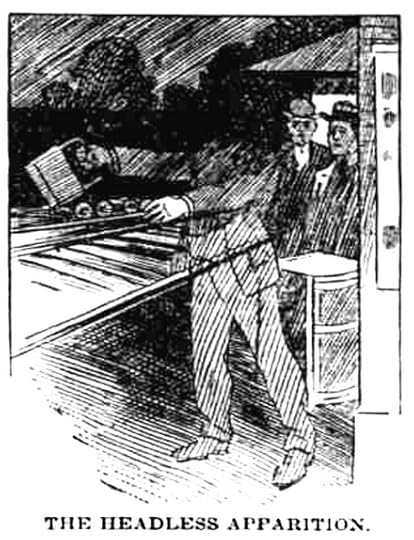 This illustration comes from a different railroad haunting, one in Indiana. You can see the illustration here, and read about that railroad haunting here.A Murder on the Tracks
The online Encyclopedia of Arkansas offers this rendition of the second paranormal explanation:
Many trace the Gurdon Light legend to a murder that took place near the railroad tracks in December 1931. William McClain, a foreman with the Missouri-Pacific railroad, was involved in an argument with one of his employees, Louis McBride, regarding how many days McBride was being allowed to work. During the Depression, the company did not have the option of giving McBride more hours on the job. McBride became very angry, hit McClain on the head with a shovel, and beat him to death with a railroad spike maul or a spike hammer. The Gurdon Light was first sighted shortly after this murder, and many have come to believe that the light is actually McClain’s ghostly lantern glowing.Now, that’s enough detail—a date, a motive, names of both murderer and murdered—to assume there would have been newspaper coverage! First, I made sure the Missouri-Pacific was among the many railroad companies connecting in Gurdon, which had served as a transportation hub. While I couldn’t find anything about the murder at the newspaper archives of either the Library of Congress or Google, Jennifer Jones provides a useful image of an Arkansas Gazette article at her The Dead History site. Also, I have no reason to doubt the quotations of the Southern Standard provided in this anonymous document titled “The Gurdon Light.”
I do worry, though, about one claim made in that document: “Shortly after that time, area residents began to see the light nearby.” I found this said elsewhere, too, but never with any evidence to substantiate it. I gave it a go myself, but as yet I haven’t found anything to put a date to the first observations of the ghost light. Sightings certainly might have begun in the early 1930s, but I would be grateful for assistance in confirming this.
Visiting the Haunting TodayA post at the Arkansas State Archives places the haunting “along the path of the old railroad track about four miles north of Gurdon and about two miles away from Interstate 30.” Comments at the Roadside America site provide more details and warn of the dangers involved. Please be very careful if you decide to investigate.
Gurdon is a small town, but it’s roughly halfway between two cities that have their share of haunted sites: Little Rock and Shreveport. If you plan a ghost-hunting tour that includes the Gurdon Light, please let us know about your experiences in the comments section below.
Discover more “Railroad Hauntings You Can Still Visit” at the page forAfter the End of the Line: Railroad Hauntings in Literature and Lore.
April 7, 2026
The Lincoln Funeral Ghost Train TARDIS Has Arrived at the Station
I reserve the right to tweak things here and there—and, of course, to add more information if it becomes available—but I’d say the Lincoln Funeral Ghost Train TARDIS is ready to be boarded. TARDIS, in this case, stands for Trusted Archival Resource Documents in Sequence, and unlike my earlier TARDIS pages, this one has two major parts.
The 1865 section looks closely at the original train that carried Abraham Lincoln’s body from Washington, DC, through Maryland, southern Pennsylvania, New Jersey, New York, northern Pennsylvania, Ohio, and Indiana to the assassinated President’s final resting place in Illinois. Thousands and quite likely millions gathered to pay their respects as the funeral train rolled by or, in some cases, stopped so that the casket could be visited in a capital building or similar public place.
Now, if we consider a “residual haunting” to be an ethereal imprint of a traumatic event that gets replayed over and over, the Lincoln funeral train qualifies times ten due to that outpouring of grief. And, sure enough, the Lincoln funeral train was afterward observed again, though in the form of a supernatural reenactment. It’s said to be an anniversary ghost, reappearing at about the same time of the year. Think of it as an annual variation on the haunted battlefield of Gettysburg traveling across seven states.
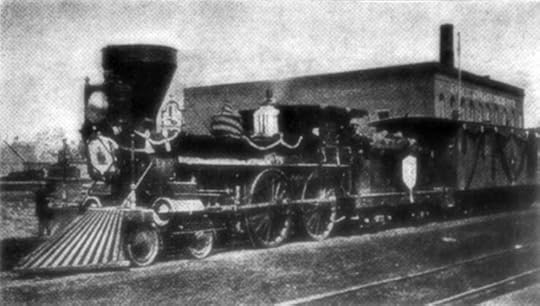 This photograph shows “the Lincoln Funeral Train, taken as it passed through Chicago on May 2, 1865,” according to an article in the February, 1941, issue of Baltimore & Ohio Magazine.
For that reason, I devote the first section of the chronology to a daily timetable of the original trip, striving to narrow down times to the minute whenever possible. My hope is that paranormal investigators will use these details as a guide to determine if the ghost train still runs its yearly route. I also did my best to show when the train was traveling at night, since that’s when the ghost train was reported to be witnessed and that’s when ghost hunters typically devote their free time to investigation.
The second section starts at 1872 with the earliest report of the ghost train. This is where we see the manifestation described as appearing once a year and at night. The witness in the first article says the ghost train comes “[r]egularly in the month of April about midnight” while an 1879 report says it’s “on that night [of the 1865 trip], every year, … during a certain hour (that varies in different subdivisions of the road).” Needless to say, ghost hunters will have to decide on their own schedules.
Speaking of Investigating Specific Locations…This TARDIS is part of my Railroad Hauntings You Can Still Visit project. All of the individual posts there end with an invitation to ghost hunters to investigate the area under discussion and to share their experience, be it productive or disappointing, in the comments section. I extend the same invitation here. I hope this post, not the TARDIS page, acts as a gathering place for any and all who have held a spectral stakeout this coming late April or early May.
However, since the 1865 funeral train traveled along more than 1,650 miles of track, there’s no single location I can recommend. Just as investigators will have to make their own schedules, I hope they’ll do their own deeper research into the specific spot they’re investigating. Here are a few points to consider:
While we can trust that the actual 1860s tracks have been replaced at some point, does the route still run in about the same place? Old railroad right-of-ways have a habit of staying put, even if they’re converted from, say, rails to trails. But there are exceptions.All of the states the 1865 train crossed introduced Daylight Savings Time in 1918, and DST now applies for the late-April and early May dates it ran. One should subtract an hour to match the times stated on the TARDIS. Even so, it’s doubtful the times I found in newspapers are 100% reliable. Give the ghost train ample time. Bring snacks. Have train-related songs on your playlist.Some of the descriptions of the ghost train include skeleton passengers, eerie music coming from the train cars, and an unsettling fog preceding the manifestation. Prepare to be scared on the chance this thing is real.Finally, remember that those witnesses who first encountered the ghost train did so with nothing more than their own senses. In other words, ghost hunting gadgetry is very optional.You can visit The Lincoln Funeral Ghost Train TARDIS here. If it inspires you to go looking, I look forward to reading what you experienced.
Discover more“Railroad Hauntings You Can Still Visit”
at the page for
After the End of the Line: Railroad Hauntings in Literature and Lore.
April 1, 2026
Curated Crime Movies: The Duke (2020)
JACKIE: How much would an exhibition raise?
KEMPTON: £30,000? £50,000? Who knows? The painting's not been out of the news, has it? I'll be able to pay for God knows how many TV licenses.
JACKIE: You're not really going to use it all on telly licenses!
KEMPTON: Why not?
JACKIE: Just saying, who couldn't make use of a couple of grand?
KEMPTON: You think Robin Hood took a rake-off?At Large
This is factual. In 1965, Kempton Bunton stood trial for stealing Francisco Goya’s painting Portrait of the Duke of Wellington from London’s National Gallery. The 61-year-old pensioner of very modest means had confessed to the crime, after trying to ransom it in exchange for £140,000 being allocated to cover pensioners’ television license fees. That amount was the same as the painting’s valuation at the time of its theft.
After all, Bunton was holding a stolen masterpiece for ransom, but he wasn’t out to cheat anyone.
The Duke is a 2020 biopic following the events. Based on what I’ve read, it follows those events pretty closely, including the ones that became public many years after the theft and the trial.
Jim Broadbent stars as the bighearted and chatty Kempton Bunton, and Helen Mirren plays his distraught and laconic wife, Dorothy. It was directed by Roger Mitchell, perhaps best known for Notting Hill, the rom-com of three years earlier.
Funny and enchanting, The Duke has a 97% critics’ score at Rotten Tomatoes.
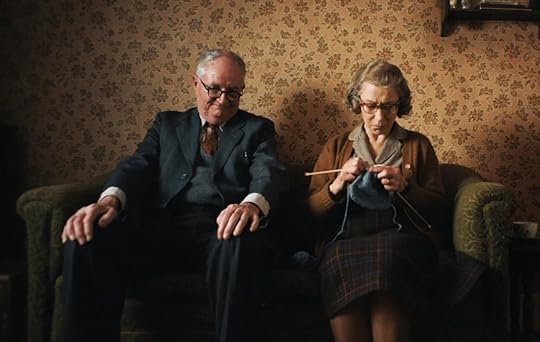 Jim Broadbent and Helen Mirren as the Buntons, an unassuming married couple one might not expect to become enmeshed in the theft of an art masterpiece.Arresting Features
Much of the humor in The Duke grows from the fact that the characters and plot are, well, fact. However, that humor never overtakes the film’s depiction of these characters’ humanity. As their backstory is revealed, we learn the Buntons suffered the loss of a daughter in a bicycle accident, and repressed grief prompts tensions in the marriage. Guilt for the death also begins to explain Kempton’s drive to serve the Greater Good. I suspect this level of depth is what attracted actors of Broadbent and Mirren’s status to the project.
KEMPTON: You've never let me talk about it.DOROTHY: Grief is private.
KEMPTON: I bought her that bike. If I got her anything else, she'd still be alive.
DOROTHY: Well, she isn't.
Need I say that their performances are admirable and engaging? While I’ve seen Broadbent in somewhat comparable roles, I can’t say I recall seeing Mirren portray a dowdy, working-class housewife before. And their fine work is reflected by the entire cast.
The film also gives viewers, even those far removed from the time and place, a good sense of life in 1960s Newcastle, England. Most of Mitchell’s cinematic storytelling doesn’t draw attention to itself, allowing the audience to become absorbed into realism. However, on occasion, he borrows an eye-catching transition involving—well, I don’t know what to call it other than moving split-screens reminiscent of groovy movies from that decade. It’s a style choice that enhances the period feel without sacrificing the narrative substance.
 Some of the film’s most amusing moments come when Kempton Bunton (Jim Broadbent) presents his court testimony.In Cahoots
Interestingly, Bunton’s legal defense loudly echoes the one used to exonerate the title characters in Henry A. Hering’s The Complete Crimes of the Burglars’ Club, one of the volumes in the Curated Crime Collection. Once upon a time, British law held that, to qualify as theft, the intention must be to keep the article in question, not to merely borrow it. They steal from the rich to give back to the rich (while hopefully that first part relieves a bit of their boredom).
In other words, the members of the Burglars’ Club don’t share the same motive as Robin Hood. Bunton is a different species of scoundrel, too, one who is more in keeping with Robin of Loxley.
In that Bunton hopes the missing masterpiece can be used to help the economically disadvantaged, The Duke better reflects the con man who repeatedly preys on the title character of Grant Allen’s An African Millionaire. (This composite novel is combined with Allen’s daring “The Curate of Churnside” in a single CCC volume). Sure enough, Grant’s master criminal, known as Colonel Clay, has no particular desire to giveth to the downtrodden. Instead, Clay is determined to taketh away from a millionaire whose business practices, while technically legal, are often far from ethical. In other words, Clay prefigures Bunton in using crime to combat a questionable if not corrupt legal system, and for this reason, Grant’s playful tales are as satisfying to read as The Duke is to watch.
Curated Crime Movies Main Page