Tim Prasil's Blog
April 7, 2026
The Lincoln Funeral Ghost Train TARDIS Has Arrived at the Station
I reserve the right to tweak things here and there—and, of course, to add more information if it becomes available—but I’d say the Lincoln Funeral Ghost Train TARDIS is ready to be boarded. TARDIS, in this case, stands for Trusted Archival Resource Documents in Sequence, and unlike my earlier TARDIS pages, this one has two major parts.
The 1865 section looks closely at the original train that carried Abraham Lincoln’s body from Washington, DC, through Maryland, southern Pennsylvania, New Jersey, New York, northern Pennsylvania, Ohio, and Indiana to the assassinated President’s final resting place in Illinois. Thousands and quite likely millions gathered to pay their respects as the funeral train rolled by or, in some cases, stopped so that the casket could be visited in a capital building or similar public place.
Now, if we consider a “residual haunting” to be an ethereal imprint of a traumatic event that gets replayed over and over, the Lincoln funeral train qualifies times ten due to that outpouring of grief. And, sure enough, the Lincoln funeral train was afterward observed again, though in the form of a supernatural reenactment. It’s said to be an anniversary ghost, reappearing at about the same time of the year. Think of it as an annual variation on the haunted battlefield of Gettysburg traveling across seven states.
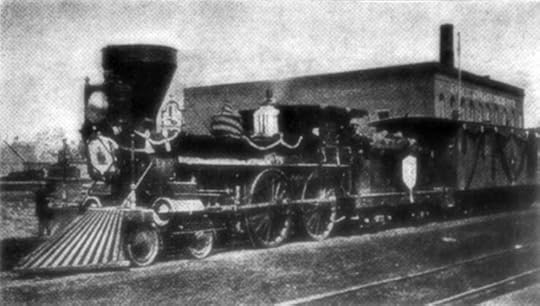 This photograph shows “the Lincoln Funeral Train, taken as it passed through Chicago on May 2, 1865,” according to an article in the February, 1941, issue of Baltimore & Ohio Magazine.
For that reason, I devote the first section of the chronology to a daily timetable of the original trip, striving to narrow down times to the minute whenever possible. My hope is that paranormal investigators will use these details as a guide to determine if the ghost train still runs its yearly route. I also did my best to show when the train was traveling at night, since that’s when the ghost train was reported to be witnessed and that’s when ghost hunters typically devote their free time to investigation.
The second section starts at 1872 with the earliest report of the ghost train. This is where we see the manifestation described as appearing once a year and at night. The witness in the first article says the ghost train comes “[r]egularly in the month of April about midnight” while an 1879 report says it’s “on that night [of the 1865 trip], every year, … during a certain hour (that varies in different subdivisions of the road).” Needless to say, ghost hunters will have to decide on their own schedules.
Speaking of Investigating Specific Locations…This TARDIS is part of my Railroad Hauntings You Can Still Visit project. All of the individual posts there end with an invitation to ghost hunters to investigate the area under discussion and to share their experience, be it productive or disappointing, in the comments section. I extend the same invitation here. I hope this post, not the TARDIS page, acts as a gathering place for any and all who have held a spectral stakeout this coming late April or early May.
However, since the 1865 funeral train traveled along more than 1,650 miles of track, there’s no single location I can recommend. Just as investigators will have to make their own schedules, I hope they’ll do their own deeper research into the specific spot they’re investigating. Here are a few points to consider:
While we can trust that the actual 1860s tracks have been replaced at some point, does the route still run in about the same place? Old railroad right-of-ways have a habit of staying put, even if they’re converted from, say, rails to trails. But there are exceptions.All of the states the 1865 train crossed introduced Daylight Savings Time in 1918, and DST now applies for the late-April and early May dates it ran. One should subtract an hour to match the times stated on the TARDIS. Even so, it’s doubtful the times I found in newspapers are 100% reliable. Give the ghost train ample time. Bring snacks. Have train-related songs on your playlist.Some of the descriptions of the ghost train include skeleton passengers, eerie music coming from the train cars, and an unsettling fog preceding the manifestation. Prepare to be scared on the chance this thing is real.Finally, remember that those witnesses who first encountered the ghost train did so with nothing more than their own senses. In other words, ghost hunting gadgetry is very optional.You can visit The Lincoln Funeral Ghost Train TARDIS here. If it inspires you to go looking, I look forward to reading what you experienced.
Discover more“Railroad Hauntings You Can Still Visit”
at the page for
After the End of the Line: Railroad Hauntings in Literature and Lore.


April 1, 2026
Curated Crime Movies: The Duke (2020)
JACKIE: How much would an exhibition raise?
KEMPTON: £30,000? £50,000? Who knows? The painting's not been out of the news, has it? I'll be able to pay for God knows how many TV licenses.
JACKIE: You're not really going to use it all on telly licenses!
KEMPTON: Why not?
JACKIE: Just saying, who couldn't make use of a couple of grand?
KEMPTON: You think Robin Hood took a rake-off?At Large
This is factual. In 1965, Kempton Bunton stood trial for stealing Francisco Goya’s painting Portrait of the Duke of Wellington from London’s National Gallery. The 61-year-old pensioner of very modest means had confessed to the crime, after trying to ransom it in exchange for £140,000 being allocated to cover pensioners’ television license fees. That amount was the same as the painting’s valuation at the time of its theft.
After all, Bunton was holding a stolen masterpiece for ransom, but he wasn’t out to cheat anyone.
The Duke is a 2020 biopic following the events. Based on what I’ve read, it follows those events pretty closely, including the ones that became public many years after the theft and the trial.
Jim Broadbent stars as the bighearted and chatty Kempton Bunton, and Helen Mirren plays his distraught and laconic wife, Dorothy. It was directed by Roger Mitchell, perhaps best known for Notting Hill, the rom-com of three years earlier.
Funny and enchanting, The Duke has a 97% critics’ score at Rotten Tomatoes.
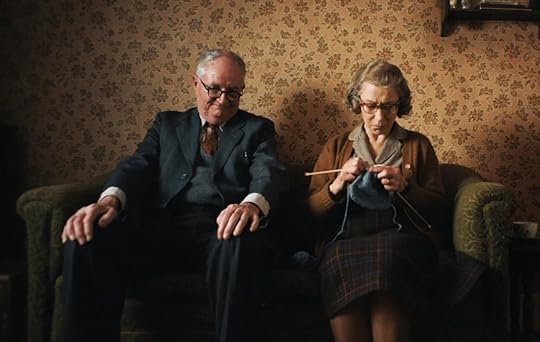 Jim Broadbent and Helen Mirren as the Buntons, an unassuming married couple one might not expect to become enmeshed in the theft of an art masterpiece.Arresting Features
Much of the humor in The Duke grows from the fact that the characters and plot are, well, fact. However, that humor never overtakes the film’s depiction of these characters’ humanity. As their backstory is revealed, we learn the Buntons suffered the loss of a daughter in a bicycle accident, and repressed grief prompts tensions in the marriage. Guilt for the death also begins to explain Kempton’s drive to serve the Greater Good. I suspect this level of depth is what attracted actors of Broadbent and Mirren’s status to the project.
KEMPTON: You've never let me talk about it.DOROTHY: Grief is private.
KEMPTON: I bought her that bike. If I got her anything else, she'd still be alive.
DOROTHY: Well, she isn't.
Need I say that their performances are admirable and engaging? While I’ve seen Broadbent in somewhat comparable roles, I can’t say I recall seeing Mirren portray a dowdy, working-class housewife before. And their fine work is reflected by the entire cast.
The film also gives viewers, even those far removed from the time and place, a good sense of life in 1960s Newcastle, England. Most of Mitchell’s cinematic storytelling doesn’t draw attention to itself, allowing the audience to become absorbed into realism. However, on occasion, he borrows an eye-catching transition involving—well, I don’t know what to call it other than moving split-screens reminiscent of groovy movies from that decade. It’s a style choice that enhances the period feel without sacrificing the narrative substance.
 Some of the film’s most amusing moments come when Kempton Bunton (Jim Broadbent) presents his court testimony.In Cahoots
Interestingly, Bunton’s legal defense loudly echoes the one used to exonerate the title characters in Henry A. Hering’s The Complete Crimes of the Burglars’ Club, one of the volumes in the Curated Crime Collection. Once upon a time, British law held that, to qualify as theft, the intention must be to keep the article in question, not to merely borrow it. They steal from the rich to give back to the rich (while hopefully that first part relieves a bit of their boredom).
In other words, the members of the Burglars’ Club don’t share the same motive as Robin Hood. Bunton is a different species of scoundrel, too, one who is more in keeping with Robin of Loxley.
In that Bunton hopes the missing masterpiece can be used to help the economically disadvantaged, The Duke better reflects the con man who repeatedly preys on the title character of Grant Allen’s An African Millionaire. (This composite novel is combined with Allen’s daring “The Curate of Churnside” in a single CCC volume). Sure enough, Grant’s master criminal, known as Colonel Clay, has no particular desire to giveth to the downtrodden. Instead, Clay is determined to taketh away from a millionaire whose business practices, while technically legal, are often far from ethical. In other words, Clay prefigures Bunton in using crime to combat a questionable if not corrupt legal system, and for this reason, Grant’s playful tales are as satisfying to read as The Duke is to watch.
Curated Crime Movies Main Page
March 25, 2026
The Short Fiction of Catherine Crowe: “A Tale of Modern Germany” (a.k.a. “The Morning Visitor”)
— Catherine Crowe, “A Tale of Modern Germany”
In the preface of her collection Light and Darkness; Or, The Mysteries of Life (1850), Catherine Crowe says she hopes the works contained therein “will not be found unworthy; especially the Tales of Continental Jurisprudence; such as ‘The Tile Burner and [H]is Family,’ ‘The Story of the Priest of St. Quentin,’ ‘The Bride’s Journey,’ &c, &c.” This suggests she saw herself having written a series of pieces unified in the setting of mainland Europe and in the subject of the legal handling of crime.
“A Tale of Modern Germany” (1846), which is retitled “The Morning Visitor” in Light and Darkness, certainly fits this series. It opens with a bit of expository discourse, something like the opening paragraphs about the analytic mental facility in Poe’s “The Murders in the Rue Morgue” (1841). Crowe, however, discusses how—from an English perspective—”continental criminal records…read like the annals of a previous century. We think we perceive also a state of morals somewhat in arrear of the stage we have reached, and certainly some curious and very defective forms of law.” Hardly immune to Anglocentrism, Crowe writes:
How thoroughly foreign and strange to us was the history of Madame Lafarge! How unlike ours were the modes and habits of life it disclosed, and how vividly one felt that it was the tale of another land! So of the Priest Riembauer, noticed in a late number of the "Edinburgh Review," who murdered the woman he had outraged; the details of whose crime were as foreign to us as the language he spoke.In other words, Crowe is making Continental crime something tantalizingly exotic while prompting English readers to feel confident in, if not smug about, their nation’s superior legal system—and perhaps its more civilized crimes.
The story itself is about a real-life murderer named Johann Georg Tinius (1764-1846), and an interesting case it is. Tinius was a priest and an avid book buyer. It is speculated that this bibliophilia spurred him to commit a series of robberies. Two of these ended in murder in 1812 and 1813. However, due to legal futzing and finagling, Tinius was not convicted until 1823. Only then did he begin to serve a 12-year sentence. That was his sentence for double murder. Committed with a hammer! Hmm, maybe Crowe is right about the foreign feeling of German jurisprudence in the early nineteenth century.
As far as I can tell, Crowe narrates the case with historical accuracy, and this raises a key question: is this a work of fiction? In that preface to Light and Darkness, Crowe refers to the contents as “tales” and “stories,” but this one might easily be deemed a historical essay, a journalistic report, a biographical sketch, or possibly some early type of creative non-fiction. Ever intrigued by the parallels between Crowe and Poe, I’m tempted to compare it to the latter’s next C. Auguste Dupin detective story, “The Mystery of Marie Rogêt” (1842-1843). Here, Poe fictionalizes the real case of Mary Roger’s murder, exporting it to France, changing names, and having Dupin arrive at a solution to an otherwise unsolved crime. Crowe doesn’t name the culprit until well into “A Tale of Modern Germany,” giving it a structure not unlike a mystery. However, her solution to the murders is the one originally determined by German officials instead of anything more speculative. Its comparison to Poe’s piece of history-made-fiction, then, is too weak to settle the matter.
Upon diving deeper into these “Tales of Continental Jurisprudence,” I might go ahead and remove this from my bibliography of Crowe’s short fiction. Better yet, maybe I’ll move it to its own section for her series about these criminal cases.
March 18, 2026
Next Stop: The Lincoln Funeral Ghost Train TARDIS
I have a few TARDIS pages here and there at BromBonesBooks.com. The acronym stands for Trusted Archival Research Documents in Sequence, and these are chronologies exploring various topics. My latest involves a railroad haunting known as the Lincoln Funeral Ghost Train, named for an elaborate 1865 train trip carrying the body of Abraham Lincoln from Washington DC, where he was assassinated, to Springfield, Illinois, where he was laid to rest. The route was far from direct, crossing seven states. And it was far from quick, taking twelve days. This was so as many people as possible—well, as many northerners as possible—could pay their last respects to the beloved President.
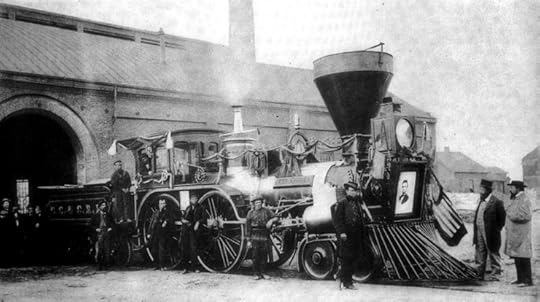 This engine, named the Nashville, hauled the cars comprising the Lincoln Funeral Train.
In the early 1870s, a ghostly reenactment of the railroad journey was reported in newspapers across the United States and the United Kingdom. Now, though, skeletons rode onboard, a multitude of ethereal Union soldiers floated behind the train, and watches and clocks stopped as the phantom cars passed. Additional sightings or, at least, creative variations on the original tale slowly popped up in publications afterward.
I’ve been hesitant to research this case because of its breadth—does the ghost train manifest anywhere along the route of some 1,650 miles? I can give specifics about the route the original, physical train traveled—but is it wise to suggest the ghost train continues to appear along any of these tracks (assuming the phenomena and the rails themselves remain)? On the plus side, this is an old-fashioned anniversary ghost, meaning it materializes on the same month and day as the journey it echoes. While it’s tough to pinpoint where to investigate the haunting, at least we have a pretty good idea of when to do so.
Despite the complications, it strikes me that my Railroad Hauntings You Can Still Visit project would be lacking without a look at this famous case. For that reason, I’ve started a TARDIS page, a timetable charting its history. It’s still in the early stages, but you can see what I have so far here.
—Tim

March 4, 2026
Railroad Hauntings You Can Still Visit: Strange Sounds and a Guiding Light in Bozeman Tunnel, Montana
 A Rocky Mountain Haunting
Until now, all but the one of the U.S. railroad hauntings I’ve discussed in this series are located east of the Mississippi River. I guess that makes sense: a denser population means more railroads and more newspapers. And more ghosts.
But here’s one set in a train tunnel in the Rocky Mountains, roughly fifteen miles east of Bozeman, Montana. Construction of a tunnel for the Northern Pacific Railroad took place between 1882 and 1884, and a report that it might be haunted appeared in April of 1885. Unlike some of the cases I’ve researched, news of this one doesn’t seem to have traveled very far, not even beyond what was then the Montana Territory. The earliest article I’ve found was in The Bozeman Weekly Chronicle, and this was reprinted in the Helena Weekly Herald about a week later. A week after that, it was summarized in The Billings Herald.
Here’s that first report in the Chronicle:
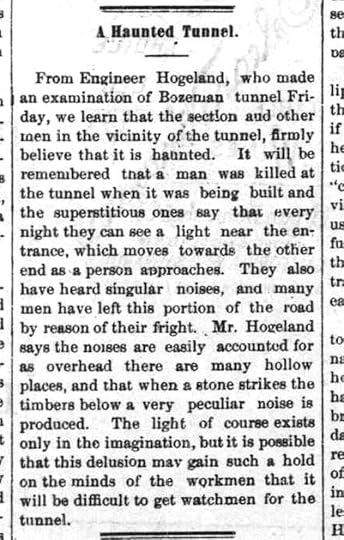
The explanation used to debunk the haunting strikes me as shaky. Attributing the guiding ghostly light—perceived on a regular basis by multiple people—to mere imagination seems perfunctory. This curt explanation might give one the impression that it is itself lacking in imagination or is a product thereof. Furthermore, while “singular noises” is a vague phrase, the witnesses were “section and other men in the vicinity of the tunnel,” people who would presumably be familiar with the structure’s sounds. I doubt it would require an engineer to deem the noises something perfectly ordinary, if they were such.
No, I maintain that there was something occurring at Bozeman Tunnel beyond fantasy and falling stones.
A Ghost Named Gus?Though it doesn’t substantiate anything paranormal, the article provides an enticing clue to the mystery when it says “a man was killed at the tunnel when it was being built.” I had to dig fairly deep to uncover evidence to clarify this detail (though not so deep, you can run a train through the hole left behind).
In March of 1883, a premature blast was said to have killed one man, but no name is given. In August of that year, a report that the collapse of a platform had killed a dozen men proved to be an exaggeration: six men were injured and no one died in the incident. And in November, a man named “Pat Keating” and “Gus Keating” in two spots on the very same page of the Chronicle is identified as a fatality of a cave-in.
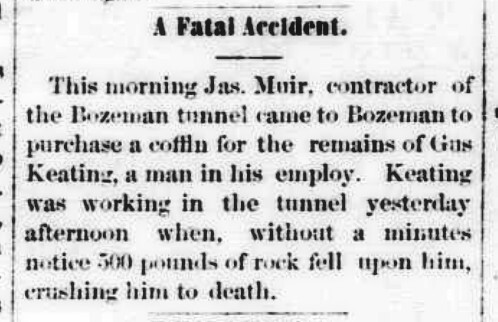 Elsewhere on this page of the November 21, 1883, issue of Bozeman Weekly Chronicle, this victim of the tunnel appears as Pat Keating, not Gus.
It seems, then, that at least two men—the unnamed victim of a blast and Mr. Keating—lost their lives during construction of the tunnel. However, this is as much a backstory for a ghost as it is inducement for interpreting weird sounds and a moving light to be of spectral origin.
Visiting the Site TodayIn the 1940s, a new tunnel was built a bit to the north to accommodate wider trains. This parallel tunnel is now part of the BNSF Railway and, therefore, should be strictly avoided by any paranormal investigators curious about the site. I’m not able to learn how accessible the old tunnel’s east and west entrances are or if the tunnel itself remains open. It is an old, old tunnel, and personally, I’d be much more anxious about all the natural dangers inside it than anything supernatural that might still be there. Luckily, the 1885 report suggests any lingering phenomena probably can be observed outside the tunnel and hopefully from a considerable distance.
That said, the old tunnel is easy to find with the western entrance, near West End, being just south of where Bozeman Hill Road and Beacon Hill Road meet. The east entrance is at a place called Muir, named for James Muir, the contractor who purchased Mr. Keating’s coffin.
 “Rocky Cañon, Near the Bozeman Tunnel, Montana,” drawn by Charles Graham, appears in the June 14, 1884, issue of Harper’s Weekly.
Paul Walters offers a thorough, well-written history of the Bozeman Pass and the Northern Pacific Railroad’s presence there. The pictures he provides are great, and since the tunnel is in a fairly remote place, maybe ghost hunters or train buffs will be perfectly content to scroll down his essay instead of visiting the location in person. Just the same, comments from anyone who has looked into the matter would be warmly appreciated.
Discover more “Railroad Hauntings You Can Still Visit” at the page forAfter the End of the Line: Railroad Hauntings in Literature and Lore.
February 25, 2026
Curated Crime Movies: Going in Style (1979)
JOE: Yeah. Actually doing this.
WILLIE: Do you hear what you're saying?
JOE: Look, let me tell you something, Willie. I gotta look back and say that my life was okay. I got my share of everything but money. And the guys who went out for that, some of them got it today, but they put too much time in getting it. Whatever—that's history. Right now, here we are, and I ain't complaining. But things would be a hell of a lot easier if we had a little extra cash.At Large
I went into Going in Style (1979), written and directed by Martin Brest, thinking it was a comedy. Given that the premise is three retired guys try to rob a bank—and given that the three guys are played by George Burns and Art Carney, both well remembered for their comedic performances, along with acting expert Lee Strasburg—I went so far as to assume it was probably a broad comedy.
I was pleased to find out I was dead wrong.
Yes, there are many funny moments sprinkled throughout Going in Style, but it’s also a portrait of three men on limited income, struggling to find some kind of thrill and some kind of financial cushion as they near their final rest. In other words, at times, this film is a moody and meditative piece less about wacky old codgers trying to get away with a major crime and more about elderly gentlemen seeking an alternative to quietly waiting until death alleviates their boredom.
This is Brest’s directorial debut, and he went on to helm Beverly Hills Cop (1984), Midnight Run (1988), Scent of a Woman (1992), and Meet Joe Black (1998). It has a critics’ score of 82% at Rotten Tomatoes. (A remake was made in 2017, but its critics’ score is painfully lower, so low I couldn’t be bothered.)
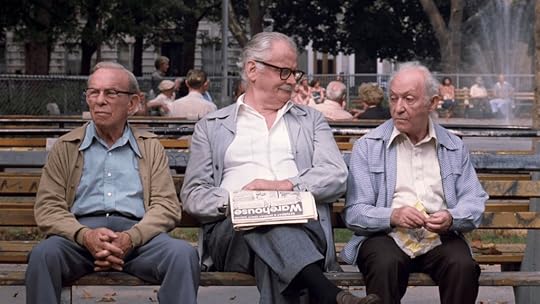 Joe (George Burns), Al (Art Carney), and Willie (Lee Strasburg) are tired of their usual routine: sitting on a bench, watching life go by.Arresting Features
Going in Style asks an important question: prior to committing armed robbery, especially when robbing a very nice bank, should one shave? It’s a question that’s both absurd and perfectly reasonable, and the scene in which the three men discuss it doesn’t follow the standard setup-punchline-setup-punchline rhythm found in many comedies. That holds true for most of the humor: it’s a juxtaposition of the ordinary and the extraordinary that prompts laughs.
 A good example of the film’s quirky humor is the scene in which the soon-to-be armed robbers must determine which bullets fit which pistols they’ve discreetly borrowed for the caper.
Along with the moments of comedy, there are moments of quiet desperation. For instance, Willie is given a moonlit monolog about being haunted by a terrible mistake he made raising his son long, long ago. Joe has a touching and tearful moment, gazing at old pictures and suffering one of the worst humiliations of old age. (I doubt that critic Bobby Rivers is alone when he says Burns gives “the best performance of his film career.”) And while the robbery brings the old men an afternoon of euphoria, sometimes euphoria isn’t doctor-recommended for those of a certain age.
JOE: You know, for the first time in fifteen years, I feel like I need a vacation. Why don't we take some of that money and go to Hawaii or Miami—someplace nice like that?AL: Hmm. Yeah?
JOE: Yeah, why the hell not? Let's go out to Las Vegas. Always had to be a two-dollar bettor. Now, I could do some real gambling, and you can get some rest.
AL: Sounds good to me. How do we get there?
JOE: I don't know. Plane, I guess.
AL: I never been on a plane before.
JOE: Neither have I. So what? We're only young once.
On the other hand, two elements of the film struck me as being out-of-place. First, Michael Small’s music score features old-timey, Dixieland Jazz-ish interludes. Was this designed to give the film a lighter, more comic tone? It feels at odds with and too consistent for the film’s range of narrative moods. Second, there’s a Las Vegas craps table scene that goes on longer than need be. The joke is that Joe and Al are trying to splurge a bit with the spoils of their crime, yet they somehow manage to increase their ill-gotten capital. That’s potentially a nice touch. But, as such, it’s too much for a touch.
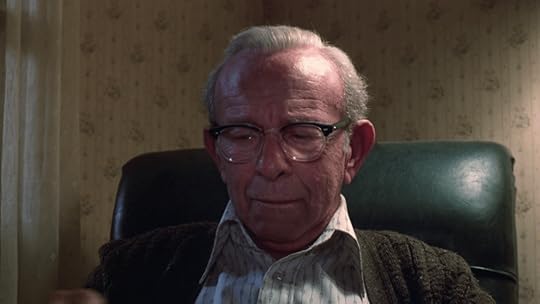 A box of memories reminds Joe of the personal riches he’s lost.In Cahoots
There’s a curious kinship between Brest’s Going in Style and Henry A. Hering’s The Complete Crimes of the Burglars’ Club, one of volumes in the Curated Crime Collection. Like the film’s trio of bank robbers, the book’s club members are men who ache for an escape from day-to-day doldrums. Both the movie and the eighteen interwoven short stories are spiced with dashes of humor. In the first of Hering’s tales, for instance, the robber stumbles upon his victim and learns he’s suffering from something far, far worse than the theft of a box of his fancy cigars. As an act of sympathy, the robber kindly offers his sorrowful “mark” one of those very same cigars.
Despite these shared motives to commit crime and moments of humor, members of the Burglars’ Club don’t need what they steal nearly as much as Joe, Al, and Willie do. While the latter refuse to return the stolen money, Burglars’ Club rules stipulate that all stolen articles be promptly restored to their owners. Brest’s criminal characters are of a decidedly different class/income bracket from Hering’s thrill-hungry aristocrats, and the age difference matters, too. Yet in a curious way, the book’s thieves have more to lose: along with lofty reputations, more years left to live mean more years behind bars. These differences make those similarities between the movie and the book all the more intriguing.
Curated Crime Movies Main Page
February 10, 2026
Curated Crime Movies: They Live by Night (1948)
KEECHIE: What is it?
BOWIE: It's the Mississippi. We're almost there.
KEECHIE: It's a big river, isn't it?
BOWIE: It's the biggest. Someday, I'd like to see some this country we go traveling through.
KEECHIE: By daylight you mean? That'd be nice.At Large
If your image of 1940s cinema is dominated by the light, fanciful movies starring Fred Astaire and Ginger Rogers—or maybe Cary Grant and Katharine Hepburn—1948’s They Live by Night might come as a surprise. It’s directed by Nicolas Ray, who’s probably better remembered for Rebel Without a Cause (1955), starring James Dean. Ray gave the earlier film, his directorial debut, the dark edge of film noir coupled with a “plight of the downtrodden” strain found in, say, On the Waterfront (1954) and The Man with the Golden Arm (1955). In this sense, They Live by Night might be seen as a transitional work, taking a big step away from glitsy escapism and toward gritty realism.
The story concerns young Arthur Bowers, a.k.a. Bowie, a.k.a. Bowie the Kid, who is introduced escaping from prison with two other convicts. Bowie, who was just 16-years-old when he was convicted of murder, intends to hire a lawyer to have his sentence overturned. In other words, he’s motivated to join his fellow escapees in a bank robbery. And his fellow escapees, both considerably older than Bowie, are motivated to keep him around as a member of their gang. The problem is Bowie has met and fallen for Keechie, the niece of one of the convicts. Bowie and Keechie are both products of broken homes, and they share a desire to find a better life. A better life together. A better life beyond the relentless pursuit of law enforcement.
Playing Bowie is Farley Granger, who also appears in Rope (1948) and Strangers on a Train (1951), both directed by Alfred Hitchcock. Cathy O’Donnell plays Keechie, and she also has roles in The Best Years of Our Lives (1946) and Ben-Hur (1959), both directed by William Wyler. Here, though, she pushes hard against the Hollywood tradition of a glamorous leading lady.
 Keechie (Cathy O’Donnell) and Bowie (Farley Granger) face a bleak future as lovers on the run from the law.Arresting FeaturesKEECHIE: I don't know much about kissing. You're gonna have to show me.
BOWIE: I don't know too much about it myself. We'll learn to together.
On the one hand, They Live by Night gives us a romance vaguely along the lines Astaire & Rogers or Grant & Hepburn or even Bogart & Bacall. But in this case, the couple’s happiness is continually blocked by Bowie’s entanglement in crime. Some of the pair’s dialog feels a bit artificial, if not clunky, at times. Yet this is curiously well-balanced with that cynical realism that, while rooted in film noir, is also moving toward films-to-come.
In addition, there are times when the dialog is pretty hard-hitting. For instance, as a Christmas carol plays in the background, Bowie returns to find the cottage where the couple has been laying low is flooded.
BOWIE [Angry]: You said you weren't here when the pipes bust. Where were you? I asked you where you were!KEECHIE: Seeing a doctor.
BOWIE: About what!
KEECHIE: The baby we're gonna have.
BOWIE: Well, that's just fine! That's all I need!
KEECHIE: You don't see me knitting anything, do you?
Wait. Did Keechie just imply she’s not planning to keep… Oh. Oh my. Well, can’t say as I’ve ever heard that addressed in a 1940s movie! (Spoiler: later, she tells Bowie that she is going to keep the baby.)
 Bowie, Chicamaw (Howard da Silva), and T-Dub (Jay C. Flippen) driving on a downward spiral.
Along with the couple’s rocky relationship, They Live by Night offers side characters with significant flaws and internal conflicts. Keechie’s father is a drunk. Chicamaw, one of the escaped convicts, seems more interested in making headlines by committing crimes than in remaining unidentified. Mattie, the other convict’s sister-in-law, must make a decision that will haunt her long afterward. There’s some nice characterization here.
There’s also some very interesting cinematic storytelling. Ray and his Director of Photography, George E. Diskant, employ some of the very first helicopter shots in film history along with ample location shooting and striking lighting and composition. With an eye on these secondary characters and artistic flourishes, I found myself more engaged the second time I watched the film, and the combination of these strengths explain why They Live by Night has a critics’ score of 96% at Rotten Tomatoes.
 Bowie and Keechie share a rare moment of fireside peace in this example of the film’s innovative cinematography.In Cahoots
If you find They Live by Night to your taste, you might consider reading Josiah Flynt’s The Rise of Ruderick Clowd and Miriam Michelson’s In the Bishop’s Carriage, offered together as a “partners in crime” volume in the Curated Crime Collection. Flynt’s novel shares the film’s rough-hewn realism and cast of downtrodden characters. Michelson’s story opens with a romance burdened by a man caught in a cycle of crime, though her heroine eventually succeeds in finding a way to, essentially, “live by day.” Of course, the three works are very different in some ways, but they all explore how a criminal life is a product of environment, of thrill seeking, and of poor choices.
Learn more about all of the selections found in the Curated Crime Collection by clicking here.
Curated Crime Movies Main Page
January 21, 2026
The Genghis Khan of Crime: What If Sherlock Holmes Wasn’t as Law-Abiding as One Might Like?
“My name is Sherlock Holmes. … Possibly it is familiar to you. In any case, my business is that of every other good citizen—to uphold the law.”
— “Shoscombe Old Place”
A Dreadful “What If?”Look. Far be it from me to cast aspersions upon a fictional character with the respect and admiration of Sherlock Holmes. I imagine many of us like to envision him as close to how he describes himself in the epigraph above: a loyal and true defender of English law and order. Riiiiiiight?
Well, as I was reading Arthur Conan Doyle’s “canon” of Holmes adventures, I couldn’t help but notice the occasional flirting with the prospect of the great detective being an outlaw. I was also surprised by the multiple times he breaks the law to resolve a case.
Let’s start with those passages in which Holmes’s astounding abilities prompt those around him—as well as himself—to wonder what if the man with so much insight into crime had, indeed, led a life thereof:
“… I could not but think what a terrible criminal [Holmes] would have made had he turned his energy and sagacity against the law instead of exerting them in its defence.”
— Dr Watson, The Sign of the Four
“It is a mercy that you are on the side of the force, and not against it, Mr Holmes.”
— Inspector Gregson, “The Greek Interpreter”
“You know, Watson, I don’t mind confessing to you that I have always had an idea that I would have made a highly efficient criminal.”
— Sherlock Holmes, “Charles Augustus Milverton”
“It is fortunate for this community that I am not a criminal.”
— Sherlock Holmes, “The Bruce-Partington Plans”
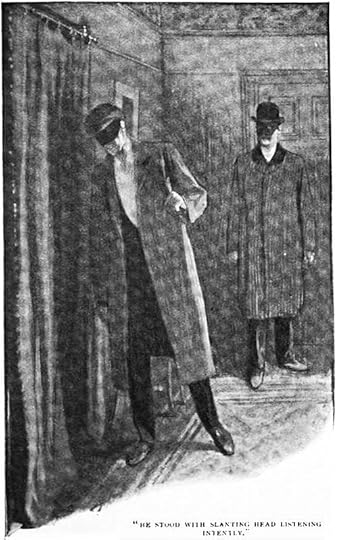 Holmes and Watson go a-burglin’ in “The Adventure of Charles Augustus Milverton.”Crossing the Crooked Line
And then there are those times when, in fact, Holmes sidesteps (to put it gently) the law as a means to attain the greater good (to put it idealistically). He even exerts a corrupting influence on his faithful companion.
“You don’t mind breaking the law?”
“Not in the least.”
Sherlock Holmes and Dr Watson, “A Scandal in Bohemia”
“Watson, I mean to burgle Milverton’s house tonight.”
— Sherlock Holmes, “Charles Augustus Milverton” [and Watson again joins him]
“I have been three times in [Moriarty’s] rooms, twice waiting for him under different pretexts and leaving before he came. Once—well, I can hardly tell about the once to an official detective. It was on the last occasion that I took the liberty of running over his papers. …”
— Sherlock Holmes to Inspector MacDonald, The Valley of Fear
“My dear fellow, you shall keep watch in the street. I’ll do the criminal part. It’s not a time to stick at trifles.”
— Sherlock Holmes to Dr Watson, “The Bruce-Partington Plans”
“Sherlock Holmes was threatened with a prosecution for burglary, but when an object is good and a client is sufficiently illustrious, even the rigid British law becomes human and elastic.”
— Dr Watson, “The Illustrious Client”
“… I suppose I shall have to compound a felony as usual.”
— Sherlock Holmes, “The Three Gables”
“There being no fear of interruption I proceeded to burgle the house. Burglary has always been an alternative profession, had I cared to adopt it, and I have little doubt that I should have come to the front.”
— Sherlock Holmes to Inspector MacKinnon, “The Retired Colourman”
Not only does Holmes commit crimes, he admits as much—even to officials of Scotland Yard! (He seems especially comfortable doing so when said official has a Scottish surname. What’s that about?) Maybe this is partly explained by Holmes’s deep immersion into criminal behavior, which has tainted his worldview. In “The Copper Beeches,” while sharing a train ride with Watson, he admits he’s unable to enjoy watching the countryside go by:
[I]t is one of the curses of a mind with a turn like mine that I must look at everything with reference to my own special subject. You look at these scattered houses, and you are impressed by their beauty. I look at them, and the only thought which comes to me is a feeling of their isolation and of the impunity with which crimes may be committed there.Accordingly, Holmes sees a crime where there is no crime in both “The Yellow Face” and “The Lion’s Mane.”
And Watson seems a tad eager to fall in with the felonious fun. Without hesitation, the doctor joins Holmes in attempted burglary in “A Scandal in Bohemia.” In “Charles Augustus Milverton,” he raises only the flimsiest objections before telling Holmes that he “will take a cab straight to the police-station and give you away unless you let me share this adventure with you.” Even when Holmes is elsewhere, Watson partners with Sir Henry Baskerville in “aiding and abetting a felony,” to use the words of Sir Henry himself, by looking askance as arrangements are made to help a prison-escapee nicknamed the Notting Hill murderer flee the country. Perhaps lurking in the back of Watson’s mind is something Holmes says in “The Speckled Band”: “When a doctor goes wrong he is the first of criminals. He has nerve and he has knowledge [to commit murder by poison].” Did Watson hear this and begin to have very impure thoughts? Does this provide a glimpse into the disappearance of Mary, his wife?
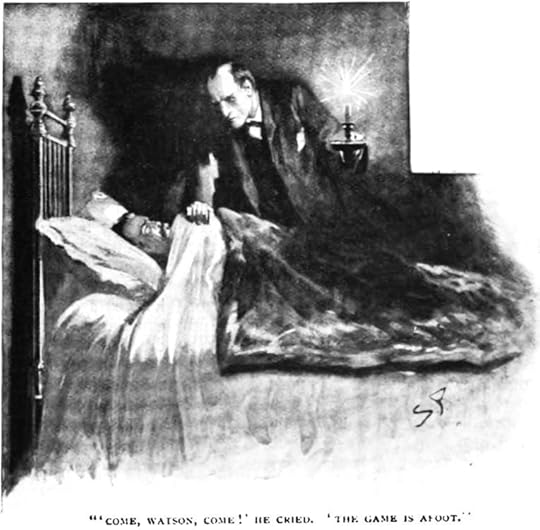 Holmes intrudes upon Watson’s personal bubble in “The Abbey Grange.”An Era of Criminal Fog?
If asked for my favorite story now that I’ve finished the canon, I would go with “Charles Augustus Milverton.” It’s as if Doyle ached to write a story in which almost every character does something very naughty, if not blatantly illegal. The client has done something bad enough that the title character is blackmailing her. As a last resort, Holmes and Watson break into Milverton’s house to retrieve the incriminating letter. Remember, if the two are caught, the harm to their reputations might destroy their careers as detective and doctor! In the middle of this crime, our heroes stumble upon another very unexpected one, which they shrug off about an hour or two afterward. (Hey, Milverton was a wanker anyway.) In the end, Lestrade stands tall as the unblemished character, even though he fell short by, well, afoot of capturing those two masked dudes sneaking around Milverton’s house.
I’m left asking what thoughts regarding crime were swirling around when the Holmes tales were debuting. This is the time frame I used to select the fiction found in the Curated Crime Collection, all of which illustrates how difficult it sometimes can be to distinguish legal from illegal, moral from immortal, and good from bad. These blurred lines seem to have held a particular interest for many readers of the late-Victorian and Edwardian eras.
Then again, stories about crime have been around long before those decades, and they persist afterward. Yes, fictional criminals are far from confined to the late 1800s and early 1900s. Perhaps, something like Holmes, “I must look at everything with reference to my own special subject.”
— Tim
January 14, 2026
Mary Jones: Her Faith Was Not in That Candle
Fear not, Mary: for thou hast found favour with God.
— Luke 1:30
Finagling Fact and FolkloreIf the tale told “in the Welsh language by an old man” and transcribed in an 1847 issue of The Athenæum were, to some significant degree, historical fact, then Mary Jones (1694-1770) would certainly be one of the most remarkable figures inducted into the Ghost Hunter Hall of Fame. First, she’s among the earliest women paranormal investigators on record, having lived well before Catherine Crowe and Ada Goodrich-Freer, both of whom were born in the century after Jones died. Second, her response when confronting a dark, supernatural entity puts her alongside the most calm and courageous ghost hunters.
But Jones’s tale is far more likely a product of folklore. The bit in that article’s introduction about the man’s story being altered “to put an oral narration into readable form” suggests as much. Also, there are markedly different versions of the story.
Even as a folkloric figure, Mary Jones is noteworthy in what she reveals about 18th-century ghost hunting and gender roles. Also of interest is how the deeply religious Jones contrasts starkly to her predecessor Antoinette du Ligier de la Garde Deshoulières, whose ghost hunt illustrates the value of skepticism while similarly being the stuff of legend.
What Do We Know About Mary Jones?Most of what we can say about Mary Jones comes through what is recorded about her husband, the Reverend Edmund Jones (1702–93). One helpful source of information is a 2025 article titled “‘Original Memoirs of Apparitions & Spirits in Wales’ (c.1738): Publishing on the Supernatural in the Long Eighteenth Century,” written by Adam M. Coward and Martha McGill, and published in the academic journal Folklore. The authors tell us that the Jones’s marriage was “an exemplary one” and Mary shared her husband’s stalwart faith. Coward and McGill also cite sources revealing that Mary was subject to a targeted haunting, to attacks from the Devil, and to divination while asleep or awake. One might assume that our ghost hunter was also what was termed a “ghost seer,” meaning she had special sensitivities to supernatural presences.
Edmund was an early folklorist with a particular interest in ghostly material, as shown in his A Relation of Apparitions of Spirits in the Principality of Wales (1780). (A smudgy but downloadable copy is at the Internet Archive while a clearer copy can be read online at the National Library of Wales.) Unfortunately, the tale of his wife’s encounter is not recorded there, and I suspect it rose after she had died.
 This illustration of Mary and her husband’s gravesite comes from the 1882 Red Dragon article discussed below.The Jones-as-Ghost-Hunter Version
The Athenæum article presents Jones as a traditional ghost hunter. The tale opens with a setting that’s a bit more specific than once upon a time: “About the middle of the last century … in one of the mountainous districts of Monmouthshire [Wales], called Blaenau Gwent….” The transcription continues:
About this time, there was in that neighbourhood an old mansion-house, a certain part of which had long been unoccupied, being haunted,—especially one particular room, in which no one who knew the place could ever be induced to sleep; and such strangers as had, in a case of emergency, been put into it, could not remain there on account of the supernatural disturbances to which they were subject. At length, Mrs. Edmund Jones, having repeatedly heard of this, paid a visit to the house and requested to be allowed to pass the night in this apartment.In other words, Jones didn’t unknowingly stumble upon the haunted spot—no, she learned of it, went to it, and solicited permission to investigate it. Once there, she began her nocturnal surveillance of the room, remaining awake and alert while reading her Bible.
After a good long while, things started to happen. Jones then showed herself to be an unflappable paranormal investigator:
[S]he chanced to raise her head from the book, and to look up; when she beheld standing before her, on the opposite side of the table, a form of terrific aspect, with his eyes fixed fiercely on her. She fixed her eyes on him in return, and gazed upon him in the most composed and unconcerned manner. After they had remained for some time looking at each other, the demon spoke, and said, “Thy faith is in the candle.” “Thou lyest,” said she; and taking the candle out of the candlestick, she turned it down and extinguished it in the socket. Then, in the triumph of her faith, she folded her arms,—and continued in her seat, setting at defiance the powers of darkness.In proving that her faith—her strength, her courage—did not vanish along with the candlelight, Jones performed the work of exorcism: “From that time forth, the house never suffered from ghostly molestations.” The tale becomes a religious parable illustrating that a strong faith can protect us from the evil things that lurk in the darkness, and it uses a standard ghost hunter framework to make that point.
The Jones-as-Waylaid-Guest VersionJones herself actually existed, to be sure, but that we’re dealing with folklore instead of actual history is confirmed by there being two other versions of this “faith in your candle” tale. Though it’s a fairly simple variation, the next version removes Jones’s status as a ghost hunter. Instead, it draws from another familiar motif of ghost stories: a traveler’s only option is to spend the night in a room said to be haunted.
I found this version in J. Glyndwr Harris’s Edmund Jones: The Old Prophet (1987). Rather than solicit permission to probe a reported ghost, Jones finds herself stuck at a friend’s house due to stormy weather, her only choice of bedroom being one with a creepy reputation. We still see Jones’s courage in her response to the situation: “she was more ready to face the ghost than venture out into the storm.” Harris writes:
[Jones] told her friend that if she gave her a candle and a Bible she would have no fear of going into the spare room. So these were provided and she went to bed in the haunted room. In the early hours of the morning the ghost appeared in the guise of a decrepit old man. He made his ghostly way towards the bed and Mrs. Jones braced herself for the encounter. She remained calm and showed no fear. As he came near the ghost said, 'Woman, your faith is in that candle!' She was not put off her guard by his gibe and in an act of defiance she blew out the candle. The ghost disappeared and was never heard of again.Unfortunately, Harris’s sources are left undocumented. Whether this tale comes from, say, a newspaper article or maybe a book, well, we don’t know. I like to think Harris heard it still being told at the local pub.
 Henry Gastineau’s “Aberystwith, or Blaenau Gwent,” from the 1830 edition of
Wales Illustrated, in a Series of Views, Comprising the Picturesque Scenery, Towns, Castles, Seats of the Nobility & Gentry, Antiquities, &c.
The Jones as Beer-Bringer Version
Henry Gastineau’s “Aberystwith, or Blaenau Gwent,” from the 1830 edition of
Wales Illustrated, in a Series of Views, Comprising the Picturesque Scenery, Towns, Castles, Seats of the Nobility & Gentry, Antiquities, &c.
The Jones as Beer-Bringer VersionThe final version I’ve found relocates the encounter to what’s probably its least spooky setting: the Jones’s own cellar. Granted, in the 1700s, this would be a place where it’s practical to bring a candle, but the fear factor goes pretty flat when we learn that Jones goes downstairs to retrieve some beer rather than, let’s say, investigate unearthly moans or some other kind of unnerving noise. This variation is found in an article titled “Monmouthshire Apparitions,” found in an 1882 issue of the magazine The Red Dragon:
It is told of Mrs. Jones that, going to the cellar one night for some beer, taking a candle to light her, she placed the jug beneath the tap and turned the key, but to her surprise there was no beer forthcoming; knowing the cask was nearly full, she looked up, and there, seated astride the cask, was the "foul fiend" himself in propria personæ. Nothing daunted at the sight, she coolly said in Welsh, "Oh, it's you who are there, is it?" "Yes," was the reply, "and your faith is in that candle." "You were always a liar," was her rejoinder, and she immediately blew the candle out. The devil, thus defied, gave in, and allowed the beer to run, and Mrs. Jones took it up in triumph for her husband's supper.It would be tough to call this a ghost story. It’s more of a the Devil himself story. Yet it’s clearly the same basic narrative as the two above. It’s as if the storyteller wanted to put an original spin on the thing, but felt a need to retain 1) some setting that would allow for a candle, 2) a supernatural challenge to Jones’s faith, and 3) her coolheaded triumph over that challenge.
Jones Granted Honorary MentionThere are four other Ghost Hunter Hall of Fame inductees whose status there depends on legend rather than factual history: Athenodorus, Antoinette du Ligier de la Garde Deshoulières, John Ruddle, and Richard Dodge. These are people who we have very good reason to believe actually lived, but whose respective acts of snooping around a haunted site seem impossible to verify. Mary Jones might have taken a place beside them. She might have, if the legend about her paranormal investigation were not undermined by those two variations that push her away from being a ghost hunter as I’ve come to define it. What’s key here is an intentional and well-planned investigation of a reported haunting, not an encounter with a spirit resulting from an accident and being at the wrong place at the wrong time.
Nonetheless, Jones’s story remains important to the legacy of ghost hunting. One of the primary goals of the Hall of Fame is to encourage paranormal investigators working today to discover and appreciate the rich heritage of which they are a part. Therefore, unless more evidence pops up, I am pleased to award Honorary Mention to the ever-resolute, ever-faithful Mary Jones.

January 7, 2026
Speculation on How and Where Dr. Watson Published His Holmes Chronicles, Part Three
Go to Part TwoThe Final Trio
I reached my end-of-2025 reading goal! I completed Arthur Conan Doyle’s four novels and five short-story collections featuring Sherlock Holmes, often referred to as “the canon.” However, I failed to solve the mystery of how or where Dr. John H. Watson went about publishing his chronicles of his remarkable friend and occasional flatmate. Not Doyle, mind you. Watson. According to those tales, the good doctor published his chronicles on a regular basis.
As mentioned in Part One, it’s reasonable to assume that readers in the Holmesverse came upon Watson’s first two narratives A Study in Scarlet and The Sign of the Four in pamphlet form. After all, in the latter, Watson refers to the former as “a small brochure” and “my pamphlet.” As novels go, these first two works are fairly short, making pamphlet somewhat more sensible than book. I’ve only scratched the surface of “true crime” pamphlets published in the Victorian era, and I’m finding they seem to focus on the trial of, say, a murderer rather than on a detective’s investigation of the case. Perhaps in this regard, Doyle was reinventing non-fiction pamphlets to better accommodate mystery fiction.
I’m forced to speculate, though, as to where those readers found the doctor’s many short-story-length chronicles, what he calls his “little narratives.” My guess is some widely read magazine, though I struggle to find any real-life parallel to a series of articles about a single detective’s methods and cases. Certainly, a series of 50-ish articles about any subject would have been very rare. That said, if Watson did published his shorter chronicles in a magazine or magazines, he might have then collected them in books, the pattern that Doyle and many other authors followed in the late 1800s and early 1900s.
Scrutinizing the EvidenceLet’s now examine what I found in the last of the canonical works. Spoiler: nothing very useful to my main concern. There are some secondary points of interest along the way, though.
The Return of Sherlock Holmes
“The Norwood Builder”
Watson, regarding Holmes: “His cold and proud nature was always averse … to anything in the shape of public applause, and he bound me in the most stringent terms to say no further of himself, his methods, or his successes—a prohibition which, as I have explained, has only now been removed.”
Holmes: “Perhaps I shall get the credit also at some distant day when I permit my zealous historian to lay out his foolscap once more—eh, Watson?”
“The Solitary Cyclist”
Watson, regarding Holmes’s many successes and few failures from 1894 to 1901: “As I have preserved very full notes of all these cases, and was myself personally engaged in many of them, it may be imagined that it is no easy task to know which I should select to lay before the public. … I will now lay before the reader the facts in connection with Miss Violet Smith. … It is true that the circumstances did not admit of any striking illustration of those powers for which my friend was famous, but there were some points about the case which made it stand out in those long records of crime from which I gather the material for these little narratives.
“The Six Napoleons”
Holmes: “If ever I permit you to chronicle any more of my little problems, Watson, I foresee that you will enliven your pages by an account of the singular adventure of the Napoleonic busts.”
“The Abbey Grange”
Holmes, taking a stance found in several earlier adventures: “I fancy that every one of [police detective Stanley Hopkins’] cases has found its way into your collection, and I must admit, Watson, that you have some power of selection which atones for much which I deplore in your narratives. Your fatal habit of looking at everything from the point of view of a story instead of as a scientific exercise has ruined what might have been an instructive and even classical series of demonstrations.” With a touch of spite, Watson suggests Holmes try writing one or two himself, and Holmes replies: “I will, my dear Watson, I will.” Indeed, he does so with “The Blanched Soldier” and “The Lion’s Mane,” both in The Casebook of Sherlock Holmes.
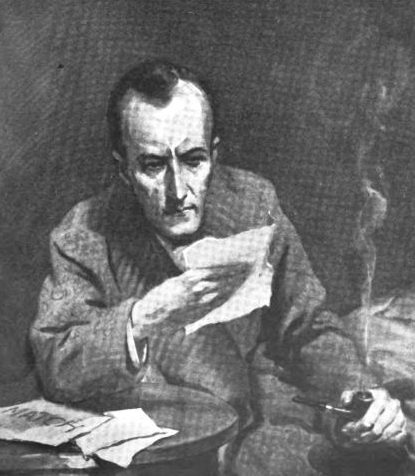 H.M. Brock’s depiction of Holmes in “The Adventure of the Red Circle“
His Last Bow
“Wisteria Lodge”
Holmes, to Watson: “If you cast your mind back to some of those narratives with which you have afflicted a long-suffering public, you will recognise how often the grotesque has deepened into the criminal.”
Holmes, to Scott Eccles: “You are like my friend, Dr Watson, who has a bad habit of telling his stories wrong end foremost.”
“The Devil’s Foot”
Watson, regarding Holmes: “To his sombre and cynical spirit all popular applause was always abhorrent, and nothing amused him more at the end of a successful case than to hand over the actual exposure to some orthodox official, and to listen with a mocking smile to the general chorus of misplaced congratulation. It was indeed this attitude upon the part of my friend and certainly not any lack of interesting material which has caused me of late years to lay very few of my records before the public.”
The Casebook of Sherlock Holmes
“The Three Garridebs”
John Garrideb, to Holmes: “Your pictures are not unlike you, sir, if I may say so.”
I believe this is the first mention of Holmes being “pictured” in Watson’s published accounts of the great detective.
After Holmes says his suit reveals Garrideb, who claims to be American, has been in England for some time, that man adds: “I’ve read of your tricks, Mr Holmes, but I never thought I would be the subject of them.” Here we see a client who knows about Holmes presumably from Watson’s chronicles, something that resurfaces in “The Veiled Lodger.”
“Thor Bridge”
Watson: “Somewhere in the vaults of the bank of Cox and Co., at Charing Cross, there is a travel-worn and battered tin dispatch-box with my name, John H. Watson, MC, Late Indian Army, painted upon the lid. It is crammed with papers, nearly all of which are records to cases to illustrate the curious problems which Mr Sherlock Holmes had at various times to examine. … In some I was myself concerned and can speak as an eye-witness, while in others I was either not present or played so small a part that they could only be told as by third person.” This last remark accounts for “The Mazarin Stone,” which is told in third-person and appears earlier in this collection.
Holmes: “I am getting into your involved habit, Watson, of telling a story backwards.”
“The Veiled Lodger”
Watson opens by explaining that at least one attempt has been made to destroy his records of certain sensitive cases. He then says other cases involved “the most terrible human tragedies.” The chronicle at hand involves one such case, and he adds, “In telling it, I have made a slight change of name and place, but otherwise the facts are as stated.” Here and there, Watson admits to smoothing out a client’s disjointed narration of the problem brought before Holmes, but for the most part he seems to be accurate and reliable. That is—if we’re to trust Watson himself.
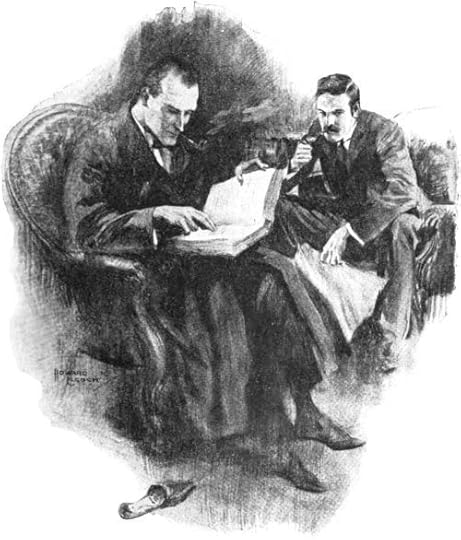 H.K. Elcock’s depiction of Holmes and Watson in “The Adventure of the Sussex Vampire“I Observe, but I Do Not See
As mentioned, throughout my reading of the canon, I didn’t see anything solid to indicate the medium through which the Holmesverse public read Watson’s chronicles. While pamphlets are likely for the first two novels, what about the many, many stories following? Newspapers? Magazines? Books? A combination thereof? I only observed that the public did read them. And that Holmes routinely snubbed the manner in which Watson told those tales. And that—as Doyle’s output of Holmes adventures grew sporadic—the author “covered his tracks” by putting Holmes in control of which cases Watson was and wasn’t allowed to publish.
One more observation involves a complaint I’ve seen made by some mystery fans: Doyle doesn’t “play fair” with readers. We can’t “match wits” with Holmes because, with Watson as narrator, the detective is allowed to rush off and unravel clues on his own, keeping crucial information secret until The Big Reveal in the final scene. As Holmes states in “The Blanched Soldier” (1926):
The narratives of Watson have accustomed the reader, no doubt, to the fact that I do not waste words or disclose my thoughts while a case is actually under consideration.These tales come too early, however, to deem this a flaw. At the time the stories collected in The Casebook of Sherlock Holmes were debuting, from 1921 to 1927, some critics were introducing specific rules for mystery writers to follow, including those reader-based conventions involving playing fair and matching wits. (I touch on and link those rules here.) I wonder if Doyle had sensed that his style of mystery-storytelling was fading, and this lurks beneath Holmes’s jibes about Watson’s chronicles being told “wrong end foremost.” In other words, unlike Agatha Christie and her generation, Watson doesn’t narrate events chronologically from, let’s say, the arrival of the client to the exposure of the criminal. Watson doesn’t let readers play the game that’s afoot alongside the detective.
But that’s on Holmes himself, the tight-lipped bugger.