Brom Bones on the Screen: “The Headless Horseman” (1934) and “Ichabod Crane or The Legend of Sleepy Hollow” (1949)
— Washington Irving, “The Legend of Sleepy Hollow“
A 1934 Animated VersionIn the quotation above, we see that Washington Irving closes his famous tale with a fairly strong suggestion that Brom Bones had a hand in frightening Ichabod Crane out of Tarry Town, clearing a path to marry Katrina Van Tassel. In an earlier post, I discuss a 1922 film in which Will Rogers plays Ichabod, and here Irving’s suggestion becomes solid fact when Brom removes the Headless Horseman costume and guffaws as his rival hightails it into the distance. A 1934 cartoon version of the story does the same, erasing any ambiguity found in Irving’s finale. (But the cartoon also adds a brand new surprise at the end, too!)
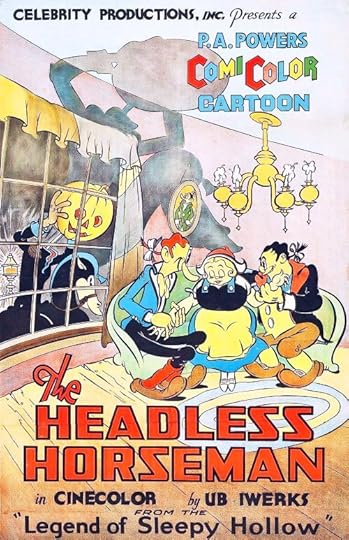
This cartoon is titled “The Headless Horseman,” and given the year, it might surprise you that it’s in color. It’s also reasonably faithful to the source material — well, about as faithful as a retelling can be with virtually no dialogue and a running time under nine minutes. Its depiction of Brom is pretty close to Irving’s, too, in that he’s a brawny bumpkin who uses what wits he has to ensure that Ichabod’s own gullibility is largely responsible for that highbrow man’s loss of Katrina’s hand.
On a side note, Katrina reveals she secretly prefers Brom when she imagines him to be the equivalent of, uhm, I want to say that’s Clark Gable, given the ears…. Okay, maybe this screen version isn’t all that faithful to Irving.
You can watch “The Headless Horseman” on YouTube, but be warned that its depiction of Tarry Town’s Black citizens leans hard on the denigrating caricature of the time.
A 1949 Animated VersionDisney’s 1949 animated retelling of the tale is deservedly beloved by many. The main title is “Ichabod Crane,” presumably to match “Mr. Toad,” the retitling of Kenneth Grahame’s The Wind in the Willows, which makes up the first half of the whole movie. If you happen to think of “The Legend of Sleepy Hollow” as specifically a Halloween story, it might be traced back to this film’s repeated mentions of that day. Irving, you see, only specifies the climax of the story as happening during “the sumptuous time of autumn,” and to be sure, the Celtic-rooted holiday would have been far from familiar to the original story’s Dutch-American characters living in the late 1700s.
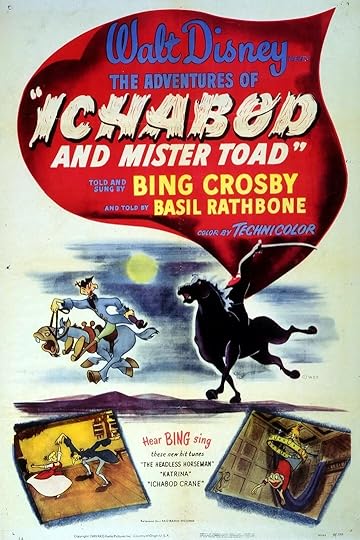
As with the 1934 cartoon, this portrait of Brom is at least in the ballpark of how Irving drew him: muscular, chummy, equestrian, and more shrewd and sly than brutal and boorish.
This movie debuted almost a decade after Disney studios dazzled audiences with the animation artistry of Fantasia, so it follows that it offers one of the greatest chase scenes of any film version. Interestingly, after that chase, the film never says or even hints that Brom might’ve been masquerading as the legendary phantom, allowing the audience to presume that the Headless Horseman was — well — the Headless Horseman. In an ending that feels a bit rushed compared to other versions, the audience learns that Ichabod disappeared, and despite a rumor that he settled elsewhere, the superstitious folk of Tarry Town prefer to think he was spirited away by their local decapitated demon.
Despite its spin on the finale, this version still has Brom wed Katrina, something that doesn’t happen in some of the films to follow. More to come.
— Tim
Click Here to Read aboutOther Screen Adaptations
of Irving’s Classic Work