Shame as Dishonor
A reader posted the following in the comments of my IG post, in response to my last essay.
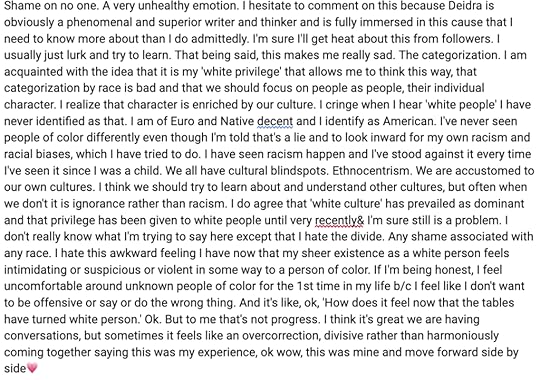
I promised the reader a response, and I thought this would be the best place for it. I’m sure others are thinking/feeling some of what this reader expressed. So, this response is for all of that. All of you:
Dear Reader,I appreciate your comments. I’ll respond to them here and am open to more dialogue with you and others around these issues.
First, I know you don’t know me, but I hope you don’t hesitate to comment in the future. I also doubt you’ll get “heat.” We don’t do that here. We maintain a growth mindset, and we’re learning to engage with difference, not only commonality. Dissenting opinions, presented with respect and a posture of learning are always welcome. Though, I’m not sure you’re truly dissenting. What I feel is a pushing back.
ShameSo. Shame. Yes, it’s an unhealthy emotion. In my essay, I’m using the noun form, but not as an emotion. Shame, in the essay, is referring to a loss of respect or esteem; dishonor. When anyone – whether white or otherwise – shows themself to be unworthy of trust, it is dishonorable. That person loses respect or esteem.
Sadly, white people rarely experience this loss of respect when acting toward marginalized groups in untrustworthy ways. Rather, it’s the marginalized person or group who is perceived to be unworthy of respect, esteem, or honor.

Shame, as an emotion, is ineffective at offering any lasting or significant change. But I’m not referring to shame as an emotion.
Minimization is Very AmericanSaying you’ve “never seen people of color differently” tells me you probably operate from an intercultural orientation of minimization. Minimization is neither good nor bad. It’s simply a way to describe how you engage with difference in the world. What I’m hearing is that you tend to seek commonality when interacting with others.
Maybe you believe we are more the same than we are different, or we have more in common than what we disagree about. These are common values held by people in minimization. What I’m hoping to do is get people to move from minimization, and into acceptance and/or adaptation. In these orientations, a person is able to appropriately adapt when faced with difference.

I want people to be able to move through each other’s differences without feeling a need to find “something in common” as a foundation for a friendship or other relationship. When we can adapt to differences, we allow the other person to be fully themselves, rather than minimizing all of who they are, simply to what we have in common.
Minimization is a very American developmental orientation. It’s natural that you would function out of an orientation of minimization as someone who identifies as American. I’m curious about your connection to your Euro and Native heritage. My research shows that people who are well-informed about and rooted in their culture of origin are more successful at moving out of minimization into acceptance or adaptation.
Ignorance Rather Than RacismThe ignorance of which you speak is due to systemic racism, and to racism in general. It’s both/and. Which came first? Well, racism is the direct result of an inability to effectively engage with difference when we encounter it in others. Systemic racism, and racism in general, results when someone (or some group) decides difference is “better than” or “worse than” or “more difficult” or “more complicated” than what I’m used to.
Difference, is simply difference. It is neither good nor bad. It simply is.
Choosing not to learn about and/or understand other cultures is privilege. And, privilege is not limited to white people. To be clear, however, privilege is still given to white people. Even today. Even right now. White privilege did not stop “recently.” It still exists. It is alive and well. It is, as you stated, “still a problem.”
Intimidating. Suspicious. Violent.Black people have historically been the ones deemed intimidating, suspicious, and violent. We have had those adjectives pointed in our direction ever since white people made up the construct of race.

The truth, however, is that white people have intimidated through colonization and this pattern of colonization has made white people suspect. I’d say violence is stealing land from people, displacing people from their homes, enslaving people, lynching people, refusing people equal status, kneeling on their necks while they die on the asphalt.
Welcome to the TableYou are right to say there is a bit of, “How does it feel now that the tables have turned white person?” going on. Rightly so. We want to know. How does it feel?
None of us can escape the role shame has played and continues to play in the history of this country. More and more, however, white people are beginning to experience shame along with the rest of us. So, yes, we wonder how it feels.
At the same time, there is also a swell of marginalized people saying, to those white people, “Watch how we do this. We’ve been dealing with it for a very long time. We know how. Learn from us.” It’s a welcome to the table, along with sincere curiosity: “How does it feel? To you?”
ProgressWhite people don’t get to decide what is and is not progress, for people who have been oppressed and disadvantaged for hundreds of years. Marginalized people are the ones who decide that.
Making space, being patient, and working for justice up and until marginalized people decide when progress has been made is the difference between diversity and inclusion. Until marginalized people look up and around and discover we finally, truly belong, progress hasn’t happened. When white people accept that this collective shame (as I’ve defined it here, and which has been misplaced for far too long) is theirs and not ours to bear, we will have moved one small step in the right direction.
A note about these images: The photographer is Jessica Felicio and her work can be found on Unsplash. I chose these images because of the stories Jessica tells about them. These beautiful women (all the same woman) could be so easily misunderstood, just as white people have misunderstood us, and racism, and their complicity, as well as their connectedness to us in shared dis-ease and loss.
The post Shame as Dishonor appeared first on Deidra Riggs.