ALLUSION vs ELUSION vs ILLUSION: simple tips to remember the difference
The words ALLUSION, ELUSION and ILLUSION are easy to confuse, given that they sound so similar – but there’s actually a world of difference in their meanings!
Here are my simple tips to remember the difference between the words ALLUSION, ELUSION and ILLUSION.
When to use ALLUSIONALLUSION is a noun meaning an indirect reference. The verb form is ALLUDE.
You can use ALLUSION in a sentence like this:
“I noticed his tactful ALLUSION to the difficult situation with your client.”
When to use ELUSIONELUSION is a noun meaning escape or avoid. The verb form is ELUDE.
To remember, think of the E of escape and ELUSION.
You can use ELUSION in a sentence like this:
“You handled that question well. Quite a tactical ELUSION!”
When to use ILLUSIONILLUSION is a noun referring to a deception – often a visual one. To remember, think of the ‘i’ in ILLUSION and the ‘eye’ you use to view an optical ILLUSION.
You can use ILLUSION in a sentence like this:
“Come see! This optical ILLUSION is really trippy!”
Pro tipRemember, while ALLUSION and ILLUSION are spelled with a double L, the word ELUSION – and the verb ELUDE – has only one L.
Now you know the difference between ALLUSION, ELUSION and ILLUSION you’ll know when and how to use phrases like ‘optical ILLUSION‘, ‘tactical ELUSION‘ and ‘tactful ALLUSION‘!
I hope my tips help you to understand and remember the difference between these commonly confused words.
Get more tips in The Little Book of Confusables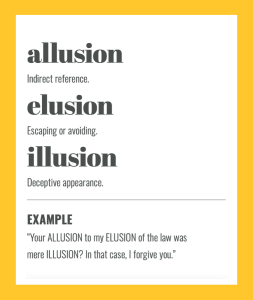
ALLUSION vs ELUSION vs ILLUSION. Excerpt from The Little Book of Confusables by Sarah Townsend. Get simple spelling tips for 500+ commonly confused words.
The post ALLUSION vs ELUSION vs ILLUSION: simple tips to remember the difference appeared first on Sarah Townsend Editorial.