Suppose vs supposed: easy ways to remember the difference
The words SUPPOSE and SUPPOSED are easy to mix up because of their obvious similarity. Here are my simple tips to help you remember the difference between SUPPOSE and SUPPOSED.
When to use SUPPOSESUPPOSE is a verb, meaning ‘to presume’.
It’s often used in a sentence like this:
“I SUPPOSE so.”
OR
“Do you SUPPOSE he’ll be coming along tonight?”
When to use SUPPOSEDSUPPOSED can be an adjective or a verb.
As an adjective, it describes something that’s generally accepted as truth.
It can be used in a sentence like this:
“This is the SUPPOSED method.”
As a verb, SUPPOSED is the past participle of SUPPOSE, meaning ‘presumed’.
SUPPOSE and SUPPOSED are most commonly confused in the expression ‘SUPPOSED to happen’.
It’s always wrong to write ‘SUPPOSE to happen’.
Remember the ED at the end of SUPPOSED and presumED to remember that SUPPOSED is past tense.
Now you know the difference between SUPPOSE and SUPPOSED. I hope these tips help you to remember the difference between these commonly confused words in the future.
Get more tips in The Little Book of ConfusablesFun, memorable spelling and usage tips for 600 commonly confused words, packed into 300+ gorgeous pages for just £11.95. You’ll wonder how you managed without it!
2023 GOLD award winner at the eLit book awards.
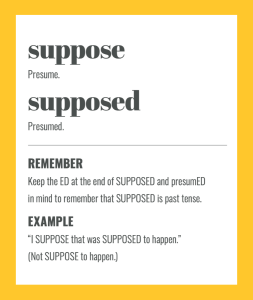
SUPPOSE and SUPPOSED. Excerpt from The Little Book of Confusables by Sarah Townsend.
The post Suppose vs supposed: easy ways to remember the difference first appeared on Sarah Townsend Editorial.
The post Suppose vs supposed: easy ways to remember the difference appeared first on Sarah Townsend Editorial.