Wander vs wonder: simple spelling tips to help you remember the difference
The words WANDER and WONDER are easy to confuse because they’re homophones. Despite the fact they sound the same, their meanings are very different!
Here’s my advice to help you remember the difference between WANDER and WONDER.
When to use WANDERWANDER is a verb that describes the action of moving aimlessly.
It can be used in a sentence like this:
“We WANDERED around the town with no destination in mind.”
OR
The famous poem from William Wordsworth:
“I WANDERED lonely as a cloud”
When to use WONDERWONDER can be a verb or a noun.
As a verb, WONDER describes the action of pondering or being curious.
It can be used like this:
“I WONDER what we’ll have for dinner.”
As a noun, WONDER describes something exceptional to be marvelled at, like the Seven Wonders of the Ancient World.
It can be used in a sentence like this:
“Her eyes were filled with WONDER at the beautiful view.”
Remember that WONDER is synonymous with pONDER, which shares the same ending – and that WANDER contains the A of Aimless.
I hope my tips help you remember the difference between WONDER and WANDER in the future!
Get more tips in The Little Book of ConfusablesFun, memorable spelling and usage tips for 600 commonly confused words, packed into 300+ gorgeous pages for just £11.95. You’ll wonder how you managed without it!
2023 GOLD award winner at the eLit book awards.
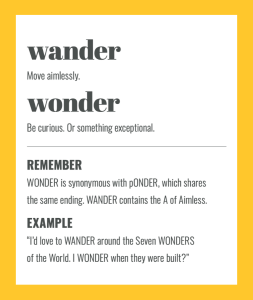
WANDER and WONDER. Excerpt from The Little Book of Confusables by Sarah Townsend.
The post Wander vs wonder: simple spelling tips to help you remember the difference first appeared on Sarah Townsend Editorial.
The post Wander vs wonder: simple spelling tips to help you remember the difference appeared first on Sarah Townsend Editorial.