How to identify the North Star Metric for your product-led business (& why it matters)
Your North Star Metric (NSM) is your compass for measuring the core value your product delivers to your customers. It helps guide your company toward sustainable growth.
When chosen and implemented correctly, your NSM aligns with your entire product-led growth strategy.
However, it is tricky to pick the right one. And that’s what I’m going to teach you today.
By the end, you'll have a clear understanding of what your NSM might be and how it can supercharge your business.
Let’s get started.
North Star Metrics and your GTM StrategyYour NSM is actually a bit different in a product-led setting compared to a traditional sales-led growth approach.
In a sales-led motion, the customer lifecycle starts with acquisition. Engagement and value delivery come into play only after a user becomes a paying customer.
In contrast, a product-led approach strategically acquires users by delivering significant value upfront. This is often done with a free trial or freemium offering before purchasing. Monetization becomes the focus after users have experienced value.
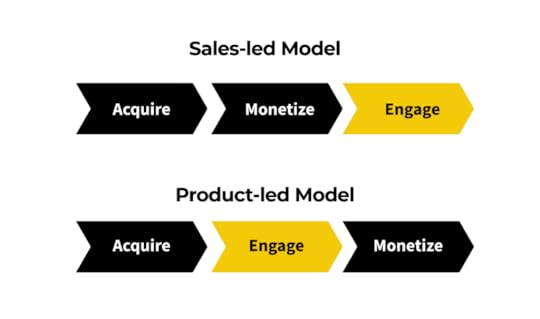
Your NSM will reflect this shift because your NSM will relate to the value users receive in the product.
Let’s take a quick look at great NSM examples:
What I love about NSMs is they pave the way for growth rooted in genuine value.
And if you choose the right one, you’ll see more users getting to value and it will have a direct result on upgrades.
Now that you know what an NSM is, let’s look into how to identify yours.
What makes a successful North Star Metric?There are three components that make up an NSM: quantity, quality, and frequency.
Collectively, they provide a comprehensive framework for evaluating user engagement, product value, and optimal user behavior.
Let’s break them down:
1. Quantity MetricThis measures the frequency of user interactions and gives a good indication of user engagement with your core product or service.
The quantity metric should:
Be easy to measure.Correlate with user success.Reflect the behavior of ideal customers.2. Quality IndicatorThe quality metric of a NSM assesses the degree to which users engage in a specific core behavior, which indicates the value derived from the product or service.
The quality metric should:
Directly tied to the product's core value.Indicate success and user satisfaction.3. FrequencyThe frequency metric of a NSM determines the regularity or cadence at which users engage in a specific core behavior, providing insight into the regular and predictable pattern of users.
The frequency should:
Align with the natural cadence of user behavior.Be directly tied to how often a user experiences value.These three components create a holistic and well-rounded NSM framework.
Examples of North Star MetricsAs you start brainstorming your own North Star metric, it’s helpful to have examples of what to do and what not to do.
Good North Star MetricsZoomNSM: The number of hosted meetings per week.
Quantity metric: Total number of hosted meetings, which gives insight into the product's core value.Quality metric: It directly reflects the core value of Zoom, which is to facilitate seamless and efficient meetings.Frequency: The weekly measurement aligns with the typical cadence of work-related activities, providing a relevant and timely assessment.MediumNSM: The number of minutes spent reading per week.
Quantity metric: This metric tracks the total time users spend reading on the Medium platform, indicating their engagement with the content.Quality metric: It aligns with Medium's core value of providing valuable written content and suggests that users find the platform's articles meaningful.Frequency: It considers users' reading habits weekly and offers a regular assessment of engagement.IntercomNSM: The number of customer interactions per week.
Quantity metric: This metric captures the total interactions on the Intercom platform, highlighting the frequency and depth of customer engagement.Quality metric: It is directly tied to Intercom's value proposition of facilitating effective communication with customers.Frequency: The weekly measurement aligns with the ongoing nature of customer interactions, providing a consistent evaluation of engagement.Bad North Star MetricsTwo of the most common bad NSMs I see are:
Number of signupsWebsite VisitorsThe main reason these two don’t work is because they aren’t tied to the core value of the product.
Another reason is because it’s not tied to every team in your organization. For instance, can the product team really help improve the number of website visitors? Not really.
A truly great NSM impacts every single team.
You’ll know you’ve chosen a good NSM when every team can work towards improving it.
One of the most powerful activities you can do is to brainstorm ways each team can improve the metric.
You can use this template to get started.
Here’s what it might look like:
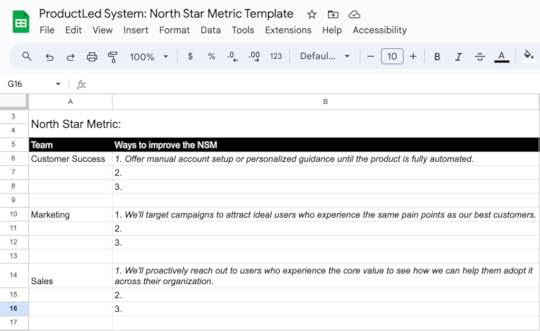
This collaborative effort is powerful because everyone is rowing in the same direction.
The key is simplicityDon't overcomplicate the process.
Select one NSM and start tracking it.
Remember, your NSM is simply a tool to monitor and ensure your business progresses in delivering meaningful value.
Your user’s success becomes your success.
Don’t forget that.
Need Help Identifying North Star Metric?NSMs fall into the data component of the ProductLed System .
.
The ProductLed System is a holistic go-to-market system that includes the nine key components that make up a successful product-led business.
You can implement everything in the data component yourself by reading this article on how to build a data-led organization.
Alternatively, if you’d like to work with a coach to implement the data component into your business, check out ProductLed Academy.
It’s our intensive coaching program where we’ll help you build a strong foundation for product-led growth so that you can scale faster and with more control.
What’s unique about this program is we’ll work with you and your team to implement the proven ProductLed System so that you can scale faster with less stress.
We’ll go through everything we went through today (and a ton more!) with your team to ensure everyone is aligned on data. You can learn more about our coaching program here.
The post How to identify the North Star Metric for your product-led business (& why it matters) appeared first on ProductLed.